The 3 Easiest Gains You Can Make (Before Lifting)
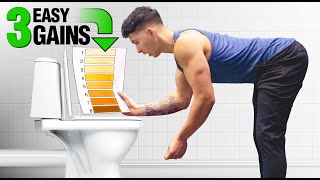
Sam explains three pre-workout factors that boost muscle gains: stay hydrated (urine color 1-2 on the scale), do cardio after weights or separately, and warm up properly with light cardio then progressive sets. Even 1-3% dehydration cuts strength and reps, and cardio before lifting can hurt lower-body power for hours.
The color of your urine, the timing of your cardio, the type of warm up you do. The state of these three things before you work out dictates how effective your workout will be at building muscle. In this video, I'll show you how to check and fix each of these three things before working out to ensure that you're getting the best possible gains. The color of your urine affects muscle growth. It matters because it shows how hydrated you are. And your hydration matters, especially when building muscle because it will affect your workout performance. So how can you tell if you're properly hydrated? Simple. Just take a look at your urine color the next time you use the washroom. Although it is crude, the color of your urine is actually the easiest way to get a good general indication of your overall hydration levels. Consistent urine colors between 1 to 2 indicate that you're well hydrated. Scores between 3 to 4 indicate minor dehydration levels equivalent to 1 to 3%, and scores between 56 indicate significant dehydration levels equivalent to 3 to 5%. How does this relate to your workout? Well, we know that muscle function starts to become impaired with dehydration levels as little as 1%, with dehydration levels as little as 2%, which would be a urine color around here known to decrease performance and motivation in the gym. Illustrating this is a 2001 paper that took weight trained males and had them perform their 1 rep max of the bench press while they were well hydrated. So urine color of about 1 to 2 on the scale. In this hydrated state they were able to lift an average 1 rep max of 260 pounds. They then had subjects repeat this while in a mildly dehydrated state of 1.5%. So the urine color would now be around 3 or so on the scale. And as a result, their 1 rep max decreased by an average of just over 15 pounds. Then they rehydrated the subjects back to about a 1, 2 on the scale and they were again able to perform what they could initially do. Another paper looking at rep performance instead of strength found a similar effect when participants were dehydrated by just 3%, so a urine color around 4 on the scale. They on average performed significantly fewer reps during each of their sets when compared to when they were well hydrated. Meaning that many of you watching can get an easy bump in your workout performance by simply making an effort to drink enough water before your workout rather than going into it dehydrated. More specifically, the colour of your urine should be between 1 to 2 before starting a workout. If it's not, then you need to do a better job of hydrating yourself. A good recommendation is just to consume at least around 500 to 600 milliliters of water an hour or two before your workout, and then at least another 500 to 600 milliliters closer beforehand. And if you're somebody who works out first thing in the morning, then being adequately hydrated before your workout will be even more important for you to pay attention to. So it turns out there's actually a good reason why gym bros carry a gallon jug with them everywhere. Next Cardio so moving your cardio to after your workout rather than before will help prioritize energy for your weights workout, which is what builds muscle. Although performing cardio burns significantly more calories than lifting does, it can also interfere with your lifting performance. Generally, to avoid any interference, you're best off separating your resistance training and cardio sessions by at least several hours or on separate days altogether, depending on how long and intense those cardio sessions are. Practically though, not everybody has the time to do this. So if you are going to perform cardio and lifting in the same session to minimize any negative effect on your weights workout, it's best that you save cardio for after your weights workout rather than doing it before. Illustrating the importance of this is a 2003 paper where participants performed 45 minutes of either high intensity intervals or low intensity steady state cardio on a stationary bike followed by four sets to failure of leg press. What they found is that both cardio methods significantly reduced the total number of leg press reps that participants could perform four hours after their cardio session and even up to eight hours after the cardio session. In line with this, a 2017 systematic review and meta analysis found that increases in lower body strength were significantly greater when participants performed their strength training before cardio, meaning that if your goal is to maximize performance and muscle growth, then you'd be best off leaving your cardio sessions for after your weights workout or at a separate time altogether. This is especially true if the cardio session you'll be performing will involve any of the muscles that you'll be training in your weights workout that day. Next Warmups Although it's true that performing too much cardio before a workout can have negative impacts on your performance, this is no excuse to skip out on a proper warmup since that can also hinder performance. But unfortunately, most people screw up their warmups by missing the sweet spot where you're doing just enough to warm up your muscles and joints you're about to use without using up excess energy that could otherwise be used towards your actual workout. To accomplish this, you want to divide your warm up into two parts. A general warm up to raise muscle temperature and then specific warm up sets to increase muscular activation and practice your lift. Illustrating the effectiveness of this two part approach is a 2011 study that compared the leg pressing strength of subjects that performed two different warm up protocols. In one group, their warmup consisted of just going straight into their warm up sets on the leg press, using one set of eight reps at a lighter weight and then going to another set of three reps at a heavier weight closer to their working weight. Whereas in the second condition, participants first did a general warm up consisting of light cycling and then afterwards performed the same warmup sets as the other group. What they found was that strength was on average 8.4% greater in the group performing both the general and specific warmup. Another 2013 paper found similar results as long as the general warm up wasn't too high in intensity and instead just enough to raise the temperature of the muscles about to be worked. So what this means is that for the best results, the general part of your warm up should consist of about 10 to 15 minutes of low intensity cardio and or dynamic stretching focused on the muscles you're about to work. For example, using an elliptical or rowing machine, or basically any cardio machine that involves the upper body as well as using upper body dynamic stretches as well is a good choice before an upper body workout. Whereas using something like a spin bike with lower body dynamic stretches like leg swings and deep squats is probably best before a lower body workout. After the general warm up, it's then best to move on to a specific warmup using warm up sets. The best way to do this is by progressively increasing the weight over two to three warm up sets for your first exercise for a given muscle group. So for example, let's say you're about to train your upper body and your first exercise is bench press. A good recommendation would be to perform the following three warm up sets. Set one, use 50 60% of your working weight for 10 reps, then you want to rest one minute. Then for set two, use 70% of your working weight for six to eight reps and then again rest one minute and then for set three use 90% of your working weight but only for about one to two reps and then you want to rest two minutes and then you can finally begin your first working set. This is generally just enough to get your muscles, your joints and your nervous system warm and ready for the working sets you're about to perform without being excessive to the point where you're overly fatigued before you've even begun your first set. Overall, guys, I hope you're able to see the importance of paying attention to the things you do outside of your workout, as that is honestly where most people screw everything up and is why many who train consistently and train hard still struggle to see results. And that's exactly why at Built With Science, we've created step by step programs that not only show you exactly what to do during your workouts, but also show you exactly how to eat and how to recover outside of these workouts so that you can build muscle and strip off excess fat in the most efficient way possible. To join today, just head on over to builtwithscience.com and take our analysis quiz to discover which approach is best for you and your specific body. Anyways, that's it for today guys. I really hope you enjoyed this one. Please don't forget to show your support by giving the video a like leaving a comment down below as to what you'd like to see me covered next, subscribing to the channel and turning on notifications for the channel as well. This all really does help me out as much appreciated. Thanks so much guys. See you next time. Sam.










