The Best 1-Minute Exercise For Faster Gains (DO THIS PRE-WORKOUT!)
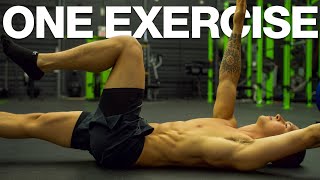
Sam walks through the dead bug exercise, a one-minute move that activates your transversus abdominis, the deep core muscle most ab work misses. Do it before your workout to reduce injury risk and improve stability. The progression goes from holds to opposite arm and leg movements.
Today I want to talk about one exercise, an exercise that literally just takes one minute to do. Yet for many of you, watching, if done before your workouts and consistently over time, can not only help potentially speed up your gains, but also help minimize your risk of injury and potentially even alleviate some of the back pain you may be experiencing. Although what I mentioned may sound too good to be true, such an exercise does exist because most people overlook this muscle and they don't train it properly even when they think they are. And as a result, this muscle gets weakened over time, especially if you spend a lot of time sitting throughout the day, which can create all sorts of problems both in and outside of the gym. So what exactly is this muscle? Well, it's one of our key muscles in our core and it's the transversus abdominis. So this muscle actually sits behind your rectus abdominis or your abs, and it wraps horizontally around your lower abdomen to stabilize your spine, almost like a weight belt. And you use this muscle, or should be using this muscle in combination with your other core muscles whenever you move your arms or legs and whenever you perform your exercises, especially in lifts like the squat, the deadlift, pull ups and overhead press. And the stronger this muscle is, the more stable you'll be and the more strength and power you can put into your exercises that require a lot of stability and hence potentially speed up your gains as a result. But the problem is that this muscle is weak as hell in a lot of people and as a result it can easily become the limiting factor in your exercises and the progress that that you're making in the gym. And the reason why this muscle commonly gets weak is because your typical abs exercises like crunches, they just don't cut it when it comes to this muscle, as this muscle is instead best strengthened by using isometric exercises that are built to enhance both muscular endurance and coordination. But what exactly does this look like though? And what is this exercise that you've all been patiently waiting to hear? It's something called the dead bug, which is an exercise that's been shown and used in several studies aiming to improve, improve transverse abdominis activation and just overall core stability, since it seems to best activate these muscles and is therefore something that I'd highly recommend you include in your routine. So this exercise is actually what's termed as an anti extension exercise, which just means that you're simply bracing your core and your deep abdominal muscles while you move your arms and legs. And although this may sound and look simple, many people struggle with executing this basic movement pattern properly. And as a result, this is the reason why a lot of people struggle with moving their hips with without excessively activating their lower back. And it's also why a lot of people can't move their arms overhead without excessively arching the lower back, which then creates a lot of risk for injury and also creates a lot of inefficiencies in your exercises, in your lifts. So what the dead bug does is it helps address these issues by teaching you how to move at your arms and legs without compensating at your spine. Now, some of you may have seen this exercise before, even tried it out, but I guarantee that you haven't done it properly and in a way that actually strengthens. Strengthens the transversus abdominis to the greatest degree. Because the main goal of this exercise is not to simply extend the arms and legs, is to isometrically brace and stabilize the core while moving at the extremities. But this version I'm showing here is a more advanced progression that, when done properly, will honestly already be too difficult for most of you. So, to start, here's what I want you to do instead. Simply lay on your back with your knees bent, like so. Then take a deep breath into your belly, a deep breath out, and when you near maximal exhalation, draw your belly button into your spine to brace your core and flatten your lower back onto the ground. You want to brace yourself as if someone were about to drop a ball in your stomach. And this should create a feeling of firmness around your entire midsection and lower back. So feel your stomach and your sides and make sure that there's tension there. If you don't brace properly, you'll only activate your rectus abdominis or your six pack instead, which is what we want to avoid. Once you get this down, continue breathing as you maintain the bracing in your core and then bring your arms straight up and your knees bent to 90°. Your lower back should still be flat against the ground, and you should still be bracing as if someone were just waiting to drop that ball in your stomach. At this point, you should already be feeling your core working hard to maintain that position. I'll be honest, if you can't hold this position with your core core brace and breathing through it for at least 60 seconds, then how the hell do you expect to hold this up In a set of squats, deadlifts, or pull ups, where you're now placing a lot greater demands on your core and even loading the movement with weight, it's simple, you're not. And this is exactly why a weakness here is such a common reason for plateaus and injuries. So start here, nail this down for at least 60 seconds. And then when you're ready, you want to progress it to do so, you can start by again bracing properly and then just bring one arm up at a time, like so. Then from here you can move on to one leg up at the time. Then from here you can move your way up to the full dead bug with the opposite arms and legs being extended simultaneously. And then from here you can even move on to something like hollow body holds where both your arms and legs remain elevated while you keep your lower back flat against the floor. But throughout all these guys, you need to be keeping that belly button drawn in your lower back flat constant 360, bracing your core and breathing properly throughout them. You want to execute whatever progression you choose to do in a way such that if someone were holding the ball right over your stomach, your core would be ready and braced for that ball to hit any moment during your reps. You can even experiment with keeping a resistance band under your lower back like so as you do the movement to ensure that you're keeping it flat against the ground. Otherwise the band is going to slip out as soon as you lose that bracing, which as you're going to find is not easy to do at all. As for when and how exactly to apply this, what I'd recommend is to first pick the progression that best suits your current level of core strength, and one that you can do properly for about a minute without absolutely fatiguing yourself. And you want to do this as part of your warm up routine shortly before you go into your workout, especially if that workout involves exercises where core stability demands are high. So exercises like pull ups, push ups, squats and deadlifts, for example. And what this is going to do is it's not only going to gradually improve your core stability and your endurance over time, but it's also going to immediately enhance your proprioception and activation of your core in your exercises for that workout. And this over time can then translate to more strength and more reps, especially in exercises where there's a lot of core stability requirements. I'd even recommend that if your core is quite weak right now, can even periodically do this exercise in between sets of your main exercise, just to again get in the habit of learning how to properly fire and use your core in your main exercise. And although this will limit the amount of weight that you want to use in your main exercise, and you definitely don't want to go to fatigue. It is in the long run going to help improve the coordination and endurance of your core and hence lead to better strength and more gains in the long run. But I hope you're able to see that it's muscles like these that we tend to unknowingly neglect that very easily start to hinder our progress and put us at a greater risk for injury. Which is why it's so important that you don't overlook them in your training for a step by step program that puts all of this together for you by showing you exactly how and why to train these overlooked muscles and how to combine them with your main workouts week after week so that you can build muscle muscle as efficiently and as safely as possible. And simply head on over to built with science.com and take the Analysis quiz to discover which science based program will be best for you and where your body is currently. Anyways, thank you so much for watching guys. I hope you enjoyed this one. Please don't forget to show your support by giving the video a like leaving a comment down below as to what you'd like to see me cover next, subscribing to the channel and turning on notifications for the channel as well as this all really does help me out. Thank you so much everyone and see you next time. Sam.










