The Best Core Workout For Thicker, Stronger Abs (YOU’RE DOING IT WRONG!)
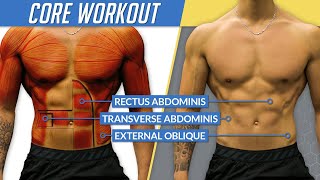
Your abs are just one part of your core, which runs from your diaphragm to your pelvic floor. This workout trains all four types of core stability with reverse crunches, bird dogs, suitcase carries, and Pallof presses, using abdominal bracing to activate the right muscles.
If you don't know the difference between training your abs and training your core, then you need to watch this video because most people use those two terms interchangeably and are under the impression that if you train your abs, you're training your core right. And I mean, sure, you can do 100 crunches in a row and sure you may actually have a nice looking six pack, but this doesn't at all mean that your core is strong and will hold up and assist you in your exercises and in your daily life. So realize that your core is what sets the foundation for everything else. If your core is weak, then your ability to get stronger in your exercises and your ability to grow the muscles surrounding each of your joints will be negatively impacted. And as a bonus, it will also provide aesthetic benefits as well. As research has not only shown that those who engage in sport that require a ton of core stability, such as professional weightlifters, tend to have increased thickness of their deep abdominal muscles relative to the average Joe, which may help with the appearance of your six pack and just making them a little bit more visible. Crossfitters and Powerlifters are a perfect example of this, as they require a tremendous amount of core strength and stability for their movements. As a result, they usually have their abs protrude even when they're at a higher body fat percentage. So now that I've hopefully convinced you to pay more attention to your core, how exactly do we go about training it? Well, although many movements and big lifts in the gym will indirectly train your core in these movement patterns, these additional exercises can help ensure that you are in fact adequately training your core and not overlooking any key muscles. But before we dive into the core workout, we need to first cover the muscles that make up the core and the proper way to go about training them. So the word core actually refers to the area of your body between your diaphragm and your pelvic floor, meaning that all the muscles that support this region and stabilize the spine can be categorized as part of your core. And when it comes to core training, it's important to realize that each core muscle does play an important role. But contrary to a typical bodybuilding workout, your goal should not be trying to train each of these specific muscles in isolation. Not only has research shown that you can't actually train these individual core muscles in isolation in the first place, but we also just wouldn't want to. Since these core muscles work together synergistically and therefore should be trained in that fashion, a much better approach would be to use core exercises that challenge the core in every possible way that your core could be challenged in a lift sport or just in your daily life. And this can be broken down into four categories. Anterior core stability exercises, where we train the body to resist excessively arching the lower back. Posterior core stability exercises, where we train the body to resist excessively rounding the lower back. Lateral core stability exercises, where we train the body to resist bending to one side. And lastly, rotary core stability exercises, where we train the body to resist excessive rotation of the lumbar spine. So we'll use these four categories to serve as the four movement patterns that we want to hit with our core workout. And with all of that being said, we're ready to dive into the workout. The first exercise we'll do here will actually serve as an activation exercise to get you to first learn how to contract all of your core muscles together, which, which our bodies tend to forget how to do because of the excessive amount of time we spend sitting in a relaxed state. So what you want to do is lay on your back with your knees bent. Then from here you want to take a deep breath into your belly, a deep breath out. And then when you near maximal exhalation, brace your core as if you were to prepare for a punch in the gut. As a result, your lower back should flatten on the ground. And if you feel around your midsection, your sides and your lower back, all of these areas should be firm and tense. Continue breathing while holding this contraction. This is what's termed as abdominal bracing, which was a term first coined by researcher Dr. Stuart McGill, a leading expert in spinal mechanics. What he found is that abdominal bracing is able to co activate all of the layers of your core muscles simultaneously, which is how your core should be contracting and working during your lifts and just in your daily life, as this is what creates the core stability and stiffness that your spine needs. And if this alone is quite fatiguing for you to do and hold for a minute or two, then that's a good sign that your core is likely quite weak and could definitely use some more attention. So going forward, just be mindful of abdominal bracing. Apply that practice to each of the following exercises that we're going to go through and eventually it's just going to start to happen on a subconscious level. The next exercise, reverse crunches, is something I've covered in past videos, but does a great job of challenging our anterior core stability. What you want to do here is lay with your knees bent, either on a bench or on the ground, with your arms holding onto something back overhead Then from here, posteriorly, tilt your pelvis and flatten your lower back by applying the abdominal bracing practice we previously went through. Then lift your knees up to 90 degrees, curl your pelvis up towards your belly button, and then slowly come back down. You want to be mindful of keeping that lower back flat throughout each repair. And to progress it, you can slow down the reps and or start loading it by adding a ball between your legs like so. As you do these, you should feel a strong contraction in your deep abdominal muscles. Next, we're going to challenge our posterior core stability by using the exercise highly recommended by Dr. Stuart McGill, the bird dog. For these, just get on all fours with your back neutral, embrace the core and then simply kick one of your legs backwards while raising the opposite arm until they're both straight. Hold this position for a second or two and then come back down and repeat on the other side. You want to avoid arching your back as you do so. If this is too difficult for you to do while keeping your spine neutral, then you can start by just doing one arm or one leg at a time. The goal here is just to simply keep that abdominal bracing intact as you challenge it by moving your arms and legs. Next, we're going to challenge our lateral core stability with suitcase carries, where you hold the kettlebell or dumbbell with one arm and take steps while ensuring that your torso remains upright and shoulders remain level. You want to look as if you were walking without the weight added on one side. As stated by Dr. Stuart McGill's research, the asymmetric weight helps challenge the deep lateral musculature in a way that is never possible with big lifts like the squat. Yet it's essential for enhancing core strength and stability. As you do these, you should feel the lateral core muscles on your opposing side working as you walk with the weight. And lastly, we're going to work on our rotary core stability with a Pallof press. Here we're just going to take a band. We're going to wrap it around a fixture, take a few steps out laterally and assume an athletic stance with your knees slightly bent, feet at about shoulder width apart and your core braced. Then start with your hands close to your sternum. Then from here, simply extend your arms forward and back while resisting the urge to rotate inwards. And if needed, you can perform this with a cable pulley instead. Like so, what this exercise does is it challenges your body's ability to resist a twisting motion, which is a key component that's missing from a lot of people's workout. Routines. As you do these, you should feel your lateral core muscles and obliques working to resist that inward rotation. So to sum the video up, here's a breakdown of the full core workout. For your convenience, I've actually created a mobile friendly downloadable PDF of this workout that comes complete with the exercises, tutorials for each exercise and how to go about implementing these exercises into your routine. To grab a copy of this, just head over to builtwithscience.com coreworkout PDF and I'll send it right over to you. But all in all, it's important that within your weekly routine you're training your core in each of the four categories that we covered. In the long run, this will not only lead to a better looking midsection, but a stronger and more stable one as well. And for a step by step program that shows you exactly how to train these important muscles and pairs them with a weekly workout and nutrition plan based on science so that you can burn off fat and build lean muscle as efficiently and as safely as possible. And and simply head on over to builtwithscience.com and take the analysis quiz to discover what program is best for you and where your body is currently at. Anyways, that's it for today guys. I hope you enjoyed the video. Please don't forget to show your support by giving the video a like leaving a comment down below as to what you'd like to see me cover next, subscribing to the channel and turning on notifications for the channel as well as this all really does help me out. Thank you so much everyone. I'll see you next time.










