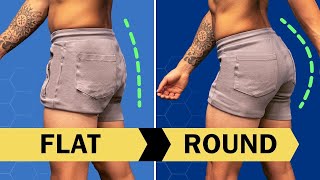
This YouTube tutorial gives a five-exercise glutes workout (gym or home) and explains the relevant glute anatomy. It emphasizes targeting the gluteus maximus with deadlifts, lunges, and hip extensions and the gluteus medius with a cable/band sweep and elevated split squats performed as a superset. The video provides technique cues (stance, bracing, knee tracking, range limits), programming: deadlifts 3x6 heavy (3–4 min rest), walking lunges 2x10 per leg (≈2 min rest), superset: 12 reps each exercise for 3 supersets per leg, and hip extensions with 1–2s top holds; offers gym and home alternatives and promotes the creator's Built with Science program.
I'm going to show you a glutes workout with five of the best exercises to grow your butt. First, we'll go through some of the science behind growing your glutes to teach us the two muscles to focus on. Then we'll go through all the exercises, which you can do either at home or at the gym. By the end of this video, your butt is going to be absolutely bootiful. So to understand how to get a bigger butt, you first need to know the muscles involved. The glutes are composed of three main muscles, two of which you want to focus on. The glute max is the biggest, most visible and most powerful glute muscle. Its primary function is the pushing of your hips forward. The glute medius is the second biggest muscle and is located on the sides of your upper butt. This muscle plays an important role in keeping our hips balanced when we move so that our bigger glute max can actually do its job. It also has a unique function, which is the moving of your thigh away from your body's midline. So the first, second and last exercise in a workout will target the glute max in three different ways. The third and fourth exercise will target the glute medius as something called a superset. So, knowing that, let's get right into exercise one. The deadlift is going to be our primary heavy exercise for the glute max, since it mainly involves pushing your hips forward. But there's a few tweaks that we'll want to make to it to ensure that the glutes are actually doing most of the work. If you only have access to dumbbells, you can still apply many of these tweaks in the same way. So, first we're going to use a foot stance that's about hip width, with the toes slightly pointed outwards. This is important because too wide of a stance, such as with a Sumo deadlift, will shorten the range of motion and limit the ability of our glutes to push the hips forward. Once you're in your deadlift position, you're going to squeeze your glutes hard and push your knees out against your elbows. You should feel more of your glute muscles turned on from doing this. From here, brace your core, tuck your chin, and then push your feet through the floor while driving your hips forward to stand up. It's important to shift your thinking from pulling the bar up to pushing the floor away with your legs and driving your hips forward to get the weight up. This will ensure that your glutes rather than your lower back are moving the weight on the way down, we're simply going to reverse this motion. With your knees slightly bent, push your hips back to lower the bar. But only push your hips back as far as they can before your lower back starts to round. Otherwise the tension will shift from your glutes to your lower back instead of when done properly, you should feel a deep stretch in your glutes and hamstrings as you lower the bar. Once the bar is just past your knees, squat it down and then reset. If you're using dumbbells, however, you'll want to instead stop just past your knees before coming back up. Rather than trying to go all the way down to the floor, you're going to perform three sets of six heavy reps with three to four minutes of rest between each set. Okay, so now we're going to move on to an exercise that will stick, still demand the glute max to work hard, but will add a new balance requirement on the glutes that you don't get with deadlifts. Bodyweight walking lunges are going to be our exercise of choice, but with three tweaks applied to it to make it more effective than your standard lunge. First tweak, we're going to align your body into a position to shift more of the tension to your glutes rather than your quads. This can be done by slightly leaning your upper body forward while keeping your head in line. Maintain that position as you lunge. Instead of simply stepping up after each lunge, think about stepping forward. Use your front leg to propel and pull yourself forward as if there was a thin wall of glass in front of you and you're trying to lunge through to break it. Now, the third tweak is a little bit tricky to do, but will put more stretch on the glutes in the bottom position to require them to work harder for you to return to the starting position. To do it at the bottom position of each lunge, take your hands and apply some resistance to guide your front knee inwards. Then push your knee back against your resistant hand as you stand up. With these tweaks applied, you're going to do two sets of 10 reps on each leg with about two minutes of rest between each set. Alright, so now it's time to have some fun. We're going to focus on the glute medius with the superset. I first came across from coach Paul Carter, where we'll perform two exercises back to back with without any rest the first exercise is a slow, controlled movement and it may not look like much range of motion, but it's going to ensure that tension is placed on your glutes rather than your lower back. To perform it, put a cable setting down to its lowest notch and connect the strap around your ankle. If you don't have a cable, you can set up a band wrapped around both legs or looped around a fixture instead. Once you're set up, grab a pole or any fixture for balance. Keep your torso upright, tuck your chin and brace your core. Now, remember our glute medius muscle. It has a specific function to bring the leg away from the middle of our body. So from here, you're going to sweep your heel back, but also slightly out to the side at roughly a 30 degree angle. Go only as far as you can without arching your lower back and without excessively tilting to the left or right. Execute this properly and you should feel a good burn in the upper side portion of your butt. Okay, so once you've done 12 reps on the one leg, you're going to immediately transition to our next exercise, which will also work the glute medius, but will now do so by challenging it. To keep the knee and hips stable as we move, you're going to grab a pair of dumbbells, elevate your back leg up onto a platform or a stack of books if you're at home, and get into a split stance position with the leg that you just worked with the last exercise as your front leg. Keep about 80% of your weight in your front leg and the other 20% in the back. Just for balance, like a kickstand, tuck your chin and bend your torso over just like we did earlier with the glute focus lunges. From here, drop your back knee towards the ground to get more glute involvement rather than quads. As you lower self, I want you to keep the shin of your front leg straight up over your foot rather than bending it forward. Once you reach the bottom position, use your front leg to push back up and repeat for a total of 12 reps. Once complete, you're going to finish off your superset by using the other leg on both exercises and and then repeat that two more times for a total of three supersets for each leg. So in the deadlifts and lunges we did earlier, the glutes were challenged the most at the bottom position when the glutes were fully stretched. This is one way to stimulate growth, but another way to stimulate growth is with exercises that are most challenging at the top position when the glutes are fully contracted. This is where our last movement comes into play. I'm going to show a gym version and a home version for you to pick from. So the jib version is the 45 degree hip extension to maximize glutes activation. With it, we're going to use a few technique tips that I covered in a previous video I made with glutes researcher Brett Contreras. First, to maximize the range of motion for your glutes, set up the pad such that it's just below your hips. Brace your core, tuck your chin and then bend at your hips to pull yourself down. From here, visualize two points at the top and bottom of your butt cheeks. Squeeze your butt hard to try to bring these two points together to pull yourself up. When done properly, you should feel a very strong contraction in your glutes at this top position. So for the home version, all you're going to need is a stack of books. You're going to come down, flatten your back against the floor, brace your core and then place one foot on the stack of books and the other foot straight like this. And then from here you're going to push down against the stack of books. Raise your other leg to 90 degrees and squeeze your glute hard. Hold this for about 1 to 2 seconds, but avoid excessive of the arch your back, keep a straight line and then you're going to come back down and repeat for more reps. And congratulations, you have just finished a great booty building workout. Bootyful. You can implement this glutes workout once a week or implement the exercises into your other workouts throughout the week if you'd prefer. Either way, I hope you're able to see the importance of carefully selecting your exercises as well as performing them in a way that maximizes growth for the target muscle. Within our Built with Science programs, we apply that to each and every one of the workouts we provide. To join today, just head on over to builtwithscience.com and take our free analysis quiz to discover which of our programs will best help you transform your body. To check out some of my other videos, you can click here if you want to work on balancing your hips. Or click here for some more butt stuff. Thank you so much for watching and I'll see you next time.