The Best Science-Based Chest Workout for Mass & Symmetry
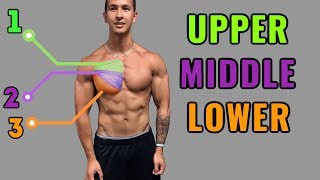
A breakdown of chest anatomy and which exercises hit each part best, backed by EMG studies. Incline dumbbell press for upper chest, barbell bench for overall thickness, dips for lower chest. Mind-muscle connection matters: verbal cues during lifts boost muscle activation.
Questions this video answers
22% increase in chest activation
Approximately 30 degrees to 56 degrees (speaker recommends 30° and 45° personally)
Five weeks; both groups had very similar bench press strength gains and nearly identical chest activation
Incline dumbbell presses (per Brett Contreras' EMG analysis)
Dips (noted as most effective in Brett Contreras' study)
Although chest is one of the most frequently trained muscles by most people, it's also the one muscle group that people tend to have the most trouble developing. And when it comes to developing an attractive chest, symmetry becomes more important than sheer size. So it's vital that you target each portion of your chest appropriately. And we can do this by first understanding the anatomy of the chest. Anatomically, the chest is divided into two main parts, the clavicular head of the pec major, also known as the upper chest, and the sternal head of the pec major, which divides into both the middle chest and the lower chest. Because of the way the fibers run, although all portions will be activated during all chest exercises, certain portions can be emphasized. Since the upper chest fibers run upward, they are best activated with chest exercises where the arms move upward. Since the middle chest fibers run horizontally, they are best activated with chest exercises where the arms move directly horizontally. And since the lower chest fibers run downwards, they are best activated with chest exercises that involve the arms moving downwards. So in this video, I'm going to show you guys a well rounded chest workout that's optimized based on current scientific literature and our anatomical understanding of the chest. Before we get started, it's important that you establish a solid mind to muscle connection with your chest. Otherwise you'll be working secondary muscles and your chest won't grow as much as it could. In fact, one study by Snyder et al. Actually showed that verbal cues help boost chest activation by 22% during bench press in trained athletes compared to when no cues were used. Some helpful cues you can use are to depress your traps and squeeze your shoulder blades back into the bench before starting any pressing movement. And think less about pushing the weight and more about moving the weight by squeezing your biceps together and back out again during every rep. As the main function of the pecs is this exact movement through the added shoulder flexion of this movement, inclined dumbbell presses put more emphasis on the clavicular head of the pecs and work several other secondary muscles as well. The main reason for starting with this exercise is to prioritize the upper chest, which is often the lagging portion of the chest in most people. But I'll further discuss exercise order later on in this video. And the great things about this exercise are one, you it allows a more full range of motion for the pecs, which leads to more hypertrophy, which is something that has been supported by many range of motion studies. And two, it's very effective at activating the upper chest. For example, an extensive EMG study by Brett Contreras analyzed chest activity with 15 different chest exercises and incline dumbbell presses were found to be the most effective compound movement for the upper chest and three it more effectively prevents muscle imbalances from forming since even each hand is responsible for an equal amount of weight. As for the best bench angle to perform these with, this is something that will vary based on your anatomy. EMG studies have shown that an optimal bench angle is somewhere between 30 degrees to 56 degrees and showed higher anterior delt activation as the angle got higher. I personally find that a 30 degree and 45 degree angle best activates my chest, which also seems to be the case for most people. So I'd suggest performing a couple sets at both angles in order to hit your chest most effectively. The next exercise, which is the traditional barbell bench press is going to put the most emphasis on the middle chest and just help with building overall chest thickness. This exercise is something I had to include in this workout because of the overwhelming evidence supporting its effectiveness at building the chest. It has been shown in several studies to be the best exercise at activating the chest and additionally the exercise that you can lift the most weight with. Also studies like this one by Akagi et al. Also show a positive correlation between 1 rep max bench press with the size of the pectoralis major, indicating that a strong bench does indeed equate to a big chest in many cases. And regarding form, you definitely want to come down to your chest for a full range of motion since as I mentioned earlier this is more effective for hypertrophy than shorter ranges of motion. However, the main problem I find with the bench press is that some people respond very well to it, yet others tend to overcompensate with adults regardless of their form and various use of activation cues, which I personally think comes down to their individual anatomy. If this is the case for you, consider alternatively using an exercise like the dumbbell bench press which has been found to have similar chest activation to the barbell bench press but less triceps activation which may be a plus if your triceps are overactive when benching. And in fact dumbbell bench press was actually shown by Brett Conciers study to elicit the best activation for the middle chest. And another plus is the greater range of motion with dumbbells since your range of motion isn't limited by the bar like it is in bench press. But as you can see even in the literature there is a lot of individual variation. So try them both out and see which works best for you. The next exercise is going to be dips, which was shown in Brett Contre study to be the most effective exercise for hitting the lower chest. Which makes sense sense given that your shoulder is put in an extended position. I personally prefer this variation called straight bar dips as I feel it a lot more in my lower chest, probably due to the added internal rotation during the movement, which is another main function of the lower chest. And it also gives my core a really good workout. You can do these on a Smith Machine bar or any barbell that's set up on a rack. You want to lean your upper body slightly over the bar and bring your legs forward under the bar as you descend. Extend to stay balanced and then use your lower chest and triceps to push back up and try to keep your elbows from flaring out too much and make sure the bar doesn't drag against your body throughout the movement. To be honest, it is a pretty tough exercise for most people, but I guarantee if you perform them properly and start using weight on them, you will see huge improvements in your lower chest. But if you're struggling with that, then stick to regular dips for now with a slight lean forward to hit your chest more as opposed to the triceps. And you want to eventually start adding weight to keep progressing it. This exercise is kind of a finishing movement, but it's something I highly recommend you include in your routine. All you do is you put a band around your back and hold each end of the band with your hands, then perform regular push ups with the added resistance. A study by Anderson et al. Compared banded push ups with the bench press. They had one group perform only banded push ups for five weeks and another group perform only bench press for five weeks and compared how their bench press strength changed after the five weeks were complete. The researchers found that not only did banded push ups exhibit nearly identical chest activation when compared to the bench press, but both groups resulted in very similar bench press strength gains over the five weeks. The fact that this exercise has the potential to improve your upper body strength as much as a bench press does, and the fact that it has been shown in multiple studies to activate the chest, especially the upper chest, very well is why I chose to include this exercise. The easy way to progress this exercise is just by using bands with higher resistance as you get stronger. The last exercise is going to put more emphasis on the sternal head of the pecs, so both the middle and lower chest will be emphasized. High to low cable crossovers have been shown in a few studies like this one by Shank et al. To be almost as effective as a bench press at activating the pecs. So it's definitely a great finishing movement that you can perform form to failure. Another bonus with this exercise and something that you can't do in most other exercises is it enables you to cross your hands over at the bottom position to allow greater horizontal adduction at the shoulder which will better activate the chest. So to conclude, here's a sample chest workout that you can perform using the exercises I previously discussed. But one thing to keep in mind is the order that you perform the exercises in Several studies have shown a trend where lifters get better gains in hypertrophy and strength and for exercises that are done early in a session, meaning you want to order exercises based on what your strengths and weaknesses are. If your upper chest is lagging, then perform the workout in this order. If your mid chest and overall thickness is lagging, then perform the workout in this order. And if your lower chest is lagging, then perform the workout in this order. This will help prioritize weaknesses and help balance out your chest more. Thanks for watching guys. I hope you enjoyed the video. One important thing to keep note of, and something that I noticed in both my personal experience and in my review of the literature is that there is a lot of individual variation when it comes to the best exercises for the chest. For example, anatomical things like how far down your pec inserts onto your humerus can actually determine if bench press will be a good option for you or not. So although results from studies may apply to most people, they don't account for each individual. Which is why I highly recommend that you guys just try out a bunch of different chest exercises and see which one best activates your chest. And with that being said, I put in a lot of time and effort into this video. So if you could please support me by giving the video a like leaving a comment and sharing the video, I would really appreciate it. And as always, please don't forget to subscribe and turn on notifications for my channel as this will really help me out. Anyways, that's it for this video guys. I will see you next time.










