The Best Science-Based Diet to Build Lean Muscle (ALL MEALS SHOWN!)
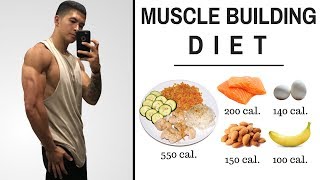
Jeremy Ethier breaks down the science of eating to build lean muscle: how many calories you need, the right macronutrient split, and what actual meals look like throughout the day.
When it comes to building muscle and adding size to your frame, your diet is going to be the most important factor that you have to get right. Because, simply put, when your diet is optimized for muscle growth, it will enable you to perform that much better in the gym and physically recover and progress that much faster. But what exactly does a diet optimized for muscle growth entail? Well, despite all of the confusion and common misconceptions surrounding this topic, it's actually quite simple. And by no means does it require you to explicitly stick to eating chicken broth, broccoli and brown rice every day. But there are a few factors that you need to get right and are primarily how many total calories, protein, carbs and fat you're consuming on a daily basis. So let's start with that. If you want to maximize muscle growth while minimizing excess fat gain, then you have to ensure you're intaking enough calories. But at the same time, you don't want to go overboard. In fact, research has indicated that more is not necessarily better for growth. Since there's a limit to the amount of muscle that you can build a month, this will cause the rest of your excess calories to be stored as fat. Therefore, I'd go with the recommendations of multiple researchers within the field, which is to aim to slowly gain roughly 2 to 4 pounds per month, depending on your training experience. And to find out how many calories this amounts to for you, you can simply use researcher Lyle McDonald's recommendation and multiply your body weight in pounds by 15 and then add 200 to 400 calories to this. If you're a beginner, aim for the higher end since you'll have a greater muscle growth potential, whereas intermediate lifters should aim for the lower end. Although this likely won't be spot on initially, you can start with this and then adjust your calories based on how your weight gain progresses. As for protein, again, more is not necessarily better, but there is an optimal range that you want to hit given that it plays a vital role in muscle recovery and growth. As for what this range is, Based on this 2018 meta analysis from the Journal of Sports medicine, intaking roughly 0.73 to 1 gram per pound of body weight seems to be optimal for muscle growth. Note that going over this range doesn't seem to provide an added benefit for growth, but in the event that you do, just know that research shows that it's completely safe to do so, given that you have normal and healthy kidney function. Now, as for carbs and fats you need sufficient carbs in order to fuel your workouts and boost your performance in the gym, but you also need sufficient fat to support your hormone levels and overall health. As for how much of each, the literature recommends to intake roughly 0.2 to 0.5 grams of fat per pound of body weight and then the remainder of your calories coming from carbs. Therefore, you have a lot of flexibility with your carbs and fats and can adjust them to better suit your lifestyle and food preferences. And if you're confused about figuring out all these numbers, an easy way to get started is to simply use a macro calculator, which I do have up on my website and I'll link that in the description box down below. But now that you've learned the basics of setting up and optimizing your diet for muscle growth, let's take a look at what a typical day of eating could look like for you. And given that the average person needs roughly 2500 calories to maintain their weight, we'll aim for an intake of around 2800 calories. And this intake will be spread across four main meals throughout the day, since.
As shown In Brad Schoenfeld's 2018 study.
This is optimal in order to maximize muscle anabolism. So with that being said, let's start with meal one. I find that a very easy and convenient way to intake a lot of calories and nutrient dense foods is to simply blend them into a shake. And in fact, as shown in this literature review, intaking liquid calories seems to impact satiety less than in taking the same amount of calories in solid form. Therefore, for those struggling to intake sufficient calories to gain weight, this shake is an excellent and convenient option. To do so, I personally usually add oats, a frozen banana and frozen berries from my main sources of complex carbs and fiber. Peanut butter as a source of healthy fat, whey protein powder as the main protein source, dairy milk for the extra calories and protein, and some cinnamon for taste and its positive effects on insulin sensitivity. Blend it all up and this will by far be the easiest and most affordable way to make a big dent in your daily calorie intake without having to resort to eating junk for the next meal. Something like the following would be a great option as it contains adequate protein and sufficient carbs which will help fuel your workout later on. It's just a simple combination of baked chicken, white rice, boiled lentils and cooked zucchini with various seasonings and light sauces added. And one of the great things about this meal is the varied amino acid profile of the foods. For example, lentils on their own are a great source of protein, however they do lack in two important amino acids. But the good thing about pairing it with rice is that grains are particularly high in these two amino acids that lentils lack, meaning that they complement each other well when eaten together, which is especially beneficial if you're vegetarian or vegan and can't have the chicken in this meal as a midday snack. One great option is almonds or any form of nuts. They're not only a great nutrient dense source of healthy fats and fiber, but also provide a variety of other important important micronutrients and minerals. Just be cautious of your serving size and not to overeat them as they are very calorie dense. So measuring out your portions would definitely be recommended and I'll leave a link to a scale I personally use in the description box down below. Although this food combination may be a little weird for some of you, it's a great option as a go to pre workout meal. This is because multiple studies have indicated that ingesting protein and carbohydrates produce pre exercise produces significantly greater levels of muscle protein synthesis, with high glycemic carbs such as rice cakes likely being the better option for performance. But regardless of what food you do choose to include in this meal, ingesting some form of protein and adequate carbohydrates is ideal to enable your body to perform at its best during your workout. In addition, although it may be of little significance, one recent study did show that ingesting whole eggs produce 42% greater levels of muscle protein synthesis to ingesting the same amount of protein in egg whites alone. Therefore, pairing your egg whites with whole eggs as done here may be more beneficial for this reason. And finally, as for your post workout meal to finish off the day, this meal is a great option and is a combination of baked salmon, baked white, sweet potato and a large stir fry of veggies. The salmon provides not only sufficient protein but also the all important omega 3 fatty acids DHA and EPA which have actually been recently shown in a 2018 literature review to possibly help with anabolic signaling and muscle repair and growth. The sweet potato serves to replenish any glycogen that was depleted during your workout. And the stir fry veggies is just what I personally find to be the easiest way to increase your micronutrient and overall vegetable intake for the day, which does likely play a role in muscle recovery and performance. But it's something I'll cover in another video. So that's pretty much what a full day of eating for muscle growth could look like for you. And here it is all written up for anyone who's interested. Hopefully this provides you with some insight as to how to approach and optimize your diet. When it comes to building muscle, the key really is to not only incorporate foods you personally enjoy, but also foods that are simple and easy to make, as that's exactly what will enable you to stick with it in the long run.
Thanks so much for watching everyone. Nutrition really is the biggest factor when it comes to transforming your body and it's honestly why so many people fail to progress despite putting in the effort in the gym. But if you're looking for a complete evidence based program that not only covers training, but also comes with a custom built nutrition software to optimize your diet based on your own stats and goal, then simply head on over to builttuthscience.com courses where you can view the four programs I have available and choose the one that best suits you. And for those who haven't yet done so, I'd really appreciate a follow on Instagram where I share a lot of my daily meals and the reasoning behind them, which I think you'd find really useful. Anyways, I hope you enjoyed this video. Let me know in the comments below what other nutrition topics you'd like to see me cover and I'll do just that. And as always, don't forget to give the video a like and subscribe to my channel so you can stay updated with my videos. Thank you all so much and I'll see you next time.










