The Best Science-Based DUMBBELL Legs Exercises For Size And Symmetry
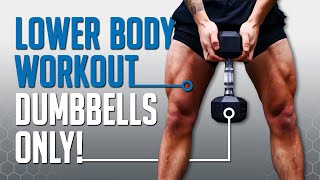
A guide to building leg size and symmetry with dumbbells. Use higher reps near failure with lighter weights, then work through dumbbell squat jumps, skater squats, split squats, single-leg Romanian deadlifts, leg curls, adductor bridges, and goblet squats with form cues and progressions.
To be honest, nothing really feels like an accomplishment quite like doing some heavy deadlifts or some back squats. However, sometimes it's just nice to change things up, and sometimes we may even have to, depending on our circumstances and equipment availability. And the good thing is that we don't need a barbell or leg press machine to adequately work and strengthen every major muscle in the legs. As long as you know what you're doing. Today I'm going to show you how to do just that with the use of a few dumbbells and a little bit of science. But before we go into the actual exercises, we first need to talk about rep ranges. This is especially true for those who only have access to a few lighter dumbbell sizes, as you will most likely not have enough weight to mimic the same amount of load that you'd normally have. So to compensate for this, instead of using our typical moderate rep ranges, we'll instead use higher reps for most of our sets and focus on simply taking each of our sets close enough to failure so that our leg muscles are sufficiently activ activated despite using lighter weight. This is what's most important for muscle growth, and is why several papers have now shown that we can get comparable results by using lighter weights for higher reps, as we would by doing less reps with heavier weight as long as we're pushing close enough or all the way to failure during our sets. So keep that in mind as we go through the following exercises. First, we'll start with dumbbell squat jumps with the weight held either by your sides or at your chest. This will not only work most of your lower body muscles, like the quads and glutes, but will also help improve our athleticism and can help better prepare our lower body muscles and nervous system for the rest of the workout. One study that implemented this exercise with a group of athletes showed an improvement in maximal strength vertical jump and sprint performance after eight weeks. And the fact that we may only have lighter dumbbells to work with is perfect for this movement. Since our goal here is power production, we we aren't going to use very heavy weights and we aren't going to do a ton of reps, but we do want to focus on proficiency with every single rep to maximize force. And to do so, research suggests to squat down to just above parallel instead of all the way down, and then explode on the way up with near maximal effort for a total of just six reps for four or five sets. Perform these reps consecutively, but move smoothly. This means a proper landing Followed by a controlled descent into your next squat. This is also the one exercise on this list where you should not train to failure. Next, we're going to move on to the hardest strength movement of this workout, the skater squat. To perform this movement, you drop your back leg and then squat back up using your front leg. It's almost like a reverse lunge, except your back foot never quite hits the ground. Holding the light dumbbell out in front of you will help even out your weight to make balancing easier. Now, the key difference between this exercise and other single leg squat variations, or the back squat, is that the hips travel further backwards and the torso inclines further forwards, which, which research has shown results in significantly greater activation of the hamstrings and the glutes when compared to the traditional back squat or other single leg variations. Now, even with just your body weight, this is quite a difficult movement. So what I'd recommend is to reduce the range of motion by placing blocks, a stack of books, cushions or any platform for your back knee to touch on during the descent. Then, over time, gradually decrease the height of this platform until you can lower your back knee to the floor. Another option is to hold onto a countertop or any fixture just to out with your balance and support during the movement. Next, we're going to move on to a quad dominant lunge variation. This movement will allow us to continue focusing on one leg at a time, yet with less of a strength demand than our previous exercise. Now, the easiest lunge variation out there are split squats, which are lunges, but without alternating legs. One study which compared split squats to lunges found that non resistance trained men completed split squats with a much greater range of motion compared to lunges. And since they were better able to balance, just making it a great choice for those who are relatively new to training for these. You set your stance and then simply drop your back knee towards the floor, then push back up with the front leg. Continue until you finish your set on that side before switching to the other leg. This exercise is going to hit your quads, your hamstrings and your glutes. But given that the skater squats we performed prior to this already did a great job of emphasizing our hamstrings and the glutes. We actually want to make this exercise more quads focused, and research has shown that we can do this just by narrowing our stance during our setup and maintaining an upright torso so that your front knee can travel forward more. This will, as a result, shift more tension away from the hamstrings. And glutes and onto the quads instead. Now, if you think you need an even tougher movement or you only have access to lighter dumbbells, then simply perform what's known as a Bulgarian split squat, where you now elevate your rear foot to place an even greater load on your forward leg. When comparing various studies, it's estimated that during a traditional lunge or split squat, the Forward leg supports 75% of your body weight, whereas the Bulgarian split squat now supports 85% of your body weight. We also see slightly less hamstring activity with a Bulgarian split squat as well, just making it the ideal lunge variation to emphasize your quads with, especially if you're limited to lighter weights. And again, just as with the standard split squats, you'll want to use a relatively narrow stance to shift more of the tension towards the quads. Next, we'll focus on the hamstrings with a single leg Romanian deadlift. As the name suggests, this is simply a Romanian deadlift, but on a single leg you want to keep your planted leg relatively straight and simply bend over the hips while keeping a neutral back. Now, the single leg Romanian deadlift has a few benefits over the standard double leg. One, you're not going to need as much weight to load the muscles, and again, this is just a great movement if you have limited weights. And two, being that you're on one leg, you're going to get more activation from your stabilizer muscles, specifically your medial glutes, as they are a primary stabilizer. In fact, in a study speaking about the massive benefits of single leg squats, like the moves we did earlier, it was suggested that a single leg Romanian deadlift be paired with them in order to better isolate the hamstrings due to the high activation that they experienced during this movement. So it's a great option, but if you find this a little too difficult to balance, however, you can start with a regression by using a split split stance and use your back leg to provide a little bit more stability as you perform the movement. Next, we're going to perform the line dumbbell leg curl to further target the hamstrings, but with a knee flexion dominant movement instead. This is important to do since, as illustrated in a 2015 paper, Activation of the upper hamstring seems to be maximized with hip dominant exercises like the Romanian deadlifts we previously did, whereas the lower hamstrings seem to be best activated with more knee dominant exercises like the leg curl and which makes sense given that the short head of the biceps femoris. One of our hamstrings muscles crosses over the knee joint and can only be trained through knee flexion. So to perform this movement, you can perform it on the ground or on a bench like so. You want to control the weight and extend the downward or eccentric portion of each rep. As strengthening this portion of the movement has been shown to be important for both enhancing athletic performance and preventing hamstring injuries. Next, to train the inside of our legs, the adductors will use something called an adductor bridge. Normally, a heavy full range of motion barbell squat and similar exercises would do the trick to strengthen this region. But since we don't have that available for us and are likely limited in terms of weights, we'll want to just ensure that we don't potentially leave this muscle behind. This is especially important since studies have shown that strengthening the adductors that greatly reduces the chance of growing injuries. So to perform this movement, you'll need a bench or some form of elevated platform. You're going to get into a side plank position, Place one leg bent on top of the support and then let your other leg hang underneath. Then simply contract the adductors of your top leg to pull your body up. Take it slow and pause at the top of each rep. You should feel the muscles on the inside of your top leg working as you do so you and if this is too difficult, you can simply hold it at the top isometrically and focus on extending this isometric pause as you get stronger over time. Lastly, to finish off the workout with some more volume, we're going to use dumbbell goblet squats. While usually we start with squats due to the ability to use a heavy load, since we have limited equipment, this actually becomes the lightest movement and a great finisher. Since our legs are already quite pre fatigued from our previous exercises, we will be able to provide greater muscular fatigue to our legs with this exercise, even though we're using relatively lighter weight. So push hard and focus on accumulating volume for these and feel free to take these sets to failure. So putting all the exercises together, here's what your lower body workout could look like. I have a listed reps on many of these movements because as I mentioned earlier, focus more on taking each set close to failure. Whether you reach this with 10 reps or 20 reps depending on your strength and the amount of weight that you have handy, it doesn't matter as long as you're pushing hard enough during each set, as that's what matters the most. Overall, this is a great lower body workout that can hang with any barbell workout even if you don't have a ton of fancy equipment. By taking the time to carefully select your exercises and properly implement them, you can create an effective muscle building workout that also doesn't overlook important key muscle groups and for step by step science based program that shows you week after week how to work out and how to eat. Get the best results regardless of what equipment you may or may not have and simply head on over to built science.com and take our analysis quiz to find out what program is best for you and your specific body. Anyways, that's it for today guys. I hope you enjoyed the workout. Please show your support by giving the video a like leaving a comment down below as to what you'd like to see me cover next, subscribing to the channel and turning on notifications for for the channel as well as this all really does help me out. Thank you so much everyone. I'll see you next time.










