The Best Science-Based DUMBBELL Shoulder Exercises For Mass and Symmetry
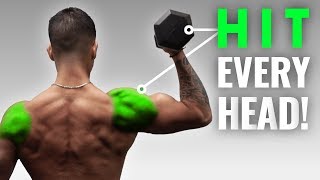
Jeremy Ethier breaks down four dumbbell moves for bigger, balanced shoulders: the shoulder press, lateral raises with a lean, a rear-delt row with elbows out, and incline bench face-pulls. He covers technique cues like scapular plane positioning and rep ranges for each.
Big, well defined and balanced looking shoulders are key when it comes to developing a broad, powerful looking upper body. But achieving them is no easy feat. And one of the biggest mistakes people make with their shoulder training is failing to incorporate enough dumbbell exercises into their routine, which is crucial that you do so, since it helps better prevent imbalances or asymmetries from developing in your shoulders and has various advantages that can help take your shoulder growth to the next level. So if you'd like to boost your shoulder development by incorporating more dumbbell work into your routine, or on the other hand, if you've only got access to dumbbells, then stick around as I'll go through the best dumbbell exercises that you can use to target each portion of the shoulder and add the size that you're after. The first exercise is going to be the dumbbell shoulder press, which can be done standing or seated. Both variations are going to effectively target the front delt with some contribution from the middle and rear delts as well, and to act as your main heavy compound movement for the shoulders. The reason why I'm giving the option for standing or seated is because they each have their pros and cons that you'll want to consider. The standing dumbbell press, for example, has been shown in a 2013 EMG analysis to elicit 8% greater front delta activation, 15% greater lateral delt activation and 24% greater rear delt activation than the seated version, as well as greater involvement from the core musculature. And the reason for this greater activation is due to the stabilization role of the shoulder muscles, which obviously becomes more challenged when you're pressing while in a standing position compared to seated. The downside with the standing version, however, is that you're not going to be able to lift as heavy of a weight, likely around 10% lighter. And once you get to heavy weight with this exercise, it becomes increasingly difficult to continue overloading, since it can be quite cumbersome to get the dumbbells into the right starting position. Whereas with the seated version you're able to both lift heavier weight and can more effectively overload it, since you now have the ability to kick the dumbbells up into the starting position. Therefore, in terms of isolating and developing your shoulder size over time, one could argue that the seated version would be ideal. Whereas if you'd like to use lighter weights without compromising shoulder activation, or you'd like to strengthen the core and improve overhead stability for sport, for example, then in these cases the standing press would be ideal in either case, though, you'll want to perform the press correctly, and one key mistake you'll want to avoid is flaring the elbows out as you press. Instead, keep your elbows tucked forward slightly in something called the scapular plane, as shown here, as this has been shown in multiple biomechanical analyses to be a much safer and more comfortable position for the shoulder joint to be in as you press. In addition, it's vital that you avoid compensating by arching your lower back, especially as you fatigue, and you can prevent this from happening by keeping your cork in track, contracted and tight throughout the press, as this is going to help with your overall stability and lead to a safer, stronger press. The next exercise is going to target the lateral deltoids, or mid delt, which doesn't receive enough attention from the shoulder press alone. Now, as I've said in the past, lateral raises are likely your best bet for growing this portion of your shoulders, since they've been consistently shown to elicit the highest activation when compared to other common shoulder exercises. However, to make the movement even more effective, you can slightly lean in the direction of the raise by hanging onto a fixture with one hand as you perform the movement with the other arm. This is based on the findings of a study on the rotator cuff, which found that the supraspinatus, one of the rotator cuff muscles, is most active during the beginning of the raise, whereas the side delts only become more active after around a third of the way up and remains highly active to the end of the range of motion at the top. Therefore, by leaning away, we effectively remove the beginning portion of the raise where the supraspinatus is most active, which as a result now enables the side delts to remain highly active throughout the whole range of motion. For this exercise, you'll want to use a relatively lighter weight with higher reps while mentally thinking about leading the raise with your elbows rather than your hands and raising the weight out as much as possible rather than simply lifting the weight up. These two cues should help you better activate the side delts and prevent the upper traps from taking over. Next, we're going to use the rear delt dumbbell row to shift more of the focus onto the rear delts as shown here, with some involvement from the back musculature and the biceps as well. This exercise is a great choice to add mass to the rear delts, since it enables you to use heavier weight and overload it more effectively than you can compared to other dumbbell rear delt exercises like reverse flies for ex. But the key to maximizing the effectiveness of this exercise ultimately comes down to how you perform it. As you can see, I'm performing what looks like a dumbbell row, which would normally mainly target the lats. However, by letting my elbow drift upwards and away from my sides, I'm now able to lessen the involvement of the lats and shift more of the tension to the rear delts instead. This is because we know based on anatomical analyses of the lats, that they are strongly involved in shoulder extension when the elbows are tucked close to the sides. But we also know that they become progressively weaker as you move the elbow away from the sides into more transverse extension, which is when the rear delts are now highly active. So when performing this movement, rather than keeping the elbow tucked close to your sides, you'll want to let the elbow drift away and upwards from the sides as you pull in order to better hit the rear delts. It's also important that you focus on keeping your body square rather than twisting at the top of every rep. And you also want to avoid any excessive arching or rounding of the lower back as you perform the movement. For this exercise, you'll want to use a relatively heavier weight with a moderate rep range of roughly 6 to 12 reps. The next exercise is a dumbbell version of the traditional rope face pull and will be used to further target the rear delts while also strengthening the all important rotator cuff muscles and the mid and lower TR in the process. And this exercise is highly effective at doing so since it incorporates the major movement functions of the rear delts, but also adds in external rotation, which is a lesser known function of the rear delts and something that the previous exercise fails to incorporate. But again, to maximize the effectiveness of this exercise, you want to ensure that you're performing it correctly. I'd suggest performing these on an inclined bench set at roughly 445 degrees, as this will help minimize any lower back involvement. Then grab a pair of light dumbbells and start with your arms straight down and thumbs pointed towards each other at the bottom. Then, as you raise up, you want to rotate your hands up and out to the side while twisting the thumbs so that they now point at the ceiling. At the top position, your arms should make the shape of a W. Hold this position for a brief second while contracting the rear delts and mid and lower traps and before you come back down for another rep. And you want to avoid making the mistake of not getting the wrist all the way back at the top position, as this will minimize the all important external rotation component of this exercise. Also, avoid compensating by arching the back as you raise a weight. Instead, maintain a straight neutral spine throughout the movement. And for this exercise you definitely want to put the ego aside and use relatively lighter weight with a higher rep range of roughly 10 to 15 reps.
So here is a dumbbell only shoulder workout that you can do using the exercises that I previously went through. Feel free to do this as a workout on its own or you can split up a couple of the exercises and just throw them into your existing workouts to see better shoulder development. But I hope that you were able to see that choosing the right exercises is important, but also performing them in the right manner is just as important if you want to build muscle most effectively while avoiding injury in the process. And if you're looking for a step by step science based program that shows you exactly what exercises, workouts, reps and sets you need to be doing based on science and how to optimally and safely perform them with in depth tutorials for each and every exercise in your program, then simply head on over to builtwithscience.com and take the analysis quiz that will determine what program will best suit you and transform your body. Anyways, I hope you guys enjoyed this video. Please let me know in the comments below what you'd like to see me cover next. Don't forget to give the video a like as well. Subscribe to the channel and turn on notifications for my channel as well as this all really does help me out. Thank you so much everyone. I really do appreciate the continued support and I'll see you next time.










