The Best Science-Based Full Body Workout for Size and Strength (“Workout B”)
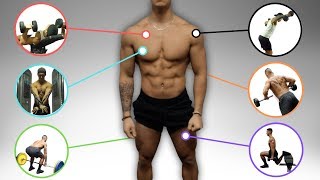
Jeremy Ethier walks through a full-body workout with barbell deadlifts, incline dumbbell presses, chest-supported rows, Bulgarian split squats, and isolation work. Each exercise includes setup cues, target muscles, and research-backed reasoning for why it builds size and strength.
For those who are unaware, this video Workout B is a continuation of my science based Full Body Workout A video. It's designed to be used in conjunction with that workout throughout the week, like so, such that you alternate between both workouts and complete a total of three full body workouts per week. And just like in Workout A, make sure to stick around until the end of this video where I'll provide you with a completely free downloadable PDF of the workout for you to use while you're at the gym. So without further ado, let's take a look at what exactly Workout B looks like. The first and most difficult exercise of this workout will be the barbell deadlift. This exercise is going to target the whole posterior chain, primarily the hamstrings, glutes and the various other muscles that make up the back. And although the conventional deadlift is shown here, as discussed in my video from last week, feel free to experiment with other deadlift variations to find what feels best for you. Regardless of what you choose, though, it's vital that you perform some sort of deadlift within this workout. This is because, as shown in this 2015 study from the journal Strength and Conditioning Research, activation of the lower hamstrings is maximized with knee dominant exercises like the leg curls we did in Workout A, whereas activation of the upper hamstrings is maximized with hip dominant exercises like the deadlift, simply meaning that you'll want to incorporate both types of movements as we've done in our routine, in order to fully develop your hamstrings in a balanced manner and minimize your risk of injury. The incline dumbbell press is going to be your main chest movement for this workout. Given that we performed the flat bench press in Workout A, we want to now include a CH movement that emphasizes the clavicular head of the pecs or the upper chest as shown here to prevent it from lagging behind over time. As you perform each rep, you want to really focus on feeling this region of the chest working. As for why this exercise was chosen, not only does research indicate that this exercise activates the upper chest very well compared to other chest movements, but it also both allows a greater range of motion and better prevents muscle imbalances on one side from developing when compared to barbell exerc, which is important for us since we stuck with a barbell bench press in Workout A. And as for the optimal bench angle, research does tend to show that the best upper chest activation is seen with an angle of roughly 3056 degrees. However, this will vary based on your anthropometry, so experiment with every angle above flat to see what best activates your upper chest while minimizing your front delt involvement. Next we'll move onto the main back movement of this workout which will be a chest supported row. Most of the upper back musculature will be worked, but with more emphasis placed on the mid back muscles like the traps and rhomboids as shown here. It's essential that we include a rowing movement to target these mid back muscles since they aren't as effectively targeted in vertical pulling movements like the pull ups we do in workout eight. Now the reason I'd suggest performing your rows either chest supported on a bench or machine or inverted from a bar is simply to help minimize the lower back involvement which is already adequately worked in the deadlifts performed earlier. Thus, any form of chest support when pulling accomplishes this. But the inverted row is also a great alternative that I suggest you try out advocating its effectiveness. This 2009 paper by Fenwick et al. Have found that the inverted row elicits significantly less spinal load on the lower back when compared to other common pulling exercises while still providing sufficient activation of the upper back muscles. However, in the event that you do choose this alternative, note that this 2014 paper that analyzed the inverted row found that a pronated grip results in significantly greater rear delt and mid trap activation when compared to a supinated grip, thus indicating that to maximize this exercise's effectiveness, you'll want to use an overhand grip that's slightly wider than shoulder width apart. Next, we'll move on to a personal favorite of mine, the Bulgarian Split Squat. The main muscles worked here will be the quadriceps and glutes and will also involve the hamstrings quite a bit as well. But as I've noted in past videos, you can play around with your step length to vary the activation of certain muscles. This exercise is something I'd highly recommend, not only because it's a unilateral movement which helps minimize any potential muscle imbalances, but also because it complements your squat strength from workout A quite well. For instance, one 2016 study on rugby players found that the Bulgarian split squat was just as effective at increasing back squat strength as the back squat itself, while placing less strain on the lower back. And as you perform the movement, you want to focus on pushing up with the front leg and avoid compensating by pushing up with the back leg. If you're having a hard time balancing during this exercise, however, then a good way to compensate is to simply setting up a lower platform for your back foot and then gradually increase the height until you can safely balance on a bench. Next, we're going to move on to dumbbell lateral raises. This exercise is going to target the lateral deltoid or mid delt, which has yet to receive much involvement given our previous exercise selection and lateral raises will likely be your best bet for growing this muscle, as they've been consistently shown, such as in this 2013 EMG analysis by Bottin and colleagues, and to elicit the highest lateral deltoid activity when compared to other common shoulder exercises. Dumbbells are chosen here simply because they're convenient and accessible to most people, but periodically switching it up with a chest support, kettlebells and or cables is something I'd highly recommend in order to incorporate different resistance curves and to find a variation that you feel best activates your lateral deltoid while minimizing trap involvement. Next we're going to move on to a couple additional accessory movements to help minimize any potential muscle imbalances as you progress. Since we had an accessory movement for the biceps in workout A, the first accessory movement here, incline dumbbell kickbacks will emphasize the long head of the triceps, which hasn't received much attention given our previous exercise selection. As mentioned in my past videos, this exercise enables the longhead to be maximally shortened and as a result is more been shown in EMG analyses to elicit very high activation of the long head compared to other tricep movements. I'd suggest setting up the incline to roughly 30 degrees and ensuring that your elbows stay locked at your side and that your arms remain parallel with your body as you perform each rep. The last exercise of this workout will be high to low cable crossovers, which will put more emphasis on the sternal head of the pecs or lower chest. Since the line of pull of the cables raise runs in line with the way that the lower chest fibers run. It's important to include this exercise since none of our previous exercise selection prioritizes the development of this region of the chest. And a couple key points with this exercise are to keep the elbow position locked throughout each rep and cross your hands over at the bottom position to allow greater horizontal adduction in order to maximally activate the chest fibers. So to sum the video up, here is what your full body Workout B could look like as recommended in workout A. If you're a beginner lifter, then sticking to just the main compound movements and the low end of the range of sets per exercise would likely be best to start and then you can gradually add more volume over time. You can also add calves and or abs to this as well, or do that extra work on a rest day.
What's going on everyone? Now, as mentioned in the beginning of this video and as I did in Workout A, I've created a completely free PDF for Workout B that's designed for you to download and reference while you're at the gym. You can it shows you the full workout, what muscles each exercise targets, step by step tutorials with visuals and more.
So to get a copy of this.
All you have to do is follow this link which I've put in the description box down below and also pinned in the comments. I hope you're all finding the free PDFs useful, but if you want to take things one step further and are looking for a workout and nutrition plan that combines all the research I do into a step by step program such that you can transform your body as efficiently as possible from your starting point.
While actually learning why it is you're.
Doing what you're doing, Then what you can do is simply head over to builtwithscience.com and take my starting point quiz I have up in order to discover which program and what approach is best for you. Anyways, as always, if you haven't yet done so, I'd really appreciate a follow on Instagram. I post a lot of exercise form videos and my daily meals on my story there as well, which I think a lot of you will find useful. And lastly, I put in a ton of effort into this video, so what you can do to help me out in return is simply give the video a like Leave a comment down below as to what workout you'd like to see me cover. Next subscribe and turn on notifications to my channel as well just to be sure you don't miss out on any future content. But that's it for today guys. Thank you so much for watching. I appreciate all your support and I'll see you next time.
It.










