The Best Science-Based Leg Day For Growth (Quads/Glutes/Hamstrings) | PUSH PULL LEGS SERIES
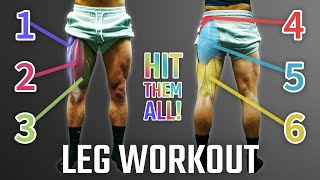
A leg workout targeting quads, glutes, and hamstrings with barbell squats, hip thrusts, and glute-ham raises. The creator backs each exercise with recent research, including 12-week studies and EMG analyses, and gives specific rep ranges and form cues.
Questions this video answers
12 weeks.
Quads grew ~12% on average; glutes grew ~9% on average.
About 20% lighter.
6–10 reps (moderately heavy).
12–15 reps (higher rep range).
This video is the final installment of my 3 part push pull Leg series that have recently released. In this video, we're going to cover your leg workout for the week. It's designed to target the quads, the glutes, the hamstrings and the calves in a balanced and carefully thought out manner by using both our anatomical understanding of these various muscles and the findings of current scientific literature. So without further ado, let's dive right into Exercise one. The first exercise shouldn't come as a surprise here, and it's going to be barbell squats, which have been shown to be a great exercise for developing the lower body musculature. For instance, a recent 2020 paper from the International Journal of Sports Medicine had a group of trained subjects perform only the back squat as their lower body training for a period of 12 weeks. After the 12 weeks, the subjects managed to grow their quads by an average of 12% and their glutes by roughly 9%, confirming that the back squat is indeed a great exercise for growing not only the quads but the glutes as well as now as for whether to perform back squats or front squats. Contrary to popular belief, their muscle activation patterns are actually quite similar. Both squat variations have been shown to activate the quads, the hamstrings and the glutes to a very similar degree, with front squats providing just a slightly higher activation of the quads and back squats providing slightly better activation for the hamstrings. However, there are some unique benefits of the front squats that you should keep in mind. First of all, the front squat achieves this comparable level of muscle activation even when using roughly 20% lighter weight than the back squat. And second of all, research has shown that the front squat produces significantly lower compressive forces on the knee as well as reduced lumbar stress when compared to back squats, which is due to the position of the bar and the decrease in forward trunk lean that you experience with front squats. Meaning that for those with passing injuries and lower back issues, the front squat, when performed correctly, may be the better option for you and won't require you to lift as heavy, yet will still still be as effective as back squats regardless, though incorporating both into your routine by, for example, performing the back squat on this leg day and then the front squat on your next leg day of the week is a great idea given the complementary muscle activation patterns that we see in the two variations, and for both squat variations make sure to use a full range of motion down to at least parallel and relatively heavy weight with a moderate rep range of 6 to 10 reps. Next, we're going to move on to barbell hip thrusts to now prioritize the glutes as well as involve the hamstrings a little more. This exercise can be argued as the perfect complementary exercise to the squat, since they've been shown in research such as in this 2015 EMG analysis to better activate these important posterior chain muscles than the squat does. However, with that being said, a new paper that came out just this year shows how this greater muscle activation may not actually lead to better growth. The researchers had a group of TR subjects either perform only hip thrusts or only back squats for a period of 12 weeks for all of their lower body training. After the 12 weeks, squats led to just over double the glute growth and hip thrust did, which goes against some of our past beliefs that hip thrusts are king when it comes to the glutes. So why would I still suggest that you incorporate them? Well, first of all, this is a relatively new finding and there has been some conflicting unofficial research by researcher Brett Contreras on on identical twins showing that hip thrusts were the better exercise for glutes growth after a period of six weeks. Meaning that I just wouldn't take the previous study results as fact just quite yet. And second of all, we know that squats are a great glute builder given that they elicit a high amount of mechanical tension on the glute muscle fibers, which is a primary stimulus of muscle growth. Hip thrusts on the other hand though, provide less mechanical tension on the glutes, but they do provide a much greater glutes contraction and puts a high amount amount of tension and metabolic stress in the glutes when they're in a shortened position at the top of the movement, something that the squat just fails to do. And lastly, hip thrusts are very low impact on the joints and easy on the lower back, yet they still enable you to lift heavy weight when compared to other glute exercises. Therefore, since hip thrusts complement the squat so well in terms of a strength curve and they enable you to perform more heavy volume for your glutes with minimal additional stress on your joints and including them in this routine is recommended. And just some general tips when you perform them are to focus on posteriorly tilting the pelvis as you thrust the weight up, avoid arching your lower back and position your feet such that your shins are vertical at the top position. You can use a barbell to easily overload the movement here over time as your booty develops and we'll use a relatively higher rep range of 12 to 15 reps here. Next, it's time to move on to square split squats to further target the quads, but with considerable involvement from the glutes and hamstrings as well. It's important to include at least one unilateral movement in this routine that trains one leg at a time in order to prevent imbalances from developing over time. As for the differences between the stationary split squat and walk in lunges, split squats do have a unique advantage. First of all, they're just easier and safer to learn. For example, research from the journal Strength and Conditioning for Research found that beginners that performed the walking lunge had quite the difficult time balancing and compensated for this by cutting their range of motion short while also reducing the activation of their all important glute medius muscle during the movement. Whereas beginners who perform the split squat instead were able to perform it with full range of motion and a significantly higher glute medius activation which was helping them stabilize their body. Therefore, starting out with a stationary split squat will be best, and then once your balance improves with this, rather than progressing them to walking lunges, you can instead progress them to the Bulgarian split squat where you elevate your rear leg. This is arguably the better progression since it helps you now increase your range of motion, enables you to better load and isolate your front leg by minimizing the contribution of your back leg, and it also gives you a better chance to identify and address any strength differences between your two legs. And then once you're able to comfortably do this variation, what I'd recommend is to progress it once more by performing half of your sets with the contralateral Bulgarian split squat, where you're now just holding one dumbbell on the opposite hand as your front leg. This dumbbell carrying position has been shown in a 2015 analysis to significantly boost the involvement of the glute medius since it now has to help stabilize the body by counteracting the weight on the opposite opposing side, which is beneficial since this muscle is pretty much neglected in virtually all compound leg movements. Yet it plays a very important role in stabilization balance and preventing and reducing knee pain. And as an added bonus of this variation, it also better activates the outer quads, which can help balance out any inner versus outer quad imbalances you may be experiencing. For these, in the regular version, we'll use moderately heavy weight for for a rep range of roughly 8 to 12 reps. Lastly, we're going to move on to the glute ham raise to now emphasize the hamstrings, since they've yet to be prioritized very well in the past. Movement the glute ham raise is a great exercise to do so since it's been shown in EMG analyses like this one by McAllister and colleagues to elicit the greatest activation of the various hamstring muscles when compared to other common hamstring movements like the leg curl and the Romania del deadlift, for example. In addition, one of the unique benefits of the glute hammer is that it forces you to control your body weight on the way down or eccentric portion of every rep. This is important given that research has shown that it's the eccentric strengthening of the hamstrings that seems to be the most important factor for not only enhancing your athletic performance, such as with your vertical jump, but also for better protecting your hamstrings from any future potential injuries or imbalances. Now, to properly execute them, you want to position your knees just behind the pad and then lower your body in a controlled fashion by contracting your hamstrings. Your head, your back and your hips should all stay in line as your knees gradually straighten and then on the way up, curl your body up by using your hamstrings while again keeping your upper body in a straight line and moving as one unit. For those struggling with this though, or just lack the equipment to do so, a good alternative is to perform a similar movement but on a Bosu ball against the wall. The same form tips apply here, but you can make it easier by simply starting out with just doing the negatives. By controlling yourself on the way down of every rep and then resetting to the top and repeating this motion, you want to work towards using a rep range of roughly 10 to 15 reps and then you can even add weight over time once you're capable of doing so with proper form.
So to sum everything up for you, here's what your leg workout could look like. For calves, I'd simply recommend adding in one standing calf raise exercise and one seated calf raise exercise to ensure that both calf muscles are hit and a mix of higher and lower rep ranges. As for your other leg day during the week, based on research I've gone through in past videos, you want to ensure that you incorporate a hip dominant hamstring exercise exercise like deadlifts into it, as well as a knee dominant quadriceps exercise for optimal development of both of those muscles and then just simply use variations of the day one leg a day exercises to make up the rest of your volume for day two. And lastly, just as I did with the push and pull workouts, I'll compile this leg workout into an easy to download free mobile friendly PDF for you to use and reference while you're at the gym. It'll show you the workout, rest times, tutorials and more. To get a copy of it, just head over to builtwithscience.com forward sleg workout PDF and I'll send it right over to you. And I'll leave a link to that in the description box down below as well. I hope you enjoyed this one and I also hope that you're able to see that to maximize your time and efforts and build muscle in the fastest way possible, then you need to not only carefully select each and every exercise that you perform in your workouts, but you'll also also need to know how to then go about executing and implementing them into your overall routine. And for a step by step program that takes care of all the guesswork for you and shows you exactly how and what to work out week after week so you can build muscle most effectively with science. Then simply head on over to buildwithscience.com and take the analysis quiz to discover which science based program will be best for you and where your body is currently currently at. Anyways guys, thank you so much for watching. I hope you enjoyed this one. Please don't forget to show your support by giving the video a like leaving a comment down below as to what you'd like to see me cover next, subscribing to the channel and turning on notifications for the channel as well as this all really does help me out. Thank you so much everyone and I'll see you next time.










