The Best Science-Based Leg Workout for Growth (Glutes/Quads/Hams)
A breakdown of leg anatomy and a science-backed workout using barbell squats, front squats, split squats, Romanian deadlifts, and hip thrusts. Full-range squats build more muscle than partial reps, and mixing low and high rep ranges targets different fiber types.
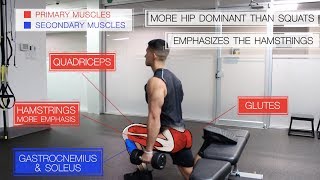
The biggest mistake people make when training legs, aside from not training them at all, is neglecting to focus on the development of all the major leg muscles. And to do this, we need to first understand their anatomy. The three main muscles we will focus on are the quadriceps, hamstrings and glutes. The quads are a group of four muscles that comprise the bulk of the muscle on the front of the thigh. Together these muscles perform knee extension, and one of the muscles, the rectus femoris, assists in hip flexion. The hamstrings are comprised of three muscles that make up the muscles of the back of the leg. Together these muscles work to extend the hip and flex the knee. And finally, the glutes are comprised of three muscles which all perform a variety of actions but are mainly involved in hip extension. As for the several other muscles like the adductors and abductors, they will play a role in pretty much all of the exercises in this video video so isolation isn't necessarily needed, but can be used for correcting imbalances, which is something I'll discuss in another video. But in this video I'm going to show you guys a well rounded leg workout optimized Based on current scientific literature and our anatomical understanding of the leg muscles, I think there's no surprise that barbell squats are in here. They are an excellent exercise for simultaneously working pretty much all of your lower body musculature. The quads and glutes are the primary focus of this exercise, with the hamstrings and several other muscles acting as dynamic stabilizers throughout the movement. Now, as for squat depth, one study by Morse et al. Found that there was a two fold increase in muscle size in subjects that performed full range of motion squats as opposed to partial squats over a period of eight weeks. And as shown in this study by Bruno et al. Full range of motion seems to induce greater muscle damage than partial range of motion, even if more volume is lifted in the partial range of motion. So you definitely want to use a full range of motion if your goal is leg hypertrophy, which means you want to come down to at least parallel when you perform the squat. As for performing them with a barbell versus a Smith machine, one study by Binstead et al. Showed that barbell squats elicited 43% higher average leg muscle activity when compared to Smith machine squats. So stick to full range of motion barbell squats for the best results. There are several reasons why I'm also including front squats in this routine. Not only do they hit all the major muscle groups of the legs very well and especially the quads, they also emphasize a lot of upper body musculature. People tend to be weakened. These muscles are essential for maintaining proper posture during lifts and even just correcting posture outside of the gym. In addition to this, although surprisingly, studies show that overall quadriceps activation is pretty much the same between the front and back squats. Research also shows that front squats may emphasize certain quad muscles that aren't activated as well during the back squat squat. For example, this table from a study by Tillman et al. Shows that certain quadricep muscles like the vastus lateralis and the rectus femoris are less activated during the back squat and more so in the front squat, indicating that performing front squats as well as back squats may provide more balanced quad development. However, with that being said, if you think including both in one workout is too fatiguing, then you can put them somewhere else in your workout split or replace them with hack squats or leg press, which both show similar results in terms of hitting all the quad muscles. This exercise is something I think everyone should include somewhere in their routine. Again, this exercise will hit all the major leg muscles, but is more of a hip dominant exercise, meaning it will put more emphasis on the hamstrings. EMG studies indicate that this exercise more heavily involves the hamstrings and glutes than the squat, meaning it's essential to include in your leg routine for development of these muscles since they aren't as well activated during the squat. In addition, this study by Turner et al. Suggests that the split squat may be as effective at increasing back squat 1 rep max as the back squat itself, while placing less strain on the lower back, meaning that it's a great complementary exercise to use with squats in terms of both muscle and strength development. And the fact that it's a unilateral exercise helps balance out asymmetries that would likely develop from only using bilateral exercises like squats and leg presses. One thing to also keep in mind is that when it comes to hamstrings, Romanian deadlifts really are king. So you want to include them somewhere in your routine, whether it be on your back day or on another leg day. In order to balance their development with the quads, this exercise is essential in order to activate and hit the glutes to a greater extent than they are in the squat. The main muscle worked in this exercise is the glutes, but the hamstrings will also be involved. The reason these are essential for glute development is a topic that has been explored extensively by researcher Brett Contreras. He found that mean activation the glute during squats are fairly low, only around 50 to 70% of your maximum voluntary contraction. Whereas for hip thrusts using the same relative load, mean activation is extremely high, around 100% of maximum voluntary contraction and it better activates the upper fibers of the glutes. Therefore they should be used complementary with squats for the best glute development. If you haven't done these, I suggest performing them with no weight just to get the movement and activation down and then you can eventually progress it by adding weight. Now as for the optimal rep range for legs, research shows that the legs are comprised of almost an even split between type 1 and type 2 muscle fibers, with a slight tendency towards a higher proportion of type 1 muscle fibers. Generally, it's thought that high reps with low weight maximize type 1 fiber growth and low reps with high weight maximize type 2 fiber growth. Some studies agree with this, however others show that both fiber types will grow regardless of the rep range used. But I think that research still points towards including a mix of both low rep and high rep work legs given their fabric type distribution, so that would likely be the best option. So to sum the video up, here is a sample leg workout you guys can use. Keep in mind that this is just a recommendation and the optimal number of sets and reps will vary individually. Also, feel free to swap out exercises or split the workout up if you're training legs more than once a week. That's pretty much it. Guys, thank you so much for watching. I hope you enjoyed the video and I hope you're enjoying my science based video series. As always, I put in a lot of time and effort into this video, so if you could just please do me a favor by giving the video a like leaving a comment down below and also subscribing to my channel if you haven't already then I would really appreciate it. A lot of you are asking me when my shoulder video and other muscle groups will be coming out and I'm planning to get those up in a few weeks or so. I do have final exams coming up so I'm going to be pretty busy for the next month so I can't promise anything, but after I'm done exams I'm going to have a lot more time to put out content. But thank you guys so much for being so patient and I'm also getting a lot of requests for online training but at the moment, I just don't have enough time to take on more online clients. But in a month or two, I'm gonna have my own website up where I'll be posting programs, and I'll have information available for online training for you guys. So stay tuned for that. Anyways, that's it for this video, guys. Thank you again for all your support. I really do appreciate it. I'll see you guys next time.










