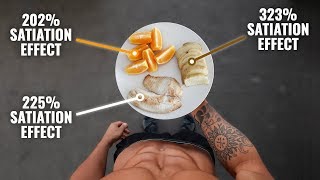
Jeremy Ethier breaks down three science-backed strategies to stay full while eating less: prioritize satiating foods based on a 1995 study of 38 foods, eat high-volume low-calorie foods like vegetables and potatoes to stretch your stomach, and bump protein to 0.4 grams per kilogram per meal. Specific swaps: oats instead of cereal, potatoes instead of pasta, apples and popcorn for snacks.
Questions this video answers
240 calories per food serving.
Approximately 0.4 grams of protein per kilogram of body weight per meal.
Protein increased from 15% to 30% of daily calories and spontaneous food intake dropped by ~500 calories per day, enabling ~8 lb fat loss over 12 weeks.
When it comes to losing fat, we all know the importance of nutrition. You can train as hard and as often as you're physically capable of, but if you aren't eating the right meals and in the right amounts, then you're simply not going to see the fat loss results that you're after. But at the same time, this is also where most people get stuck, because with all the misinformation out there, it becomes difficult to know what exactly you should be eating in order to burn fat most effectively. But the truth is, it's a lot more simple than you may think. And it essentially comes down to just a few key tips that I'll be sharing in this video that most ripped lean individuals incorporate into their own daily meals. Before we dive into those tips, though, let's clear something up. Despite what you may have been led to believe, there are no magical fat loss foods that will somehow burn fat for you without a calorie deficit in place. As we know that at the end of the day, that's what's going to ultimately determine if you lose fat or not. So therefore, in order to optimize your nutrition for fat loss, it's absolutely vital that you design your meals such that they make it much easier and more likely for you to maintain a calorie deficit to burn fat. And we can do so by incorporating meals that fill you up more and fill you up for longer, as this is going to help you maintain your deficit and prevent you from overeating. And this is especially true given that research has shown that an increase in appetite is one of the main reasons why fat loss eventually slows down for most people. And in fact, in a 2009 paper, the researchers found that as subjects lost fat, they also began to experience an increase in hunger that led them to subconsciously consume more calories and caused their fat loss progress to come to a halt. So, to help you avoid this, in this video, we'll go through three key tips along with various fat loss meal examples that you can use and incorporate right away. The first thing you want to do is incorporate food foods into your meals that are highly satiating. And to do this, we'll use the findings of a classic 1995 study where researchers from the University of Sydney investigated the effects of 38 different common foods on hunger levels. The researchers fed subjects a serving size of 240 calories of each common food and then measured subjective hunger ratings afterwards. And as you can see in the results here, out of the list of the 38 foods, popcorn, oats, fish, Fish, potatoes, apples and oranges were shown to have the greatest satiating effect and kept subjects fuller for longer, meaning that incorporating these specific foods into your daily meals is a great way to keep you full throughout the day without sacrificing a ton of calories, therefore providing the best bang for your buck. And an easy way to implement this information is to simply make a few smart food swaps into your current meals. For example, instead of having a bowl of cereal for breakfast, switch these out for oats, which have a 45% greater effect on satiety. And instead of having white pasta or white rice in your main meals, switch these out for baked or boiled potatoes, which have a 63% and 57% greater effect on satiety, respectively. And then for your snacks, it would be wise to choose high satiety fruits like oranges and apples in order to keep you full between meals. But by incorporating these simple swaps into your meal plan, it's going to make a huge difference in your ability to stay full and maintain a calorie deficit day after day and hence improve your ability to burn fat. Next, it's key that you make sure that the foods you eat are high in volume relative to their calorie density, because one of the signs that your nervous system uses to signal fullness to your brain is the degree at which your stomach stretches. So as you can imagine, the higher in volume the foods are that you eat, the more you're going to be able to fill up and stretch the stomach. Meaning that if you design your meals such that you incorporate foods that are higher in volume yet lower in calorie density, you're going to be able to stay full and satisfied for longer without having to intake a ton of calories. Illustrating this point is a paper from the Journal of Clinical Nutrition which found that modifying a pasta dish by replacing some of the pasta with vegetables instead said not only lowered the calorie content of the meal, but also led to subjects feeling more full and more satisfied after the meal, leading them to consume less calories than they would otherwise. So obviously veggies are an excellent choice for this. But other practical high volume foods you should consider implementing into your own meal regimen also include fruits, air popped popcorn, broth based soups and potatoes, for example. And to put this into perspective for you, let's compare 100 calories of rice cakes and a 100 calorie bowl of popcor corn to this 100 calorie slice of bread and 100 calories of chips. It's pretty clear which ones are going to keep you fuller for much longer and for the same amount of calories. And to be totally honest, simply incorporating more fruits and veggies into all of your meals is what I personally do and would recommend you start doing as well, which can be very easily done by just swapping in a couple servings of vegetables into each of your meals, as doing so is going to do wonders in terms of keeping you full and maintaining your calorie deficit. This the next tip is to simply boost the protein content of your meal. This is because multiple research reviews have shown that protein is significantly more filling than both carbohydrates and fats. So by increasing the protein content of your meals, it's going to aid in fat loss by making you feel more satisfied and more likely to stay in a calorie deficit. A classic example of this is a 2005 study from the University of Washington which found that when subjects increased their protein intake from 15 to 30% of their daily calorie intake, they experienced a sustained decrease in hunger and their spontaneous food intake dropped by an average of around 500 calories per day, which over the course of 12 weeks enabled them to lose over 8 pounds of fat. And in fact, research shows that an increase in protein intake in your diet that's as small as just 5% will help with losing fat by enhancing satiety and promoting muscle maintenance. So even if you're not a fan of high protein foods, even just slightly boosting the protein content of your meals is also helpful. But based on a 2018 review paper, generally the optimal protein amount to aim for per meal seems to be around 0.4 grams of protein per kilogram of your body weight, particularly if you consume four meals or three meals and a high protein snack throughout the day. So aiming towards that goal per meal by incorporating various high quality protein sources is going to be an easy way to keep you full throughout the day and indirectly boost boost fat loss as a result. So to help you put this all into practice, you want to prioritize having more highly satiated foods, incorporate more high volume low calorie foods and consume a protein source within every main meal. For breakfast a great option is oats for its highly satiating effect, which can also be combined with whey protein powder in order to boost the protein content and hence the fullness for this meal even more. And strawberries are also a great low calorie, high volume food that can be added into the oats to further boost satiety. And then for lunch and or dinner. Boiled potatoes are a great option since they were found to be the most satiating food. Add a highly satiating protein source such as fish to the meal and more volume through the use of veggies and you have a solid meal that's going to keep you full for several hours on end. And lastly, for snacks, as mentioned earlier, foods such as minimally flavored popcorn, oranges and apples are all great options that are going to keep you full until your next meal.
I hope that you're able to see that it's little tweaks in your diet like the ones I went through in this video that really make all the difference when it comes to losing fat as fast as possible. That's exactly why within my Built With Science programs, I not only show you what and how much you should be eating that in order to lose fat, but I'll also show you exactly how to set up and structure your daily meals such that it makes the fat loss process process as smooth and as effortless as possible. To join today, simply head on over to builtwithscience.com and take the Starting Point Analysis quiz, which will determine what program is best for you. Anyways, thank you so much for watching everyone. I hope you enjoyed the video. Please don't forget to show your support by giving the video a like leaving a comment down below as to what you'd like to see me cover next, subscribing to the channel and turning on notifications for the channel as well as this all truly does help me out. Thank you so much everyone. I really do appreciate your continued support and I'll see you next time.