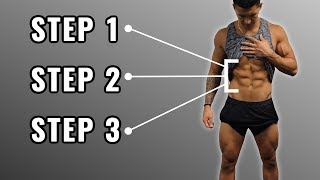
This YouTube video (Jeremy Ethier) debunks common myths about getting six-pack abs and presents a three-step, evidence-based plan: (1) prioritize nutrition to create a sustained calorie deficit (use his online calculator to set calories/macros), (2) follow a resistance-training program plus 1–3x/week direct ab training to retain/build muscle and define the midsection, and (3) monitor progress (daily weigh-ins, weekly averages) and adjust calories or add cardio as needed until reaching roughly ~12% body fat. The video cites several studies to support claims and concludes with calls-to-action linking to downloadable workouts and a nutrition tool.
Questions this video answers
A 2011 paper in the Journal of Strength and Conditioning Research (cited in the video).
A 2014 EMG paper in the Journal of Strength and Conditioning Research (video-cited findings: squat <20% activation; sit-up ≈40%).
A 2015 systematic review and meta-analysis (cited in the video).
Around 0.7% of body weight per week.
Approximately 1.2 pounds per week (170 lb × 0.7% ≈ 1.19 lb).
Lets face it, six pack abs are something that most men want. They not only complete a lean muscular physique, but are also representative of all the dedication and hard work you've put in to attain them. However, with the amount of people wanting a six pack of their own comes the overwhelming amount of bad advice out there on how to actually get them. For example, a quick Google search is all it takes to come across a plethora of misleading information. Some say you have to ingest certain types of special foods and drinks while avoiding others. Some advocate special fat burning pills as all you'll need, whereas others promote ab exercises as the key to stripping off that belly fat, which is now something that most people unfortunately believe in. Well, coming from someone who has personally stripped off that belly fat to reveal my six pack, I can tell you that none of those previously mentioned methods alone will help if you in fact, taking just a quick look at the research proves my point. For example, this 2011 paper from the Journal of Strength and Conditioning Research found that six weeks of direct AB training, five days per week, had no effect on reducing belly fat in overweight subjects, simply meaning that no amount of AB exercises alone will get you a six pack. So what should you do instead? The good news is that the real evidence based way to get a six pack is actually quite simple and and with the following three steps I'm going to cover, by the end of this video you'll have a complete game plan to get you there. Step one is the most important step and involves setting up your nutrition, which is going to be responsible for stripping off the excess fat that's covering your six pack in order to reveal them. As many of you know, in order to lose fat you must be at a calorie deficit and the easiest way to create a significant calorie deficit is simply by eating less. Now, although you could theoretically do this by exercising more instead, that's actually much harder to do and sustain. For example, most people would find it much harder to burn an extra 500 calories daily by jogging for 40 minutes, as opposed to just eating a little less. Which is exactly why you need to prioritize your nutrition. Now as for exactly how much you should be eating in terms of calories and macronutrients, I've simplified everything by setting up a calculator on my website that will calculate everything for you based on your stats and I'll leave a link to this page in the description box down below. After you get those numbers, write them down and that's what you'll want to stick with until you refine them in step three of this video. And as for the types of foods to eat, to hit your numbers, here's a helpful graphic that provides some examples of what the majority of your diet should consist of. Step two involves setting up your resistance training program, which is recommended because when combined with a calorie deficit, it's going to enable you to maintain your muscle mass as you lose fat and and help better shape and define your midsection as you lean down. For example, this 2015 systematic review and meta analysis looked at the effectiveness of a calorie deficit alone, a calorie deficit plus cardio and a calorie deficit plus resistance training on body composition in overweight individuals. Their analysis found that a calorie deficit combined with resistance training provided the most favorable changes in terms of fat loss and muscle gain. As for what resistance training program to use for a good routine, I'd highly suggest checking out my upper lower workout split videos which come with a PDF you can download and get started with right away. And again, these will all be linked down below. And as for direct AB training, despite what I said earlier, it actually is something I'd recommend incorporating in your routine. The main reason is because compound movements and resistance training exercises in general don't stimulate the abs very well. In fact, this 2014 EMG paper from the Journal of Strength and Conditioning Research found that activation of the ABS and external obliques during the back squat was quite minimal, less than 20%, whereas the standard sit up led to more than double the activation at around 40%. So since the abdominals and obliques can be grown just like any other muscle, these findings mean that you should be training them directly as this will improve their look once you strip off the excess fat covering them. My recommendation is to train them around one to three times per week with a mixture of both weighted and unweighted exercises which can be done on your rest days and or after your main workouts. For example, as for cardio, it's not necessarily needed from the start and will be mainly used as a tool to speed up the fat loss process which will be discussed in step three. Once step one and two are in place, the last thing you need to do is monitor your progress throughout the weeks and adjust accordingly to ensure you're heading in the right direction. And you can start by simply weighing yourself every morning and tracking that over time. Multiple studies like this 2011 paper by Garth and colleagues have found that aiming to lose around 0.7% of your body weight per week is a sweet spot in order to maximize fat loss while minimizing muscle loss. For example, a 170 pound individual would aim to lose roughly 1.2 pounds per week, so what he'd do is track his morning weight over time and take a weekly average of it. If he's getting close to his goal weight loss per week, then we know he's on the right track. If, however, he's not losing weight at all or not fast enough, then he should adjust by either slightly reducing his calorie intake or adding a little bit of cardio in order to now hit his goal. And conversely, if he was losing weight too quickly, which isn't necessarily a good thing, he would simply do the opposite. You will inevitably have to lower your calorie intake and or slightly add more cardio as you progress, but the key is to do so gradually. Also keep in mind that weight is just one measurement of progress. It's also important to assess how your strength is doing in the gym, how your body changes, look in the mirror and so on in order to get the most accurate depiction of your progress. So basically you keep doing this until you reach roughly 12% body fat or below, which as you can see is the level of leanness you'll have to attain in order to see a well defined six pack. Just note that you will lose fat from other areas like your face and arms before it eventually comes off your stomach due to the fat cells there being more stubborn. So the key is to be patient and trust the process. Although attaining a six pack may seem impossible to you or far off from where you are now, trust me on this. With dedication and adherence to the three step protocol I went through, you will get there.
Thanks so much for watching everyone. I hope this helps some of you out who are struggling with all the misinformation out there. Although it take a lot of hard work and patience, just trust me, the end result will be worth it. And if you're looking for an all in one evidence based program that not only covers training but also comes with a custom built nutrition software to automate the nutritional adjustments you should be making over time in order to transform your body as efficiently as possible, then what you can do is simply head over to builtwithscience.com and take my steps. Starting point analysis tool I have up in order to discover which program and which approach is best for you. Anyways, if you haven't already, I'd really appreciate a follow on Instagram. I post a lot of informative videos and content on there as well, which I think a lot of you will find useful. And if you enjoyed this video then please don't forget to give it a like leave a comment down below. Subscribe and turn on notifications for my channel as well as this all really does help me out. Thank you so much everyone for the support. I really do appreciate it and I'll see you next time.