The Best Science-Based PULL Workout For Growth (Back/Biceps/Rear Delts)
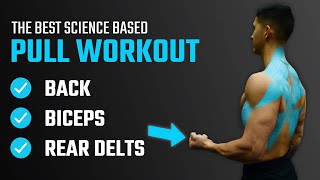
Jeremy Ethier builds a pull workout targeting lats, biceps, and rear delts with research-backed exercise choices. Pull-ups versus chin-ups, barbell rows, and lat pulldowns get compared for growth. The routine rotates vertical and horizontal pulls, then hits isolation work with close-grip curls and face pulls.
Foreign for those who are unaware, this video is part two of my recently released Push Pull Legs routine series. In part one of the series, we covered a sample push workout for the week to target the chest, shoulders and triceps. In this video, however, we'll cover a sample science based pull workout for the week to now target the various back muscles, the biceps and the rear delts. Given that these muscles work together during pulling movements, it's a good idea to train these muscles together in one workout as we'll do today. And just like in part one of this series, at the end of the video you'll receive a free downloadable PDF of this pull workout for you to conveniently refer to while you're at the gym. Now, before we dive into the workout, it's important that you first understand the reasoning behind its setup, which involves the following the first four exercises will rotate between vertical pulling movements and horizontal rowing movements. It's beneficial to rotate from one to the other throughout the workout to not only work our back muscles from different angles, but to also avoid overstraining certain stabilizer muscles that are heavily involved in certain planes of motion. And then we'll finish the workout off with two accessory movements to work the smaller muscle groups that will still need a little more emphasis. So with that being said, let's take a look at what research indicates the optimal pull workout might look like. The first exercise we'll perform in this pull workout are pull ups, which are one of the best best exercises for targeting the lats to increase the width of your back. In fact, when compared to seven other back exercises in a paper by the American Council of Exercise, the pull up came out on top with the highest lats activation. In addition, research has shown that the pull up also activates various other back and arm muscles to a high degree as well, meaning that it's a great overall back builder and therefore should definitely be a staple in your routine. Now as for its counterpart, the chin up and its effectiveness despite both movements being quite similar, there are a few key differences that are highlighted in the following paper by Udes and colleagues. The researchers found that although both exercises activate the lats to a similar degree, there were two main differences. One chin ups provide greater biceps activation, which is expected due to the grip, and two pull ups provide significantly greater lower traps activation, meaning that overall both are great options. But given that the lower traps is a back muscle that tends to become weak and unwelcome underdeveloped on lifters. Yet it's especially important for posture and shoulder health pull Ups can be argued as a better alternative here for this workout, and it's why they're chosen here. But on the other hand, if you're currently unable to perform pull ups as suggested in my recent pull up strength video, you'll want to swap these out for kneeling lat pulldowns instead, since this exercise has been shown to best mimic the pull ups muscle activation pattern when compared to other commonly used alternatives. Next, it's time to switch the angle of pull by moving to a horizontal pull up movement with the barbell row, which has been shown in research to not only be a great overall back builder, but is especially useful for mid back thickness and lower back development given that it outperforms other common back exercises in terms of activation of these areas. Therefore, we'll be using them here to complement the pull ups done earlier to now focus on our back thickness and also just hit our lats from a different angle and to properly execute them for the best back development. What you'll want to do is first lower your upper body by pushing your hips back while slightly bending your knees. You want to stop at the point where the flexibility of your hamstrings prevents you from going any further down without rounding your back, which for most individuals is somewhere around 45 degrees. Then you'll want to use an overhand grip that's just outside of your knees and pull the bar up towards your upper abs region while keeping your elbows at roughly a 45 degree angle, as this specific form has been shown to be best for upper back thickness, which is exactly what we want to achieve with this exercise. Next we'll move back to a vertical pulling movement with a lat pulldown to further target the lats and various other back muscles. However, rather than the wide traditional overhand grip, we'll be switching to a closer underhand grip. And the reason for this is because anatomical studies have shown that the lats are comprised of an upper and a lower region which can actually be preferentially activated during your back training. Exercises that involve more shoulder adduction, such as in the traditional pull ups we did earlier, have an angle of pull that is more in line with the upper lat fibers and the teres major and therefore will more effectively hit these regions, whereas exercises that involve more shoulder extension, such as in the reverse grip lat pulldown, now have an angle of pull that is more vertical and in line with the lower lat fibers and therefore will more effectively hit this region of lats. So since we've already worked the upper lats sufficiently in the pull ups that we did earlier on in the workout, we'll now want to put more emphasis onto the lower lats to further maximize our back width, which can be done by simply using an underhand grip with the lat pulldown. And with this exercise, you'll want to incorporate a slight lean back and keep your elbows tucked close to your sides as you perform each rep in order to best activate the lats. Next, we're going to move back to a horizontal rowing movement similar to the barbell row, but performed in a way that will now emphasize the rear delts to a much greater degree. It's important we do so in this workout, given that most people's rear delts are often neglected and relatively underdeveloped when compared to the rest of their shoulder. And although traditional rowing movements do involve the rear delts, we can heighten their involvement by tweaking our elbow position as we row, because we know that when the elbows are tucked closer to our sides as we row, the lats are biomechanically in a more advantageous position. But if we widen our grip to enable us to flare the elbows out more as we pull, as we're doing here, the rear delts are now put in a more advantageous position and the involvement of the lats is minimized. And by laying on an inclined bench, we can then boost the activation of the rear delts to an even greater degree. This is because research indicates that you can better target the upper back muscles by limiting the involvement of the lower back in the movement, which is especially important for us to do here since our lower back is already relatively fatigued from the barbell rows that we performed earlier. And if you're having some trouble setting this up with your bench, though, a viable alternative is the dumbbell rear delt row, where you perform a similar row, but externally rotate the shoulder at the end position like so in order to best engage the rear delts. Next, it's time to move on to some isolation work for the biceps, but more specifically, we'll be targeting the long head of the biceps, since the short head of the biceps has already received most of the emphasis in our previous pulling movements. And the close grip barbell curl is a great exercise for this purpose because by both keeping the elbows close to the body and using a narrower grip that's within shoulder width, we'll be able to put the outer head or the long head of the biceps into in a more advantageous position when compared to the inner or the short head, which you're likely going to feel right away and to further heighten its involvement, you want to focus on lifting with your pinkies as you curl the weight up and utilize a full range of motion during each rep. Lastly, we're going to finish off the workout with face pulls which will be mainly used to target the rear delts, mid and lower traps and our various rotator cuff muscles. However, what we want to do is two versions of the face pull. For the first two sets, you want to perform them kneeling or standing and focus on externally rotating the shoulder at the end position such that you're in a biceps flexing pose in order to best strengthen the rotator cuffs. And then for the last two sets, you want to then switch to lion face pulls in order to now emphasize the rear delts to a greater degree because as stated in some of my past videos, by lying down you're able to minimize the effect of gravity acting on the upper traps and hence better prevent the traps from taking over the movement which resulting in better rear delts activation. So to sum everything up for you, here's what your pull workout could look like and just as I did with the push workout, for your convenience, I've compiled all this information into an easy to download completely free, mobile friendly PDF for you to download and use for reference while you're at the gym performing this pull workout. It'll show you the full workout, rest time, step by step tutorials for each exercise and more. So to get a copy of it, just simply head on over to built with science.com for forward slash pull workout PDF and I'll send it right over to you and I'll leave a link to that in the description box down below as well.
Guys, I hope you enjoyed this one and I also hope you're able to see that to maximize your time and efforts and build muscle in the fastest way possible, then you need to not only carefully select each and every exercise that you perform in your workouts, but you also need to know how to then go about executing and implementing them into your overall routine for a step by step program that takes care of all the guesswork for you and shows you exactly how and what to work out week after week so that you can build muscle most effectively with science. Just like countless of our members have done with their Built with Science programs. Then simply head on over to buildwithscience.com to take the analysis quiz to discover which science based program would be best for you and where your body is currently at. Anyways guys, I hope you enjoyed this one. Please don't forget to show your support by giving the video a like leaving a comment down below as to what you'd like to see me cover next, subscribing to the channel and turning on notifications to the channel as well. It says all really does help me out. Thank you so much everyone. I'll see you next time.










