The Best Science-Based Trap Workout for Growth
Jeremy Ethier breaks down trap anatomy and the best exercises for each section. Upper traps respond to above-knee rack pulls and barbell shrugs, mid traps to prone reverse flies with thumbs-up, and lower traps to prone Y's. He includes execution cues, a sample workout, and three ways to program it.
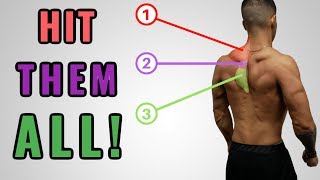
Of all the major muscle groups, the traps are one of the most important muscles for creating a powerful looking upper body and completing a well developed frame. For example, take a look at the following two pictures of me, the original on the left and the edited version on the right. With a considerable downsizing of my traps, you can see the extent to which the well developed traps on the left contribute to the overall aesthetic of my upper body by connecting the neck to the shoulders, whereas on the right this component is absent and takes away from the muscularity of my physique. And not only that, but adequate development of all three portions of the trap muscle adds considerable size and definition to the back musculature between the lats while also playing an important role in injury prevention and improving posture. And despite the fact that several common pulling exercises will involve the traps, they can be further emphasized through direct trap training. But in order to learn how to best work out the traps, we need to first understand their anatomy. Anatomically, the trapezius muscle is divided into three main regions, commonly referred to as the upper, middle and lower traps. The upper traps are the region most people focus on, likely because they are clearly visible from the front view. The middle and lower traps, on the other hand, are often underdeveloped in most people, partly since they're not visible in the mirror, but also because other more powerful muscle groups like the upper traps and the lats tend to overpower them, which is detrimental since they not only help add extra definition to your back, but they play a very important role in scapular stability, which is especially useful for preventing shoulder impingement. Therefore, ensuring that you're actually emphasizing each portion of the traps based on their function and anatomy is vital. And in this video I'll show you an evidence based workout that does just that. When it comes to trap development, rack pulls above the knee have become increasingly popular as of late and for good reason. Although this exercise will target the majority of the back musculature, most of the emphasis is placed on the upper traps. And the reason they're so effective at building the upper traps can be explained through the findings of the following two EMG analysis studies. Both studies found that during the conventional deadlift, upper trap muscle activity is the lowest during lift off to mid lift when the bar is around knee height, whereas from past the knee to lock out, the involvement of the upper traps increases and reaches its maximum muscle activity. Therefore, by limiting the movement such that you're only performing the upper portion of a deadlift, you able to specifically emphasize and overload the upper traps with heavy weight without taxing your lower body musculature, making above the knee rack pulls a very effective option for targeting the upper traps without impairing your recovery. It should also be noted that since, as shown in this 2011 study from the University of Kentucky, upper trap muscle activity during the deadlift increases with heavier loads. You should therefore strive to use heavy weight when performing this movement in order to maximize upper trap involvement. But as always to avoid injury, do so within your relative capabilities. The barbell shrug is another excellent exercise to include in your arsenal for trap development. They will again mainly emphasize the upper traps and seem to be one of the best options when it comes to activating and developing this region. One 2008 paper from Anderson and colleagues found that the shrug elicited the highest upper trap activity when compared to four other common upper trap exercises. In agreement with this, an ext extensive 2010 EMG analysis by researcher Brett Contreras analyzed upper trap activity with 25 different shoulder and trap exercises and the barbell shrug was once again found to elicit the highest upper trap activity. However, despite already eliciting high upper trap activity, it's vital that you perform the barbell shrug optimally in order to maximize its effectiveness. And as shown in this paper from the Journal of Clinical Biomechanics that analyzes shrug, there's two things you can do. The first thing you can do is widen your grip width. This is because performing the shrug with your hands shoulder width apart increases the involvement of the levator scapulae muscle in your neck and lessens that of the upper traps due to their respective muscle fiber orientation. So instead, by widening your grip when you perform the shrug, you can see how the line of pull is now more in line with the way the upper trap fibers run, which helps increase their involvement while lessening that of the levator scapulae muscle. The second thing you can do is rather than simply shrugging the weight completely straight up and down, you want to instead think about squeezing your shoulder blades together as you shrug up. Since the upper traps not only function to just elevate the scapula but also assist in retracting it, it means that this small tweak will lead to a better contraction. This next exercise is something I'd highly suggest you add into your trap training arsenal. They're called prone reverse flies and mainly emphasize the mid traps, which will not only help with the overall aesthetic of your back, but also helps tremendously in terms of injury prevention and improving posture. Multiple studies have found that the prone reverse fly with external rotation such that the thumbs are pointing up elicits maximal activity of the mid traps, which is likely because of the way the mid trap fibers run, since, as you can see here, the line of pull of the arms is most in line with the mid trap fibers, which run pretty much horizontally. Now, as for how to perform them, simply lay on a flat or inclined bench or even on the floor and lift your arms straight out to your side with your thumbs pointing up. The goal is to feel a strong contraction in the middle of your back, so avoid shrugging your shoulders up as you perform them in order to minimize upper trap involvement. I'd highly suggest that you start out without any weight and then gradually add weight over time as needed. This exercise will mainly emphasize the lower traps, which, like the mid traps, not only contribute to aesthetics, but also play a vital role in strength and stability of the shoulder and improving posture and in support of this exercise. One 2003 EMG study by Ekstrom and colleagues found that prone Y's elicited the highest lower trap activation when compared to nine other common lower trap exercises, which again is likely because of the way the lower trap fibers run, since as you can see here, the line of pull of the arms is most in line with the lower trap fibers, which run downwards at a slight angle. And the way to perform this exercise is pretty much identical to the previous exercise, just with your arms positioned such that they make a Y shape. I'd suggest starting out with no weight initially, and then you can progress it by either adding weight over time or. Or by performing the same concept with the cable machine for the added resistance where you kneel down and grab the opposite cables with each hand and raise your arms overhead such that they make a Y shape.
So to wrap this all up, here is a sample worker you can do using the exercises previously discussed. Keep in mind that this is just a recommendation and the optimal number of sets and reps will vary individually, but. But I just wanted to give you guys some sense of direction to take. And as for how to best implement this, you have a few options. If your traps are really lagging and it fits well with your workout split, you can run this just as a workout on its own. Another option is to just add a few of these exercises when you train back or shoulders to help give your traps a little more emphasis. Or alternatively, you could run a specialization phase for a few months with these exercises to hit the traps with greater volume. Just keep in mind that many back exercises, especially the deadlift already target the traps, so just ensure you're not overdoing it. And guys, keep in mind that you don't just want well developed traps, you want the rest of your back and overall physique to be just as developed.
And if you're looking for a truly.
Evidence based program that shows you exactly how to do this and how to use science to help you reach your goals as efficiently as possible, then simply head on over to builtwithscience.com courses where you'll be able to choose a program that best suits you. Anyways, if you found this video useful then please don't forget to give it a like leave a comment and subscribe to my channel if you haven't already. And I'd also really appreciate it if you guys give me a follow on Instagram as well, where I'll be posting informative content on a more regular basis. Thank you everyone so much for all your support and I'll see you next time.
It.










