The Best Science-Based Upper Body Workout for Growth (Chest/Back/Arms/Shoulders)
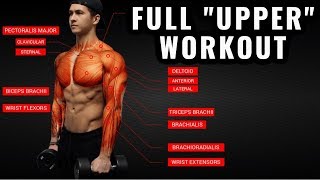
Jeremy Ethier breaks down an upper-body split with four compound moves in order: incline dumbbell press, chest-supported row, overhead press, and pull-ups, then adds isolation work for biceps and triceps. Set your bench to 30 degrees, do four compounds if you're starting out, and follow the free PDF for progression.
Foreign when it comes to choosing a workout split that optimizes muscle growth, there's a lot of factors that need to be considered. But due to the optimal training frequency and realistic time commitment of an upper lower split, it makes it a very effective choice for many lifters and can be easily adjusted based on your training experience. So in this video, I'll show you exactly how to organize and choose exercises for your upper body workouts based on current scientific literature and our anatomical understanding of the upper body muscles. But first off, for those who are unaware, an upper lower split simply involves splitting up your workouts into upper body days and lower body days, often two of each being performed every week. Ideally, you'd want to organize the split like so, and although the exact days for each workout isn't important, it's best to include a rest day after two consecutive days of training to allow sufficient recovery. Now, as for the best exercises to include in your upper body workouts, a good way to set it up is by sticking to the following guideline. Choosing your exercises in this fashion ensures that your upper body muscles are worked in a balanced manner, which helps prevent muscle imbalances from developing and helps target all of the upper body musculature. So, with that being said, let's take a look at what the optimal upper body workout might look like through the added shoulder flexion of this movement. Incline dumbbell presses will put more emphasis on the clavicular head of the pecs, also known as the upper chest, which is more often than not a weak point for most people, one EMG analysis by Brett Contreras found that out of 15 different chest exercises, incline dumbbell presses were found to be the most effective compound movement for upper chest activation. Therefore, by starting with this exercise, you're able to effectively prioritize the upper chest. And since utilizing dumbbells as opposed to a barbell more effectively prevents muscle imbalances from occurring and allows a greater range of motion, it makes incline dumbbell presses the ideal option for the horizontal push exercise of this workout. Now, as for the best incline setting, research tends to show that the optimal bench angle is somewhere between 30 to 56 degrees for most people. I've personally found the best activation with a 30 degree incline, but experiment with it and see what best activates your chest. Next, you want to move on to a horizontal rowing movement. My personal favorite is a chest supported row which will effectively target pretty much all of the upper back musculature. One study by Lehman and colleagues found that rowing movements provide similar levels of lat activation as LAT pulldowns, but more activation in other areas of the back like the traps and rhomboids. Therefore, it's essential to include at least one rowing exercise in your routine to help with both back width and thickness. But with that being said, I personally suggest using some form of a chest supported row in this workout because it helps minimize the involvement of the lower back, which as you'll see will be heavily involved in the next exercise. And as I'll make note of later on in this video, exercises like the barbell row do have their place for back development, but given that research shows that they elicit high lower back involvement relative to other back exercises, their inclusion in a workout needs to be carefully thought out. Next, you want to move on to a vertical pressing movement. The overhead press is an ideal choice due to the ability to easily overload it with weight and target several muscles at once. It mainly targets the anterior deltoid with some involvement of the lateral and posterior heads as well as heavily stresses the core, the triceps and the serratus anterior muscle to help push and stabilize the weight overhead. And as explained in my shoulder video, since this exercise has been shown in studies like this one by Baron and Buskies to be the best exercise for the anterior deltoid and was even shown to outperform dumbbell front raises by 41%, I'd argue it's the only exercise you need to include in your regimen that emphasizes the front delt. Finally, you want to move on to a vertical pulling movement. For those who are capable, I'd suggest adding in pull ups given that they pretty much work all of your back musculature and also heavily involve your shoulder and scapular stabilizers. One study by Ness and colleagues found that pull ups elicit similar LAT activation as LAT P but more biceps involvement. In addition, one study from the Journal of Strength and Conditioning Research showed that subjects were able to pull 25% greater total weight with pull ups as compared to LAT pulldowns. Therefore, one could make a case for the superiority of pull ups to lat pulldowns, but given that pull ups are generally a lot more fatiguing, lat pulldowns might be the better option here given that the previous exercises are quite energy demanding. So it's really up to you, which you prefer, but again, including both in your weekly routine is definitely the best option. Next you want to move on to some accessory movements. For the biceps, my go to choice would be the incline dumbbell curl since it preferentially emphasizes the long head of the biceps, which often doesn't get as much attention. And as shown in this study from the Journal of Sports Science and Medicine, it enables the biceps to be active throughout the whole range of motion rather than just the beginning or just the end, which is the case for many BICE exercises, making it, in my opinion, one of the best choices for biceps development, especially for the long head. And then on your other upper body day, you could simply choose a biceps exercise that emphasizes the short head of the biceps more for balance development of both heads over time. Similar to the biceps due to the flexed position of the shoulder, this exercise is going to emphasize the long head of the triceps, which which doesn't get much attention otherwise. Dumbbell extensions on an inclined bench is something that I recommend as it helps prevent muscle imbalances from occurring and minimizes the momentum used. And by using an incline bench, it helps put the shoulder into an even more flexed position to further target the long head. But just also be aware that any triceps exercise that puts your shoulder in an extended position will effectively target the long head. And there's many exercises that do this, so just play around with them and see which one you like best. So to sum the video up, if you're a more intermediate or advanced lifter, here's what your upper body Day one routine could look like. You could also add face pulls or chest flies as an additional exercise if you feel that your rear delts or chest needs more work. On the other hand, if you're a beginner and just starting out in the gym, then this routine will likely be excessive in volume for you. Research has shown that for beginners, isolation exercises don't provide more muscle growth when compound movements are already used. Therefore, rather than performing the two or three extra isolation movements, I'd simply stick to the four main compound exercises like so. And as for your second upper body workout during the week, you want to stick to the same general outline I showed earlier in this video, but switch up the exercises. For example. These exercises are a good option for your next upper body workout during the week as they complement the ones I mentioned in this video. And as I've done with some of my other videos, I've compiled all of this information into an easy to follow free PDF so that you guys can have it with you when you're at the gym. It shows you the full workout exercise tips with visuals and a progression scheme for each exercise to help ensure you're progressing over time. To get a copy of this sent to your email, just simply follow the link I've put in the description box down below and I've also pinned a comment down below that provides the link as well.
That's pretty much it for the video guys. Thank you so much for watching. Make sure to get your copy of the PDF routine that I mentioned by following this link. I think you guys will really find it useful. And let me know in the comments down below if you'd like me to do a video on the lower body days for this workout routine or just any other topics that you'd like to see in the future. And if you guys could do me a huge favor by giving me a follow on Instagram where I provide a lot more informative content on a regular basis, I would really appreciate it. And as always, if you enjoyed this video, please don't forget to give it a like. Leave a comment down below and also subscribe to my channel if you haven't already. I've got some really exciting videos coming up, so stay tuned. Anyways, that's it for today guys. I'll see you next time.
It.










