The Best Science-Based Workout Split To Maximize Growth (CHOOSE WISELY!)
Jeremy Ethier breaks down workout splits backed by research, explaining how training frequency affects muscle growth. He recommends different splits based on your experience level, from beginner routines to advanced programs designed to maximize gains.
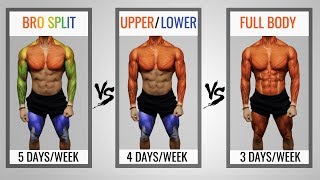
One of the biggest decisions you have to make when starting out in the gym is choosing what workout split you're going to use, or in other words, simply figuring out how you're going to group your exercises throughout the week. For example, when I first started going to the gym, I used what was popularized in fitness magazines and what everyone at the gym seemed to be doing, the Bro split, which simply involves training each muscle group once per week with high volume within each workout. And after a few years of this style of training, as you can see in this photo of me at I believe 18 or 19 years old, I definitely made good progress. But looking back with the knowledge I now have, it begs the question as to whether or not I would have progressed noticeably faster had I used a different or better workout routine than the BRO split. And honestly, I think there's a good chance I would have. And as for what I would have done instead, and recommend you do as well, let's first take a look at our options. One popular option is to train certain groups of muscles together during each workout. The upper lower split is a good example of this and involves training your upper body together and your lower body together. Another similar concept is a push pull leg split where again, multiple muscles are trained together each workout. Another popular option, which is basically the opposite of the Bro split, is a full body routine in which you train all of your muscles during your workouts, mainly through the use of compound exercises. And these other workout splits are likely superior to the Bro Split for a variety of reasons. The main reason though, as explained in my training frequency video and is outlined in this 2016 meta analysis by Schoenfeld and colleagues, is that when volume is matched, training each muscle at least two times per week results in significantly greater muscle growth than training each muscle just once per week as you do in a Bro split. In fact, as stated in a further meta analysis by Greg Nuckols, subjects training at a higher frequency grew 38% faster than those training at a lower frequency and a similar result was found for upper body strength gains as well as which is likely due to higher training frequencies not only being able to better optimize the protein synthesis response throughout the week, but also enabling you to perform higher quality sets. For example, if you do 16 sets of chest per week with four exercises using a Bro split, you would start to fatigue after your first exercise and your performance would decrease from then on. Whereas if you were to split that into two workouts per week, for example as part of your push days, then you'd be able to perform those exercises with better quality since you're not doing as much volume all at once. Thus, you can see how the bro split may not be the best option. For these reasons, and opting for a split that instead trains each muscle at least twice per week is likely optimal. But now moving forward, as for which of these splits is best for you, it depends on a variety of factors, but mainly on your training experience. For example, if you're a beginner and just getting started in the gym, then I'd recommend the full body workout split two to three times per week where within each workout you use mainly compound exercises to hit every muscle. And the reason being is because as a beginner your primary goal should be to master the main movements in the gym by improving your motor learning, coordination and building up a base level of strength and endurance without causing excessive muscle damage. And since a full body training split enables you to perform these movements more frequently when compared to other splits, you're able to master them more effectively and build a solid base of strength faster than you would otherwise. In fact, this 2018 paper by Ochi and colleagues found that training each muscle muscle three times per week as you do in a full body split was not only more effective at improving strength in untrained individuals when compared to lower training frequencies, but it also reduced their rate of perceived exertion, meaning that they felt their workouts were easier and they were able to recover faster despite actually performing the same amount of volume as the lower frequency group, which is a major bonus as a beginner since you're more prone to muscle damage, fatigue and soreness from your workouts. However, despite the various benefits of full body workout workouts, given the positive relationship between volume and muscle growth, as you gain more experience, you're inevitably going to have to increase volume in order to further progress at the optimal rate. And although you could simply continue increasing the volume of your full body workouts, there will come a point where your workouts just become too long and fatiguing to complete. And in fact, based on research in rats at least, there may be an upper limit to the number of sets you can do per muscle in a single workout before its benefit on muscle protein synthesis plateaus. Although the exact number is not clear, it does imply that once we go above a certain threshold of workout volume, splitting it into separate workouts throughout the week should produce greater muscle growth than performing it all in a single workout. Hence why I'd recommend that once your progress stalls with the full body split, switch to a four day upper lower split or something similar such that you have more training days to fit in extra volume. And then as you gain even more experience, it can be wise and possibly more enjoyable for you to switch to a five day routine or a six day push pull leg split or something similar to once again fit in extra volume as needed to continue progressing without causing your workouts to be excessively long. But as you can see, although some routines have various advantages over others, there really isn't a best workout split. Your training routine should be simply viewed as a tool to organize your workout volume in a way that is most enjoyable and most practical for you. Whether it's with a bro split like I started out with one of the alternatives I mentioned, or something completely different. Just know that workout volume and consistency are the more important factors, so focus mainly on those two variables and you will see positive results regardless of the workout split you use.
That's pretty much it for the video. Thank you so much for watching. And to sum everything up for you, here are the main points that you'll want to keep in mind. I hope that this video was able to clear up any confusion you might have had regarding choosing the right workout sponsors split. And if you're looking for an all in one evidence based program that combines all of this research for you in order to transform your body as efficiently as possible from your starting point, then what you can do is simply head over to builtwithscience.com and take my starting point identification quiz which will determine which program and which approach is best for you. Anyways, if you haven't already, I'd also really appreciate a follow on Instagram and I post a lot of informative content and videos on there as well. So give me a follow there so you can stay updated with everything I'm doing. And as always, if you enjoyed this video then please don't forget to give it a like. Leave a comment down below and subscribe to my channel if you haven't already. Thank you so much for all the support everyone. I hope you're all doing well and I'll see you next time.










