The Easiest Way To Fix Your Posture At Home (Just 3 Exercises!)
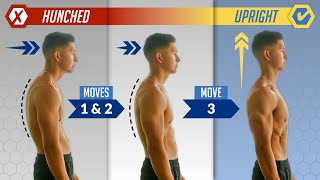
Three exercises fix the hunched posture that comes from staring at screens. A foam roller mobilizes your thoracic spine, Cat-Cow retrains extension, and lower-trap progressions from prone cobra to W and Y shapes rebuild the muscles that hold you upright.
If you're watching this video on your phone or laptop right now, then I'd be willing to bet that you're probably in the following posture with your back rounded forward and your head protruding outwards. I'd also be willing to bet that you just realized that you were in that posture and immediately attempted to correct yourself. Which brings us to the major problem. Nowadays with our excessive phone and computer use, we get stuck into this posture for hours on end without even knowing it, which over time causes our joints and soft tissue to adapt to this posture. And as a result, it causes this kyphotic posture to become the norm for us. More specifically though, what this does is it creates a lack of something called thoracic extension in our spine, which is simply our ability to extend our mid back upright out of this rounded posture. And what often comes hand in hand with this lack of thoracic extension is a forward head posture as well as since if the back is rounded and the eyes gaze straight ahead, then the head is forced to stick out forwards. A simple way to tell if you have these postural adaptations is to simply relax your body into your natural comfortable posture and in the mirror, take a picture from the side like so if you look something like this, then you've clicked on the right video. Now, although I have made several past posture videos that do work on this issue, I understand that many of you out there just won't be consistent when presented with a ton of different exercises. I get it. They're boring and corrective exercises are not fun for most people. So in this video, I thought I'd create a simple routine that shows you how to potentially get the most improvements in your posture with the least amount of effort by focusing specifically on the most common issues that I mentioned earlier. Since fixing those issues alone can often fix the various aches and compensations that we see upstream in the head, the shoulders and the neck, but also downstream in the lower back and pelvis as well. And to do so, there's just three moves that when executed properly and consistently in the right order, can help do just that. Now, before we dive into the actual exercises, it's important that we first understand the reasoning behind them. So let's take a look at the posture we talked about earlier. The main problem here is that as a result of sitting hunched over, your mid back has lost some of its ability to extend upright. And and as a result of this lack of thoracic mobility, research suggests that certain mid back muscles, most notably the lower traps, get weakened and their activation can actually become inhibited since the back is now in a position where the lower traps are placed at a disadvantage and becomes more difficult for you to activate as a result, which worsens the whole postural problem, since these muscles function to pull the shoulder blade back and down and assist in keeping your posture upright. And unfortunately, given this association between poor thoracic mobility and weak lower traps, this is what makes the lower traps one of the most difficult muscles to learn how to get firing and activating again. I mean, most of you watching this are probably thinking to yourself, how the f do I activate that? So what's the solution? Well, first we're going to work on mobilizing our mid back, which will help us temporarily get our body alignment in a position that will better enable us to actually activate the lower traps in the first place. In fact, research has consistently shown that by addressing and mobilizing the thoracic spine first, lower traps activation significantly improves when tested afterwards. Then, after we mobilize the thoracic spine, we'll work on a lower traps exercise to work on activating and strengthening them, which is going to be the key to fixing your posture long term, rather than just temporarily by doing a bit of stretching. And when used all together, this simple, systematic approach has been shown to significantly improve the postural imbalances that we tend to see when sitting. So now that you're more familiar with the reasoning behind this approach, let's take a look at what exercises would be best. First, we're going to work on some thoracic mobilization. To do so, I'm going to present a few options, depending on what you may or may not have at home. The first option is going to involve a foam roller. To set up, lay on your back with your knees bent and place the foam roller around the level of your shoulder blades. Then place your hands behind your head to support your neck. From here, contract your abs and then lead in with your head. Slowly arch your upper back over the foam roller, return back to the starting position and then repeat that for a few more reps. Make sure that as you do so, you aren't letting your ribs flare up in your lower back arch. Instead, we want the motion to come from the mid and upper back while the lower back remains neutral. After you do a few more reps in that position, continue moving the foam roller further down each segment of your back and you want to repeat this until you reach the end of your mid back region. Ideally, you do want a foam roller for this and I'll leave a link in the description Box down below to some I'd recommend. Another option though is to place two tennis or lacrosse balls into a sock like so, and then use that as a replacement. Now, if you don't have a foam roller tennis balls handy, an alternative is to place your elbows on top of a bench or couch. With your hands together, sit your hips back into your heels and simultaneously drop your chest towards the ground. Hold that bottom position for a few deep breaths before returning up and then repeat for more reps. Again, you should feel this in your mid back, so avoid compensating and arching that lower back instead. Next, we want to use an exercise that'll help our body ingrain that mindful awareness of how to actually extend at the mid back. To do so, we're going to use something called Thoracic Cat Cows. For these, get on all fours, sit your hips back into your heels to round out your lower back and then from that position, just slowly transition between arching your mid back as you take a deep breath in and then exhaling as you now tuck your tailbone and round at that mid back region while keeping your chin tucked. For these, just like in the first exercise, we want to emphasize the movement to come from the mid and upper back region as opposed to opposed to just the shoulder blades or the lower back. Next, once we've successfully mobilized our mid back with the previous two exercises, we're now going to temporarily be in a much better position to be able to activate and strengthen our lower traps for long term results. However, to do so, it's important that we choose our lower traps exercises carefully. This is because what comes as a result of this hunched over posture are tight upper traps. And the problem with tight upper traps is that research has shown that they can further weaken the lower traps by essentially taking over whenever we try to train them. Therefore, to maximize your success when it comes to lower traps training, we need to specifically choose exercises that have been shown to not only maximize lower traps activation, but also at the same time minimizes the involvement of the upper traps as this is going to help ensure that they don't take over during the movement. And luckily, there's been plenty of research on this exact topic and is what we're going to rely on to guide our exercise selection. So to start, we're going to use something called the modified Prone cobra, which has been shown to activate the lower traps very well with the least activation of the upper traps when compared to several other lower trap movements. To perform it, lay on your stomach with your arms down by your sides. Next Using your mid and upper back muscles, raise your chest slightly off the ground while keeping your chin tucked. From here, lift your arms up while turning your palms out so that your thumbs point towards the ceiling. Hold this position and think about pulling your shoulder blades back and down as if you were reaching your fingers down towards your feet, as these are two of the main functions of the lower traps and key to activating them. Hold this top position for about 10 seconds before coming down and then repeat for more reps. You should feel your lower traps as shown here, working as you hold each rep almost like a pinching feeling in your mid back. Practice this daily and then once you're able to activate your lower traps quite well here without compensating with your upper traps, we want to then swap your lower traps exercise for more difficult progressions that can continue challenging and strengthening those lower traps to a greater degree. The first progression will be a similar movement but with your hands placed behind your head. Lift your chest up, keep your chin tucked and then reach the arms up towards the ceiling while again focusing on actively keeping the shoulder blades back and down. Next, we're going to change the arm position into a W shape, like so. Keep your thumbs facing the ceiling and pull your shoulder blades back and down as if you were pulling your elbows down towards your back pockets. Last is our most difficult progression. For these, you'll want to reach out diagonally with your arms such that they make a Y shape with the elbow slightly bent overhead. This will put your arms directly in line with the lower trap fibers. Then raise your chest up, keep that chin tucked and raise your arms up with your thumbs facing the ceiling. And just like the other exercises, hold the top position for 10 seconds while thinking about bringing those shoulder blades back and down to get the lower traps firing. And you can also increase the resistance of any of these progressions by simply holding onto light weights into each hand. The main goal of this is to gradually move through each of these exercises over time as you master each progression, which can simply be defined as your ability to execute the progression with a high activation of the lower traps, yet minimal involvement of the upper traps. So take your time and don't rush through these. Now, after you do your lower traps exercise, I just want you to stand up and try to put this into practice. So while standing, pull your shoulder blades back and down as if you were reaching your hands down towards your feet. And while squeezing your shoulder blades together, you should feel your lower chest working from this alone. Be mindful of this and even do this simple exercise as you stand or sit throughout the day just to get your brain in the habit of actually using your lower traps to keep you upright rather than slouched over. So to summarize the daily routine, here is the action plan over time, by consistently devoting at least just five to ten minutes a day to work through this, you you should notice a significant improvement in your ability to activate your lower traps and other important mid back muscles that have been weakened over time. This will then enable you to actually use these muscles more not only when you stand and sit throughout the day, but also in the gym with movements like the pull up, face pulls and rows that normally should be strengthening these mid back muscles and movements that you should definitely be doing more of to counteract all the pressing that we do. As a result of this, you'll be able to see long lasting visual improvements in your hunched over posture. Posture which can in turn create a lot more relief upstream in your upper traps, your neck and your shoulders, and even potentially downstream in your lower back and other areas. And for a step by step program that shows you exactly how to properly train these often overlooked muscles and combines it with a weekly weights routine so that you can build lean muscle while improving your posture and various imbalances in the process. Then simply head on over to builtwithscience.com and take the analysis quiz to discover which of our steps science based programs will be best for you and where your specific body is currently at. Anyways, thank you so much for watching guys. I hope you enjoyed this one. Please do me a favor by giving the video a like leaving a comment down below as to what you'd like to see me cover next, subscribing to the channel and turning on notifications for the channel as well as this all really does help me out and I'd really appreciate it. Thank you so much everyone and I'll see you next time.










