The Fastest Way to 12% Body Fat (From Any Start Point)
YouTube explainer (Jeremy Ethier, June 2025) showing how to reach and maintain ~12% body fat with a science-backed, multi-expert system. Key pillars: preserve muscle via resistance training (hit muscles 2–3×/week; ~6 hard sets/muscle/week often sufficient), set protein at ~1.8–2.8 g/kg, estimate calories as bodyweight (lbs)×10–13 then validate by tracking weight (aim 1–2 lb/wk loss), and manage metabolic adaptation by monitoring weight and reducing calories ~100 kcal when stalled. Cardio and NEAT matter but follow a constrained energy model—prioritize 7–9k steps/day, add steps or 2–3 weekly short cardio sessions only when needed, and favor dietary adjustments for 80% of deficit changes. Psychological strategies (planned treat meals, accept hunger, sustainable targets of ~5–7% bodyweight loss over 12–16 weeks, maintain 2–3 weeks or lean bulk) are emphasized to avoid rebound. Multiple studies and expert consensus are cited to support thresholds and tactics.
Questions this video answers
Less than 1% (from a DEXA analysis of over 9,000 American men).
1.8 to 2.8 grams per kilogram of bodyweight per day.
Multiply bodyweight in pounds by 10–13 (lower end if sedentary or very heavy, higher end if active or lighter).
About 1–2 pounds (0.45–0.9 kg) per week.
Approximately 100–200 calories per day per 5% bodyweight lost.
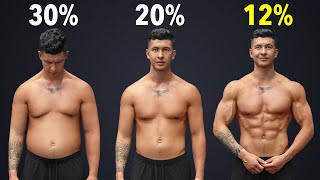
This is what 30% body fat looks like. Drop down to 20% and in the right lighting, you might see some ab definition. At 15%, your upper abs start showing. But to really strip off the fat around your belly, you usually need to go even lower. At 12%, your six pack finally pops. Veins show in your arms and the best part? It's still maintainable and lets you enjoy life. For me to get there from 15% body fat, took me six weeks to find out how long it would take you find your current level of body fat from this long lineup, here's how much fat you have to lose. Go all in and here's how many weeks it'll take. And for women, here's the equivalent. But here's the problem. Based on the DEXA scan analysis of over 9,000American men, less than 1% ever reach 12% or below. Your body is smart and without the right plan, you'll either get stuck early on or end up regaining even more fat than you lost. It's why I teamed up with five of the world's smallest, smartest scientists and elite coaches to create a step by step plan that will not only get you to 12% but easily maintain it afterwards. Let's start with training.
Most people want leaner, they don't just want smaller. Most people lose like a substantial amount of muscle while losing fat.
That's Dr. Mike Israel, a well known professor and bodybuilder with a PhD in sport physiology. He explained if you're losing weight without lifting weights or just not lifting properly, then up to half of your weight loss can be muscle rather than fat. Now this doesn't just make you look skinny rather than lean, but it also causes your body to start fighting against you.
When you lose muscle, your body seems to have a special extra sensing ability to kick your hunger and cravings into higher gear than when you don't.
Now the other parts of this plan will help bring your muscle loss down to zero. But your lifting routine is your biggest line of defense. And while that the way you train shouldn't change much from your muscle building phases, Dr. Mike does suggest one important tweak. Consider lighter weights for higher reps.
So putting a little bit more weight on the bar each time becomes less realistic in a fat loss phase, especially as you get deep into it. However, endurance relative to your body mass typically goes up. And so it turns out that you are not only better at higher uplifting, but you can actually make some gains by adding repetition here or there. And that psychological ability to add repetitions isn't a big deal. You're conserving muscle just as well as you would with heavier weights. But you get some progress. Progress.
When would they kind of make these switches?
Some people all the way from 30 to 12% would just train ultra well with whatever normal rep ranges they do and it would never bite them in the ass. Some people, anything below 25% and their diet fatigue is already so high just from genetics or whatever that like, oh shit, I really do need the higher reps to come rescue me. I'd say the easiest recommendation I have is continue training normally until you feel really fatigued and your strength is really starting to be like.
But Dr. Mike's take got me thinking. Is there an optimal workout split for fat loss that most people are missing?
If you're in a fat loss phase, you, as soon as you're not growing muscle, then you start losing it and then you come back and hit it again. You grow a little bit, but then you lose it again and you could just continue to lose muscle that way over time. So like a 20 set chest workout one day a week on a mass gaining phase, you got your shake with you, you got your carbs and you're good to go. Like those kinds of workouts just might be really, really tough. And at the end of, you know, sets 15 through 20 on a fat loss phase, oh, you're doing sets all right. Quote unquote. But not a whole lot is happening. So slightly more frequent workouts that make sure to hit the muscle, every muscle that you want to preserve maximally, two to three times a week on a fat loss phase and gets really good.
Although there's yet to be direct research supporting Dr. Mike's theory here, it does make sense. And the diets I've been able to preserve the most muscle with have always been when I'm training each muscle multiple times a week. Now I'll put my favorite workout spl options up on screen and I'll leave links to each of them in the description box down below. But even with the right workout split, how many sets do you really need to maintain your muscle? A brand new study tried to find the answer and even I was shocked by what they found. So imagine three groups. Group one only diets. Group two does the same diet, but adds two and a half hours of cardio per week plus a quick 30 minute full body workout. Group three doubles the workload, five hours of cardio and two 30 minute full body workouts every week after 16 weeks. Can you guess what happened? Well, the diet only group dropped 15 pounds. Nice on paper until you realize 40% of that weight came from muscle. The second group lost 22 pounds, but 20% of it was still muscle. The third group, same weight loss as group two, but 100% of it was fat. No muscle loss. They even lost 50% more visceral belly fat. Now, there's two really interesting findings here. First off, two short full body workouts per week, just six hard sets per muscle was enough to prevent muscle loss. For chest, that's just three sets of bench and three sets of flies per week. Now, I'd argue that advanced lifters might want to aim for six to 10 weekly sets to be safe. But still, if you're training hard, you need far less than you think to maintain your muscles. But here's where it gets really interesting. So even though group three did double the cardio as group two, they didn't lose any more weight. The researchers think that the only reason they lost more fat was because the extra lifting day signaled their bodies to burn more fat rather than muscle. Which might get you wondering. Is cardio useless for fat loss? It's an important question. But before we dive into that, let's get to the most crucial part of your plan your diet to 12% body fat.
You can eat junk food and still lose weight, still lose body fat, maintain lean mass.
That's nutrition expert Lane Norton, a competitive bodybuilder and powerlifter with a PhD in nutritional sciences. He explained how step one of setting up your diet is figuring out how much protein you should eat.
I have a range I like to use. I tell people, you know, 1.8 to 2.8 grams per kilogram. If you're at the bottom end of that range, you're still getting enough protein that you're probably optimizing lean mass. So once protein is set, you have to kind of, you know, take those calories away, right? Because they're allotted the protein. And now you're left with carbohydrates and fats. And you can kind of look at carbohydrates and fats as both are just sources of fuel, right? And so what I tell people is picking a carbohydrate or fat breakdown that is easiest for you to adhere to, right? Like, if you're somebody who likes more savory things, a little bit lower carb. If you're somebody who likes a little more starches and sweet things, maybe a little higher carb, lower fat.
Personally, I like a balanced approach. I mostly get my fats from eggs, peanut butter, and avocado carbs are timed mostly around my workouts. Oats a few hours before and potatoes after, plus fruits and veggies throughout the day. Protein is in every meal, and because life without dessert just isn't the life I want, I finish the day with a sugar free Ninja Creamy made with my Built with Science protein. But if a donut jumps into my cart every now and then, I'm not complaining.
There was one study looking at over 100 grams per day of sugar intake, like sucrose versus about 10 grams per day. The macros and calories were all exactly the same and they were eating the calorie deficit and both groups lost the exact same amount of weight, exact same amount of body fat, and all their blood markers improved in both groups. If you're eating the appropriate amount of macros and calories, it doesn't really matter that much. I love ice cream. You know, I have usually like, you know, a small serving of ice cream almost every day. So if you want to fit in some treats, it's okay. But if you want to be satiated, probably best to get the majority of it from minimally processed foods.
But with that in mind, let's talk calories. Because you're not going to lose any fat if you're eating more calories than your body needs. But on the other hand, if you eat too little calories, your body will be forced to start burning through muscle instead. Now, to roughly estimate how many calories your body needs, you want to take your body weight in pounds and multiply it by anywhere between 10 and 13. You can use the lower end if you sit most of the day or you're over £200, and then the higher end if you're active or just lighter. I'll also link a more advanced calculator in the description box down below. But remember, all calorie calculators, they're just a rough estimate. It's not uncommon for them to be off by 500 calories or more, which is the difference between you losing fat or gaining it. A far more accurate way to truly know how many calories your body needs is to stick to a calorie target, track your weight daily, and aim to lose about one to two pounds per week if your weight's dropping too slow or too fast and you know when needs adjusting. Now, my fitness app, which I'll cover later on, it handles all this for you automatically and it can lock in your true calorie needs within just a couple weeks, just like a coach would do. But here's what most people don't know. After about four weeks of dieting, maybe six if you're lucky, something strange starts to happen to the body, which leaves people stuck right around 20% body fat. It's not a motivation issue. It's your metabolism fighting back. In the next part of the plan, I'll show you exactly how to beat it. It's basically making all these subtle changes to reduce your energy expenditure and at the same time, really jacking up hormones that are associated with hunger. And so basically, the body is doing everything that it can to get you to eat more food and burn fewer calories. That's Dr. Eric Trexler, a Duke scientist and the chief science officer behind a fitness app. He explained how almost immediately after you start dieting, your body fights back. It's downregulating your resting energy expenditure and even your physical activity habits that you're not even thinking about. So changes in your postural control, changes in the amount you fidget. And to make things worse, as you get lighter, you'll naturally burn fewer calories just by existing. As a result of all these side effects, Dr. Trexler has found that for every 5% drop in body weight, your metabolism could slow by 100 to 200 calories per day. So let's say you start at 180 pounds and you lose 10 pounds. That means you might now be losing fat at half the rate you were at the beginning. And if you push in another 10 pounds, fat loss might just stall completely. Now, the fix here, it's not complicated. Weigh yourself daily. Track the weekly average, and if your weight stalls for at least two weeks, lower your calories by around 100 calories per day. That is exactly what I did when I cut from 15% to 12%. I started at 2300 calories, but after four weeks, my app sensed that my metabolism had adapted. So it lowered my target and kept me progressing. But here's the thing that most people don't realize. Eventually, your body hits a wall. So I learned this one the hard way. One of my earliest diets, I went straight from 25% to 12% body fat. And it worked. I lost 25 pounds in just 16 weeks. But afterwards, I had crazy cravings, and I was just starving. I remember I'd lie in bed at midnight, just constantly thinking about donuts. And more nights than I want to admit. I would get up, I would drive to the store, and I would inhale six donuts in one sitting. As you can imagine, within just a few weeks, I gained all the weight that I lost right back. And honestly, I felt horrible, felt like a failure. And it turns out I made a crucial mistake.
And we noticed that almost everyone who wanted to lose 10 plus percent of their body weight over the course of several months failed. And the vast majority of successful people aimed for roughly 5, sometimes 6, sometimes 7% loss over the course of 12 to 16 weeks.
So for somebody who weighs 180 pounds, losing 10% of their body weight, that equates to roughly 20 pounds. And usually that would take about 12 to 16 weeks of straight dieting. After that dieting phase, you have two options. Number one is you can maintain your weight for at least two to three weeks, ideally longer. Or if you want to stay productive, then you can transition into a lean bulk phase and focus on building muscle for at least a few months. But you don't want to dive back into another dieting phase until you're actually ready. If you're still fantasizing about Twinkies, burritos and donuts, you're just not there yet. Now, this might even double your timeline based on what I showed you earlier. And believe me, if I hadn't learned it the hard way, I would have completely ignored this advice. But I would much, much rather see you take twice as long and keep the fat off for good than just end up right back where you started like I did. Now, everything I've shown you so far can already help you get to about 15% body fat. But to make it all the way to 12% and actually maintain it afterwards, you're going to need some form of cardio, but not the way most people do it.
So if you're thinking, oh, I'm going to use my wearable device, or I'm going to look at what's burned on the cardio machine, or I'll use some estimation, oh, I burned 300 calories. Awesome. That's going to add 300 to my daily deficit.
That's not the case. That's Dr. Eric Helms, pro bodybuilder and publisher of over 160 research studies. Eric explained that your total daily calorie burn, it doesn't directly increase with more exercise, as you might expect. This is known as a constrained energy model. When you add more cardio, especially when dieting, your body finds sneaky ways to offset it. You fidget less, you might move less, and sometimes you get hungrier and end up eating more. So even though technically your cardio session may have burned an extra 300 calories, but at the end of the day, this might only amount to 150 or even less. And that's exactly what researchers found in the study we mentioned earlier, where participants doubled their cardio, yet didn't lose any extra weight. But this doesn't mean cardio is useless. It's still a key tool to getting you to the 12% body fat. You just have to use it properly.
We see a pretty strong relationship that if you are at what we would describe as sedentary levels of activity, which is generally thought of as being, say, below 5,000 steps per day, you get a decoupling between energy intake and body weight, where you generally are not regulating your appetite signals as well. When you're not active. Humans are meant to be active. And right around the time point or the step count point, when you're getting into the 7 to 9,000 steps per day range, that is where we start to see a coupling with appetite regulation at the population level and body mass. But also if you do a whole lot, then it can go the other way. I see now it's driving hunger up.
So here's what to do. First, set your baseline. If you're taking fewer than seven to 9,000 steps per day, try to get within that range. Next, if you're already doing that, try adding three to 5,000 more steps per day up to a max of about 15,000 steps. Or if you can't commit to steps, try adding two to three short cardio sessions per week. But most importantly, stay consistent and only when fat loss stalls. Use what Eric calls the 80% rule.
Good rule of thumb is like 80% of your adjustments and work to try to increase your calorie deficit should probably come from nutrition and not from steps or added cardio.
Safe cardio increases only when dropping calories now becomes unsustainable. Now at this point you have to be really careful. You have the perfect plan on paper. But there's still one thing that can stop you from ever reaching 12% body fat. Your mind.
It's not always just about that meal. It's also about what are the other things around it that are affecting it.
That's Lauren Conlon, a researcher and coach who through years of experience found three mind traps that keeps people in the cycle of losing fat only to regain even more. The first has to do with treat meals.
If you're somewhere and somebody brought like store bought like treats, you know, is that really as exciting? Like probably not. If it's the holidays or you're at a party and someone main their like like M and M cookies that are like your favorite, like, yeah, I want you to have one or two of those. I don't want you to have the stale, like office cookies. And most people have generally something social that is like an enjoyable social thing that they can like look forward to maybe once a week. And there's probably a few other things like food wise during the week maybe they could probably say no to.
But let's say Saturday night, you know, it's a worth it dinner out for you. Lauren has found that there's a second big mistake people make beforehand that can sabotage weeks of progress.
They want to say, okay, I know it's going to be a lot of calories. Let me just like really, really restrict during the day. So you go to this dinner and then you're like, oh my gosh, well, I'm going to order this drink that I really wanted. Oh, we're going to have appetizers, like, yeah. And now things you're like, well, I haven't really eaten all day, so like, I can just have this now and then maybe go home, maybe overeat it, then maybe have a few too many drinks, don't really feel too great the next day, feel bad about what was consumed. So then what happens? Maybe don't train, maybe don't eat healthy that next day. Or people maybe get into this behavior mentally where they're like, I need to overcompensate now. Well, because I did this, now let me go walk a bunch and do extra cardio. It just creates this big cycle of like up and down, up and down. If you make a decision, go for it. I want you to own it. Even if it was, you know, quote unquote, not on the plan, but you made that decision in that moment that you wanted to do that. That's fine. I'd rather you own that because then you can say, you know what, I did enjoy that and that was worth it.
But perhaps the most powerful psychological fix her clients make has to do with hunger.
Okay, well, can I tweak this and can I hack that? It becomes this obsessive focus that like, honestly magnifies it. So outside of doing all the things that can help manage hunger, recognizing that it is probably going to be a part of your diet and just accepting that it's there is one of the best strategies.
But here's what most people don't realize. How your hunger changes can reveal what level of body fat is actually sustainable for you. Some people, like myself, have an easier time getting lean, while others are naturally better at gaining size. Very few are gifted at both. So if you already feel miserable well before 12%, realize that you can still look incredible at a higher body fat, especially if you've taken the time to build muscle and properly train your abs to make them pop more. And for the only two ab exercises you need to do just that, you can give this video a watch next. But if you want a full science backed system that puts together everything we talked about into one personalized plan, from workouts to nutrition to motivation, you can try two weeks free of my new app over@builtwithscience.com thank you so much for watching. I'll see you next time.










