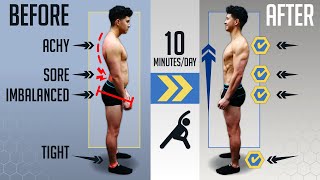
A practical YouTube mobility routine that identifies deficits using four quick tests (shoulders: Apley scratch; thoracic spine: posture photo; hips: bodyweight squat; ankles: squat with/without heel elevation) and prescribes focused drills: towel shoulder pulls, thoracic extensions and cat/cows, 90/90 hip transitions, ankle knee-over-toes presses, and a weighted goblet squat to integrate gains. The video emphasizes testing before training (to avoid unnecessary or harmful stretching), consistency (daily or multiple times/day), and using the routine as a warm-up while avoiding long static holds before workouts.
Questions this video answers
Shoulders; thoracic spine; hips; ankles.
Apley scratch test (goal: fingers touch; top hand reach top of shoulder blade; bottom hand reach bottom of shoulder blade).
Daily or two to three times per day, with about two sets per exercise.
If your body feels stiff and achy in certain areas, you're getting pains and knots here and there, or your posture has, over time evolved into something like the following, then chances are your body would benefit from having more mobility. In fact, most people are lacking sufficient mobility in key areas due to a lack of movement. Combined with the funky positions that we put our bodies in throughout the day. This can then affect not only our posture, but also our risk of injury or our ability to perform certain exercises and just our quality of life. This is why dedicating more time to improving your mobility can be so beneficial. And this doesn't require a lot of time at all if you focus only on the areas that actually need work, rather than wasting your time and effort on performing mobility exercises in areas where you actually don't need an increase in mobility. In fact, in some instances, this can even do more harm than good. Now, as for where these problem areas are, physical therapist Grey Cook and strength coach Mike Boyle shaped a concept that's called the joint by joint approach. Based on their years of experience and research, they found that typically there are four main areas where people tend to lack sufficient mobility the most. The shoulders, the thoracic spine, the hips, and the ankles. Therefore, what we're going to do in this video is we're going to focus our mobilizations on these specific areas. And within each specific area will also first determine if you truly could benefit from more mobility in that area or not. So that by the end of the video, you'll have a personalized mobility plan based on the areas where your body can use the most work. The first area we're going to cover is a shoulder joint. A lack of mobility here is nowadays quite common, especially in males. In fact, in the shoulder mobility test I'm about to show you, on average, almost all male subjects, including young subjects in their 20s, failed the test, with the failure rates just continuing to rise and worsen with age. This result was slightly better in females, but still had a similar trend as males. And this common mobility deficit becomes a problem because of the compensations we then make not only in the gym during our major lifts, but also in our daily life during any reaching or overhead tasks, for example, which can then lead to pain and discomfort down the road. So to test for this mobility deficit, we're going to use what's called the Apley scratch test. To perform it, simply reach one arm up and over your shoulder and your other arm up your back as far as possible to pass. Ideally, you'll want those fingers to touch, but Aim to at least get your top hand to reach the top of your shoulder blade and your bottom hand to at least touch the bottom of your shoulder blade. If your top arm fails, then it's likely missing adequate shoulder external rotation and abduction. If your bottom arm fails, then this indicates that it's likely missing the opposite adequate shoulder internal rotation and adduction. So do the test on both sides and see how you do and note down which arm has the worst mobility on each side. We'll want to then use these results to determine which specific shoulders and positions need the most. Work with our mobility drill in order to correct the imbalances and the mobility drill we're going to use is quite simple. Just grab a shirt or towel and hold it in each hand using the test position with both hands behind your back. Then to mobilize the top arm, perform reps of gently pulling down on the towel while actively reaching downward with your top arm. Whereas to mobilize the bottom arm, perform reps of pulling the towel up while actively reaching up with your bottom arm. Each rep, do so gently and avoid letting your shoulder round forward as you do so. You'll want to only do the respective arms that failed and spend more time on whichever needs more work. Next we'll move on to the mid and upper back or in other words the thoracic spine. This area often stiffens up due to excessive sitting and technology used throughout the day and we over time lose the ability to extend our back out of this hunch posture. To test if this is a problem area for you, it's pretty simple. Just take a picture sideways in the mirror with your body relaxed. As hard as this picture may be to look at, analyze it and if your mid to upper back seems to round then and that's a good sign that it could use some mobility work to do. So we're going to first mobilize the area with thoracic extensions. Here, just place your elbows on a bench or couch with your hands together. Sit your hips back into your heels as you drop your chest towards the floor. Hold this for a few seconds and then repeat this motion for more reps, trying to go deeper. Every rep you should feel this in the mid and upper back region. We'll then follow this up with cat cows that can either be done on the floor or conveniently done while seated, like so. Perform it slowly while focusing on rounding and extending mainly that mid upper back region. Next we'll move on to the hips that tend to get tight from sitting and driving and also tend to Develop various imbalances because of all the positions that we put them in throughout the day, and the test we're going to do here is pretty simple. Perform a bodyweight squat. If your feet turn out excessively on the way down, or your hips just seem to lock at a certain depth and you can't go below parallel, or your hips tend to shift to one side during your squat, then these are all potential signs that your hips could use some more mobility work. Another indicator is that your hips just feel stiff in general. So if this sounds like you, then you'll want to add what's called the 9090 drill to your mobility list, as it's a great exercise to mobilize pretty much all of the hip muscles at once. To perform it, bend both legs to 90 degrees, like so. Then, while keeping your torso stacked over your hips, simply transition from one side to another. By opening up your hips, you should feel the hip external rotators of the front leg being stretched and the hip internal rotators being stretched of the back leg. You can also lean forward to deepen the stretch of the front leg and can also come up to your knees at the end position to deepen the stretch of the hip flexors in the front of your hips. Play around with it and again, just spend more time on what feels the most restricted. At first, you may even need to support your body with your arms, but over time, just trust me, this will improve. Lastly, we need to look at the ankles, which is where, admittedly, most of the problems stem from. When our ankles lose their ability to move, it affects the rest of our body. To determine if they are problematic for you, we'll use a pretty simple test. Again, we're just going to perform a bodyweight squat and see how deep you can go without rising up off your heels or leaning forward excessively. Then we're going to repeat this, but this time we want to put weight plates or a book under each of our heels and then see if your squat improves in terms of depth and form. If it does, then you'd likely benefit from adding the next ankle mobility drill into your daily routine. Simply find an elevated platform like a bench, a couch, or even your stairs and place one foot on top of it. Then, using your arms under your bench or couch, pull yourself forward to drive your knee directly over your toe while keeping your heel planted. Hold the M position for a few seconds and then repeat for more reps before switching sides. Lastly, to tie everything together, we're going to add a weighted goblet squat to the end of our mobility routine. Here you'll want to hold any weighted object like a backpack stuffed with books or a weight plate out in front of you and then sit into a deep squat. Hold this position while keeping your chest up and rocking side to side to transfer the weight and stretch to one ankle at a time. This is a great way to further mobilize basically your entire body, but in a more functional position. So what you'll want to do is simply go through the test for each of the four joints and use that to determine what your daily mobility list will look like to then see the best results and to maintain your new fan mobility with this routine, you'll want to implement it daily or even two, three times a day with about two sets per exercise. This should be done at a time that you'll be most consistent with and can even be done as a warm up before your workout to help you improve improve your range of motion and performance in that workout. When using it as a warm up though, just avoid holding each stretch statically for prolonged periods as that can provide the opposite effect and actually hinder our performance. But guys, just also don't forget that you need to be mindful of the positions that your body is in for the rest of the day. Even the most mobile of individuals will get tight if they sit down in the same position all day, so make an effort to move more, whether it be with this mobility routine or or by simply getting up for a walk every now and then as that is very likely the root cause behind your aches and tightness. And for a step by step program that shows you exactly how to build muscle and lean down as efficiently as possible without neglecting important aspects of your training like mobility and prehab. Simply head on over to builtwithscience.com and take our analysis quiz to determine the best program for you and your specific body. Anyways guys, that is it for today. I hope you enjoyed this video. If like you, please don't forget to show your support by giving the video a like leaving a comment down below as to what you'd like to see me cover next subscribe to the channel and turning on notifications for the channel as well as this all really does help me out. Thank you so much. I'll see you next time.