The Perfect Push-Up To Build Muscle (AVOID THESE MISTAKES!)
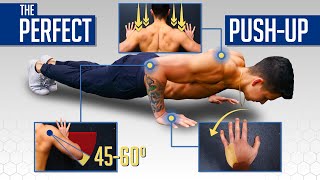
Most people flare their elbows too wide and move too fast. Keep your grip at or just outside shoulder width, tuck elbows to 45 degrees, and slow down to 2.5 seconds per rep to activate more muscle and protect your joints.
Questions this video answers
November 22, 2020
Keep elbows below 60°; ~45° preferred.
Use a grip roughly just outside shoulder width or narrower.
At least 2.5 seconds per push-up (can slow to 5–6 seconds for added difficulty).
Tempos compared were ~1.5 seconds, 2.0 seconds, and 2.5 seconds per push-up; 2.5 s provided the greatest activation.
The push up is one of the most primitive muscle building movements that we possess. Unlike some other bodyweight exercises such as dips or pull ups, you need absolutely nothing to perform this movement. It can be used for strength development, muscle growth or even as an effective warm up tool. In fact, at least for beginners, it's been shown in the literature to provide chest and triceps size and strength gains that are comparable to that of the bench press. However, just because it's a simple exercise doesn't necessarily mean that it's simply done due to the high amount of muscle mass and joints which are involved in this exercise. There is a lot that can go wrong which as you'll see is not only detrimental for growth but is also problematic from an injury and pain standpoint since we tend to do pushups with a lot of volume and the wear and tear from improper form can accumulate very quickly. So in this video ill share what the most common and problematic push up mistakes are and how to fix them right away so that you can start seeing faster growth while avoiding potential injury down the road. The most common mistake people make with their push ups is flaring their elbows out, commonly as a result of using a hand position that's too wide, thinking that this is going to better target and grow their chest. But instead it actually does the opposite while putting our shoulders at a greater risk for injury. Because whenever we do any pressing motion like a push up or we want our elbow angle to line up with our chest fibers in order to best activate them, but what happens when we use a wide grip is that not only is the range of motion shortened, but our body is also forced to flare the elbows out to the sides whenever we get to the bottom position. So now as you can see, the elbow angle and the tension is now best lined up with the front delts instead of the chest, which is what we want to avoid. In fact, multiple studies comparing a wider grip with the elbows flared out to a narrower grip with the elbows tucked in have indeed found not only significantly less chest activation with the wider grip, but also less activation of the triceps and less strength and power improvements likely due to the reduced range of motion. So instead use a grip that's roughly just outside shoulder width or narrower. And then when you execute your push ups, don't forget to tuck your elbows in towards your body rather than flaring them out. Now as for the optimal elbow angle, here's what research has to say. One study examining the effect of elbow placement during the pushup found that at degrees higher than 60 degrees out, the shoulder is placed in a compromised position that can lead to shoulder impingement. So keeping them tucked to below a 60 degree angle, preferably right around 45 degree, is recommended. What you'll find when you implement this to your push ups is that rather than moving vertically up and down, your body will now actually move forward and back slowly, similar to the correct bar path of your bench press, which is a good thing. So make this simple tweak in your elbow positioning as it will not only help place our elbows in the optimal position for chest activation, but will also be a much safer position for your shoulder to be in. Next, we want to be mindful of our hand orientation. The first problem that we see is when people have their hands turned in slightly. What this does is it not only encourages the flaring of the elbows, which as I previously mentioned is something that we want to avoid, but it also places our shoulders in an internally rotated position that puts us at a greater risk for shoulder impingement. Not to mention the added sheer stress on the elbows that research shows this hand placement causes as well. So instead, when you perform your push ups, keep your hands in a neutral position, so not pointed in but also not pointed out. Because similar to how you would set your feet when you squat, you should actively screw your hands into the ground like so to promote external rotation of your shoulders before your push up. So if your hands are already pointed out quite a bit, then this prevents us from being able to do this. Then after you set your hands, you want to promote this position as you go into your push up by thinking about distributing the weight in your hands more externally rather than internally by again thinking about screwing your hands outwards. Apply this tweak and you'll immediately notice a big difference in the stability and the comfort of your shoulders as you perform each replacement. Foreign Most people are unaware that by making very simple adjustments to your push up form, you can actually emphasize specific muscles more than others, which is beneficial when you want to specifically focus on working a certain muscle group, like during a chest focus workout or an arms focus workout for example. To do this, we mainly want to pay attention to what our elbows and shoulders are doing during the movement. For instance, if we wanted to make the pushup more chest focused, then we would want to limit the amount of flexion that our elbow experiences by moving our hands back a touch during the setup and then keeping our elbows stacked right on top of our wrist as we execute the pushup. What this will do is it will place more tension on the chest and less tension on the triceps, which is exactly what a 2005 paper found when comparing several different push up variations. On the other hand, if we wanted to make the pushup more triceps and arms focused, then we want to maximize the amount of flexion our elbow experiences instead. This can be done by tucking the elbows in and dropping them down and back as far away from your hands as you're capable of doing comfortably during the push up, as opposed to keeping them stacked over your wrist like in the chest. Focus variation. This subtle tweak will take the triceps through a greater range of motion and hence place more tension on them rather than on other muscles like the chest and shoulders. And lastly, if we wanted to emphasize the shoulders a little more, then we would want to elevate our feet up onto a high enough platform or perform a pike push up, similar to the effect of adjusting the incline of a bench further and further up as we press. The added shoulder flexion in these variations will shift more and more of the tension to the shoulders rather than the chest or the triceps. So play around with these variations and place them in your routines based on what muscle you want to emphasize the most. The next mistake is something I've talked about frequently for other exercises, but is just as commonly seen with push ups and it's shrugging the shoulders. Even if you have the proper hand placement, once you start fatiguing and grinding out reps, it's very easy to let the shoulders shrug up towards the ears. This not only shifts tension away from the chest and onto the traps, but it also causes you to lose a ton of stability and present strength. So instead, using your lats, actively pull your shoulders down and away from your ears and into a stable and locked position that you want to now maintain as you perform each rep. This simple change will add a ton of much needed stability to your push up, improve your push and strength, and ensure that most of the tension goes towards the target muscle rather than the traps. Lastly is speed. For most of you with a good amount of training experience, push ups become fairly easy when done only using your bodyweight and as a result, when you do perform them, you probably tend to knock out a bunch of pushups as fast as possible or just with a relatively fast tempo. Now, if you're doing this for a fitness test, then go for it. However, if you're regularly using push ups as part of your training program to build muscle, then you aren't going to benefit as much for a couple reasons illustrating these reasons is a study that examined different tempos during the push up. The researchers found greater chest activation and significantly greater triceps and rear delt activation as the speed of the pushup slowed down from 1.5 seconds per push up to 2 seconds per push up to 2.5 seconds per push up, which provided the greatest activation. What's even more of a concern though is that doing push ups with a fast tempo resulted in 135% greater sheer force and 163% greater torque elbow joints, which is a major concern if you're doing quite a lot of volume with your pushups since over time this can cause excessive stress and pain to the elbow joint. So if pushups have gone pretty easy for you, then instead of just trying to bang out more and more pushups with a relatively fast tempo, slow it down and take at least two and a half seconds to perform each pushup. You can even slow it down even further to five or six seconds per pushup if you need some added difficulty because doing so will enable you to stress and grow your target muscles to a greater degree as you get stronger over time while placing less unwanted stress in your joints. So hopefully you're able to see that there's a lot more that goes into even the simplest of exercises like the push up. Yet if you want to see the best results while minimizing your risk of injury, then you need to apply the same level of detail to each and every one of your exercises in your routine. And for a step by step program that does all of this for you by showing you not only the workouts to do every week, but then how to execute those workouts and exercises to maximize your results. Then simply head on over to builtwithscience.com and take our analysis quiz to determine which program is best for you and your body. It doesn't matter whether you have full access to a gym, just a set of dumbbells or just your body weight, we have science based programs that will work for you just like it has for thousands of our members. Anyways, that is it for today. I hope enjoyed this one. Please don't forget to show your support by giving the video a like leaving a comment down below. So what you'd like to see me cover next? Subscribe to the channel and turning on notifications for the channel as well as this all really does help me out. Thank you so much everyone. I'll see you next time.










