The Worst Bench Press Mistakes Everyone Makes (Avoid These)
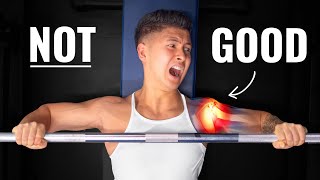
Five bench press mistakes: flaring elbows instead of tucking them, using the same grip width as everyone else, letting shoulders dominate the movement, skipping full-body bracing, and assuming barbells are the only option. Recent studies show machines and dumbbells build chest muscle just as well.
Questions this video answers
27 trained subjects.
2023.
Do you ever feel pinching or pain in your shoulder when you bench? Or maybe you notice your shoulders and arms are working more than your chest is? Or maybe every time you start going heavy, you end up hurting yourself. This isn't because the bench press is a bad exercise. It's just that most people do it wrong. There's five mistakes almost everyone makes. Fix these and I guarantee your shoulders will thank you and you'll start to actually feel your chest activating like never before. So the first mistake has to do with your elbow angle. Raise your elbows to shoulder height and then then try to bring them back as far as you can, as if you were benching. Do the same thing again, but this time with your elbows angled in into an arrow shape. Notice how much further back you can get. So when you're benching, if you use too wide of an elbow angle, you're going to have a very hard time bringing the bar all the way down to your chest. And doing so can create a lot of strain on the shoulders. A tucked elbow angle will not only help you get deeper, but should also help you better activate your chest. And since it usually aligns with the direction that most people's chest fibers run, whereas once you get too wide, the tension shifts from the chest towards other muscles in the shoulder. However, the perfect elbow angle will vary for everyone. Some of you might do better with around 60 degrees, whereas others will feel better a bit more flared out. But rather than whipping out your protractor the next time you bench, just focus on your bar path. If you use too wide of an elbow angle, the bar would travel pretty much straight up and down right over your upper chest. But with your elbows tucked, you're forced to move the bar slightly forwards on the way down and slightly backwards on the way up. So if you simply focus on touching your lower chest or your nipple area with the bar on the way down, then your elbows should naturally end up in the right place. However, what if you use a Smith machine? How does this apply there? Well, generally there's two types of Smith machines. The first are angled Smith machines. In this case, you want to face in the same direction that the Smith machine path is angled at, so that the bar moves down and slightly forward on the way down. Then simply position yourself on the bench such that at the bottom position, the bar touches the level of your lower chest right around your sternum. On the other hand, if you're using the Smith machine that goes straight up and down, you won't be able to get an angled bar path so in this case, I'd recommend positioning yourself such that the bar ends up a little bit higher, right around the level of your mid chest. Now, in order to properly apply the previous tip, you need to first fix your grip. Most people just use the same grip as their friend or they'll follow the markers on the bar. But the right grip depends on your body. For example, let's take a look at quite an interesting 2022 study. They had 27 trained subjects perform the bench press and analyzed the activation of their chest, shoulders and triceps. Now, even though all the subjects used the exact same grip width, some of them experienced the highest activation in their chest, some saw the highest activation in their shoulders and and others saw the highest activation in their triceps, suggesting that a grip that works well for somebody else may not work quite the same way for you. But finding the right grip for your body is actually quite simple. Next time you're on the bench, rest the bar on your lower chest, the target touch point we covered back in the previous step. If at this point your forearms are angled in, your grip is probably too narrow and will lead to more triceps involvement. Whereas if your forearms are angled out, it's probably a bit too wide. Although this grip is often used by powerlifters since it can help boost your strength, in my experience it often leads to less chest involvement, and some research shows it may lead to a higher risk of shoulder injury. Instead, to get more chest with less stress on your joints, at this bottom position, your wrist, forearms and elbows should ideally be straight up and down, stacked directly under the bar, however far away your hands need to be to accomplish that is your ideal grip width. Okay, so you're using the right grip and you're not flaring your elbows out too much on the way down. But there's a common mistake you want to avoid. On the way up. You see if your shoulders are relatively stronger compared to your chest, you'll tend to let your chest cave in and your shoulders roll forward and take over. This is usually why people feel their front delts get sore after benching instead of the chest. Now, although it is unclear as to how well muscle activation correlates to actual growth, I did want to see if my EMG machine would tell the same story. So on both on myself and my friend Max, I measured the activation of the chest and shoulders when using the improper form compared to using the correct form. I'm about to show you using the same relative load in both conditions. Now, on both of us, especially Max, the Correct form led to more chest activation and less front delta activation. Now, as for how to actually execute the correct form, Start by creating a pro proud chest by sticking your chest up towards the ceiling. Then, on the way down, use your back muscles to pull the bar down to your chest as if you were doing a row. Squeezing your shoulder blades together and keeping your chest up and proud, lightly touch the bar with your chest. And then on the way up, don't just think about pushing the weight up. The main function of the chest is horizontal adduction or bringing your arms together. So keep your chest up and think about squeezing your biceps into into the sides of your chest as if you're trying to touch your biceps together. It's less of a punching motion and more of a squeezing motion. Now, you may have to lighten the weights to do this properly, but it'll help ensure that your chest is doing the work rather than your shoulders. The next fix has to do with your setup. Most people look like this when they bench. Their feet are tapping all over the place and their body is very loose. But notice how powerlifters often take their time setting up before their big squat, deadlift or even bench. You may not be able to see it, but they're tensing their back, core and several other muscles to make their body as stable as possible when they lift. This not only gives them more strength and power, but it also reduces the risk of potential injury or compensations in their form. Think about how easy it is to smash an empty can compared to when it's unopened and full of pressure. That's the stability and rigidness you want to create every time you bench. And here's how to do it. Let's start with the lower body. Use a wide stance with your feet planted under your knees. Push your knees out and lightly drive your feet forwards to activate your quads and glutes. For the upper body, activate your lats by bringing your armpits down towards your hips. Then, after you unrack the bar, squeeze the bar hard and think about twisting your hands outwards as if you're trying to bend the bar into a U shape towards your feet. And lastly, take a deep breath into your stomach and brace your core as if you just coughed really hard. By creating this whole body tension before you press, you'll be able to then transfer energy just like a bow and arrow. So the last fix may not be what you're expecting. I want to Highlight A recent 2023 meta analysis, which is basically a massive study of studies. The researchers tried to see if doing free weights like the bench press led to more growth compared to using machines like the Smith machine. They found no significant differences. Another 2023 study found the exact same thing. So if you apply all the fixes I mentioned in this video, yet you're still having trouble with the bench press, then your body honestly just may not be well suited to bench press. But unless you're a competitive powerlifter, you shouldn't feel like you have to bench. You can still make just as good of gains with chess machines or even dumbbells where your joints can move a lot more freely. And you can also consider playing with the range of motion if you can draw a line between the two handles when using dumbbells, you'd be surprised with just how deep you actually have to go in order to mimic touching your chest during the bench press. So if going all the way down when benching is what aggravates your shoulder or you just don't yet have the mobility for that, stop an inch or two short. Just don't be stubborn. If your body is telling you it doesn't like the way that something feels, then you need to listen to it. However, that said, regardless of what exercise you choose to do or not, do you always need to make sure that you're using the proper form? Poor technique is the single biggest reason why many people end up hurting themselves in the gym or just don't see very good results from their workouts. And for a step by step program that not only builds your workout for you, but teaches you in depth how to perform each and every exercise in your program, just head on over to built with science.com and take our quiz to find the best plan for you and your body. It's worked for thousands of others and it will work for you. Highly recommend giving this video watch next to fix your deadlifts or or give this video a watch next to fix your squat. Thank you so much for watching. I'll see you next time.










