The WORST Stretches For Low Back Pain (And What To Do Instead) Ft. Dr. Stuart McGill
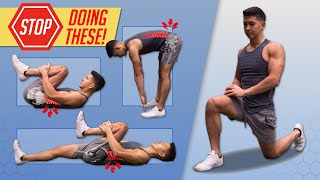
Dr. Stuart McGill explains why toe touches and knee-to-chest stretches feel good but can damage your discs. Instead, try cat-camel movements, psoas stretches, hip airplanes, and chest extensions to reduce spinal stress without the risk.
One of the first solutions people struggling with back pain seek are lower back stretches to relieve their pain. But the truth is, many of these stretches are just short term fixes that actually end up doing more harm than good and are the opposite of what people should be doing to adapt changes that permanently eliminate their back pain. For example, common stretches like toe touches, pulling your knees to your chest, and other similar stretches, they trigger what's called a stretch reflex, which is a neurological phenomenon that temporarily reduces pain sensitivity. Meaning that after you perform these stretches, you'll often experience about 15 to 20 minutes of pain relief, which many would obviously perceive as beneficial. But the problem is that in putting your spine in these flex positions, you end up re aggravating your discs. And after you've experienced temporary relief, the pain will return much, often worse than before. Which just creates a vicious cycle of thinking that these stretches are doing good and are the only solution for relief, yet in reality are just contributing to the pain. The key is to break this cycle. If those stretches cured you, then you wouldn't be watching this video. So instead of focusing your energy on stretches that bend the spine, focus your effort on movements and stretches for other parts of the body that can actually aid you on your road to being pain free rather than make the pain worse. And within this video, with the help of Dr. Stuart McGill, one of the most respected, experienced and knowledgeable experts in the world on treating back pain, will share four such moves that can help do just that. So to just start out our immobilizing routine, what would be the first move that you'd recommend?
Well, based on the findings of our research, where we assessed the stresses in the spinal discs, we found the cat and camel was the very best way to reduce the friction in the spine and prepare the person to move the position for beginning. The cat camel is on all fours, knees are under the hips, hands are over the shoulders. Most people need to spread their knees a little bit apart to free the hips, so the move is full spinal flexion, including the ball and socket joints of the hip and shoulders and full spinal extension.
Also, you want to avoid pushing the end of each range, as this is not a stretch and it's a simple movement of the spine that's most important. Now, Dr. Stuart McGill measured spine stress on patients perform this movement, and he found that only seven to eight cycles were all that was needed to help reduce spine friction and resistance. In fact, he found that further cycles could even undo the value of this exercise.
As we measured people performing the cat camel back and forth, we Measured the reduction in friction or the gooeyness of the joint, if you want to consider it, that. And with within each cycle, the person reduces that friction and they asymptote, meaning that they don't remove any more friction after seven or eight cycles. So that's all you need. More cycles is not better once you've done six or seven. So that's the warm up recommendation.
So stick with that recommendation and avoid overdoing it. After completing the Cat Camel and reducing a bit of friction in the spine, we're now ready to move on to some mobilization drills for other problematic areas within the body that may be contributing to your back pain. The first drill will target one of our major hip flexor muscles, the psoas. Although this muscle is already pretty tight in most individuals due to prolonged sitting, which puts this muscle in a shortened position, much of Dr. McGill's EMG research showed that back pain actually tends to tighten this muscle even further, which is problematic because, as you can see here, the psoas attaches to the lumbar spine. So when this muscle becomes tightened, it can actually pull your pelvis forward and down into an anteriorly tilted position, which can increase the compressive force on your lower back and just worsen the pain that you might be experiencing. Stretching this muscle and taking it out of the shortened position it's in all day can therefore help provide some relief to that lower back tension. However, Dr. Stuart McGill's research has shown that your standard hip flexor stretch will not access this muscle due to its unique anatomy. Instead, there's a unique move that we can do that helps to specifically stretch this muscle. So I also know that based on your research, you found that the traditional hip flexor stretch, it just doesn't really target the psoas very well. Instead, there's actually a special stretch that you recommend. Can you briefly just take us through how to perform it?
Well, Jeremy, as we've discussed in the past, the traditional lunge stretches the hip flexors, it's true, but it doesn't target the psoas. The psoas is a very special hip flexor in that anatomically it travels up the lateral spine to the level of the diaphragm. And if I adopt the lunge position, I feel general hip flexor stress, but it's not the psoas. But when I raise my hand up very strictly over my head and push and lean my shoulder into the forward leg and I drop the shoulder back, all of a sudden, I feel that psoas tendon become tight. And now, for the first time, I'm getting a true psoas stretch. And I'll hold that for two or three seconds and then I'll lunge, go to the other side. I can feel the softness in the tendon, push my arm up with effort, very strictly drop the shoulder back. And now I can really feel the psoas stretch for the first time. And I will go through six cycles per side and really enjoy the newfound mobility.
Next, we want to move on to a drill that will help us further mobilize and open up the hips while strengthening some of the important hip muscles that tend to be weak and inhibited in those experiencing back pain. This is important to do because Dr. McGill's research has shown that stiff and weak hips cause more motion to be transferred to the spine, which whenever we move or exercise, and can therefore worsen the back pain that you're experiencing. To improve this, we're going to use a mobilization drill that's called hip airplanes. So for these, assume a single leg stance, Brace your core and grip the floor with your planted foot. Then place your hands on your hips and rotate your torso forward over your planted leg while kicking your back leg behind you. You want to keep the back leg completely straight and your planted leg knee in a slightly bent position. Next, rotate your hips in towards your planted leg and then transition to rotating it away from your planted leg. A cue that may help out is to think about simply moving your belly button towards your planted leg and then away to the side. You want to rotate only as far in and out as you're capable of doing at the moment and build upon this range of motion over time as you improve. And you want the movement to come from your hips as opposed to simply twisting your upper body. So just be mindful of that and aim for a total of three sets of three controlled reps with the movement. If needed, you can hold onto something for balance initially to get more familiar with the movement, but eventually the goal is to progress this to the full hip airplanes with the arms spread out straight to the sides in order to add another dimension of difficulty to the movement. So the last move is going to help with the daily upkeep of your back. Most of us sit for quite a bit throughout the day and all of this sitting, especially when done in a poor posture, is creates a lot of built up stress on the discs in our back. This corrective drill here was designed by Dr. Stuart McGilla to help combat that stress from sitting that can often worsen our back discomfort.
People complain that Sitting at the computer causes back pain. And as much as they try to sit upright, sooner or later, after an hour or so in front of the computer, they are sitting in this cashew like position. The antidote, as we have measured it, is to stand up and there is a stress that's been built up in the posterior part of the disc. Simply stand, put the hands behind the back and relax. And now we're going to measurably and progressively dispel that stress, putting the hands over the head and just allowing that to dissipate some of the posterior stress in the disc. And then put the hands as far back as possible, comfortably possible, and then fully and deeply inhale, jacking the diaphragm up off the pelvic floor into full gentle extension and then putting the arms down. And if we were to remeasure the stress that they had built up in their discs, it would be measurably dispelled.
By breaking up every 20 to 30 minutes of prolonged sitting. With this drill, you'll be able to prevent an excessive buildup of stress on your lower back and will be better able to prepare your back for each period of sitting. So as a summary, if you're experiencing back pain, then try to replace the bad stretches that do more harm than good with these moves instead and do them regularly. Ideally, you want to do these daily or even multiple times a day, just to break up your sitting. If you're quite sedentary and you sit throughout the day, and if this helps alleviate your pain and discomfort, then that's a sign that you're on the right track and it's an indication that you'll want to continue performing these stretches. At the same time though, just keep in mind that back pain is specific to you and your situation and there isn't a general fix for everyone. Luckily, Dr. Stuart McGill has created a book, a back Mechanic, that guides you through a self assessment and then teaches you a solution matched to your specific pain. I personally read through it and I would highly recommend it. One side of the Pain. He also has other books that can help you then focus more on performance. And I'll just leave the links to his books in the description box down below. And for those of you who are looking for a complete step by step program that uses science to show you how to properly train and eat week after week to transform your body in the most efficient way possible. And simply head on over to builtwithscience.com to take our analysis quiz that will determine which of our programs is best for you and your specific body. Anyways, that is it for today, guys. Huge thank you to Dodger Stuart McGill. First help with this video. I hope you all enjoyed it. And don't forget to show your support by giving the video a like and hitting that subscribe button. I'll see you next time.










