What Are The BEST Protein Sources to Build Muscle? (Eat These!)
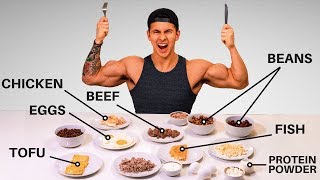
Leucine content and digestibility determine which proteins best build muscle. Animal sources like whey, eggs, and meat rank highest, with whey offering the most leucine per serving. Plant proteins work too but require larger amounts or mixing multiple sources.
Today we are going to eat like Hercules. What is this gonna consist of, sir?
It's gonna consist of seven whole meals, I think two steak meals, there's gonna be two fish meals, two chicken meals. There's also gonna be, there's gonna be a protein drink. And here's the key. Here's the key. Lion blood.
Although ingesting lion's blood isn't necessary, we all know that protein plays a major role in muscle growth. Failing to get enough protein means that your muscles won't recover and grow to the best of their ability. However, getting enough protein shouldn't be your only priority. It's vital that you also take into account the sources that you're getting your protein from as you want to ensure that they're high quality sources. Because as you'll see in this video, doing so can enable you to maximize muscle growth and optimize your recovery and performance. But before we dive into what the best protein sources are, let's first take a look at what makes a protein source good in the first place. Generally, there's two main factors that determine the quality of a protein source. One, leucine content, which is an essential amino acid shown in a number of studies to be the most potent amino acid at stimulating muscle protein synthesis. And two, digestibility, which is simply the proportion of amino acids from the protein that can then be digested, absorbed and used for protein synthesis and growth. Thus, the higher the leucine content and the higher the digestibility of a protein, the better it will be for muscle repair and growth. So what protein sources meet this criteria? Well, research has indicated that animal based protein sources are generally better for protein synthesis and growth than plant based protein sources. And the reason for this, as explained in this literature review from the Journal of Nutrition, is that animal based proteins typically have a higher digestibility and a higher leucine content than plant based proteins do, which are also often deficient in other essential amino acids as well. But to be clear, this does not mean that you can't maximize growth if you only ingest plant based proteins. But it does mean that there's a few things you'll have to implement which I'll go through later on in this video. But for now, let's take a look at the various animal based protein sources and determine what might be best. So, based solely on the criteria I mentioned earlier, whey protein powder comes out on top, it's been shown in multiple papers to have both the highest leucine content and the highest digestibility when compared to various other protein sources. And since research also indicates that most individuals need roughly 2.5 grams of leucine in a single meal to maximize protein synthesis, it makes it a very practical and calorie wise option of doing so. However, you don't just want to rely exclusively on whey as your main protein source, because if you did, you'd be missing out on the various micronutrients and minerals that other protein sources provide, which can play an important role in your recovery performance and perhaps even augment muscle growth, for instance. What's actually really interesting is that recent research has indicated that certain micronutrients found in whole food protein sources may actually boost the resulting protein synthesis response to a greater degree. Illustrating this one 2017 paper compared the protein synthesis response between roughly 20 grams of protein from egg whites versus roughly 20 grams of protein from whole eggs. They found that the whole eggs elicited a protein synthesis response significantly higher than the egg whites, which the researchers stated could not be attributed to the differences in caloric intake, but rather was likely because the yolk in whole eggs contained several micronutrients that are potential candidates to augment the protein synthesis response. Now, although this is a relatively novel finding, the results of other recent studies are in support of this as well. Despite explain the potential importance of micronutrients for recovery and growth. So what I'd recommend is stick to whey for your pre or post workout meal given its convenience and superior digestibility properties, but don't rely on it excessively throughout the day as it's lacking in micronutrients. Instead, it's a good idea to incorporate some of the following high quality whole food protein sources as well. Eggs are very affordable and as I mentioned, rich in various micronutrients and you can definitely add egg whites to them as well. For more leucine and overall protein, lean meats such as chicken breast, extra lean, ground turkey and grass fed beef are all great options with a high leucine content and rich in a variety of important minerals. Lean fish such as tuna and oily fish rich in fatty acids such as wild salmon and mackerel are recommended as well given the various benefits of their Omega 3 content which as I've stated in past videos, may actually play a role in muscle recovery and growth. These are all excellent protein sources that each have a rich composition of essential amino acids and different micronutrients that have been widely supported by the literature to support muscle growth, so you'll want to incorporate a variety of these into your diet. In addition, slower digesting protein sources such as casein, protein powder and foods high in casein such as Greek yogurt and cottage cheese are worth discussing as well. This is because research has indicated that although fast digesting proteins are preferred during the day, when there's not a very long break between meals, high amounts of slow digesting protein is the preferred choice during longer periods of over six hours without food, such as overnight, since they will elevate protein synthesis for a longer time. Thus, strategically ingesting a high amount of a slow digesting protein either shortly before you sleep or or if you know you won't be ingesting protein for 6 hours or longer would be recommended in order to maximize growth. Now as for plant based protein sources, although they're essential for vegans and vegetarians, I'd recommend everyone aim to incorporate them as well for both sustainability and the additional fiber, micronutrients and various phytochemicals that they provide. However, as I mentioned earlier, plant based protein sources don't stimulate protein synthesis as well as animal based protein sources do. But there are ways to compensate for this. For instance, as shown in this 2019 review by Jordan Trimelon et al. 20 grams of a plant based protein often doesn't elicit an adequate protein synthesis response, but the consumption of a greater amount of plant based protein and or mixing different plant based protein sources raises the muscle protein synthesis response to a significantly greater degree. Therefore, with plant based protein sources it's a good idea to ingest a greater amount at a time and or mix different sources within the meal or throughout the day to optimize the protein synthesis response. And for your reference, here are various plant based sources you can incorporate that are relatively high in protein and rich in the various essential amino acids. So to sum the video up, here.
Are the main points that you want to keep in mind. Just note that at the end of the day, total protein intake is what's most important for supporting muscle growth, but at the same time you also want to pay close attention to the quality of the protein that you're ingesting for the reasons I previously discussed. As I've said in the past, your nutrition will hands down be the most important factor when it comes to transforming your body. I used to be completely lost as to how to approach my nutrition and I know a lot of you out there are in the same position. This is exactly why with my built with science programs I not only cover training but but also stressed the importance of nutrition and even developed a custom built nutrition software designed to optimize your diet based on your own stats and goal and to get started you can simply head over to builtwithscience.com and take my starting point quiz I have up in order to discover which program is best for you. Also, I know a lot of you struggle with meal ideas, so I'd highly suggest giving me a follow on Instagram where within my stories I share a lot of my own daily meals recipes and the reasoning behind them, which I think a lot of you will find useful. As always, don't forget to give the video a like if you enjoyed it, and subscribe to my channel if you haven't already so you can stay updated with all my future content. Anyways, I hope you enjoyed the video. Please do let me know in the comments below what other nutrition topics you'd like to see me cover and I'll do just that. Thank you so much everyone and I'll see you next time.










