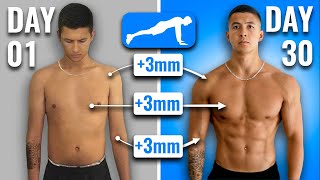
A fitness-focused YouTube video analyzing what happens if you do 100 push-ups per day for 30 days. The speaker reviews which muscles are most activated (chest, triceps, anterior deltoids, core, serratus anterior), cites studies (2015 EMG, 2017 Journal of Exercise and Fitness, 1997 recovery research), and gives a week-by-week account of expected effects: week 1 neural adaptations and DOMS, weeks 2–3 accumulating fatigue from insufficient 48-hour recovery, and week 4 joint strain and muscle imbalances. The video concludes that while push-ups can produce beginner gains similar to bench press, daily 100 push-ups without rest often limits recovery and progression; the routine is useful for habit-building but suboptimal long-term without modifications.
Questions this video answers
Chest (pectoralis), triceps, anterior shoulders (deltoids), core, and serratus anterior.
About 15 to 20 push-ups in a row.
Up to 48 hours after exercise.
Chest thickness increased by 18.3% (~3 mm); triceps increased by 9.5% (~3 mm).
Approximately 180 push-ups per week (three sets to failure twice a week, ~90 push-ups per session).
Push ups are one of the most effective exercises to increase your strength and build up your upper body muscles like the chest, the shoulders and the triceps. Some people take this exercise to the extreme and commit to doing 100 push ups a day and seem to get impressive results. Heck, even Saitama did it from one punch man, and you saw just how well it worked out for him. 100 push ups do it every single day. But what really happens to your body if you do 100 push ups a day for 3030 days? What muscles will grow by how much? How much will your strength improve? Are there any side effects you should know about? What happens after the 30 days are over? Is it even worth your time and effort? Today we'll cover all that and more. First off, to maximize your gains and minimize injury from doing 100 pushups a day, it's important to make sure that you do them with proper form. But provided that your form is in check, what kind of growth can you expect from doing 100 pushups a day takes? To answer that, let's take a look at the following 2015 paper where researchers measured muscle activity levels during the push up. The highest activated muscles were the chest, the triceps, the front of the shoulders, the core and another muscle called the serratus anterior. These are likely where you'll experience most of the improvements in terms of size and definition. As for how much of an improvement to expect in these muscles, although we're going to dive into the specifics later on in this video, I do want to highlight a study published in the Journal of Exercise and Fitness in 2017 that shows just how effective push ups can be. The researchers measured muscle size and strength in two groups of untrained subjects. One group used only push ups during the workouts, whereas the other group used a bench press after eight weeks. The authors found similar size and strength increases in the chest and triceps muscles of both groups, suggesting that, at least for beginners, push ups can be just as effective as a bench press. Now, although this may seem promising, there are various side effects to doing 100 pushups a day that you'll want to be aware of, starting with week one. So, based on norms provided by the Canadian Society for Exercise Physiology, men who rank fair in terms of their fitness on average can do about 15 to 20 push ups in a row. This means you'll likely need to do several sets of push ups to get to a total of 100. In fact, during the first few days, or even the first whole week of the challenge, many of you may not even have the strength to reach a total of 100. Luckily, this is when something called neural adaptations will kick in to help out. This is a phenomenon where although your muscles won't have yet grown, your brain will have improved its ability to recruit the right push up muscles and as a result, your push up strength should improve quite rapidly throughout this week. In addition to this, the most noticeable effect you'll experience in week one is what's called doms, which stands for delayed onset muscle soreness. This refers to the tenderness and soreness you'll experience in your muscles one to two days after exercise. Since in this case, your body isn't used to doing 100 pushups a day. Week one is when you'll experience the highest amount of soreness in your chest, your shoulders and your arms. This is perfectly normal and should die down towards the end of week one. If you're feeling it in your traps and your lower back, however, then that's a sign that your form may be off. Now, although soreness should die down by week two, there is another side effect that will start to creep up and potentially slow down your progress. By the way guys, before we dive into the next side effect, I'm curious, have any of you actually given this challenge a shot? If you have, after watching the video, leave a comment down below sharing how your experience went and how the results you got compared to what I'll go through later on. For now, let's move on to what to expect in weeks two and three. It might sound counterintuitive, but whenever you work out, you're actually breaking down muscle, not building it. It's during rest when your body recovers and builds your muscles up to be bigger and stronger. Back in 1997, a group of researchers tried to determine just how long this recovery process takes. They found that our muscles continue to recover and grow for even up to 48 hours after we work out. Based on this paper as well as other similar studies, this 48 hour time frame seems to be the average time that it takes a muscle to fully recover. So in the case of doing 100 pushups a day, since you're training the same muscles every single workout to they aren't getting a long enough break to fully recover. Because of this, you'll likely start to experience quite a bit of fatigue. In weeks two and three, your body and muscles may start to feel more exhausted than normal and as a result, your push up performance may even start to decrease. This, combined with the next side effects, you'll start to feel in week four can make continuing to do 100 push ups a day extremely difficult, and as we'll talk about later on, potentially not even worth it. So by the time week four rolls around, your body will have taken a beating from the high frequency and high volume push ups. We'll cover how much you can expect your muscles to grow after this week. But before that, you may start to notice two things. The first thing has to do with muscle imbalances. Push ups are great at training the front pushing muscles of your body, but your back isn't involved at all. If you regularly train your front muscles without training your back muscles, then the stronger front muscles will over time start to pull your body forward into a hunch over position with shoulders rounded forward. Ideally, to balance this out, you want to perform plenty of back work focused on the muscles that'll help you keep you upright and shoulders healthy. Now the other thing you'll notice has to do with your joints. Even with proper form, the repetitive motion of push ups can create a lot of strain, especially on your wrists and elbows. Your wrists not only need a high amount of mobility to perform push ups on the floor, but they will also be loaded with quite a bit of weight that you probably aren't used to. Because of this, your wrists will be one of the first areas where you notice discomfort. To mitigate this, you can try to do pushups with handles or dumbbells, anything that allows you to grip it instead of placing your hands flat on the floor. As for your elbows, pay attention to the bottom position of your pushup. If they don't remain aligned directly on top of your wrist as you perform the pushup, then you're creating more stress in your elbow joints. Normally this is okay, but if you're doing 100 push ups a day and not allowing your joints to rest and it'll very quickly start to take its toll on your elbows. So you've successfully made it through the 30 days. What kind of growth and other benefits can you expect to see? Is it even worth your time and effort? Let's see what the science has to say. So in the push up study I mentioned in the beginning of this video, the subjects weren't doing anywhere near 100 push ups a day. Instead, they were assigned to three sets of push ups to failure twice a week. Given that the max number of push ups they could do in a row was around 30 reps. And this would equate to roughly 90 pushups being done each session, a total of roughly 180 push ups per week. Now Although this sounds like Nothing compared to 100 push ups a day, they still experienced significant growth. Over the course of eight weeks. They experienced an 18.3% increase in the muscle thickness of their chest, which equated to about a 3 millimeter increase in thickness. Their triceps also experienced a 9.5% increase in growth, which also equated to about a 3 millimeter Increase. And the researchers mentioned that this rate of growth is similar to other past studies. So if you have these numbers, you can get a rough sense as to the kind of growth you can experience after a month of doing push ups just twice a week. If you were to do 100 push ups a day, would you experience more growth? Well, I'd expect it to be similar or perhaps even less because you're not giving your body adequate time to recover and grow grow. In addition to that, keep in mind that after these 30 days, if your body gets stronger then it's going to need more of a challenge to continue growing. Eventually, standard push ups just won't be enough and you'll have to start incorporating bands or added weight. Now as for whether this is all worth it or not, honestly, I would not recommend the standard approach of 100 push ups every single day without rest. It just causes too many recovery issues and lacks of progression. You need to continue seeing results past those 30 days. One benefit it does provide however is it gets you in the habit of exercising. It's a great way to get your foot in the door and build momentum. That said, this routine can definitely be made far better with a few tweaks. It has the ability to provide even more growth with less effort and less strain on your body. I will be working on a video that shows you a better way to execute the 100 push ups a day challenge and I'll link that at the end of this video when it's up. In the meantime, if you're looking for a proven science based program that guides you every step of the way to your dream body, just head on over to built science.com and take my analysis quiz to discover the best approach for you and your specific body. But that is it for today. I'd highly recommend that you give this video a watch next to learn how to properly perform the push up for more gains and less injury. Thanks so much for watching. Don't forget to give the video a like subscribe to the channel for more and I'll see you next time.