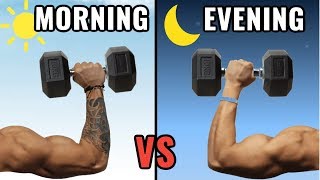
Jeremy Ethier breaks down research on workout timing for muscle growth. Evening training showed roughly 50% more muscle gain than morning in one 24-week study, mainly because higher core temperature and better hydration boost performance. But consistency matters more than timing, and morning trainers can close the gap with caffeine and longer warm-ups.
Questions this video answers
72 trained men over 24 weeks.
The evening training group experienced nearly 50% more muscle growth than the morning group.
Approximately from around 3 to 9 pm.
The time of day in which you train is something you've probably never taken into much consideration. Most of us simply train when our schedule best allows us to, which is perfectly fine. But surprisingly, research actually shows that there's an optimal time to train that not only seems to slightly boost performance and strength gains, but also significantly accelerates the rate of muscle growth. And in this video, I'll discuss exactly what time that is, along with what to do if you're unable to train at that time. But to start, let's take a look at research Although studies regarding the optimal time to train for growth is limited, a few recent studies can help provide us with some insight. For example, this 2016 paper by Kuzma and colleagues compared the effectiveness of a training program performed in the morning versus the evening on 72 trained men. The researchers found that after 24 weeks, the evening training group experienced nearly 50% more muscle growth than the morning group, and there was a slight yet non significant trend towards better strength improvements for the evening group as well. And although these results may initially seem out of the ordinary, they've actually been reproduced in multiple other studies. This 2009 paper from the Journal of Strength and Conditioning Research found that subjects that trained in the evening experienced slightly greater muscle growth than subjects that trained in the morning throughout a period of 10 weeks. Similarly, research conducted by Shett and colleagues found that subjects that trained in the evening experienced slightly greater muscle growth and fat loss when compared to subjects that trained in the morning over a period of 10. So as you can see, based on the research, it seems as though training in the late afternoon or evening seems to provide a slight edge in terms of muscle growth when compared to training in the morning. And as for the exact reason behind this, there's several possible explanations, but as shown in this 2008 paper from the Journal of Sports Science, the most plausible theory is that most people are simply able to perform better and are naturally stronger in the evening when compared to the morning. Which is likely because you're more hydrated, more fueled with glycogen, and most importantly, your core temperature is at its highest in the evening. Which is important since research shows that core temperature is highly correlated with exercise performance and that typically people are strongest and perform their best when their core body temperature reaches its peak. And since, as shown here, most people's core body temperature is at its highest from around 3 to 9pm this would theoretically be the best time to work out, which likely explains the results of the studies presented earlier. However, before you make any changes to your gym schedule the There are a few other factors to consider. For example, if you work a physically demanding job, then it's likely best that you work out before your shift or during lunchtime as opposed to after, since you'd likely be less fatigued, and there is some research in support of this. In addition, none of the research took into account that most gyms typically get notoriously crowded during evening hours, meaning that you're often waiting longer for equipment, have to change your exercise selection based on what's available, and so on, which in my opinion can very well just negate the positive effects of training in the evening. Now, if either of these two points do apply to you, or training in the morning just better suits your schedule, then there are a couple of things you can do to ensure your performance is at least close to what it would be in the evening. One common yet effective strategy is to simply ingest caffeine before your morning workout, which research shows seems to help reverse the morning neuromuscular declines most people experience with morning workouts. For example, this 2012 paper supports this idea and found that ingesting caffeine prior to a morning workout raises neuromuscular readiness and strength close to what it would be at during evening levels. Just be aware that caffeine tolerance might become an issue over time and is something I'll cover in a future video. Another thing you can do, as recommended by researchers from this 2011 study from the Journal of Sports Science and Medicine, is simply ensure that you're adequately warmed up before your morning workout or even perform a longer than usual warm up, since there is a clear relationship between core body temperature and physical performance. And for those looking for a warm up routine to use, I've already made a video on this and will link it in the description box down below. And the last thing you can do is simply ensure that you're being consistent with your workout time. Multiple studies have indicated that if you ensure that you always train at around the same time, for example early in the morning, your body's circadian rhythm adapts to slightly reduce the performance decrements you typically experience in the morning. And thus, despite the evening being the optimal time to train for most individuals with the previously mentioned three tips, you'll be able to achieve comparable results when training in the morning compared to training later on in the day. So to sum up the video, here are the main takeaways. Keep in mind though, that despite research showing that the evening is the optimal time to train, there is so much individual variation and other factors to consider for example, although I personally feel that I do perform best in the evening, I consistently work out in the morning since it helps get my day started and it's just what I feel I'll be most consistent with. And at the end of the day, it's consistency and adherence to your training program that are the most important factors when it comes to what will deliver you results. So just prioritize choosing a time that you personally enjoy the most while also keeping what I mentioned in this video in the back of your mind and implementing the various strategies I covered to minimize any performance decrements.
Thanks so much for watching everyone. I hope you enjoyed the video and found it useful. As always guys, if you're looking for a truly evidence based program that basically combines all the research I've done into an easy to follow systematic method for you to follow to reach your goal physique, then simply head on over to builtwithscience.com forward/courses where you can take a look at the four programs I have available and choose the best one that suits you. Anyways, if you enjoyed this video, please don't forget to give it a like leave a comment down below and subscribe to my channel if you haven't already, as this all really does help me out. And for those of you who haven't already, I'd also really appreciate if you gave me a follow on Instagram where you can see more of content I post and stay updated with what I'm doing. Anyways, that's it for today guys. Thank you so much for all your support. I really do appreciate it and I'll see you next time.