Why You Can't Lose Stubborn Fat (4 Things Stopping You)
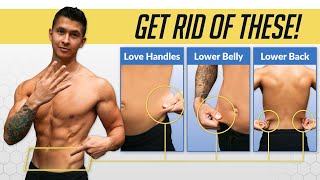
A YouTube monologue explaining why certain body areas (lower belly, love handles, glutes, lower back) resist fat loss and outlining four habits that prevent breaking through: (1) being too aggressive/impatient with dieting, (2) poor calorie tracking, (3) poor calorie management (food choices and satiety), and (4) reduced daily activity. The video uses a member case (Trevor, ~80 lb loss over nine months) to illustrate patience and appropriate pacing, gives concrete guidance (aim for ~0.5–1% bodyweight loss per week), and ends with a promotion for the Built With Science program and a call to action.
If you've attempted a diet in the past, then you probably noticed that some areas on your body lose fat quickly, while other areas just don't seem to budge. For most of us, it's the lower belly love handles and lower back fat that we just can't seem to get rid of, regardless of what we do and how hard we work. And as I've explained in my past videos, there is a scientific explanation to this. Simply put, these areas receive less blood flow and contain fat cells that are more stubborn to burn off when compared to other areas of our body. In fact, our glutes are known as the toughest place to lose fat and have been shown to be 10, 20 times more stubborn to get rid of than belly fat. So if you think that you have a heart, just imagine what pro bodybuilders have to go through in order to get striations in their glutes to start showing. Now I'm just going to assume that you're probably not after the shredded glutes level of leanness, but nonetheless, getting rid of stubborn fat in the belly and lower back will still still require a great deal of patience and perseverance as these areas are generally the last to go. Take Trevor here for example, one of our Billow Science members who recently lost an incredible 80 plus pounds over the course of nine months on his program. Now, if you take a look at his pictures a little more closely, you'll notice that throughout the course of his journey, despite losing almost 60 pounds, his stubborn areas like his lower belly fat and love handles were still still hanging on. It wasn't until he broke past this point did he start to see more and more progress in these problem areas and eventually, by simply being patient and sticking to his calorie deficit, he managed to lose those problem areas altogether. However, the problem with stubborn fat is that staying patient and adhering to your calorie deficit will get more and more difficult to do. As you get leaner and leaner, our body fights back and as a result we most of us get stuck right around here and is why so few actually end up successfully burning off these stubborn areas. In fact, this is where Trevor mentioned that he had the most difficult time to break through. And that is exactly what this video is about where I'll cover four habits that you need to break that are preventing you from breaking through that sticking point. Fix these and just like Trevor did, you'll be able to finally burn off those stubborn areas. The first thing preventing you from losing that stubborn fat is you're too aggressive and impatient with your approach. What what most people don't realize is that your rate of weight loss throughout the weeks will and should slow down. Because when you're at a higher body fat percentage, research has shown that you're able to lose fat at a faster rate with less risk of muscle loss. But this ability diminishes as you get leaner and leaner. Yet the second that people stop losing one to two pounds a week and their weight loss begins to slow down, they get worried and they try to speed it up by drastically cutting down their calories and using unsustainable approaches. This can then lead to rebounding altogether or too much weight being lost too quickly, which then comes at the cost of muscle loss. Something that we want to avoid at all costs. Since, as covered in my past interview with Dr. Eric Trexler, Muscle loss seems to be highly correlated with increased hunger levels, which doesn't seem to recover back to normal until that muscle mass is restored. Which is problematic because this then makes dieting that much harder, to the point where you just can't stick to it for long enough for fat loss to reach those stubborn areas. So instead, stick to a rate of weight loss of around 0.5 to 1% of your body weight per week. Starting out, if you're at a higher body fat percentage, you can stick to the higher end of the range since you can afford to lose more weight per week. But as you get leaner and leaner and your body fat lowers, you want to then slow this rate down to minimize the risk of muscle loss. As long as you're not completely stalling. For example, you might initially be losing two to three pounds a week, yet only losing around half a pound a week once you do get pretty lean. And that's. And as you can see in Trevor's weight loss graph here, he applied this concept and slowed his weight loss down, especially as it got considerably leaner towards the end. So, just like Trevor did, don't get discouraged. Stay patient and trust the process. The next habit you need to break is poor calorie tracking. To achieve the level of leanness needed for stubborn fat to come off, you're going to want to not only be tracking your daily calorie intake, but doing so accurately in order to ensure that you're actually eating at a calorie deficit. Because most of us are horrible at just estimating our food intake. In fact, the data shows us that people tend to underreport their daily calorie intake by anywhere from 300 to even over 1000 calories per day. Even dietitians have been shown to underreport their calories by an average of 223 calories per day. I mean, take for example, people who eat a serving of peanut butter. If you actually wait it out, it can easily double or triple the calories you thought you were consuming. But even if you are tracking, you may not be doing so accurately. Many people overlook the little things like condiments, creamers and sauces that you use throughout the day and fail to realize how small the serving sizes are for these and how easily it can rack up hundreds of additional calories throughout the day. And when you then throw when the dinners out, the social events, or the weekends where most people just end up letting loose or just loosely tracking their calories, that can easily rack up to thousands of additional calories that will completely offset the hard work that you put in all week. In fact, one study actually showed that subjects who were monitored on their diet tended to lose weight during the weekdays, but would end up plateauing or even gaining weight back during the weekends due to overeating. So again, just realize that sacrifices will have to be made. Be diligent with your tracking and try to prioritize cooking more meals at home so that you know exactly what's going into your meals. And when you do go out for dinners or social events on the weekends, for example, plan ahead so you can actually have a good time and enjoy yourself without sabotaging your progress. For example, if you know that you have a big social event on Saturday, then simply cut down your calorie intake by another hundred calories or so during the week in preparation. Then on the day of the event, stick to mainly protein and veggies leading up to it so you can save more calories for that meal. You can easily save an additional 2,000 calories or so to spend spend at that event if you simply plan ahead. The third habit you need to break is poor calorie management. In the beginning of your diet, you can get away with being more flexible with your food choices, skipping meals and fitting in more treats. As long as by the end of the day you're still eating at a calorie deficit. However, as you get deeper into your diet and you get leaner and leaner and are now also likely eating less calories than you were in the beginning of your diet, you have much less wiggle room. At this point, your body is going to be doing everything that it can to fight back to prevent us from continuing to lose fat. You'll be Hungrier, you'll be more fatigued, and as a result, you'll have a much harder time adhering to your calorie deficit. Which means that if you want to break past this point, then you need to now start managing your daily calories better. Although yes, your daily calorie intake is what matters most for weight loss, the way you spend these calories every day has a major impact on your hunger levels and recovery. So instead of spending or saving your daily calories to fit in convenient, less nutritious, high calorie foods that won't do much in terms of your hunger, you're going to have to make some sacrifices here and instead opt for high volume, nutrient dense, low calorie foods that will provide the best bang for your buck. In terms of suppressing your hunger, boosting your daily energy levels and speed, speeding up your recovery. As you get leaner, you're going to have to accept that you will be hungrier than you were when you were carrying around more body fat. And managing that hunger with the right foods really is going to be key for you to continue making progress. I mean, yes, you can still fit in treats here and there and use an if it fits your macros approach, but the frequency at which you do so will have to decrease as you get leaner and leaner and adhering to your calorie deficit becomes more difficult. The last thing that is preventing you from losing that stubborn fat is that you've gotten lazier. You've been dieting for a while, things are getting tough, and the initial excitement of starting your diet is gone. This is when people start to overlook little things. They start to be less active, they start to skip out on walks, and they'll just move less throughout the day than they used to. In fact, research has consistently found this to be true when dieting, since your body tries to preserve its energy in response, which is detrimental for fat loss, since these subtle movements actually do burn a significant amount of calories every day. This, in combination with the fact that you just weigh less now than you did at the start of your diet, can result in you now unknowingly burning hundreds of calories less than you did before, which can easily put fat loss to the halt. So to account for this drop in calories burned, you do have a couple options. You can either bump up your overall activity levels a little bit more and and, or slightly reduce your calorie intake. But in order to minimize the extent to which you have to do those two things, just make it a habit to move more throughout the day, keep track of your daily step count, aim to hit a target, and be consistent with that target throughout your diet so you don't end up unknowingly burning significantly fewer calories, especially as you get leaner and leaner. But all in all, when it comes to losing stubborn fat, the more variables that you can control and keep track of, the better. As it's often an oversight in any of these these variables I mentioned that cause people to stall and prevents fat loss from ever reaching those stubborn areas. That's exactly why within our Built Science programs, we not only guide you week after week of your workouts and nutrition, but we've also included tracking software that'll enable you to see how your weight and the daily calories you burn change throughout the weeks. This is how our members, like Trevor, were finally able to get rid of that stubborn fat after countless unsuccessful attempts to to get started today, just simply head over to builtwithscience.com and take a free analysis quiz that'll determine what program is best for you and your specific body. Anyways, that's it for today guys. I hope you enjoyed this one. Please do me a favor and show your support by giving the video a like leaving a comment down below. So what you'd like to see me cover next? Subscribing to the channel and turning on notifications for the channel as well as this all really does help me out. Thank you so much everyone. I'll see you next time. It.










