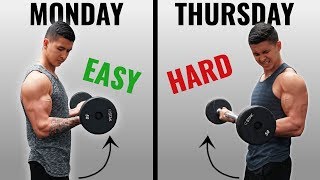
Jeremy Ethier breaks down why some workouts feel harder than others. Losing just 2% of your body water tanks performance, skipping sleep over 12 hours does the same, and two days of low carbs cuts your reps. Drink a liter before and during, sleep 7-9 hours, and eat enough carbs.
Questions this video answers
As little as 2% body water loss.
Approximately 7.7 kg decrease in 1RM.
Roughly a gallon per day for men and three quarters of a gallon per day for women.
Approximately seven to nine hours per night.
>12 hours awake (evening workouts after extended wake time can reduce performance).
We all have days where our workouts feel great, where the weights feel light and you're able to lift more weight and do more reps than usual. On the contrary, though, I think we can all relate to workout days where the weights just feel heavier than normal, making it a struggle to hit the numbers that you normally do. But rather than just dismissing it as a bad workout or assuming that you've lost muscle mass, you need to realize that there's a few reasons that research has indicated consideration can help explain why the work that you've been doing suddenly felt harder. And by acknowledging these factors, you'll be able to consistently have better workouts and therefore make better progress. So with that being said, let's start with the first factor. Hydration Ensuring that your body is adequately hydrated before and during your workout is essential in order to maximize your performance. Research has shown that decrements of physical performance, including reduced motivation and increased perceived received effort, have been observed with dehydration as little as 2%. In fact, this 2001 paper from the Journal of Strength and Conditioning Research illustrates the significance of this quite well. The researchers took weight trained males and had them perform their one rep max at the bench press while they were hydrated. They then had subjects repeat this while in a mildly dehydrated state, which caused their resulting 1 rep max to decrease by 7.7kg. Then they rehydrated the subjects and they were now able to more or less perform what they could initially, simply meaning that hydration plays a vital role on how well your body is able to perform and how difficult your workout feels. And although the amount of water you should drink daily depends on a variety of factors, for a baseline number, I'd stick with the Institute of Medicine's recommendation of roughly a gallon of water a day for men and three quarters of a gallon for women. More importantly, though, you want to intake a good portion of this before and during your workout. What I personally do and recommend is simply drink a liter of water prior to your workout and another liter throughout your workout, regardless of how much you've already had throughout the day, as doing so will just help ensure that your body is adequately hydrated for your workout. Next, you'll want to ensure that you're getting adequate sleep if you want your body to perform at its best. Similar to the effects of dehydration, multiple studies have found that being sleep deprived causes the body to give up when it would otherwise normally be physically capable of pushing further, resulting in a decrease in the number of sets and reps you're able to perform in a training session, especially with compound movements, which might explain why your workout felt tougher if you've been running on little sleep. But if you're unable to get the recommended seven to nine or so hours of sleep a night, then you do have a couple options. One option is to avoid working out after an extended wake time. What I mean by this is that if you're going to be running on little sleep and waking up at five in the morning, for example, then research has indicated that working out in the evening when you've already been awake for over 12 hours will likely lead to decrements in performance. Therefore, if possible, you want to try to workout before your wake time extends considerably. Another option, which you may or may not already do, is to simply ingest caffeine prior to your workout, which, as I've explained in other videos, has been proven to restore your workout performance when you're in a sleep deprived state. And next, if you've had a few days where you just haven't been eating enough food, especially carbs, then your workouts are likely going to suffer due to the lack of glycogen in your muscles. For instance, a study from the journal Strength and Conditioning Research had subjects perform the squat in a glycogen depleted state by limiting their carb intake for two days prior to testing. They found that there was a significant decrease in the average total number of repetitions they could complete during the squat when compared to their normal performance. Obviously, to prevent this, you'll want to be more consistent with ingesting adequate carbs, carbs and enough food in general in order to fuel your workouts. The ideal amount will depend on your goals and various other factors, but if you're struggling with this, I'd highly suggest heading over to my science based diet videos which will guide you through exactly how to set up your nutrition with various examples and I'll link both those videos in the description box down below. And although there are many other possible factors that can affect your workout, these three typically have the biggest impact and are therefore vital, you acknowledge in order to prevent them from hindering your performance. Doing so is going to enable you to have more good workouts and therefore speed up your overall progress.
That's pretty much it for this video everyone. I hope you enjoyed it. Just do keep in mind that progress in general will always have its various ups and downs and you can't expect to make consistent progress every single day indefinitely. Which is why it's vital that you not only consider what I mentioned in this video, but also properly manage your recovery and incorporate the right training strategies to avoid burning out. And if you're looking for an all in one evidence based program that shows you exactly how to do so and optimizes both your training and your nutrition so that you can progress as quickly as possible, then simply head on over to built with science.com and take my starting point quiz I have up in order to discover which program and which approach is best for you. As always guys, for those who haven't already, I'd really appreciate a follow on Instagram. I post a lot of informative videos and content on there as well, which I think a lot of you will find useful. And if you enjoyed this video then please don't forget to give it a like. Leave a comment down below. Subscribe to my channel and turn on notifications for my video as well so you don't miss out on any of my upcoming content. That's it for today. Thank you so much for the continued support. I really do appreciate it and I'll see you next time.