Why You’re Not Losing Fat (4 HIDDEN Mistakes You Don’t Realize You’re Making)
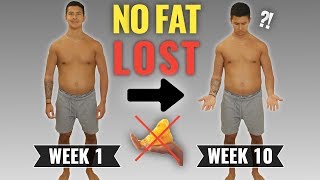
Jeremy Ethier breaks down four fat loss mistakes: underestimating calories (one study found people reported 1340 kcal but actually ate 2500), weighing yourself sporadically instead of daily, overestimating calories burned by up to 70%, and confusing muscle gain with fat loss on the scale.
Questions this video answers
1,340 calories (self-reported).
Over 2,500 calories (measured).
Roughly 1.65 pounds per week.
Up to 70% (per the video's cited research).
Up to 25% (per the video's cited research).
One of the most common reasons why people give up on their fat loss journey is simply because they aren't seeing any progress despite putting in the work and doing everything right. And I don't blame them. Believe me, if I didn't know any better and wasn't seeing the results I was after, then I would sure as hell quit too. But rather than giving up altogether, it's important that you instead take a step back to pinpoint exactly what it is you're doing that's preventing you from losing fat. And let me start off by saying that no, you're not genetically cursed, no, your metabolism is not damaged, and no, you're not too old to see results. Instead, there's a few hidden mistakes that I see people unknowingly make all the time and that I even used to make that prevents you from losing fat despite your hard work. And in this video, I'll show you exactly what those mistakes are and how to correct them so that you can actually start burning fat and see seeing the results that you're after. The first and most common mistake you don't realize you're making is underestimating your calorie intake, meaning that you're unknowingly overeating, which prevents any fat loss from occurring. This is a mistake that 99.9% of people are making when they claim that they don't eat a lot of calories but still struggle to lose weight. Illustrating this is a paper from the British Journal of Nutrition which looked at a group of women struggling to lose weight despite despite claiming to be small eaters as they reported their daily calorie intake to be on average, just 1340 calories. However, after the researchers determined their true daily calorie intake, they found it to be on average over 2500 calories, which was clearly the reason why they couldn't lose any fat. And it wasn't until subjects were then supplied with the actual amount of calories that they claimed to be eating that they started finally losing weight at roughly 1.65 pounds per week. And this phenomenon of underestimated estimating calorie intake is something that multiple other studies have found as well, with one study showing that even experienced dietitians ended up under reporting their true calorie intake. So why exactly does this occur? Well, the truth is that most people are really bad at estimating the actual amount of calories that they eat. For instance, how many calories would you guess is in this meal consisting of two pieces of whole grain toast with avocado and a Little bit of olive oil drizzled on top of Chances are you wouldn't have guessed that this healthy meal consists of a whopping 620 calories. Now let's take a look at these two seemingly similar bowls of dry oats. Would you honestly be able to eyeball and guess that the one on the right has almost 100 calories more than the one on the left just from adding a little bit more oats? Probably not. And this difference in perceived versus actual calories very easily becomes the factor that's inhibiting your fat loss. So to mitigate this, you'll want to start monitoring your food intake and ideally taking the time to accurately measure everything with a food scale. I'll leave a link in the description box down below to a very affordable one that I personally use myself. You can then use an app like my Fitness Pal to then track the calories from these foods. I highly recommend you do this, or at least try it out, as it's going to help you see how many calories you're truly eating at, and it's also going to drastically improve your skill of estimating calories in foods. In addition, you want to make sure that you don't forget about hidden calories. For example, let's say you require 2000 calories to lose weight. You've monitored your food intake for the day and you're confident that you hit that goal. But upon further analysis, you've forgotten about the drop of oil that you used to cook your eggs and the ketchup that you ate them with, the drizzle of salad dressing added to your healthy salad, and the little bites you had of your significant other's chocolate bar. That's a whopping 300 calories that you've forgotten about, which can easily put you out of the calorie deficit that you thought you were in and becomes the reason why you're not losing fat. So just be aware of and take into account these hidden calories as they do quickly add up and can prevent you from seeing the results that you're after. The next hidden mistake you're making is you're not properly weighing yourself. What most people do is they weigh themselves sporadically every week or so. And the problem with this is, well, let's use myself as an example. The following image is my daily weigh in history for the last four weeks as I've been cutting. As you can see, my weight fluctuates quite a bit, which is completely normal, but the overall trend is downwards and my weekly average weight has decreased every week, which is a good thing. However, if I were to have instead weighed myself randomly once a week using the first two weeks as an example, I could have ended up with this data, which would leave me confused and frustrated because I'd be under the impression that I haven't made any progress and actually gained weight despite all my hard work. Which you don't know isn't true and leads you to quit altogether. But this is just because you haven't taken the time to properly track your data. With only one weigh in per week, you become severely misled about the general direction of your weight change. So what you need to do instead is weigh yourself every single morning right when you wake up, after you've used the washroom, but before you eat or drink anything, as this is going to help minimize any weight fluctuations. You'll then want to write down this number every day and take a weekly average of it. And then every week you'll want to compare that average weight to the prior week's average, as this will more accurately represent what's actually happening with your weight. And then if after three or four weeks or so you don't see any change in your weekly average weight, then you'll be much more informed that something may need to be changed in your plan and you can address it accordingly. And if you don't currently have a precise weight scale that measures with decimal points, which believe me, is essential, I'll leave a link in the description box down below to one that I personally use and recommend. The next hidden mistake you're making is overestimating and eating back the calories you burn. A lot of people find that after doing an intense workout, they're hungrier and feel as though they should eat more to compensate for the calories that they burned. But what multiple papers have found is that especially after a cardio session and people end up eating back a significant portion or even exceeding the calories that they burned from their workout, which can slow down and or prevent fat loss altogether. And to make matters worse, research indicates that people tend to overestimate the calories they burned in a workout by up to 70%. And devices or machines that track the calories that you've burned in your workout have been shown to overestimate the actual calories that you burned by up to 25. So if you're using either of those methods to track your calories burned and then you're eating back your calories based on that, that's likely what's hindering your fat loss. A Much better method is to stick to a set daily calorie intake and a set weekly workout routine. Then you simply keep track of your weekly average weight. And if you're not losing weight, then you adjust your plan accordingly by either slightly decreasing your calorie intake and or bumping up your weekly cardio as needed. The last mistake is you're not realizing that you're going through a body recomposition. And when most people think of fat loss, they immediately think of numbers on the scale. They assume that if their weight isn't going down, then they're not losing any fat. But this isn't always the case, because if you're relatively new to training, or you're coming back from some time off, or you've just started taking your training and your nutrition much more seriously, then you're more likely to experience something called a body recomposition. This is where your body both builds muscle and loses fat at the same time, which is a good thing, but it will result in your weight actually remaining the same, which can throw people off. And this right here is exactly why it's so vital that you measure your progress in other ways rather than just relying on the scale. So in addition to tracking your weight, it's also a good idea to keep track of your strength in the gym, take weekly progress pictures, and take weekly bodily measurements. Because if, for example, in the past six weeks your weight has stayed the same, but your strength has increased, your arm measurements have increased, and your waist measurements have decreased, then these are all signs that you're going through a body recomposition. Meaning that you can rest assured that you are indeed making progress and doing everything correctly. All in all, I'll admit fat loss can be confusing at times. And nothing is more demotivating than not seeing the results that you're after despite. Despite actually putting in the work. But if you take a step back, review the various points I went through in this video and properly apply them, then you will see the change that you're after.
Guys, as I try to emphasize in this video, I can't stress to you enough the importance of tracking. Tracking your strength in the gym, tracking your foods, tracking your weight, and so on are all a must. Because by having all these variables tracked, you'll then know exactly what it is that you need to change or adjust in order to break through any plateaus you encounter. And this is why, within my Built With Science programs, along with the training and nutrition programs that you're going to get, you're also provided with multiple tracking softwares that I've built so that you.
Can easily and accurately track your workouts.
Your diet and your weight change over time and basically just everything that you need to along your journey within the program. You're also going to learn how to avoid making crucial mistakes like the ones I went through in this video before they even happen and it's why so many of my members are seeing incredible changes in their bodies. And so to join today simply head on over to builtwithscience.com and take the assessment quiz which is just going to determine what program is best for you. Anyways, thank you so much for watching. I hope you guys enjoyed this video. Please don't forget to give it a like leave a comment down below as to what topic you want to see me cover next subscribe to the channel and turn on notifications for the channel as well as this all really does help me out. Thank you so much everyone for your continued support. I really do appreciate it and I'll see you next time.
It.










