Why You’re Not Making Gains (4 HIDDEN Mistakes You Don’t Realize You’re Making)
Four mistakes that kill muscle gains: unrealistic expectations, not tracking progress, switching exercises too often, and skipping full range of motion. The speaker breaks down why each one matters and how to fix it.
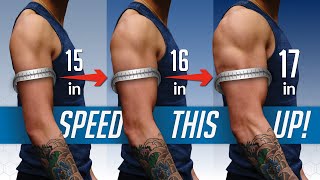
Packing on additional muscle is hard to begin with. Its made even harder and frustrating when you put in the work yet aren't seeing the results to show for it. But the reason why you're not seeing the gains you know you think you should is not because you're genetically cursed. Instead its more often than not due to a few key mistakes that you don't even realize you're making that keep you stuck in the same place. Now, aside from the most obvious and commonly discussed mistakes that you should definitely check off the list first, such as getting enough sleep, protein and calories in general, there's a few other lesser known mistakes that you're probably guilty of and are the ones that I want to focus on in this video. By the end of it, you'll know exactly how to tell if you are actually building muscle as fast as you should be and how to speed up the process. The first mistake is that you just don't have realistic expectations as to how quickly your muscles should be growing out, which admittedly is very slow, especially when compared to losing fat. As a natural, it can take months to put on just a few pounds of muscle, yet takes just a week or two to lose that same amount of weight. But in fat. As for what you can expect, a recent 2020 study, as well as a larger analysis of over 200 studies found that on average, subjects were able to increase their muscle size by about 1.6percent per month, meaning that if you currently have 15 inch arms, then a realistic increase in arm circumference from two to three months of training would only be about half an inch, with untrained individuals likely able to gain slightly more than that and vice versa for more trained individuals in terms of weight gain, this would translate to about 2 pounds of muscle per month when you first start training, and will quickly dwindle down with experience. Now, this may not sound like much, and visually it isn't, but this effect will compound and lead to significant gains over the years, just as it did with myself and everyone else who trusted the process and remained consistent. So if you're currently not experiencing noticeable gains week after week, then just note that this doesn't necessarily mean you're doing anything wrong. You may instead just need to realign your expectations. Now, as a follow up to the previous point, although progress will be slow, you need to ensure that you're actually making progress. But how can you know if you're making gains if you aren't measuring or tracking anything? This is especially true for muscle growth because of how slow the process is and because of how easy it is for additional fat gain to to mask the gains that you don't realize you're actually making as you put on more weight over time. To put this into perspective, here's Trevor and his nine month transformation. Using one of our built in science programs, you can clearly see drastic changes in his fat loss over the nine months. And even if he didn't take any measurements or weigh himself, he could in theory just use the mirror to assure him of his progress. Contrast that with another one of our members, Kevin and his nine month muscle building transformation. While his transformation was incredible, the gains made week to week and month to month would have been barely noticeable until compounded over several months. And then using another member of ours, Ishaan, as an example, when you then put the additional fat gain that often accompanies muscle growth into the picture, it becomes even more difficult to visually assess your progress. Its not until you eventually strip off that excess fat do those hidden gains become visible. Which is why along the way you need to be diligently tracking key indicators that'll help you determine if you're truly building muscle despite what the mirror may or may not say. More specifically, track your daily morning body weight, but most importantly, track your strength and rep performance in your exercises. Because although you may gain weight if you're bulking, your weight might stay the same or even decrease if you're going through a body recomposition where you're building muscle and losing fat at the same time. But if your strength and or rep performance is improving during your exercises, then you can rest assured that you are likely building additional muscle regardless of what your weight is actually doing. In addition to this, another helpful metric that you want to look at is both your waist circumference and your muscle circumference measurements for your main muscle groups, which were shown in the study I mentioned earlier to at least for the arms, correlate very well with increases in muscle size. But to improve the reliability of this method and minimize error, you you'll want to have someone measure for you. Be consistent with where you measure. Take the average of multiple measurements and measure every couple months or so. If you're getting stronger and your muscle measurements are increasing and you're gaining weight, or on the other hand, if your muscle measurements are at least staying relatively the same, yet you're getting leaner, you're getting stronger, and your waist measurement is decreasing, then in both of these scenarios you can be quite confident that you are building additional muscle. The next mistake you may not realize you're making is switching up your exercises too often. Many people do this with the idea that it'll confuse the muscle and prevent it from getting used to the same workout week after week. But in reality, when a new exercise is initially introduced, it takes your body at least a few weeks to neurologically adapt to it and learn how to actually perform the movement most efficiently. Which is why you'll get very sore and progress the fastest in the first few weeks of a new exercise or only after this initial learning or relearning phase is when strength increases are then predominantly due to increases in muscle size. Meaning that if you switch your exercises too often, all you're doing is essentially putting your body through this learning phase without giving it a chance to truly master the exercise and progress it to stimulate more growth. Which is why we see in the literature subjects that constantly switch their exercises as opposed to keeping them the same week after week, tend to experience less strength gains and would likely translate to less less muscle growth in longer duration studies. So instead, a good rule of thumb is to choose a decent variety of exercises for each of your muscle groups and then keep them in your weight training routine for at least four, eight weeks. This is going to give your body sufficient time to neurologically master those movements to the point where further improvements in those movements will most likely come from added muscle and will give you an opportunity to start monitoring your week to week progress more accurately. After this point, exchange the exercise for a close variation of it only if either you're plateauing on that exercise, its getting stale and demotivating for you to do, or it just starts to cause aches and pains. Otherwise keep it in and continue progressing. Ok, so maybe you're not switching up your exercises every workout and instead you are staying consistent with them and progressing them week after week. Even if you are doing that, this last mistake can hinder your growth and it's neglecting the loaded stretch component of your training, which most often just comes down to failing to use a full range of motion, particularly on key exercises where this matters the most. Because what's interesting is that several papers support the idea that applying tension to a stretched muscle seems to be an independent stimulator of muscle growth in addition to tension itself, and seems to provide a different type of growth in the muscle. Which just simply means that in exercises like squats for the quads, chin ups for the lats and pressing movements for the chest, the full stretch under load that your target muscles get at the bottom of these specific movements is extremely important for stimulating muscle growth. Its partly why these movement patterns are so effective at stimulating growth and is why in the literature we see significantly more growth with a full range of motion on these movements when compared to a shorter range of motion but with heavier weight. So during your pressing movements like the dumbbell press or even pushups, pay attention to the bottom position where your chest is fully stretched under load. Get as deep as you comfortably can and av simply bouncing out of this position. And the same applies to the quads in the squat. Up to a certain point, the deeper you go, the more loaded stretch your quads will experience and the more growth you'll be able to stimulate. What you can also do with these movement patterns is you can look for ways to further increase the range and loaded stretch that you get from these exercises during push ups. For example, performing them on a stack of dumbbells or books is an easy way to provide a greater loaded stretch on your chest or during lunges. Performing them with your front foot elevated can help you get a greater loaded stretch in your glutes to stimulate more growth. But in general, just be aware of the importance of this bottom position in these key movements. It's often the most difficult part of the movement and very easy to skimp out or cheat on, but doing so may very well be the reason why you're not seeing the results you want to despite doing all the right exercises. So as a recap, here is a quick summary of the key points from this video. To build muscle, yes you need to work hard, but you also just can't overlook other important variables like tracking your progress, executing the right exercises in the right manner, properly fueling your body and managing your recovery, and for an all in one system that shows you step by step how to optimize each one of these variables to transform your body as efficiently as possible, just like it's done for thousands of others. And simply head on over to builtwithscience.com and take our analysis quiz to discover the best approach for you and your specific body. Anyways, that is it for today guys. I hope you enjoyed this one. Please don't forget to show your support by giving the video a like leaving a comment down below as to what you'd like to see me cover next, subscribing to the channel and turning on notifications for the channel as well as this all really does help me out and it's much appreciated. Thank you so much guys and I will see you next time. It.










