Workouts That WRECK Your Joints (I Wish I Knew This Sooner)
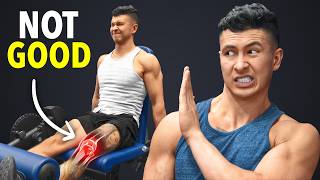
Jeremy Ethier explains five common gym mistakes that damage joints and gives practical fixes: (1) match form to your anatomy (vary squat stance, heel elevation, deadlift variations, align machine pivots and seat/handle heights); (2) strengthen neglected mid-back muscles (traps, rhomboids) and rotator cuff with specific cues and prehab (face pulls, prone arm circles, wall slides); (3) avoid fixed-bar grip overuse by using unilateral or rotating-handle variations to respect natural carrying angles; (4) progress with alternatives to always adding weight (increase reps, better form) and listen to body signals; (5) periodically rotate exercises to give joints a break. Video includes concrete examples (Max/Alex squat contrast, videographer Brendan's deadlift reach, Kevin's rowing cue) and an anecdote about Ronnie Coleman to illustrate long-term consequences of overtraining.
Questions this video answers
Every 8 to 12 weeks.
Handles should line up with the level of your nipples.
Every morning and anytime away from the desk, do 10 wall slides leaning on the wall.
Most people make common gym mistakes that quietly wreck their joints, but they're easily avoidable. Instead of just copying the big guys in the gym or online, the real fix is actually understanding your own anatomy. And after years of researching movement science and working as a kinesiologist, I found five simple tweaks that can instantly ease your joint pain and more importantly, save you from bigger problems down the road. Now, the first fix you need to make is start using form that actually matches your anatomy. It's not talked about enough, but your individual bone length, your joint mobility, and even the shape of your sockets, they change what proper form looks like for you. Take squats, for example. If you have long femurs and tight ankles, like Max over here, your torso will lean forward. So if Max tried to squat straight up, he'd lose balance and fall over. But some people, like Alex, who is one of our built with science coaches, they're just built to squat. He has short femurs and amazing ankle mobility, which lets him squat really deep while staying upright. Both are correct for their bodies. But forcing Max to match Alex would compromise his lower back through rounding. And the same goes for your foot placement. Back when I first became a personal trainer, we were actually taught that proper squat form requires a narrow stance and toes pointing perfectly straight. Now, some people's hips, they're designed well for this, but some people will try copying this, and they'll just feel a strong pinching sensation and won't be able to get very deep before hitting the wall. Deadlifts, they tell the same story. Long arms make conventional pulls a breeze, but if you have shorter arms, like my videographer Brendan, you'll have a really hard time getting into the bottom position without rounding your back. And to fix this, you don't need to start measuring your bones or going to get an X ray of your bone structure. You just need to experiment with simple adjustments. If you're like Max, who leans forward quite a bit when you squat, try elevating your heels onto plates. Now, this will hit more of the quads rather than the glutes, but you also might feel less lower back strain and just a smoother squat overall. But also play around with your squat stance, so you can use a barbell lightweight, or just grab a light dumbbell, hold it your chest. And there's three stances I want you to try out. Okay? First one, toes forward and relatively narrow stance. This one does not feel good for me. All right, Second one, go a little bit wider and point your toes out slightly. So this one is Actually, my sweet spot, like, I could tell that feels really good. The third one, even toes even further out and come down. That one feels a little awkward for me. But based on your hip structure, what you'll typically find is that one of those three will feel really good. But also keep in mind that the wider your stance is, the less deep you're going to be able to get during the squat, which is perfectly fine. And then for deadlifts, let's say you're like Brendan and you have trouble getting into the bottom position without rounding your lower back. That's where I try elevating the bottom position or using sumo instead. And this applies to machines, too. And so for leg extens, leg curls, what you want to look for on these machines is the pivot point, right? So sometimes you'll see a sticker. And this is basically where the machine rotates. And what you want to do is just make sure that the pivot point is aligned with your knee. If it's not, it'll lead to a little bit more stress above and below the knee. So you just want to modify your seat and your setup so that the knee is in line with that pivot point. And then for chest press machines and even the pec deck, what you want to do is adjust the seat height, right? So what you're looking for is the handles. They should line up with the level of your nipples, right? So right here you can see the handles are a bit too high. My elbows are flared out. So what I need to do is bring the seat up a little bit so the handles around the height of my nipples. And this is going to be a lot more natural. Press less stress on the elbows and shoulders. Now, these adjustments will instantly help, but you'll also want to avoid the next mistake of ignoring the most neglected muscles in the gym. I'm talking about the ones that keep your shoulders safe every time your arms move. Now, when you get shoulder pain, everybody blames a weak rotator cuff. And don't get me wrong, they're important, and I'll show you how to strengthen them. But you can't ignore your bigger mid back muscles, like the traps and rhomboids. You see, your scapula isn't really attached to your ribcage through a physical joint. Instead, it's suspended by muscles getting tugged on from every direction. Your traps and rhomboids pull on the scapula from the top and midline of your body. And since the scapula is attached to your humerus, they have a direct impact on how your shoulder moves, which just means if they're weak, your shoulder isn't going to be very stable whenever you press or pull. And to make matters worse, most of us sit all day with our shoulders pitched forward, making it tough to activate these muscles in the first place. You can think of them as being locked in the long position. So even when you train back, you might just let your arms do all the work for you while your mid back takes a vacation. I know because I did this for years. But once I fixed it, my back started going faster, my shoulder clicking and the discomfort just disappeared and even my posture straightened up. Now, how did I fix it? Well, there's two things. So first, I learned how to properly engage my back muscles. Take our head engineer, Kevin, who spends his day coding, slouched over with his back muscles usually stretched out. So when Kevin first started doing rows, look what happened. It's very subtle, but you'll notice that his shoulders are rolling forward, which just tells me he's not really using his back muscles. He's just pulling with his arms. What you want to see is this instead. Show him the right way, Kev. Attaboy. Now he's actually properly using his mid back muscles. Now, to get there, you'll want to start by pressing your shoulders down. Skip the shrug. Then think about pulling with your elbows and and pinch your shoulder blades together like you're trapping a pencil between them. Then let them fully open up. On the way back. You might need to use less weight to get this right, but if you do it properly, your shoulders will stay back instead of rolling forward and the contraction will hit your mid back. Instead of just pumping up your forearms and biceps. And then for pull downs and pull ups, your shoulders can't stay frozen. If your arms are the only things moving, your back's barely involved. So on the way up, let your shoulders relax and rise up towards your ears. And then on the way down, pull with your elbows while shoving your shoulders down and away from your ears. But I also like to sprinkle in some prehab exercises to further strengthen these areas. So after every upper body session, I finish my workout with three sets of face pulls or prone arm circles. And then every morning and anytime I step away from the desk, I'll lean on the wall and bang out 10 wall slides just to keep things strong. Now, while these changes will make a massive difference in your back strength and shoulder health, you don't want to make the next mistake, which has to do with your grip. So back when I first started lifting All I did was I copy the biggest guys in the gym. Barbell curls, skull crushers, bench barbell rows, overhead press. My routine was purely built off of these big movements. And while it worked, I noticed issues would quickly come up. At first, I'd start feeling something in my wrist, and then we'll go down to my elbow, and then eventually even my shoulder. Why? Well, let's start by just looking at barbell curls and bar pushdowns. Most people don't know this, but your arms don't hang perfectly straight down. They have what's called a natural carrying angle. The bump on the back of your elbow is actually part of your ulna. And as you extend your elbow joint, that bump plugs into a groove in the back of your humerus. And when it locks into place, the inside of your elbow joint can start to angle outward slightly, creating that carrying angle. Women tend to have a slightly deeper groove on average, which just means their carrying angle can even be more intense than it is for men. Which means when you clamp your hands to a straight bar during a curl, you force your bones, tendons, and ligaments into a line they were never meant to hold. And triceps are no different. They actually prefer to extend out at an angle rather than perfectly straighten down. Which is why, especially once you get stronger, straight bar pushdowns can feel really rough on your elbows and wrists. Now, the carrying angle, it's not as relevant for other muscle groups, but still, any time you do an exercise where both of your hands are locked onto a bar handle or even a machine, you're forcing both sides to follow the same fixed path. And to make matters worse, even though your elbows can angle in or out, your wrists can't rotate to match tendons, ligaments, and muscles. They pull on each other, which just means the strain in your wrists can eventually lead up to your elbows and shoulders. Now, the fix isn't to eliminate these exercises altogether. And it's not like if you do any of these exercises, you'll instantly hurt yourself. But let's say you do just one of these exercises twice a week for three sets of 12 reps. So after one week, that's already 72 reps. And after a year of doing this, that's almost 4,000 reps. So the stress can add up, which is why you want to balance it out with a simple rule I like to follow for each muscle group. Work in at least one exercise that lets your elbows and your hands freely rotate. So think dumbbell presses for chest and shoulders. Single arm cable rows or single arm pull downs for back dumbbell. Or single arm cable curls for biceps and cross body cable push downs for triceps. But now that you fix your workouts, you need to start thinking about how you're going to progress them. Which leads me to the next mistake. So when I first got serious about lifting, I was told that the only way to grow was to add more weight every single workout. And so I did exactly that, no matter the cost. And it worked. But I would always get to a point where I'd strain my shoulder or my knee and just be forced to take time off. Everything changed once I switched my mindset about progression. I was thinking about it all wrong. You don't force your muscles to grow by lifting heavier. You challenge them with a certain amount of weight. And if you've done your job with your recovery, you should come back stronger and able to lift more. It's earned rather than forced and pushing too soon and making little compromises with your form just to lift that extra weight. It adds up and can lead to an immediate injury or just a slow burn strain that shows up months later. And I'm sure you guys can also relate to days where you've had a rough night of sleep, missed a meal, or maybe your body just isn't feeling it. Those are actually the most dangerous days. And that's actually how my girlfriend, now wife hurt her back 10 years ago. So she came off a full shift of working as a waitress and headed straight to the gym severely dehydrated and under slept. And even though she was in a rush, she was still eager to beat her squat PR from last week. So she skipped her warm up, slapped on heavier weight and was grinding through the reps with not so good form until she felt a sharp pain in her lower back. And later that night she could hardly walk. Unfortunately, this injury still bugs her to this day. So if a PR isn't there, just don't force it. And also keep in mind that lifting heavier is just one form of progression. I want you to imagine for a second two groups of people. The first group uses the same weight over 12 weeks, but focuses on just doing more reps. While the second group focuses on adding more weight as they get stronger. Which group do you think will build more muscle? Well, scientists have actually tested this and they found that both methods are equally as effective for growth. So if your body isn't ready for more weight, just aim to do one to two more reps instead. Or try to match the same reps as last time, but with Better form or less effort. Now, the farther you advance in the gym, the slower your progress is going to be and your programming needs to reflect that. And that's exactly why within my Built with Science plus app, we've designed a workout coach that uses all your data to tell you exactly how much weight and reps to do every workout to make sure that you're still progressing without overdoing it. But even with that, you need to make sure that you're paying attention to your body along the way. Take eight time Mr. Olympia Ronnie Coleman. So in his prime, he was lifting insanely heavy weights and for hours and hours a day. But these days, Ronnie is experiencing excruciating pain and can hardly walk. Now, it's hard to say exactly what got his body to where it is today, but one thing is for certain, his obsession with training played a major role. Take this as an example, so mid set of his usual 600 pound squats. On his eighth rep, boom. He heard a gunshot like crack in his back and instant pain. Now most people would have went straight home or to the hospital. Ronnie, he was more concerned about finishing his leg day. And while you'd think he has regrets about the way he trained, that time.
When I was in there doing that squat, I'm like, oh man, I only got two deadlifted. So probably just two of you. All right, that's the only regret that I have now.
That you didn't do more reps?
Yeah, cuz I had six. I had six in me.
Now Ronnie was a different breed. He was a straight savage. But there's an important lesson to learn here. If your elbow whispers that doesn't feel so great, don't reply with shut up. Lift lighter for higher reps or just switch it up. In fact, every eight to 12 weeks you should take a look at your plan. Are there any exercises you feel are starting to wear you out? Your joints need a break from doing the same movement over and over again. So consider switching things up. Like switching your favorite chest press machine for a dumbbell press instead. Or simply changing up your grip on your pull ups. Even minor adjustments can help and you can always go back to your favorite exercise or once you've given your joints a break. But if you're wondering what some excellent exercises are for growth, yet are also super joint friendly, then start by giving this video. Watch next for two amazing exercises for your arms. Or if you're looking for something that takes care of all the guesswork for you, then you can get two weeks free of my new fitness app over at builtwithscience.com thanks so much for watching. I'll see you next time.










