The Future of Health: Peptides and BeyondSound Bites #peptidetherapy #healthoptimization #habits
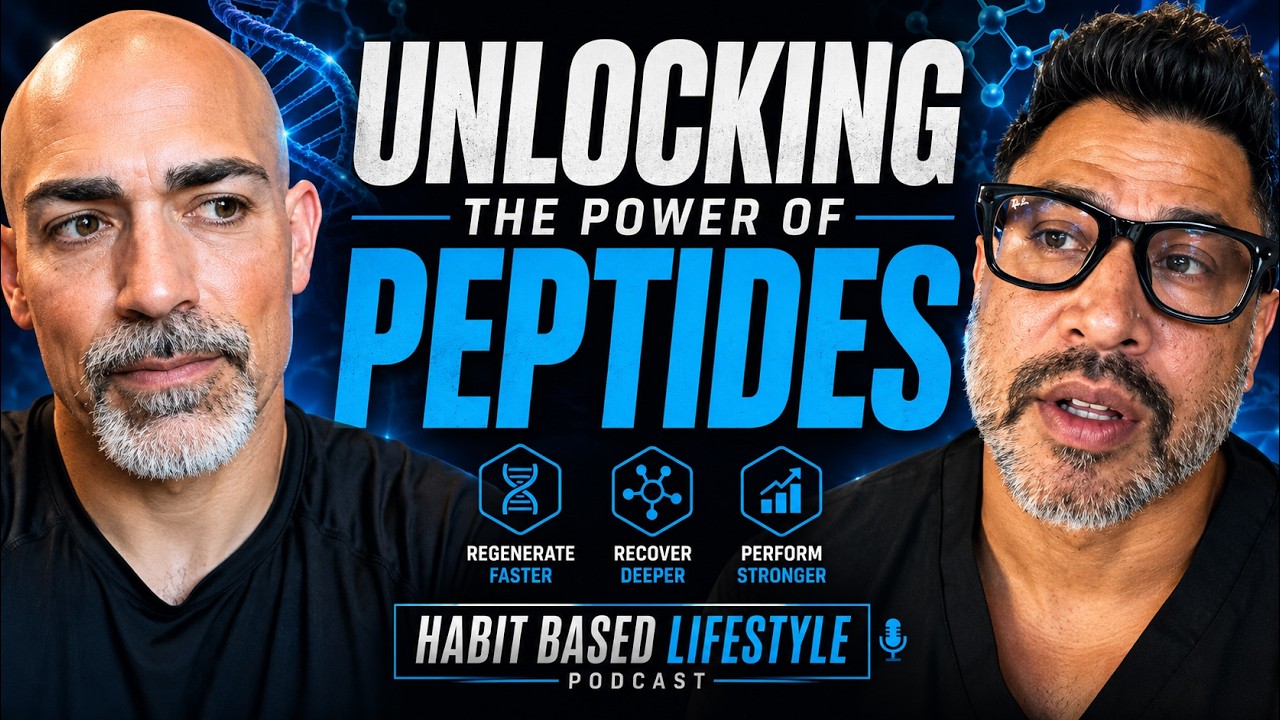
In this Habit Based Lifestyle Podcast episode, host Jesse Ewell interviews Dr. Solomon John, a board‑certified family physician with a geriatrics fellowship who transitioned from hospital medicine to anti‑aging and peptide‑focused wellness clinics. Dr. John recounts his personal health crisis in his early 40s—overweight, fatty liver, pre‑diabetes, and high blood pressure—that led him to functional medicine, genetic testing, and ultimately peptide therapy, which he used to reverse his own conditions. He describes how peptides differ from conventional pharmaceuticals, noting that about 80 FDA‑approved peptides exist for specific indications, but most are used off‑label for longevity, metabolic health, and tissue repair. The conversation covers common pitfalls in peptide use (poor sourcing, unclear dosing, treating symptoms instead of goals, unrealistic expectations), the murky regulatory environment, and the anticipated shift toward regulated tele‑health prescribing and possible oral nutraceutical formulations. Dr. John shares his top peptide classes—GLP‑1 analogs for metabolic health, nootropics like C‑Link/C‑Max, neuro‑repair agents such as DiHexa, anti‑inflammatory/regenerative peptides BPC‑157 and TB500, and others like ARA‑290. He emphasizes a holistic approach: comprehensive labs, clear patient goals, lifestyle habits, and disciplined supplementation (e.g., vitamin D, methylfolate, MK‑677). The episode ends with resources for clinicians—Dr. John’s book The Peptide Prescription, his consulting website, and a call for education over hype—while speculating on future FDA/CPAC decisions that could legitimize peptide access and reduce the gray market.
Chapters
The purpose of this show, the purpose of this show is to guide you to realign, realign with habits that get you to live the life, live the life.
Welcome back to the Habit Based Lifestyle Podcast. I'm your host, Jesse Ewell. Today we got a very special guest, Dr. Solomon John. He's an MD from South Carolina, educator of peptides, owner of multiple wellness centers. Solomon, I want to welcome you on the show today.
Hey, thanks for having me, Jesse. It's a pleasure.
Yeah, man. I know we chatted a little bit in the intro. Can you tell everybody, you know, on this show today, I'm super excited to have you, but can you tell everybody a little bit about, you know, some of those initials behind your name and just kind of a brief intro about you?
Yeah, sure. So I'm a board-certified family medicine physician. I did a fellowship in geriatrics too, which is by the American Board of Internal Medicine. And so I was practicing in nursing homes and, and ERs and hospitals. That was my primary gig for a long time. And then I started an anti-aging clinic, but started with Botox, fillers, and those kind of things. So one week I was working in the hospitals and the next week I started wellness, what we know now as wellness clinics. Back then, we're talking 20 years ago, we just called it a cosmetic clinic. So yeah.
Okay. Nice, man. So, uh, Let me ask you this, like, let's go back. Like what made you, you know, want to be a doctor in the first place? Like when, when did you know that that was kind of like your, your thing?
Well, it was kind of a generational thing. My dad's a physician. My sister's a physician. His dad was a physician. My mother wished she was one and she wanted me to be one. So kind of, kind of was a family inherited thing. And I always wondered, is it just because of the family influence that got me here? But then once I realized I was into helping people and helping others and just so much suffering and chaos in the world. What's my, my role in helping people navigate through that? So I found my own path, which kind of led me to the peptide world really at the end of it all by helping myself first, then I was able to help others, you know? Yeah.
So, you know, you're a, you're an MD, you know, I'm guessing you kind of like worked in more of a hospital setting in the beginning. Like when did you decide you needed to kind of make that transition?
When I myself got sick in my early 40s, I'm 51 years old. I was going through a major divorce, you know, financially was hit and, you know, was down in every aspect of my life, was overweight. My BMI was what, you know, was like a 34, and I'm not a big guy. I'm like 5'9", but I was 190 and I had fatty liver. I was in the CrossFit gym and I just, every muscle and every movement just was so heavy. And I went to the doctor, one of my friends who owns also a health clinic, who also was a hospitalist one week, and he had his own primary care office and did all my labs, genetic testing, and I had COMT issues. I had a methylation issue, things we don't study in medicine. Right. And, and then my gut health was off and, you know, I had fatty liver and pre-diabetes. I was high blood pressure. And I'm like, my gosh, I've turned into all the same people that I treat. And I'm lecturing them the way I would lecture myself with diet and work exercise. And I myself thought I was doing the right things and I wasn't. And so he was like, I'll give you 3 to 6 months with diet lifestyle. If not, we're gonna put you on meds. And that was it for me. Then I went down the rabbit hole of nutrition, of whole foods, of gut health. I got a functional medicine certificate, got peptide certified. 'Cause back then when you did the A4M modules, it all kind of went together. And then one thing led to another and I started some compounds on my own and, and for research use initially, and then was able to reverse some of my stuff and got into great shape and then ran a clinic down here in South Carolina. It's a chain, actually 8 of them. And they had hormones and peptides from pharmacy. Compounds, compound pharmacy. So I was team, their medical director, which allowed me to leave the hospital realm for a short time, actually, since really for the longest time now. But that was the job that let me leave. But I served as a corporate medical doctor there. And then that's when I learned peptides, started reading, wrote my book, started educating others, started seeing where the sources were coming from, all that kind of stuff, and started doing product development and all kinds of different pathways with it. And while I was doing that for about 3 years, treating all these patients with hormones and peptides and changing changing their lives. And I'm like, wait a minute, I couldn't do this with prescription, like a cholesterol pill or blood pressure pill. I was just putting Band-Aids on those, right? And when I did it for myself and people are seeing it works for others, that's when I kind of said, this is the way we should be helping clients and patients and people to get over whatever things in life, whether it's an injury, emotional trauma, their fatty liver, whatever it is, like just their, their fatigue, their Hm, you know, and then I started doing a bunch of research. That job allowed me to do about a year or two weeks. That's when I did all my research for my book. Cause I didn't see a ton of patients cause it was a concierge practice. And so it took me away from the grind and that's kind of how I ended up where I'm at now. That's awesome, man.
So yeah, I got a couple questions. So, you know, number one, I think one of the things I always respect about people in the health space are when they've went through their own journey and they've kind of like healed themselves. I think that's. You know, it, it's kind of like, well, I'm a health professional, I should know these things. But then at the same time, I think there's a humbleness that comes to, and like a pride thing we gotta get over that's like, hey, here I am preaching this all day, but I'm not actually doing it myself. And so I think it's pretty cool that you would do that because to me that makes you someone I want to follow and respect, especially, you know, in the space right now because there's a lot of people that, You know, they're just like, hey, I want to offer peptides. You know, I like them. Like, I should just go do it. Right. And like, I think what's cool about what you're doing is like, hey, I had my own health issues. I solved them this way. And now I want to share that with other people. And, and I think that's a really powerful, you know, transformation story, number one. And then I think that makes you more valid in coming to see you than a traditional person I might go into where, you know, you still smell cigarettes on them when they come back in from their break and you're like, dude, am I really supposed to listen to this guy?
Yeah, I was, I was rounding one day and I smelled cigarettes on my respiratory therapist and she's the one who's supposed to be giving the med nebulizers to people with asthma. And she just got off her break and you could smell the nicotine. It was like, I just looked at her, I said, you good for a smoke break? And she just looked at me and just walked away. I'm like, okay. But yes, you know, but that People don't identify with their degrees, diplomas, and they get this role identity thing, almost like entitlement syndrome. And I've also noticed that with my colleagues that are against peptides, or there's no literature, there's no evidence, there's this, there's that. So I do have to combat a lot of people and educate because none of this stuff we really— anybody knows, even the side effects of all the medicines that are clinically evidence-based, they You know, they're not in the sense of how many people did you follow that you admitted that had a GI bleed because they took a Celebrex? I mean, there's a lot. I used to admit those all the time back when Celebrex was first there. Now we don't see it as much because Celebrex isn't as used because it's known to do some of these things. And so it's just limited to surgical issues and not as given as much as it used to be. So peptides are in that field right now. They're, they're not quite a biologic. They're not really a drug. Some of them are, some of them are patented and some of them have been. FDA has approved about 80 peptides that we can prescribe as prescribers, but for certain indications. So, you know, like the growth hormone analogs can be doing for HIV lipodystrophy, but you and I, we're not really allowed to use it for, let's say, anti-aging or, hey, we're both over 50 or whatever the ages are. And, you know, and I'm just doing it for longevity. That's just not a thing. But we know from a medical standpoint, growth hormone after 30, 40, 50, you lose 10%, 15% every decade. From the science standpoint, if you're gonna study neuroendocrine, it kind of makes sense. Well, just like testosterone, you gotta replace that. You might have to replace this too. That's if you do black and white. Now there's some people claiming you can increase their testosterone by diet and some other things and some, and I, I'm open to that because if we don't have to have medicines, injectables or capsules, I'm all for that personally. Yeah. Yeah.
I think, I think the thing on that is like, okay, yeah, maybe we can, or maybe some people can do it by diet and exercise. Maybe some can't. Is there a place that kind of has both, right? Well, maybe some of it, yes, could totally be diet and exercise. Some of it can be testosterone, or maybe it's just a milder dose. But I think there's— in the health space especially, there's either kind of like black or white. There's no middle. And like where I feel like, you know, people can really step into, it's that middle place, right? Of like, hey, let's do this in a smart way if we're going to use it, but like not just rely on that either and say, okay, you can go eat whatever you want. Not work out, but like, take this and you can expect to get this result. I think that's, you know, that's kind of your placebo effect. And ultimately to me, if you have experience and have your own experience, you, you step into the middle, you know, right away. And that's what differentiates you from everybody else versus, you know, maybe you go to a, a traditional doctor, they're like, hey, just take this, see what happens. I'll see you in 3 or 6 months. You know, the other side's like, take everything and let's just see what happens. And, and I don't I don't think that's, I don't think that's right either. And, but I think there's a place in the middle where people can do it in a smart way. I've seen it, you know, with my own eyes and experienced it myself. But I mean, here's what I'll say, man. I've been in the health space for going on 25 years. A lot of it's in the training space and being around chiropractors, functional medicine doctors, MDs. It's, it kind of is like a religion that you buy into. And if you try to go outside of the religion, everybody kind of like, you know, shuns you or like stones you. Right. And so I think there's a big identity shift you have to have if you wanna go outside of, you know, your religion, you know that.
I mean, yeah.
It's like, hey, we all learn this way in school. And there's usually a small percentage of people that are like, hey, I'm gonna go over here because I've been over here for a long time and it's not getting me the results I want. I want to come over here and start learning some new things. Things, and you kind of have to go through the scrutiny. And then eventually at some point people are like, hey man, I've watched you, I want to do the same thing, you know? And I think that's the natural progression. But I'll just say hats off to you, man, for, for just kind of doing that yourself.
Oh, I appreciate that. You hit me at a perfect time because I'm getting a lot of static from some of the NDs around, you know, they're, they don't, conversations end up being acting personal and I'm not like that. I try not to anyway. Sometimes you can get heated in conversations, but yeah, but it's just the educational part and people are like, just show me the evidence. Where's the evidence that these things work?
Right.
You know, so I, I'm kind of old school. My father was an old-time cardiologist and this is the thing, Jesse, with medical education, there's a lot of people don't understand. My father went to medical school when there was one blood pressure med. That was it. He's a cardiologist. He's a cardiologist. Only one blood pressure med when he came outta medical school. Now there's hundreds, right? So there's so many classes, there's so many of them. And so the education has changed so much in 50 years, even 20 years that you can't keep up. And they say the education for a medical provider, a medical doctor, a DO, MD, changes after 5 years. That information they learn is completely inaccurate because the new evidence has completely changed or new findings. And I'll give you one, one quick example. What I see the peptide world doing right now is what hormones did back in 2002. In 2002, there was a Women's Health Initiative and they took this oral progesterone capsules, which is kind of a no-no when we practice in hormones. And, and they said that they gave all these women who were 63 or average median age was 63. So way past menopause to help with vasomotor symptoms. And they gave them a little medroxyprogesterone as well. And they found they had increased cancer, breast cancer, stroke, venous thromboembolism. So every medical board and every person that was out there doing hormones was under scrutiny, me being one of them, because I got certified in 2012 in Ohio and I got a medical board investigation, went through the whole thing, kind of had to go through that and basically stopped doing hormones for a while. It was like, I can't do it because these people will say they'll take my license away. And so, you know, that's my livelihood. So I let it go, but kind of not, you know, I kind of kept up with my CMEs and whatever. And now in 2023, 2020, I think it was 20— yeah, 2020, a new study in JAMA came out disproving, or I should say maybe contradicting the results of that study and now saying, no, it's when you do it at a younger age. And they didn't quantify the age, but less than 60 for sure. They said you do it with bioidenticals, not those synthetics. You actually help to decrease cancers. You help with skeletal muscle and bone. So that's 20 years of research and evidence that's gone now for those patients who are 60 now that have passed away. So people are like, my, my generation's 40. I'm, I'm sorry, I'm 51. So 20 years, I got 70. I'm, that's the end of my life soon. So I don't have the time for evidence-based to catch up. And if peptides are, are in a modality that can help people, then I'm kind of saying, well, just like anything else, like an antidepressant or even a blood pressure med, sometimes they work, sometimes they don't. You gotta go up on the dose, you gotta add another med. Same with peptides, same with whatever. Modality you're doing. Even with surgery, surgery doesn't always help. The knee pain still stays. So I'm trying to educate providers. The thought process is still the same. It's just, you've got another tool in your toolbox and do it kind of educational-wise with some blood markers and vital signs and such. But yet the evidence may not be there. And some of this is, if you think it's anecdotal, then don't do it, stay away from it. But if you think it helps people, try it and see if it works. But it's safe. I can tell you that. Not in big doses, not so much. I have admitted people to the hospital who were on prescription meds, a ton of meds. Research guy had huge double dose of a Reda product and he was admitted for pancreatitis. Another one for small bowel obstruction. So, but a lot of these are people getting it off gray markets, not under doctor's care. There's mixing it with other meds. Like they just weren't smart about it, you know? Yeah.
I think, well, let's maybe go into this. So like what are the, what are maybe like the top 3 or 4 mistakes that you see people making with peptides? You know, like, just let's imagine we're talking to an audience of health professionals that are, hey, is this something I should actually offer to my clients? Like, what are the mistakes you see, number one, clients making? Some of them you just mentioned was like, hey, getting research-use-only products, people just not knowing the source of where they came from. But like, what's— can you speak into that a little bit?
A little bit. So it depends on the clients because you've got people who are like, hey, I'm taking this research from such and such company and I'm doing this, am I doing Right. So some of it is just the mixing that they get. They ask me questions. Some of it is, hey, if I'm a medical provider and I want to train, and that's kind of what I do, I train other providers how to implement stem cell treatments and peptides and hormones and aesthetics into their practices so that they can have another line of services that they can help their patients with. So that's kind of what I do when I'm not seeing patients doing hormones and aesthetics. But we, we basically tell them like, you don't treat symptoms. Like somebody says, I feel fatigued. Well, it's not like you check a thyroid and thyroid's low and you give thyroid medicine. It, it, peptides don't work like that. And I think that train of thought is what people get caught up in. It's like, well, what are your goals? What are you trying to achieve? Well, hey man, I'm, I'm like 50. I've got grandkids coming. I really just want to be, I want to be able to be active and playful for my kids. Then drawing, drawing like blood panel, seeing that blood panel, and based off the blood panel, am I addressing metabolic health? Am I addressing signs of aging with maybe low hormone panels, which could be growth hormone, which could be testosterone or estrogen or whatever it is? Am I addressing a CRP that's elevated, a homocysteine level that's elevated that needs— now that's systemic inflammation, and that's a 5-methyltetrafolate vitamin that needs to be prescribed. And they're not even prescribed, they're just given over the counter at GNC, you know? Yeah. Is it a vitamin D level that needs to be addressed? And then But once you've done all of that, then what's the person's goals? Like, I've got friends who— one guy was in the hospital. He was— we went on our 50th, we did the guy's 50th, and we were doing the debauchery stuff, right? Smoking cigars in the hot tub. And the guy got Legionella infection and he was in the hospital and he was— did the traditional IV antibiotics, was on the step-down ICU, lost a ton of weight, was sick as all get out, and said, hey, I need to— I need to gain muscle again and I need to feel better. And I was wiped out.
Out.
So we checked his testosterone and checked some other things. He needed a growth hormone analog. He's in the gym crushing it and he's gained so much more muscle. His energy's back. He says, all I do is I'm so active and vigorous. Him and his wife's relationship is much better. They're more vigorous in the, in the bedroom. And, and his whole quality of life is just 360. We were able to wean him off his cigarettes and vaping and get him off some of his bad habits. And he's been doing great. So it's like, that's how I use it. You know, it depends on the clinical situation and what people are trying to do. It's not like, hey, I want to be a bodybuilder. Builder, so I'm just gonna inject this peptide and boom, now I've jacked, I got a six-pack. And that's what I think people are making the mistake, what peptides can do and how we use that, you know?
Yeah. I mean, kind of the things I heard is like, hey, number one, what is your goal? Like, kind of what are the things you're going through? Number two, let's see what your blood work says. So let's get to the root problem. And then, you know, I think the third one naturally is like, are you actually getting it from someone who knows what they're doing?
You know, so it's like, yeah, two sources, Jesse, right? Let's say like, are they getting a legitimate source? 'Cause sourcing is a problem, right? You don't know what you're getting when you do these research compounds. The other is, is that, is it a prescribed compound, which, you know, which is under scrutiny still. And July 23rd, as you know, that meeting will happen and will kind of open up the future to these compounds, you know?
Yeah. So talk about like dosing, like, You know, you go through a research use only company and you're kind of guessing on dosing. You go through somebody else like yourself and you're, you're giving them, or, you know, the people you're working with are giving them kind of a custom dose. Like talk about the difference of, hey, just guessing, or like, is this the correct dose?
Yeah. So like there is, you know, for testosterone, for females and males, even hormones, there are weight-based calculations and things like that that you can do. Peptides are a little different because there's no standard dosings for whatever you're doing. But what— there's some of the research out of the international studies from Russia, or there's— the way I learned it was actually from an international pharmacy in India. That's how I had to figure out dosing. I was literally doing Zoom calls and FaceTimes with China, India pharmacies, actually some FDA-approved facilities and labs. And there's a lab out of California called Genogenix. And so you can get peptides as either a lab product or you can get it at a prescription drug from a compound pharmacy. That's how I was able to in the past. It's been a lot more restricted lately, but I still have FDA-approved labs out of California that can send us. And then it's basically between the provider, the doctor, and the patient to agree. And they come up with these, some of these anecdotal dosings. But that's just where the controversy happens. Like, Well, how much do you really need? How much is too much? Is too much too much? And, and how, what are the side effects? And this is where I think my colleagues that are MDs are in that black and white kind of thinking are in a way correct. Like there is no regulation, there is no standard dosing. What we have done is I use the International Society of Peptides. They have had pharmacists and other people that have their dosing recommendations. So they have a bunch of publications you can get. So that's kind of what I use. And I start with their starting dose and I start with their, they'll like get the guys on testosterone, you can only do this much. And so there's all these kind of outlets you can find through CMEs and continuing education. But it is a process and it's not like, you know, the American Heart Association has an agreement. Hey, you got heart disease, you got to be on a beta blocker, right? We don't have that with peptides. And that's another thing that will have to be done in the future. But one of my favorite orthopedic surgeons, Dr. Seeds, he owns the SSRP, and he, you know, used to treat all these professional athletes and, you know, says peptides are the way to go. I didn't have to do surgery. And, you know, when you hear that, it's kind of like, okay, he's going to be a forefather in that. And then eventually, as government says, hey, July 23rd, we would meet with the CPAC. Are we going to introduce peptides? And what does this mean? And then regulations are going to start coming through, and then only access to providers maybe, or maybe just professionals that know peptides. I don't, I'm not sure how that's gonna play out, but I, that's what I see in the future happening. Or, or restrictive access. And now you got the whole gray market flooding and everyone's just doing what they're doing right now where it's like, what are we doing? How we doing? You know?
Yeah. Which is kind of what testosterone used to be back in the '90s to early 2000s.
That's right. That's right. Yeah.
You go to a, you go to a pharmacy in Tijuana back in the '90s, you'd see 5 or 6 baseball players, WWF wrestlers walking out of every pharmacy.
That's right. That's right.
It was wild, man. So dude, in fact, my first peptide I took, this is like back in 2016, was from Dr. Seeds. He made a BPC compound. That's the first peptide I ever took.
Oh, nice. Nice. Me too, actually. That's so funny. Yeah.
That guy's kind of the, you know, grand godfather of at least around here, right?
Yeah, absolutely. He's— I try to tell other people too, like, hey, you guys got to go to a conference, get certified. He's got a great online portal now. And it's not that expensive. I mean, relatively speaking, compared to some of these other people, but, and you know, you don't have to be a doctor, right? So this is the wellness space. It's a little like yourself, Jesse. You've been into wellness. So, you know, nutrition, you know, lifting, training, resistance, mobility, like these are things in medical schools they don't teach you. And that's what I am. My passion has always been an athlete. I've always been playing sports. And so I always had that special interest. So wellness to me, isn't just limited to a doctor who can prescribe or a chiropractor or, you know, and so I learned from you. You can learn from me. We all learn from each other. Might not always agree and we might see it a different way, but I think the conversations are just happening now. We're just starting to break the surface. And I really appreciate that religion analogy you said, because I think that's where we're at with the peptide world. Like, hey, yeah, I'm Christian and you're Jew, or I'm Muslim and you're Hindu. Like, well, yeah, that's where I've seen it, and that made it totally put it together.
Yeah. You know, the thing that I always see is, is like, it doesn't matter. Like, I'll put it in the training world, you know, it was like people would make a religion out of kettlebells, or people would make a religion out of CrossFit, right? And then it's you broke free from the religion, you were kind of like shamed. But I was always, I think one of the best analogies anybody ever heard about training was like Dan John. He's like, hey, training or working out is basically Mexican food. And, and everybody's like, well, what do you mean? And he's like, well, Mexican food has like meat, tortillas, cheese, and you know, salsa, right? Or maybe some avocado. So he is like, basically it's like 5 foods.
Okay.
And you either fry it, you grill it, or you, but it's still Mexican food. And he's like, whatever training you do, it's just Mexican food. Like what's the foundational things? Everything else on top of it is not, it's just like a, it's an extra thing, right? But it's like, it's not going to change your life. These things have been around forever and you got to follow the principles. And, and that's really the way I see health is like, hey, you can tell me peptides are bad, but like if you're going out every weekend and slamming, you know, 12 beers and, and smoking smoking weed, but then you're shaming everybody on Monday through Friday about how bad peptides are, you're just uneducated and you're afraid to learn. And that's really the bigger issue. And you know, so that's kind of the way I look at a lot of this stuff is like, once you make things a religion, you stop learning, you know? And to me, that's really the bigger issue is, is like, why would I not want to learn about something that could potentially help my clients get better? Even if it doesn't, at least I have an understanding of them. And so I can have that conversation with my client. You know, but I haven't, I haven't heard anybody say legitimately, I've taken peptides and they didn't do, they did absolutely nothing for me. And so when people tend to tell me, hey, I'm not interested in it. I'm like, okay, well, like being interested to take them is one thing, but like learning about it, you gotta be living under a rock, man. If you're not gonna have, if you're in the health space and you don't, you haven't at least studied them.
So I actually have heard about, well, in the last year, maybe only 3 people who've told me peptides didn't work for them. And they only did it for like 3 weeks. 3 days, you know, and peptides, you need a loading cycle to get the receptors saturated. Right. So I tell people now, I used to tell them 2 months, now it's 4 months, but like, you know, and so they're like you said, uneducated, they just don't know and skeptical. And it isn't a fix. It's not a quick fix, but people are looking for that. I will say this, the, I've seen some of the weight loss clients and they do phenomenal, but they don't work on their habits. Right. So. Yeah. You know, so that, so you would get a decreased appetite with, you know, there's appetite especially, or something, right? You, you would get the decreased appetite and now they love it cuz they go out to eat. They can only eat half of what they used to eat and that's how they're losing their weight. But they haven't really focused on, am I eating protein? Am I getting my carbs right? Am I getting the healthy fats? Am I actually getting my caloric intake? And what is my basal metabolic rate? They don't go that deep. They just want the end result of of having a flat stomach.
Yeah. I mean, I think, I think the biggest thing is, you know, like you said, like if you're taking a GLP-1, the rules still apply. Like you have to have a support system with it. You gotta have proper nutrition. Otherwise, you know, you essentially just starve the weight off and then you just put back on twice as much, or you have that rebound effect. But the people that I've seen have a strong support system with it, it it's life-changing for a lot of those people when it's done correctly. And that's, you know, that's the, the power of it is, right? It's like you give someone a gun and you decide not to give them directions on how to shoot it and you give them bullets, like what's gonna happen, right? And so it's kind of the same way with peptides is like you can't give people loaded guns and not teach them how to shoot it, how to like operate it. Otherwise, bad things are gonna happen. And unfortunately there's a lot of people out there handing those out.
So, yeah, I'm, I mean, I am curious to see what will happen in the future and where all this goes. Yeah.
What, what are your thoughts, man? What are your thoughts on, on that? Cause I mean, we're back, we're basically like a week, maybe 8 days away from that.
So what I think is if the FDA decides to collaborate with the CPAC, the Compounding, you know, Pharmacy Committee, I think if they approve these things, what's gonna happen, you're gonna see a surge of these online telehealth platforms. Like the Hims, right? They, they will come in and they'll be on your feed like, hey, you're looking to get peptides, you just do a quick physician visit. And by legality standpoints, that's a good faith exam. They sign off on it. Now you can get your monthly prescription or subscription of your peptide, right? That will be one avenue of how this will play out. The other will be other providers will start to say, oh, okay, maybe I can start to use these. And people are gonna, people are asking, they go everywhere. There's people are asking about peptides like this. That's just something you gotta know. And a lot of people don't know it, so they go somewhere else. And so the other will be physician access will be a little bit harder to get to. I think if that's the case, the gray market will kind of disappear in the future. There's gonna be better sourcing, there's gonna be better restrictions when they do the compound, the warehouses, they're gonna be able to track with a lot number, expiration date, batch numbers, certificate of analysis, and a complete complete kind of systematic way of how they're monitoring these peptides and where they're coming from, where they're going from start to finish, whether the API is from overseas or not, whatever it is. So I think that will probably start to see more regulations. When you do more regulations, you got more government agency bodies. When you do that, you got more licensing. So you got that, you gotta pay more. So I think it's going to go that route. That's my personal opinion. I don't know if it doesn't and F— the FDA and big pharma says, hey, we can't capitalize the way we wish, then they might let it go. But to get research and evidence-based and do trials with phase 1, phase 2, and do human, you're gonna have to have these companies like an Elon Musk guy that's got a bunch of extra cash who wants to put this to the market. And no one is doing that. And so, you know, so it's gonna be a while before we get any evidence-based in the literature and it becomes mainstream as a medical modality.
What do they say it costs? Almost a, either $1 billion or $12 billion to do.
It's, yeah, it's crazy amount. Like just to get an application in, I think it's a quarter of a million dollars to put your application in or something. It's like, yeah. So it's a lot. And then the FDA has to figure out what they're gonna categorize it as. Is it gonna be a biologic? You know, what kind of patent do they get? But there was a 2013 Congress law that said that you can't really patent a natural occurring compound. So what they're doing right now is big pharma is actually in litigation trying to figure out what's that number. So if it's a compound, it's 44 amino acid compound and more, well, that should be a drug even though it might be a natural occurring compound. And that's how they're doing the Retta right now. True.
Yeah, I read that about, I think it was 39 is the cutoff and they're trying to, and Retta is like right there.
Yeah, exactly. So they're trying to, Retta I think is 40, maybe like 38, 37 in there. They want it to be, it's like 44 is the number. So if they can get it to 44, 45, so the big pharma guys are going to have 5 GLPs in one, okay. But then the compound pharmacy might just have the individual ones. And then as that happens, the cost will all go down. It'll go skyrocketing up first and then over time they'll go down.
So it'll be, it'll be like oil, right?
Exactly. And you, you seem like, since you know the wrestling world and we, I grew up in in the '80s too. So it's like, you know, that side of the Wild West where they were just doing whatever compound, they were fine and fired up.
And I w— okay. I was, I mean, I was legitimately going to Tijuana.
Yeah.
So like I had a whole connection through a pharmacy.
Yeah, man.
I've been, I've probably been in every avenue from Mr. Olympia competitions. I had a friend that trained, um, UFC fighters. To college football players.
So yeah. So you've seen the dark side and the light side, so I get it. Yeah.
Everything, man.
Yeah. And that's the top, that's the part that some medical providers don't understand that the, yeah. You know, how these UFC fighters are training and what they're putting in their bodies or like even just a simple bodybuilding competition, the unnatural guys, how much compounds they're putting in their bodies to look like this amazing superhero. Freedom. Now do whatever you want. I'm not a judgmental guy, but people are doing it, they're going to do it. That's why we're in America— freedom of speech, freedom of free will. So in a way, it's kind of nice. But I came from Pakistan, my family's from overseas, and my grandfather had a heart attack back when he was close to his 60s, and he didn't do cardiac cath, he didn't do aspirin, he went on a beta blocker. He was on a little blood pressure med, and, uh, he lived to 92, and he had one other episode. And then you've got my uncle who was 51, his son, his youngest son, who at 51 had a massive MI while going through some stressful times, lost his job, had this, he had a property, his tenant slashed his property, he was getting fined. And he was looking through all that and the stress of everything caught up to him and he had a big heart attack. But you know, now he's on all the meds and he's had little mini ones since, and it's the stress and, but two different worlds, two different lifestyles, two different modalities. And they also, there you can buy everything from the pharmacy too. You know, you just buy it cash. Hey, you need a aspirin, you need a, you, you pay cash for the cardiac cath, you pay cash for the EKG. There's a different system.
Listen, man, one of the biggest and best Sestanon 250s I ever took was from Pakistan.
I have a guy there who's tried to help, help me with some things and try to bring him over here. I'm like, well, let me, let me figure it Yeah.
I mean, back, back in the late '90s, early 2000, that was kind of like the gold standard of that, or like Russian Sestanon 250.
I was gonna say it came from the Russians, from Afghanistan down to Pakistan. That's how it came. Yeah. Yeah.
So I mean, it's, it's crazy, you know, to me that right now is like the Wild West. It kind of feels, you know, I used to live in Washington State, so when medical marijuana became a thing, you know, we would train guys. I was a, I was training a couple guys that opened up some of the first medical marijuana stores and it was the Wild West, man. And it, this feels very much the same, you know? So I do think there's some, you know, it's kind of like, hey man, you learn how to do this legally and can make a real impact on people. But also, you know, like you said, doing it in a smart way and having a support system. Um, that's, that's huge. You know, health, the, the basics of health never really go away. What you layer on top of that depends on the foundational stuff you're doing, right? How effective it is. And that's, you know, that's kind of, that's the health space, right? Is like you gotta have some foundational things people are doing first before you're gonna see some major changes. And, and that's what I think is cool about your story, you know?
I appreciate you, man. Yeah. Yeah.
All right. So talk to me about this, man. Like name, name your top 2 or 3 peptides. I've also seen some other peptides that I don't know if you can talk about or not, but like, I want to kind of know a little bit about those. If you can't say them on this, that's cool. We can, you know, talk off—
I'll give you my favorite classes because what I've seen for the most results and where I've seen people's lives change. And so when, of course, are GLPs. I think they, they help people metabolically from the inside out that we don't see, get rid of fatty liver, visceral fat. They get energy, they lose 15% of the body weight. Now their joints are better. Now they don't need that knee replacement. So for me, that's been one of the best compounds for me. Okay. The other nootropics, and the one particular that's standing out to me, I've had two, C-Link and C-Max, which comes as a spray. It increases BDNF. I think that's a different philosophy of how we prevent people from having diseases that make their mind depressed or they're anxious or whatever. I think that is a modality that could possibly help. DiHexa has so much promise in the stroke, the traumatic brain, and the neurons. So those are kind of the ones that I really am like, wow, these are really impressive compounds. Another one in that is ARA-290. And then, you know, BPC-157 and TB500, I mean, that's just like the staple bread and butter of just everything from gut health to systemic inflammation, the regeneration. I've had multiple friends tell me, hey, I had a meniscal tear. I was told I needed surgery. You gave recommendations to try this. They went and did some research, did their thing. And one guy texted me, yeah, I'm running again. I'm playing golf again. Another one said, hey, I went if, you know, a knee surgery. So those have been kind of my top, I think.
Okay.
Yeah.
I would say I've done the CMAX, Celenq. I did the, you know, injection. I, I do notice it, but I do notice if I take it too much, I get kind of a weird effect to it. But I have tried BioMind. I don't know if you know what that is, but it's, it's by Bio Longevity Lab. They have a Dihex.
Yeah.
Got some other stuff.
That's probably the mix. That's, that's Jay Campbell's company. Yeah. He has a mix and actually just saw his email about that. And I tried that one.
That's probably the strongest one I've done.
And, and what, how'd you see?
I mean, I felt great, man. It's like being locked in. I, I actually gave to my son to try it in football. He's like, that's the most locked in I've ever been for like 4 hours straight, you know?
Isn't that amazing? Yeah. The dihexa part of that is just amazing. But yeah, I like what Jay Campbell's doing. He's another guy I follow, read his books. That couple, they're really thick, but, and, but he has a lab, see? So you get the peptides from those labs. And so that's kind of the way, and they're, they're overall those facilities, you know, that as long as they're not causing harm to people and what is the definition of that and how are we quantifying that? That's where I'm at as a medical provider. Are we causing harm? Harm. Don't really think so. You take risks versus benefits. Now I have seen people get harmed by some certain peptides with different interaction, but if somebody decides, hey, I want to try this and inject my belly and do this, which is why one of my guys was trying to develop something orally so we can just change it to nutraceuticals so that, that way we can ship it to everybody. And then you don't have to worry about it.
I've been doing, you know, so I've done the whole testosterone pellets to injections to even like rubbing it on your skin. And then now the last 6 months I've been doing an oral liposomal.
Mm-hmm.
And I've been seeing, you know, some really good results from that. And it, it seems to be more steady. So obviously if that's going that way, I could see peptides making that same shift. Yeah.
So that's gonna be the future too. And you'll see a lot more Trokeys and a lot of the, but that, that the only difference with the testosterone, I think with the oral, you gotta take it every day, right? You just take it again. Yeah. But if you were good with that, you don't have to stick yourself anymore. I would do that. Right. And, and I'm trying to get some guys to do that now that are in my testosterone clinics. And hey, I think that's gonna be the wave. And then it takes the controversy away of peptides. 'Cause that's the controversy, right? Is the, hey, I'm injecting myself with a substance. Like that doesn't go well, but hey, if you take a Red Bull and you're taking alcohol and you're doing all this other stuff that a Sprite, even a Mountain Dew is so bad for you. Right. Hey, but you can take that orally. Why can't you take some of these orally? Now it's to the consumer and now you don't have to go through an FDA type process. You just say, hey, it's a nutraceutical. None of these claims are, are approved by the FDA. You've got a product that possibly could mass market produce, which could help others too. So that's kind of where I'm at with things where I think the future of all this will go.
Yeah, that's amazing, man.
Cool.
Yeah, per— okay, so personal, personal habits. You do daily, what would you say your top 2 are?
Well, meditate in the morning, but I take a pinch of Bahagol sea salt and with, with, with 1 full glass of water. And then I, I do take, I do take my supplements and my supplements are vitamin D. I take a methyltetrafolate vitamin. I do take MK-677 daily. And then I've got like a, a biotin product for my hair. Whatever. So that's kind of like, I do that religiously wherever I'm at. I put that out and I sit there and I think about my day, what I want to do, how I want to do, when I'm gonna do my workout. And I don't want to present myself to the world. Just go for it.
Okay. Awesome, man.
Love it.
MK-677, huh?
Have you tried that one?
I have not tried it for more than about 30 days.
Okay. Gotcha.
Yeah.
Yeah. So it's a, it's a good one for, it's, I, I like it for the guys who are the skinny fat, right? That they need something. Type of muscle building modality, but they don't have the appetite and they need to get their caloric intake in. So it's a good option for them. It's a capsule too. It goes and acts at the ghrelin pathway, so it does make you a little hungry. So, yeah, but then it'll give you a good spurt of the growth hormones. It's really, it's really good like that. You get all the benefits of it without the, without the central pathways being affected. Okay, cool.
Anything else you want to leave us with, man?
Like No, man. If people wanna know more about peptides, how to get educated, you know, I wrote a book called The Peptide Prescription. It's on Amazon, barnesandnoble.com. If you want, just reach out to me on Instagram, direct message me. I've got my, in my little profile links, I've got websites linked. I do consulting. It's at www.drsolojan.com. Jan is spelled J-A-N. So yeah, and that's about it. If people wanna get ahold of me, I'm, all I do is educate at this point. It's kind of hard to give medical advice over this stuff, you know? But, uh, do a little bit of public speaking and try to help people get to their best selves. That's kind of what I'm all about.
Awesome, man. Well, thank you so much for being on the show today. Guys, if you want to find out more about Solomon, just go into the show notes. There'll be a link specifically to his Instagram. We'll also put anything else relevant, uh, for him in there. He's, he's a very trusted source. I followed this guy for a few years, have conversations all the time with him.. So, you know, if you want to find out more about what he's doing, how he's helping other health practitioners, reach out to him. Hey man, I want to appreciate you for being on the show today. Thank you so much. I appreciate it.
Yeah, man. Thank you so much again, man. I appreciate it. I was finally figuring out where we're going to collaborate. I'm glad we got to, man. You know?
Yeah, for sure, man. So super excited. Guys, you want to find out more about what we're doing inside Habib Based Lifestyle Community, you can join our Facebook group. Also, you can check out in the show notes our peptide protocol. It's a quiz that will show you exactly where you're at with offering peptides. If you're already offering them, it'll show you how to grow your practice. It's a 2-minute quiz. You can go down in the show notes. Until next episode, have a great day. One sec, man.
You've always dreamed of. This, this is the Habit-Based Lifestyle Podcast with Jesse Ewell.
More from Jesse
Trainers Can You Sell Yourself #fitnesstrainers #personalbranding #fitnessbusinesscoach

Taking The Leap Ashlee's Entrepreneurial Journey #entrepreneurmindset #entrepreneurjourney
Debunking Misinformation #factcheckteam #healthfacts #mythvsfacts #youtubeshorts
A Game Changer For Weight Loss #weightlosstips #healthyweightloss #healthandwellness #youtubeshorts

From ER Nurse To Entrepreneur #careertransformation #healthcareentrepreneur #youtubeshorts
Beyond Hustle: How Men Can Win in Business Without Losing Themselves #mensleadership #habits
First Steps To Better Health #healthylifestyle#healthjourney #wellnessmindset #youtubeshorts

Fault vs Responsibility #accountability #mindsetshift #personalgrowth #youtubeshorts
Blame VS. Responsibility The Key To Progress #personalgrowth #mindsetshift #youtubeshorts #shorts
Taking Responsibility In Business #leadership #accountability #entrepreneurship #successmindset

Love Hate Relationship #gymlife #workoutmotivation #fitnessmotivation #healthylifestyle