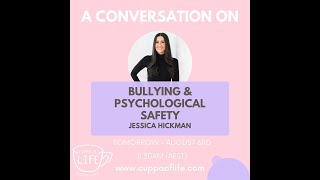
In this interview, Jessica Hickman shares her journey from a Welsh newcomer in Australia to a people‑and‑culture leader on a massive oil‑and‑gas construction project in Darwin, where she created mental‑health programs for 7,000‑10,000 fly‑in/fly‑out workers. Despite early successes and awards, she endured severe workplace bullying and harassment from a senior HR manager, leading to extreme burnout, physical illness, and a hospitalisation. Her recovery involved meditation, mindfulness, Reiki, and a spiritual awakening, which inspired her to found Bullyology in October 2017. Hickman defines bullying as repeated, intentional, health‑harming behaviour and distinguishes it from harassment. She discusses the shift from traditional schoolyard bullying to pervasive cyberbullying, the impact on youth, and the importance of trust between parents and children. Central to her message is the concept of the upstander—recognising wrongdoing and acting to correct it—contrasted with the bystander effect. She offers practical advice for parents, teens, HR professionals, and individuals on how to confront bullying, challenge unconscious bias, and create supportive cultures. The interview concludes with a symbolic reminder of her commitment: a cup emblazoned with “I commit to action. I’m an upstander.”
Chapters
Good morning, good morning. My journey began in the humble hills of Wales, as you can tell by my accent. I've always really had a passion for social impact, and I came to Australia in 2013 with a backpack and a dream. And I came for a 4-month career break, trying to decide what I wanted to do. So I was very fortunate to be offered a role leading people and culture teams on a large oil and gas project.
Wow.
In Darwin. So we were on a large construction project with 7,000 to 10,000 workers. I was working and looking after a workforce that were fly-in, fly-out workers living on our camps for 4 weeks at a time, away from friends, family, isolation, loneliness that come with all the complexities of alcohol, binge drinking, and really mental health. So I was allowed to create amazing culture-based programs, make local partnerships really focus on mental health. So you can imagine me stood with my Welsh accent, a Welsh chick going, "Let's talk about mental health," to Aussie and Kiwi scaffolders. So it was an uphill journey that over 6 months I would spend every day walking 6K in my hard hat and Minion boiler suit, really nurturing and building a strong relationship of trust. People started to use the mental health hotline, started to look after their peers, even crack some of the tough nuts that didn't believe about talking about mental health and got them as champions. Was very lucky that got a lot of traction and funding and a lot of media support, and I was nominated for Northern Territory Young Achiever of the Year and Exceptional Women in Resources. All great on paper, but 6 months in, I had a new HR manager and my life drastically changed. The more successful I became in my role, unfortunately, the more the bullying and harassment heightened over a period of time.
So let me just stop there. So you got bullied and harassed by an HR director?
Yes. This person really, now I understand they felt threatened by my competency. Sure. So I was very much nurturing in the H, the human element, and this person would say they're very much IR. And the soft, fluffy stuff had no place in the construction industry. It escalated to even physical bullying where I'd have to be publicly berated, have things thrown at me. So it was challenging. So I reported the bullying 32 times and we went through a pretty horrific period where I remember watching him bully another person. It was actually the cleaner and her in tears. And I thought, enough is enough. My body was heightened for such a period of time. We're in the construction, oil and gas industry. So I was working 60, 70-hour week, filling everyone else's cup, but not filling and nurturing my own. So what happened was I started to develop a lot of physical, mental, and emotional signs really that I ignored. And that really manifested into anxiety, sleepless nights, heightened constantly. And sometimes I would even vomit before work when the bullying was at its height. I actually collapsed at work where I suffered extreme burnout. And that was really a sobering experience to find myself in a Darwin hospital. Well, friends and family on the other side of the world, young girl thinking, I've done everything in my power and even won this company millions of dollars of work for the culture-based program in all the media. Awards as long as my wall. And yet they couldn't even protect me. So how could I create this culture? So yeah, that was really when I had to leave because a long time I believed the false promises that it would stop. I felt that I needed to also support everyone else. But yeah, I had to learn a bit of a tough lesson that shook me and woke me up. I went on a healing journey and that's where, you know, you always find light in the dark. And really, I found the spiritual element of myself. I found meditation. Meditation, mindfulness, holistic health, studied as a Reiki energy healer, and just really emerged myself into understanding the mind, body, and spirit connection. And that's when I made a commitment to, um, not allow myself to be a victim of my circumstances, but really harness and use the power of my learnings to emerge myself into understanding bullying, harassment, tall poppy syndrome, and really understand why people become bystanders and not upstanders. And that's when I founded Bullyology in October 2017. So what I really do is actually not only raise awareness and education on bullying, harassment, and toxic behaviors, but shift people from bystanders to upstanders and take a proactive approach similar to schools. Really, the core concept behind Bullyology and what I do with the upstander movement is help people build capability to recognize one's own unconscious bias or language modernise mindsets and create change.
Define bullying for me.
So bullying is repeated, intentional, health-harming behaviour. So the person has intent to damage the health and safety of an individual or a group of people. And then we've also got harassment, which really falls under the banner of discrimination. People hide behind, oh, it's just his or her personality or just their leadership style, and that's just not acceptable.
No, it's not.
And also I hear the language, "Well, this is the way we've always done it," and in this 21st century modern world, that's not what we can stand by now.
And the forms of bullying has changed, cyberbullying now.
If we typically look at schoolyard bullying, it would end at the school day, or even workplace bullying, you would come home and be in, hopefully, in the safe haven of your home where maybe you could unwind, get some family support, but what we're seeing now with technology, there's no break between, um, working, school, or coming home. And unfortunately, that's really impacted a lot of stuff I do with youths at the moment, is looking at the anxiety and the addiction to mobile phones.
How can you advise teens to be upstanders, um, as so often cyberbullying is very targeted to the personal and the individual?
My advice to parents always is to trust So really building that trust with your child to let them know no matter what has happened online, whether someone shared, you know, a sexual image of you, which we see all the time, or nasty comments or taking pictures of you at a party you shouldn't have been at, whatever it is, you can trust us and speak to us. You need to build that trust with your youth that they can come to you and tell you whatever. And that's my biggest advice to parents, really, and check in with them constantly. And tell them that if there's something you've seen online, you must tell us and we will support you the best we can.
Define upstander for us. How do we be better as individuals?
Yeah, so really upstander is recognizing when something is wrong and acting to make it right. But it's hard to understand upstander without first recognizing when we become a passive bystander. The bystander effect, really, the easiest way I can describe it is we're driving down the highway someone's broken down or had an accident, and one or two people at the scene. What do we do? We think, ah, not our responsibility, someone else will deal with it. The more people that are at the scene, the less likely we are to stop and involve ourselves. Really, a key mission, um, of mine is to help people understand the bystander effect so they can recognise where they've become a passive bystander, or maybe where they have a bit of unconscious bias towards a certain person or gender, whatever it may be. There's a lot of things we can do to be an upstander that isn't necessarily taking on the bully, but really it's understanding how we can actually recognize and act.
As an HR professional, what advice do you have for dealing with our colleagues in HR who may still take the approach of sweep it under the rug?
I would really say that you need to actually lead by example and have these challenging conversations. And again, if it's not being resolved within your team, that's probably something you need to escalate up, um, leadership change because the standard you walk by is the standard you accept. Ah, well. So, so if really you're allowing these behaviors to happen within your team, really that's just something that is accepted throughout the organization. So again, it is uncomfortable and it is challenging, but my advice would be to seek advice with your leader or someone, a peer you trust across the organization, of how to approach this because it's not a one-size-fits-all.
Is it best to to check with the person who's just been bullied first before even approaching what the problem is.
Yeah, depending on the comment, you can actually say, I've said in board meetings, actually that comment isn't appropriate and challenged it, but I would always have a conversation with them afterwards because a lot of things with unconscious bias or behaviours or language, they don't know until you challenge it. Right. If there is bullying, harassment, and it is making you uncomfortable and it is your leader, they would definitely prefer you speaking to them one-on-one because if you challenge a leader in a group setting, that could actually turn quite nasty.
You've got a special cup.
I have got a special cup. It says, "I commit to action. I'm an upstander." Then it's got a picture of me to remind me to always be an upstander against bullying and harassment.