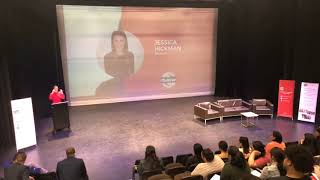
In this opening segment of a live workshop, the emcee (Speaker A) greets the audience, humorously asks for lower‑quality photos, and issues a trigger warning for potentially sensitive stories that may be shared later. The emcee emphasizes the importance of a safe, open environment and invites participants to step out if needed. The emcee then introduces the first speaker, Jessica Hickman, noting that she is based in Australia, is the founder and director of Bodyology, and will be speaking about her work. The segment sets the tone for the event, establishes audience safety protocols, and provides brief background on the upcoming presenter.
Chapters
And if you're gonna take photos of these of me, can you just lower the quality? Because I feel like I'm standing up here looking like a car crash this morning. So if you guys can kind of control that and make me look like— I don't want to look Instagram good, I want to look like Bibo good. Do you remember Bibo? For some of us that remember it, yeah. So I want to look like Bibo profile or like Instagram bad photo. That's kind of what I feel like I'll do my best for. But yeah, thank you Jay for your workshop. I hope that I've and inspire you to think about having a discussion, not only in this wider group setting but within the networks that you go out to from here. And yeah, so it is my privilege to continue to— Oh, welcome guys! Guys, this is friends, friends, this is guys. We've met before, we go way back.
Cool.
So yeah, Also, this should have been a warning yesterday as well, and I kind of forgot to say it, but there might be some stories that are shared today that might trigger you. So if at any point you feel the need to get up and take a breather outside, then by all means do so. So this is just an opportunity for you to continue to feel safe in an open environment like this. But enough of me talking and me getting sick of myself being up here. So we're going to carry on with our first speaker of the day. So I'd like to welcome Jessica Hickman to the stage. Just a little about her, a little bit about her. So she joins us from Australia. She is the founder and director of Bodyology, and she's here to talk about her stuff. So Jessica, the floor is yours.
Hi everyone. Thanks for having me here today. I'm Jessica Hickman and I'm from Wales. I live in Australia, so I'm a long way from home. But today I'm going to share a story of what brought me here today. So today, somewhere in the world, someone will lose their life to bullying. Can I just get a raise of hands if you've ever been affected by bullying, whether bullied or seen someone bullied, or someone in the family or someone at school? Yep, don't be ashamed. There's a lot of us out there that are suffering silent battles. So even though I'm from Wales and live in Australia, we are a global community and bullying is very topical worldwide. So rather than stand here and tell you a load of stats around bullying, I'm going to share my personal story of how I was a victim of workplace bullying and it pushed me to the point where There was times where I thought that I couldn't continue and survive. So growing up in Wales from a very loving family, at the age of 14— and I can relate to a lot of people in the room— I started volunteering at a local youth club. I think I've always been passionate about community work, and there in the youth club I progressed, and by the age of 19 I was in a manager's position, which was quite unusual considering some of the people that went to the youth club were at the time 25 years old, so I felt like I was doing a great job. We were talking around bullying a lot, and I never thought as an adult that I would suffer extensive bullying in the workplace. So I left, decided to go backpacking for 3 months and take a bit of a career break after studying, and I found myself in Australia. So 5 years I've been in Australia, so the 3 months escalated, and my family is still wondering, am I coming back? Where I've made a home for myself there. I was pretty lucky when I first arrived in Australia to pick up a position as a human resource officer working in the resources industry. So I worked in Darwin, which was excellent for me to get the culture of Australia. It's a wide population of indigenous people, and it was a great introduction for me. So I was working in the oil and gas industry on a large construction project. Where I thought that everyone from New Zealand was there. They were— we heard yesterday about the fly-in fly-out industry, so a lot of our workers were from New Zealand. And when I arrived there to resume my position, I was lucky enough to be given a visa, so I thought, this is my ticket to this country, this is amazing. Life was perfect. When I arrived, I quickly identified there was a massive gap in mental health in Australia. A lot of these men were big Kiwi scaffolders and didn't want to open up about their emotions. So you can imagine me standing in front of 300 scaffolders saying, "Let's talk about mental health." They thought I was a crazy Welsh chick. So I decided that there was a stigma with reporting it to HR or managers. So I decided to reposition myself and build trust, learn the culture, speak with the people, walk with the people. So I walk around the Arlan gas plant in the Darwin heat in my high-vis Minion suit, hard hat, glasses. Build relationships. My culture programmes were going amazing. I started winning awards, Young Achiever. We raised £75K for local families. People could help people in communities. Everything was perfect until 6 months into my position, I got a new HR manager and my life drastically changed. For one, he didn't believe women should be in the workplace. Let alone that I was an immigrant, as I was called. Um, you know, I'm a white woman who suffered racism, and the fact that I was a woman and I was championing for equality, representing men and women, and speaking about mental health automatically put me in a position where my gender worked against me. So the intimidation started Day 1 in his position as my manager, he pulled me into the office and told me that he didn't like the way that I worked. I was only successful because of the way I looked and was I having relationships with the workforce, and these men only respected me because I came across as weak and easy. A girl standing in front of up to 1,000 construction workers being weak and easy, that's something that I sat Certainly wasn't. It was intimidating enough to be told that. I just couldn't believe it. I was completely devastated. So I started to think that it was me. It then went on to the inappropriate requests to set up Facebook and social media accounts, sometimes flirt with the men to find out what they get up to on the weekend, find out if anyone was involved with drugs or alcohol, and stalk the men. It was just absurd. The things he was asking me to do. Then it came to the personal attacks of my appearance. There was no way I looked sexy in a boiler suit. I wore mascara because I'm a female and you should be allowed to wear mascara or lipstick or anything you want, but he would attack my appearance. One day I curled my hair as we had a corporate function and he said, "What the eff is wrong with your head today?" So I became a nervous wreck. I started to develop anxiety about the way I looked, how I spoke to people. On one occasion, a big Kiwi scaffolder came in and he was in tears. His mum unfortunately just passed away, so like any good human, I comforted him, gave him a glass of water, arranged his flight home, provided family support. My boss publicly humiliated me in front of the whole the whole office clapping and openly said, "Could you be any more desperate? You clearly fancy him." So all of everything I did was being sabotaged. He had a lot of hatred for the workforce. It wasn't only me that was being bullied, but it was me that was his preferred target. So my life became very, very difficult. I reported the bullying 32 times to upper management. I made the decision early on that I would stay and put my own happiness aside and serve the people. I was frightened that if I left, someone I cared about would end their life. When I left the project, there was reported to be 14 suicides on the project. This was a 4-year project of 6,000 people, and 14 people had lost their lives, but they were unreported and swept under the carpet. So I was fearful of leaving, plus I was on a visa. I thought that if I left, this would be my livelihood lost, and he reminded me daily that the company owned me and I should do as I'm told. So workplace bullying came from nowhere and it happened quickly, and it really damaged everything about me, my mental health. I would wake up each morning and put on this mask and be this strong female on on the outside winning all these awards, helping a lot of people, but behind the scenes I was a quivering mess. I'd get home from work and my mental health, anxiety, borderline depression, and everything just really suffered. I started to develop symptoms similar to PTSD, post-traumatic stress disorder. So we hear this commonly from people that return from the war. I would have flashbacks. My bully, my manager, joined me in the bedroom in not a fun way. I was having nightmares and I would wake up sweating thinking he stood above me. I was fearful each morning when I woke up thinking, how can I survive a 10-hour shift? I would vomit, I lost my appetite, and sometimes I would purge on food just as comfort. I would lose weight, gain weight. Relationships were affected, friendships were affected. Living on the other side of the world from friends and family, my friends were all ones I'd made over the course of the 3 and a half years. And I guess I wasn't, even though they're very loyal friends, I wasn't a good person to be around. All I wanted to talk about was my bullying. Eat, sleep, go out, everything was completely consumed by what was happening in the workplace. I was completely burnt out. I was emotional, I cried a lot, my physical health started to suffer. I started to have anxiety attacks. If I look back at my sick leave records, I try to think of how many days where I couldn't physically get out of bed and help other people. I had good days where I felt really confident and wasn't going to let it get to me, but when the bad days came They were horrific. I would spend most weekends locked in my bedroom, most of the time crying on my floor until one of my housemates would come and scoop me up and say, "Come on, let's continue." But I would— and then I started to drink more alcohol on the weekend because I just wanted to numb out the pain of a Monday morning. I would spend the whole of Sunday completely hungover, emotional, and in tears. So my parents were on the other side of the world, and it was hard for them, and I didn't want to be that daughter that contacted them consistently me just crying. So I stopped telling them what was really happening, which was a hard thing to do because I felt like I wasn't being honest with my parents. But it was a decision I made. So I carried the weight of the world on my shoulder daily. I would go into work and people have the trust in me to talk about feelings