Building the Largest Childcare Network in the U.S. with Jessica Chang of WeeCare

Jessica Chang built WeeCare into the largest U.S. childcare marketplace by first helping providers with software tools, then partnering with employers to subsidize care. The pandemic wiped out 20% of childcare providers. A $200 monthly stipend can save an employer $10,000 per employee turnover.
Chapters
Jessica, welcome to the show.
Thank you for having me.
Yes. And sharing your story is gonna be a fun time today. I want to know at the start here, for people who aren't familiar with what you're doing with WeCare, tell us a little bit about like high-level overview. What does WeCare do?
So WeCare is a childcare marketplace. Specifically, we actually service employers and subsequently service their employees, working families with their childcare needs from everything from finding childcare to managing that childcare experience. On the other side of our marketplace is our childcare providers. And we are a business-in-a-box toolset for our childcare providers. So they can focus on caregiving while we focus on everything else.
With the pandemic, a lot has changed in the work world. I know from reading an interview of yours as well, last year in 2020, you had an idea for something with childcare benefits and kind of changing the game in that regard too. Take me through what that program that you launched now entails, how that's helping people in this kind of new world of work.
Yeah, so COVID really did a number on the childcare industry. And specifically, the brunt of all of these issues really lied on families and providers. So when families couldn't afford it, providers were willing to slash their tuition to stay open and help them out. So obviously, that had a big effect. You saw 3 million women leave the workforce. You saw dozens, well, not dozens, probably 20% of the whole childcare workforce leave childcare completely and will never return.
Yeah.
And what we saw as a result was that employers were having difficulty with retention and recruitment, right? So if an employee goes to them, goes like, well, I can't go to work today. I don't have anyone taking care of my 5-year-old that's running at home and doing crazy things. So how do you expect me to actually be productive? Or how do you expect me to even be able to do anything? And we saw that there was a synergy to it as well. Because, you know, if someone needed childcare, it was really because they were working. So we really went to employers and said, well, what do you need too? And for employers, it was about retention and recruitment. And we built a network that was the largest network of childcare providers. And we had the ability to fulfill 90% of what employers were looking for, and 90% of what employees needed.
Going back to building that network, it's pretty impressive, obviously, to build that, to set out for that and build the largest childcare network in the US. Where did this idea come from in the first place to even do this, Jessica?
So, you know, the, the idea really came from my own personal struggles. When I was, I was actually a VP of marketplace at a tech company and I ended up getting pregnant and finding it really difficult to find childcare. So difficult at one point or another, I almost decided to actually leave my career to actually start my family and felt that was extremely unfair. And also unfair, the fact that I was the one, like the mother, was the one that actually had to leave and, you know, had to decide between career and family. Now, the other part of it, I think a lot of people don't know, is that I'm also a preschool owner and operator. So for me to really understand this industry, I wanted to understand what providers were feeling and understand what their struggles were to really truly be able to say, hey, we can figure out a solution that works for families and providers. So I operated 3 preschools, owned, operated, rolled up my sleeves, like talked to parents, talked to teachers, helped with kids. And before I decided to actually start WeCare.
One thing I'm curious about is with that and starting this company, did you always know it would be venture-backed company, go big with this? Like, take me through that mindset around that in the beginning. Was you going from owning a few childcare facilities to then tech company venture-backed, a little bit different on that side? Did you always know that's what you wanted from that? Take me through that.
Yeah. I've always known that, like, I've always, like, prior to actually owning and operating preschools, I was in tech. And I've always believed that it's always the private sector that pushes for change. And when you become large enough, can you really affect change? So for me, it was really a learning experience to see if I could personally affect change. And if I could personally affect change, there was something that I could potentially do that could scale that change and bring about a wider change to that childcare industry. That was always my goal from day one and is still the mission of the company is we want to make childcare accessible and affordable for all families.
What helped you the most on the, the growth and getting traction with this to getting to the point you're at now, which is, I mean, it's an amazing position, obviously launching a new kind of product as well. But what fueled that growth in an industry where there's obviously other childcare options? There's— I don't know if there was necessarily on the tech side how that was going, but what fueled the growth of WeCare?
Yeah, we actually in the beginning really focused on supply because supply was the issue, right? If you look at it, there's more and more families, but there's dwindling supply. It just doesn't make sense economically. So we focused on helping providers. And in general, most childcare providers don't get paid a lot. Like an average preschool teacher makes $20,000 a year, and it's not even enough money for them to support their own families. Let alone do one of the most important jobs in the world, right? So for us, it actually made a lot of sense because we were actually helping them start their home daycares or actually help existing home daycares actually continue on as well, that there was a strong value prop. For those that were starting, they were like, look, it'd be great if I could make 3 times more because then I would actually be able to stay in childcare. And for those that were existing daycares, it was, this has been your baby for 10+ years. And finally, someone is actually thinking about your wellbeing and helping you succeed as a small business owner.
Take me through the actual experience of working with WeCare from both sides, from the parent side, and then from the provider side. I know people are going to be wondering about that as well. I want to hear more about that side of things and how you have experienced it.
Oh boy, it's— I think marketplaces are one of the hardest companies to build. It's because it's always like a chicken and egg. Well, who do you help first? We wanted to actually focus on supply, like I said in the beginning, because I think there was more of an incentive to be like, hey, how do we actually sustain supply and grow that supply? And to be honest, like, that was a choice. Right? Like, we chose to focus, let's call it, on the egg. And then later, what we looked at was how do we actually kind of now come back and say, well, how do we help the families? Right? And what we did was actually we partnered with larger corporations to be able to actually get more demand in. Because as you remember, with the chicken and egg scenario, it's like, well, you're bringing all these providers on. Are you telling them that you're going to bring them families when there's no families? And in the beginning, we didn't say that. We said, hey, let's help you operate, or let's help you get started, right? So we had time to bring them on and then kind of go over to demand and bring partners on to be able to fulfill on that demand.
What would you say, diving deeper, I know you mentioned a little bit already, but What were you seeing that they wanted at that time on the provider side of it? You mentioned a little bit about— I want to go deeper into what they were looking for, their challenges, things that you saw you could really help them with.
Yeah, I think the first part was actually operations. Like a lot of these individuals, whether that is starting their own business or running it, they weren't good at it, right? They're like, look, I'm a— I'm good at teaching kids, but I don't want to be the administrator. I don't want to be the director. Like, I don't want to think about all those other parts. that are part of a small business. So really, that actually worked for us because they were like, well, I know how to find families because I get tons of referrals. So we're like, okay, well, great. Let us help you operate then and build software to actually be able to let you operate out of your pocket, which was really important too. It's like, well, I don't use my computer. I don't like using Excel. I have no idea what any of this software means. But I do know what mobile apps are and I can download them. And if you can allow me to function without going on a computer, great.
With the progression of your company then, so for going from that point where you're starting, you have this idea to now and being the largest provider of childcare network, I should say, in the US. With that progression, how has your role shifted and what are you thinking about most today?
Yeah. So I think the biggest shift has been we no longer focus directly on families. And really, we went from B2C to B2B2C, right? And that focus on employers was really as a result of COVID What we saw was that someone has to actually come in to help with paying for childcare. Right? Because if you think about in a traditional setting, providers need to be paid more. And if providers don't get paid more, they leave the industry. Well, how do providers get paid more? You raise tuition. So then childcare becomes even more unaffordable for families. And it's a cycle of like, well, how do we actually resolve that? And by bringing in employers, you can really answer that from a permanent solution. Well, employers can actually subsidize for the cost of childcare. Which makes it affordable for families, but it makes the provider get paid in whole for what they actually deserve.
What are you hearing from employers then in terms of their needs? And how do you kind of portray the value of what WeCare brings? Because I know from talking to so many founders in the last number of months and the war for talent and keeping talent as well as attracting talent, How does what WeCare does in terms of all the stuff you have and you can offer them in terms of childcare, how do you portray that value to them? What are they asking for in that? I'd love to hear more about that.
Yeah. So there's actually been a really big shift in employers and how they think about care benefits. I would say prior to COVID, you know, care benefits in general were really for top talent. Like, how do I keep my top talent, my managers, so they can be promoted to directors and VPs? And then there was this shift in COVID which became more about, well, how do I keep all talent? Because if you think about it, like, you know, what COVID did was it really put a focus on essential workers, people that needed to go to work. So for example, if you're a grocery chain, you don't have someone to restock your shelves or be at the checkout counter, you don't actually make money.
Yeah.
And as employers really start to rethink that thought, something that became a nice-to-have became a necessary benefit that we have to have to keep our employees. And that was an interesting point for us because when employers were thinking about that, they really came to us and asked, well, do you have a lot of different locations? Because some of my workers are now working from home, right? So I need more locations, but I also need something that my $15 or $20 an hour employee can actually afford. I can't send them to something that's going to cost them $3,000 to $5,000 because then they're going to look at me and be like, that's not a benefit. And so the shift in thought actually really spurred employers in asking for a network that was really affordable and accessible for all of their employees.
With that and using WeCare, and I want to dive deeper into this, like, What is the difference in terms of cost savings, whether it be percentage or dollars, whatever, with using WeCare versus other options? How do you get to that point too? Because I know, you know, people are going to be curious about that as well. I'd love to hear more about that.
Yeah, so I'll just give you the average. An average preschool— this is across the nation, so like, mind you, California and New York are that, that much more expensive. Of course, across the US, an average daycare cost is Probably around $1,200 to $1,500 a month. That's daycare. Nannies, you're probably ranging between $4,000 to $5,000 a month. An average home daycare, and this is across the nation, so these stats are out there, it's probably closer to $650 to $850 a month.
Geez.
So there's significant savings, and the reason why there's significant savings is you don't have overhead. Right. If someone operates a licensed home daycare, they get to do it in their home and then they have a ton of tax write-offs too, because guess what? You're running a small business out of your home.
Yeah, it is interesting to see that difference. I imagine a lot of people just don't understand or know what's available in that regard and what they can save. So it's like having them understand it first and be like, wait, what? Yeah, you just save all this. It's kind of insane. I was looking at the website and looking more about The savings and just the comparison. It was pretty interesting to see how much the difference was in like an average city. And it's just, it's insane. It's a lot. It's a ton from that as well. And one thing I'm curious about too, with the future of work, with your company itself, like how did you adapt in terms of the environment of going through COVID and everything we've had the last 18 months or so? How has your team changed at Weekcare?
Oh wow. So I think COVID, I mean, it was interesting. First of all, everyone went remote, right? So suddenly you were like, every day we see you guys at work. Now we have to figure out how to work remotely. And, you know, childcare got hit really badly. Like when COVID started, childcare was one of those industries that completely almost shut down, like for a couple of months.
Yeah.
And so it was hard and we had to rethink how childcare was consumed and that's what employer benefits really took off. But even between that, we even created a health screening toolset for our providers so they could stay open. And to be honest, 90% of our providers actually stayed open throughout COVID, didn't shut down for one day. But that, that's kind of the kind of environment that you want, right? Like, if you look at a traditional company, they're not going to be able to do that. But when challenges are hit to a tech company, this is where you utilize all of your resources and you power through. We created a health screening toolset. We were able to sell that to not just daycare providers. We sold it to universities and even restaurants. And then that helped actually increase our revenues. And then through that, we discovered corporate benefits, which ended up actually really taking off for us.
With what's next for We Care, you're launching this program. I'm curious, like, what have you seen already? Anything more around with, with the childcare benefits, what you've seen already in terms of the impact and what you think will happen next 1, 2, 3 years kind of moving forward with this too?
You know, I'm gonna answer the second question first. I think what really is going to happen with childcare benefits, it's become, it's going to become the norm for companies, just like health insurance and 401 did previously. Childcare as a benefit or care benefits are going to be commonplace where employees are going to look at a company and be like, why don't you have this? What is great is that from a benefit standpoint, it's probably one of the easiest things to give like an employer in terms of an ROI. Like employers always ask this, if I start spending this money here, what do I get out of it? Right. But it's probably one of the easiest things to be able to really quantify. So for example, let's say you are looking on retention and recruitment. We all know industry standard is if you lose an employee, it's probably going to cost you 20% of their annual salary to To recruit and replace that employee. But when it comes to, you know, a monthly stipend, you literally can pay 4 to 5 times less than that recruitment cost by offering just a monthly childcare stipend. It's like if an employee makes $50,000, it's going to cost you $10,000 to replace them. But instead, what if you gave that employee $200 A month for a monthly stipend, which is like 25% of that childcare cost. $200 equates to $2,500 at the end of the year. $2,500 is 4 times less than $10,000.
Are you, are you seeing any pushback at all from people you talk to about this? Because I mean, it seems to make complete sense when you're explaining it. And it's like, of course, this is the future. Do you get much pushback from companies or what does that look like from companies?
You know, we actually have so much interest coming from companies that we don't have enough people to service everyone. But I think the biggest pushback is a timing thing, right? It's like, okay, not right now. We'll do it, you know, this is gonna be a big next year initiative, but we need to be educated on it. So I think, yeah, so that probably is one of the other things is we're, for this industry, because it's so new for a lot of employers. We're building relationships, but most of that time we're spending on educating them. Like, why is this important? How does it actually benefit your employees? And how does it actually help your bottom line?
Tell me more about that piece with the education side, because I know there's a lot of businesses where they're kind of leading the way in the forefront of what their industry is doing. What does that education piece look like for you at We Care?
Yeah. So it's a lot of webinars. It's a lot of talking to benefit brokers. It's usually them that kind of makes those suggestions to large employers. It's also really giving them a landscape of the industry and asking them what they're trying to solve. It's not surprising that a lot of employers don't actually know how many employees have children or if they need childcare at all, right? Like most of our employers, we asked them like, well, we don't know. We really don't know how many employees have children. And so really like what we're really helping them was educating them on what's the norm, why it's important, but we're also providing data back to them because as a tech company, we can see exactly who, what, what type of childcare people need, where they're looking for childcare, how much does it cost, what they can afford. And that data is really useful for them on deciding what I can do in terms of a benefit that is going to help my employees.
Yeah. And it's with this new world of work and remote work and everything, it is just evolving quickly and people don't know what the norm is. And to have more data, you know, that you guys have, which is great to be able to provide that for them and, you know, give them some guidance on what to do. I think that's the most important thing. I know at Vitalyze, we always kind of think about companies that have Some data in some capacity that's really useful and beneficial that they can stand out with. And I imagine We Care with that side of things is going to be able to do a lot, which is exciting. Why we're invested. And what's the best way for people to get in touch with you, Jessica, and learn more about We Care as well?
Yeah. So for employers, it's pretty easy. It's benefits@weecare.co. So W-E-E-C-A-R-E. For others that just want to understand maybe the benefits space or talk about childcare, you could just email me at jessica@weecare.co. So weecare.co. And if you're just a family, you can also just go to weecare.co and look for childcare as well.
Perfect. Jessica, thank you for coming on the show today. Really appreciate it.
Thank you for inviting me and Happy Thanksgiving.
Happy Thanksgiving indeed.
More from Jessica


Founders exchange: Creating community for working moms with Jessica Chang of Upwards

Jessica Chang of Upwards on Solving the Labor Shortage through Democratizing Child Care
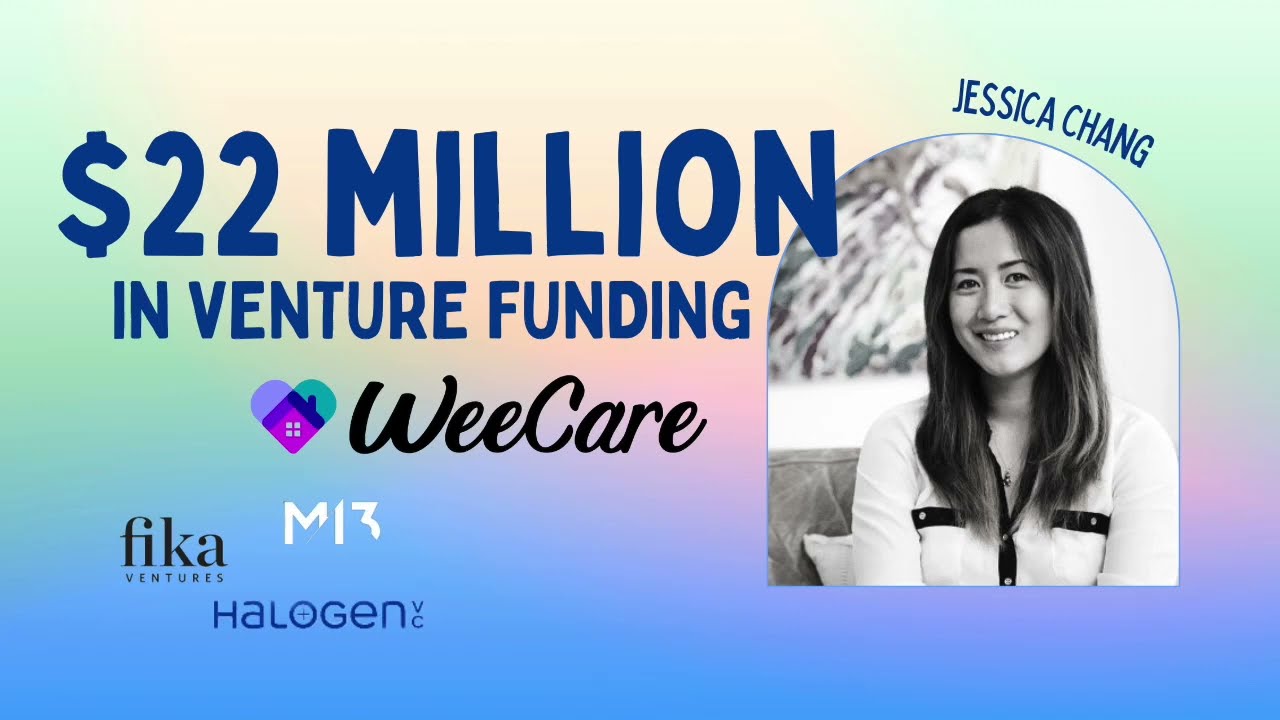
Jessica Chang raised $22 million to build WeeCare, the largest childcare network in America

How She Got on PBS and How it Exploded her Business with WeeCare's Co-Founder Jessica Chang


Upwards on PBS NewsHour | How a tech startup is making quality, affordable childcare accessible.