Jess Lee, Partner, Sequoia,CEO,Pllynore/ Xuhui Shah, VP, Yahoo
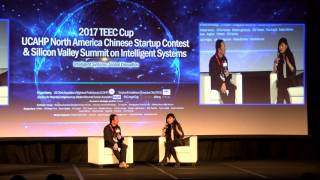
Jess Lee moved from Google PM to co-founding and running Polyvore, then joined Sequoia as a partner. She talks about building a startup, hiring, and why she's now betting on consumer products, AR/VR, and AI.
My name is Shaoxi Hui. I'm right now at Yahoo as an engineering VP investment. But today is not about me. Today is about Jesse. And Jess Lee, if you haven't seen the news headlines, is the newest member investment partner at Sequoia Capital. And before that he was the CEO. She was the CEO and co founder of Polyvore, a style and shopping app company that was acquired by Yahoo in 2015 for a rumored $200 million. And Jesse was also a product manager for Google Maps before that and has a degree in computer science from Stanford University. Jess is half Chinese, half Japanese and grew up in Hong Kong. And she's on the Fortune magazine 40 under 40 list and in the Glamour magazine 35 under 35 list. So very impressive resume. And welcome, Jess, to this conference.
Thanks for having me. I should also mention that two of the co founders of Polyvore are Tsinghua University alumni. So big fan of this and really amazing to see such a great alumni network hosting such a big competition here.
Okay, so let's get started and I've prepared some questions and first I'd like to walk through your background and your career a little bit. And one of the things you notice, there's a lot of people here either from China or have Chinese background and you're from Hong Kong. And tell us a bit about your background, your upbringing and how that influenced your career.
So I was born in Canada, but I grew up in Hong Kong. I lived there from age 2 to 17 and then I only moved to the US from for college. My mom, who's Japanese, was an entrepreneur, so she ran a small business interpretation translation service. Not a tech company or anything, but she ran it out of our apartment in Hong Kong. So I think I grew up seeing a female entrepreneur and that certainly helped me think about. I never ruled out the fact that women could be leaders, so I think that definitely helped. As for the upbringing, I think Hong Kong is such a global, multicultural city. So having lots of different perspectives that definitely. And then I think Chinese culture, the half Chinese part of me is, you know, Chinese culture is very entrepreneurial. I think that was a huge part of what influenced me to become an entrepreneur. And then interestingly, the Japanese side, Japanese culture is a lot about craftsmanship and high quality. So I think polyvore was an interesting blend of two of those things, the entrepreneur side. But we were also very design focused and cared a lot about like the craftsmanship of the website and the app that we built. So I would say maybe that's some of what Influenced me.
Okay, you mentioned the two co founders, Jianing and Guang Wei. They're actually computer science classmates from Tsinghua University. And perhaps as a coincidence or as a result, they hired more, you know, Chinese engineers or managers with similar background and that you're familiar with, you interact with in the last many years. And how do you see that as a advantage or disadvantage? And how do you leverage these kind of unique background of theirs?
Well, I think at the end of the day, startups are, they're really hard. The average successful exit takes seven years. And not everyone realizes how much work and blood, sweat and tears goes into it. And the one thing that makes it worth it to come to work every day is not just the mission of what you do, but the people that you work with. And so you want to hire great people. You want to surround yourself with people who are smarter than you, who are amazing at the one thing that they are best at, and people who you get along with. So recruiting, it turns out to be one of the most difficult and most important parts of building a company. It's not just the technology, it's not just the product or the customers or sales, it's recruiting. So if you can tap into people from your network and you have a big network like the Tsinghua University network, then that's a significant advantage. So we did have a lot of Tsinghua alumni at Polyvore, one of our engineering managers, one of our architects, a lot of Tsinghua blood thanks to them. And I was able to recruit out of Google, where I worked before. So I would say definitely tapping into your networks and to your background is incredibly important. Yeah, it's a unique advantage, I would say.
Right. And going back to the very beginning, it's also a very unique story that you were at Google and you discovered Polyvore, you actually become a user and then you wrote in some suggestions. Tell us a little bit more how that played out.
Yeah, I mean, I was very happy at Google working on Google Maps, but one day somebody showed me Polyvore and I fell in love with it. I was a very active user who wrote in with some suggestions and complaints and then they wrote back and said, hey, these are great ideas. Why don't you just come fix this stuff yourself? So that's how I ended up at Polyvore as the first product manager. And then as the years went on, we just kept growing and my role shifted a little bit and I just kept volunteering to do new things. And at some point, Jianing and Guangwei and Pasha, the other founder, came to me and they said, hey, we've always thought of you as a co founder. We'd like to officially start calling you a co founder. And just that recognition, I think, is a really rare and very generous thing to do and it meant a lot to me. And then after a few more years after that, I stepped into the CEO role. So it was a very unusual path to being a CEO. I went into Polyvore thinking, I just want to go and learn as much as possible about how to run a startup so that I can start my own company one day. And then Polyvore somehow became my company. So it was an amazing journey.
Yeah, that's a very unusual, impressive story. So does that mean that one of the advices you can give to the entrepreneur is that always leave some space for maybe a future co founder to emerge?
I haven't heard many stories of that happening, so I don't think you have to reserve that space. But I will say maybe the lesson that I took away from that, and I think part of the reason why I was able to grow within Polyvore and just sort of a general philosophy is volunteer to do the hard and important things that aren't getting done. What happened with me at Polyvore is we were all writing code in the beginning because at the end we had to write the product, the features. But then anything new came up, like, oh, we need a new office or we need someone to talk to the people who want to advertise on the site. I would just volunteer to do it, partly because I was maybe the worst engineer out of the four of us. So it was, let me volunteer to do that. I just kept volunteering and that in turn led to me running those departments. So I started doing our sales for ads. And then I realized I don't really like sales. I'm not that good at it. So I ended up hiring someone to do sales and that person reported to me. And then by many years in, I found that I was running all the departments except for engineering. And so that kind of led naturally to the CEO role. So that's one piece of advice. Maybe the other one would be optimize for maximizing your learning. I think that's what I went into Polyvore thinking. I was like, I don't know if this is going to work or not, but I know that I will learn a lot of things along the way. And if you just keep maximizing for learning versus success or failure, then you always feel good about your journey because you know, I mean starting a company is. You're not guaranteed to succeed. In fact, the odds are against you. 99% of companies fail. So you shouldn't go into it thinking like I must succeed. You have to go into it thinking, well, of course you strive to be the one, the one, the few that succeeds. But you always have to remember I'm learning along the way and that is a really valuable experience.
Yeah. So as you mentioned that seven and a half years since you joined Polyvore that finally it's acquired by Yahoo. That's a long journey. And you started from doing the hardest thing from the bottom and then work all the way to become a CEO and co founder. And what I'm interested is what are the greatest failures or lessons you've learned along the way?
Well, it's not like there was one big failure. It's like there were many, many failures constantly. And I think that's one of the things that people don't realize. Starting a company and running a company is so hard. Right. There's lots of little things need to. There's so many variables of things that can go right or wrong. And when you stack up all those probabilities of will this go right? Even if it's 80% chance of this one thing going right, which is pretty good, you have to multiply that by the probability of this other thing going, like recruiting the right person, defeating your competitors, having the right technology choices. When you multiply out all those probabilities and let's say 80% is pretty good, you basically multiply it all out and you get some very low percentage of success. So you have to know that going in that you're going to be failing constantly along the way. And I would say a lot, there's a lot of them all over the place, but there were, you know, people I think, you know, you'll get better as you go along, but you're always going to make some hiring mistakes and you're going to want to give people like a shot and believe the best in people. But when you wait too long to take care of one of those problems, especially the higher up in the, like an executive, then it has so much damage on the organization. And so just being too slow at that is probably one is like a critical failing of mine personally, not moving fast enough on those things because I want to believe the best in people, but it's really not one failure. It's just like constantly.
Yeah, yeah. One of the things, as you start to explain your journey to, from a, the first product manager of Polywar to become the CEO and then become the honorary co founder. And at what point you realize that oh, I'm going to be the CEO, there's no better, you know, because a lot of the entrepreneur or startup companies I talked to, it wasn't a very scientific process. Just pick because they have more than one co founder, one of them becomes CEO or they need to hire another CEO. It's always kind of important question for them to solve. Any advice? When do you realize that you are versus the other co founders or hiring somebody from outside?
It wasn't my realization, I would say. I think the problem with the CEO role is that the job evolves as the company evolves. So when you're smaller, all you care about is product market fit, right? And so maybe all you care about is engineering and product management and you could be the perfect CEO for that moment in time. And then maybe later it's about, it becomes more about sales and then the CEO needs to be the head salesperson. And then maybe later it becomes not true. I mean the journey, you know, depending on whether your enterprise or consumer is very different. But later it could be that, you know, the product that you're building is not just the product, it's actually the organization. So it's about if you're running a 6,000 person team, it's really not, you're not making the decisions about the frontline product details anymore. You're making decisions about executives and the people and the strategy and leaving a lot of that to your team. You have to empower them. So your product that you're building is the organization and making sure the teams all work together properly. So the hard part about the CEO role is that changing underneath you. And I certainly felt this like just when I got good at being CEO, the job changed and I'm back to square one and it's, you know, experiencing failure all over again and then learning and then failing and then learning and failing. So I think the most important trait to be one of the founder that goes all the way through to, you know, from the beginning to the end is actually to have a lot of humility and self awareness of what the company needs versus ego about. I'm awesome at everything you need to see like this is what the company needs right now. I either need to get good at that or hire an executive who can help. It doesn't have to be that you step down as CEO. If you need sales at this time, maybe you need to hire a great CRO, which is, which is what I ended up doing. I knew sales was very important and finding monetization, but that I was not the right person to do ad sales. So we hired a fantastic CRO to help with that. So it's really about that. There was no moment in time where I realized, but I think there were a lot of. We just looked at what the company needed at that time and actually one of the co founders who was CEO is the one who suggested it, which I did not expect.
Yeah. So again, it's a long journey. One of the things that I just came, I'm curious about is that it, you know, I just find out that truly you don't understand a single word of Chinese, but yet the co founders are Chinese and then there are many engineers and managers Chinese. And so it's a cultural question, how do you get along with them so well. Right. You know, even though you don't have the advantage of like speaking a native language with them.
So one of the things I'm most proud of about Polyvore was we've actually won, we won a lot of company culture award. So we won great place to work 2015, top workplace in tech. Even though we were a tiny, you know, 125 person startup, we were alongside folks like Google or Twitter or Workday. We also won best place to work for diversity and for women in 20, 2015 or 2016, I think. So those are some things that I was, I was really proud of. And I think the reason for some of that is the way we ran the company was very much about, let's focus on try to make things about outcomes, not output, so the results and try to make things about as meritocratic as possible and you have to work really hard at that. So things like making sure that the goals were very clear with metrics and numbers and having each team honestly report whether things were going well or not, but then also making it a constant part of the conversation to talk about what's going well and what's not going well. Like if I get up in front of the team and say, here's what's not going well, here's what I didn't do. Right. That sets an example for the team to be able to say, oh, here's what we didn't do, right. So you just get a more honest, more transparent tone to the company and it's all about the, it's much more about the results and the outcomes, not just the outcome output. Does that make sense? Like it's not just about I did this, I Did this, I did this. Like, I did a lot of work. It's like, did that work help the company or not? And that's the equalizer across all cultures and all genders and races and ages. It's did the work, you know, was it good?
Yeah, I think the culture is really important and you set a really good example. Because I get the privilege to work with you at Yahoo for a short period of time together as co workers, and I get to see some of the things in action. But the question for the startups, the young startups today, is that when should they start to pay attention to that? Some of them may say that, oh, when the company become bigger, I will get to it. And now I'm too busy to worry about it. Or do you think it should be earlier?
Well, no matter what, you have a culture at your company, whether you're consciously shaping it or not. The culture is often the extension of the personalities of the founders. Right. And their beliefs and philosophies. They set the example and that becomes the culture. So you can either pay attention to it and try to shape it a certain way and recognize it, or you cannot. I would say you should do it. You need to. You're setting norms anyway. You might as well be explicit about it. It just saves time. Because when you're going through all the ups and downs, especially when you're in the downs, right. Culture can be one of the things that lifts the team up and makes them believe and makes them want to keep going through the hard times. And the hard times are the ones where you really prove your leadership ability. If you're strapped to a rocket ship and you're going, you know, people will put up with a lot of problems, a lot of bad things, a lot of bad culture, as long as you're winning. But if you're not winning, and there's always going to be moments where there are setbacks, like that's the moment where you'll lose people and they'll not want to stay. So culture helps keep you together.
So now let's talk about things from the investor side. And of course, you know your news. The news about you joining Sequoia made headlines around the Valley. And why did you decide to become a venture capitalist? And why Sequoia?
Yeah, I felt like one of the best ways I could make an impact was to leverage all the painful lessons from my startup journey and take that and help the next generation of entrepreneurs. I did definitely think about doing it all over again, and part of me still wonders, but I Thought that part of what I loved about Polyvore was we ran the company almost like startup school is what I like to think about it, because I figured we may or may not succeed, but at least we can teach everyone on the team how to run a startup and then maybe some of them will go on to succeed. And we have had folks from Polyvore start companies, many of them, and that was something I always took great pride in. One of our interns went on to start Stitch Fix, and she's just been amazing. So it's a great source of pride for me to see that. And just knowing that I would feel that way about entrepreneurs that I worked with made me want to do it. As for why Sequoia, what's amazing about Sequoia is it's been at the top of its game for over 45 years, right? That's a long time. That's a lot of success through multiple generations of tech cycles, multiple generations of people leading the firm, generations of different kinds of leaders who are become founders and entrepreneurs. So it's somehow managed to have this tribal knowledge about what works and what doesn't and successfully hand that down from generation to generation while also obviously evolving with the time. So the idea of going where I could learn from some of the best and have that platform to help the next generation of, you know, to help my founders, combined with that, I really also appreciated that. I felt like Sequoia has a very global perspective, which is important to me. So Sequoia was actually quite early to establish. The Sequoia China office was created, I think 12 years ago now. Now it's very obvious. Of course you have to be in China, but back then I think it was a lot of other VCs thought they were crazy, but that just turned out to be incredibly smart. So the global flavor was also a big part of it.
Okay. So yeah, the China angle is very, very, very important. Of course, you know, people here love to hear more about it and any more to add on, I know your VC life is only a couple months and how do you find that VC life so far?
I mean, it's literally been. I think this is my fifth week. It's been amazing. It's so inspiring to meet so many entrepreneurs to see some of the pitches here I really liked. It's so great to see the passion and then also the idea of being able to help through all those tough moments. So I'm very, very excited.
I'm sure a lot of people want to hear about what is your favorite sectors Investment focus. And how do you think about AI, intelligent systems or other things?
Yeah, I mean, I think it's great that the theme of this conference is intelligent systems and AI. It's clear that that is we're finally at the point, I think in terms of the algorithms, plus having access to lots of data and massive computer power to be able to really tackle the problems. And there's so many applications. What I'm interested to see is if I've noticed that there are almost two types of companies. There are ones that start with the business problem and then apply AI to it. So maybe something like reading MRIs, replacing or self driving and then you apply AI machine learning to that. And then there are companies that are trying to build a platform or tool chain around AI. We saw one today at today's pitches. But it's going to be interesting to see which can both of those succeed. Where will we see more success?
Cool. Any other personal favorite areas that you're going to spend more time in the next few months?
Yeah, I'm very interested in anything consumer related because that's sort of my background. That's where I can feel, very feel that I can be helpful to entrepreneurs from a product and design standpoint using my PM background. But AR and VR are big ones and I think I'm also quite interested in some of the consumer hardware. So the drones of the drone companies are very, very interesting to me. Internet of things, all of which have AI applications on top of them, but those are some of the areas I'm pretty interested in.
Yeah, I saw people taking notes already. Okay.
And you know, I would encourage you to come early to speak to me or to Sequoia.
Yeah, of course. You know, today I think 90% of the people here are entrepreneurs and many are, you know, either based in Silicon Valley or come from outside Silicon Valley to try to pitch to investors or potential investors to raise money. Do you think right now is a good time to raise money? Any advice to these entrepreneurs?
Yeah, I mean, now is definitely a good time to raise money. I think the market's not quite as frothy as it was in maybe 2015, but there's always money for fantastic ideas from fantastic people. What I've seen so far in terms of maybe pitch advice is there's the product, the market, the team. I've noticed most of the presentations were structured that way. I think that's fantastic. I think one of the things to really think about is the market size and how to capture that to show that it's as large as possible. Demos are always great. Yeah, I thought it was good to see such variety here today.
Cool. And now any advice for the founders and if you were talking to them and what general and I know that there are secret sauce you probably don't want to share, but what general advice do you want to give to those funders if they were to pitch to you?
Okay. There's no secret sa I would say this is just a general philosophy that I have, which was also a company philosophy. But it is best to do a few things well, both as like a person as well as a company. Like what's the one thing that you do amazingly well either as a person, as a company and to really make sure that comes across very, very clearly because it's hard to be exceptional at everything and only the truly if you're usually companies are known for one thing and being you have to be the best and the most exceptional at that in order to create the kind of like market leading companies that Sequoia is very proud to have backed over the years.
Okay. I think we're used to a our time and thank you again. Thank you so much for joining us.
Thanks.
Yeah.
And please stay at a stage for just a moment and we would like to express our Sincere gratitude to Ms. Jess Li for your support and contribution to our event. So now on behalf of the summit organizers, Mr. Xu Huisha, I would like to present you with a token of appreciation. Thank you for joining us today. Thank you very much.
Thank you again for joining us. You're only a month or so in and I hope to will see you again next year. Come back and then we can ask you more about the conferences koia and the changes you made there. That will be really exciting.
More from Jess

Sequoia Partner & CPO Jess Lee: What Great Founders Do Early and How AI Will Change Consumer Apps





Sequoia's Dannie Herzberg and Jess Lee on Building an Enduring Firm | Upfront Summit 2022


How Do I Exit and What Happens Next with Justin Kan, Jess Lee and Mike Marquez

Creating B2B2C Marketplaces Lessons from Wonolo - Jess Lee, Sequoia; Yong Kim, Wonolo

"Lessons Learned in My Startup Journey" at Founders Embassy's Borderless Summit 2018
