Are our leaders using COVID-19 for branding? America's Marketing Doctor has an opinion…
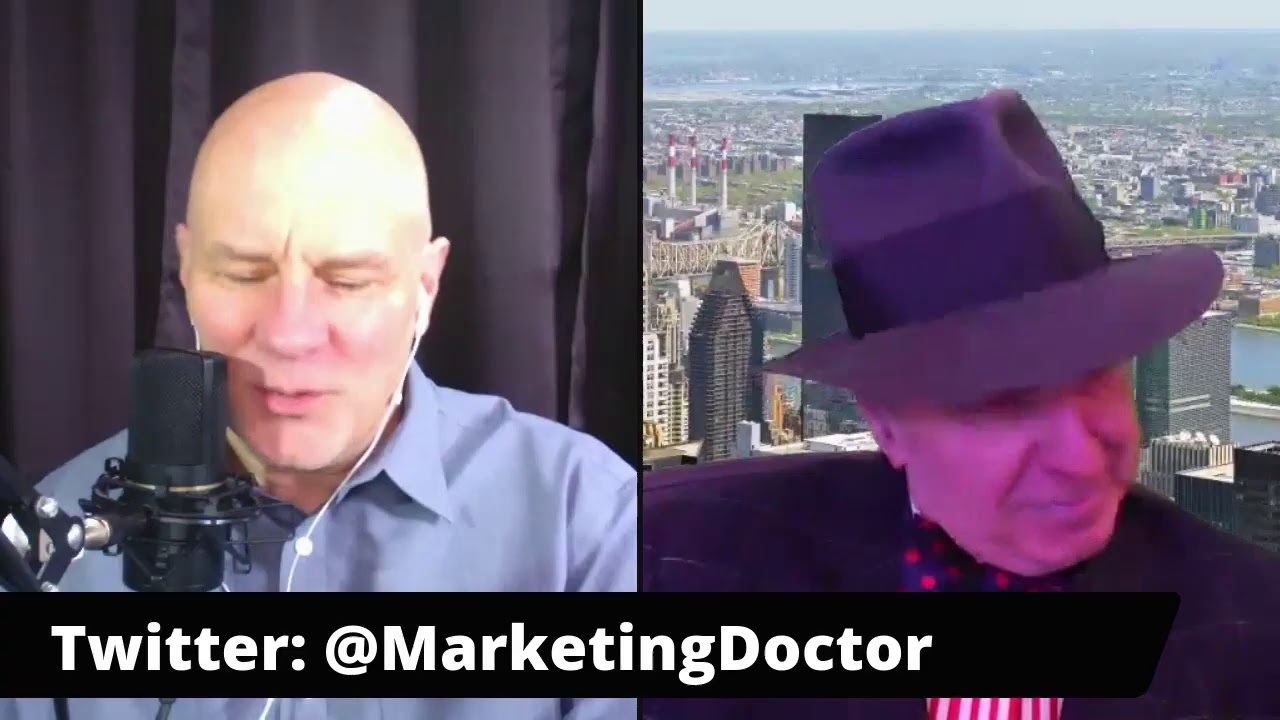
Dr. John Tantillo and Jim Bouchard examine how political leaders used COVID-19 for branding while attacking businesses for doing the same. They discuss the botched PPP rollout, partisan double-talk, and how statistical models got weaponized for political narratives. The takeaway: authenticity and consistency matter more than exploiting a crisis.
Chapters
In just a second, we're going to bring on dear friend Dr. John Tantillo, America's Marketing Doctor, and I didn't bring him on today to ignite any kind of debate about which party or which candidate has the moral high ground on all this COVID crisis stuff, but frankly, I've been really turned off by some of the actions of the candidates and officials of both major parties. I know a lot of you express the same. I know the theory in politics is what, never let a good crisis go to waste, right? But just at the same time, these leaders are asking us to stand down, and some have been really actively criticizing businesses, any businesses, and some small businesses that are marketing or promoting services during this whole mess, but it seems they have no problem exploiting the crisis for their own ends. Dr. Tantillo is a dear friend and mentor. One of America's leading authorities on branding and marketing. You've seen him on Fox, Cavuto, Newsmax. You've read his contributions in numerous national publications, and he's the author of this wonderful book right here, People Buy Brands, Not Companies. You need that on your library. So anyway, Dr. Tantillo, without further ado, let's bring him on. Hey, Mike, there you go.
The man, the legend.
How we doing there? I don't know, I'm wondering, I'm looking for your wisdom. I justified being angry at all the exploitation of the COVID crisis here. Am I just naive to think that once in a while these guys have put their swords down, you know?
No, I think you're absolutely right, and it's why, um, it's basically why people hate politics. I mean, you know, people don't care about who— most people, only Democrat. And this is what I try to convey to people, and they really don't want to deal with it. No one cares about Joe Biden's choice of vice president, especially when they don't have money for their families.
Right.
And I don't care what side of the aisle you're on. But if you are not getting your check, or when you hear that the funds have run out, and one side— and I'm not going to mention the name. Okay, but you hear that one side is calling the other side, you know, incompetent. This isn't good. And I brought this up. And I basically said this. Democrats, you must realize that 68% of the population or the electorate, better said, are not Democrats. And for that, I get really— John, I can't believe how much you've changed. I can't believe what a terrible statement that is. And you're for him.
Well, you're just, you're just watching the numbers, right? I mean, that's you know, that's part of it. Um, oh, and always, hey, thanks for tuning in, you guys. Give us some thumbs up and some hearts so we know you're out there. And also, please, we don't want to lecture at you. Please, uh, share your comments, share your ideas, show your suggestions, pick a fight with us if you want. Just get in the comment threads. We'll be watching. We're watching you on Facebook and on YouTube Live. So if you got comments, just share them and we'll, we'll pop them up and we'll address them as they come up. Again, thanks all you guys for supporting all these live streams. No, I, I hear what you're saying, and in fact, ironically Just before we went live, the news came out that the, you know, the PPP program, after all this, uh, holding off the small businesses, the self-employed micro-entrepreneurs, right? Don't apply, don't apply, don't apply. Well, a couple days ago they opened it up, and today they shut it down. And then at the same time, like I said, what, what really aggravates us, especially as micro-entrepreneurs, right, is— and I, I can find evidence on both sides. They're thumping their chest, they're patting themselves on the back, they're telling each other, you know, their own, how great a job they're doing. And yet there it is, right?
Oh, you hit the nail right on the head. And that's why, uh, people, as I said, or voters, or I would say people in general, uh, don't like partisan politics because It's, it really isn't about satisfying needs. And see, that's where I come in, where none of these other geniuses talk about, which is marketing. That's what marketing is all about. And that's why, and I was, as you well know, I was not for Trump. But He satisfied or satisfies the needs of what I call the non-Kias. Okay. A Kia is not the name of a car. Well, it is the name of a car.
And it's not killed in action.
Military friends of mine, it means killed in action.
Right.
No. A Kia is a know-it-all. Okay, and the last article or last column I did for Newsmax, I talk about these Kias. And guess what, Jim? They only make up 12% of the electorate, of the working, of working people. Okay, 12%. And who are they? They are other politicians on the state, local, and federal level. They are lawyers. They are teachers, professors. You see what we're talking about? So they're a minority. And by the way, the obverse of that is that 76% of your workers work for either small businesses and they're dictating more money should go to the people. No, that means more money should go to the teachers. Go ahead.
No, it's not just, you know, the know-it-alls, it's the know-it-all of a sudden, you know what I mean? It's these people, right? They're experts. I've got a question, and, you know, from a leadership perspective, it's interesting. Um, when Joe Biden reached out last week, I think it was, and said he would sit down with President Trump and, and offer suggestions, you know what, I, I had talked about that I think 2 weeks before that when that they were still, he was still in full battle mode. Now I understand, I understand his election cycle going on, I understand all of that, but I thought, I said, just from a purely leadership perspective, how many people might he have swayed if he were sincere and if he genuinely reached out and said, look, let's just put the campaign aside for a little while, let's share ideas. You think that would have helped him from a branding perspective?
Sure, yeah. I, it would have, but I think it would have been perceived— well, it would have been perceived from the other side as being a strategy. I think from a perception point of view, in terms of independence, it would have been a good thing. And by the way, that's what this is going to all be determined by, because the way I see it It's 30% of the country like Trump, 30% hate him, and there's a 40% that can go—
40% of us that don't know from day to day, right? And that brings us to something that happened— I don't remember if it was just— I think it was yesterday. Um, you know, every time I found an opportunity, and, and as you— as with you, um, you know, I was not a supporter any way, shape, or form along the line. Now, I've also tried to do some forensic, again, from a clinical leadership perspective, and I can find several ways that I think that Trump has responded pretty damn well to this whole thing. But every time I find a way to defend him, he goes out and does something like this. What's up with the— talk about— and talk about overt branding during this crisis, putting his name on the checks. Yeah, I've never— I've never heard about that.
Well, there is precedent for it.
Is there? Yeah.
Not on the check.
It's clever branding.
But I mean, the problem is, with our president, is that he likes to poke people in the eye. And he likes to start controversy. But let me respond to the question that have been done by other presidents. Saint Obama, when he did the stimulus package, had on the side of road, this is brought to you by— I don't know if it said— it wasn't— I don't think it said Obama. But it did say, yeah, by, you know, the federal government.
I remember the signs.
So that there was that. And I think Bush, uh, did it as well. So it of course would have been more subtle, but this guy is Mr. Promotion.
That's true.
I mean, this is the— that's his brand. If you want false humility, you have all the politicians. It's part of, of politics branding 101.
But again, like I said, am I Am I the black swan here? Do most people really respond to that? And like I said, I mean, you know, I don't want to tick through the names, for God's sake, we'd be here all day, right? It seems like an endless stream of people, every press conference, one of them from Congress, the Senate, the House of Representatives, the administration, all stepping up and getting their, you know, stamping their branding on whatever decision is made. But to me, that's extremely off-putting. Am I unusual? Do most people really see that and respond to it positive way?
This might come off as me being partisan. But it appears that what is baked into Trump is that you expect braggadociousness.
Yeah, right. Sure.
But and what I'm— when a politician does it, people roll their eyes. It's almost so that— and, and that's what drives him, quite frankly, crazy. Yeah, he can't— he can do it, but when I do it— and it's the same with, with Trump, that he gets— he's, he's not the Teflon, he's the Acro.
Okay.
Yeah. Uh, President, everything gets But, but to be fair, and I'm going to get in trouble for saying this, sometimes he asks for it. I just— oh yeah, always do what he does. But in his mind, from a strategy perspective, he thinks it, it makes the people overreacting look sillier than it makes him look.
And it has to do—
He's just doing— Go ahead.
No, no, it has to do— and again, I'm going to hold up your book. Terrific book, you know, People Buy Brands, Not Companies. And I know in there you talked about that. You've talked to me about this and you've been such a help with us with our branding. It's about the consistency, the authenticity, right? Now, we've got to get to a couple questions too that are coming up. But I want you to respond to that one first. If, for instance, if I went out and started, you know, stamping my name and everything and started bragging about how great I was. It's not consistent, right? It's not, it's not who I am. So it wouldn't work for me, right?
Okay.
Not that I'm going to try. This is a hypothetical.
Well, to respond to what you're saying from a personal branding perspective, a few years ago, I was helping a student, you know, develop a business card. To go on the job interview. And this kid was a very good-looking guy. And he put— he was asking me whether or not to put his photograph on the card.
All right.
Okay. And I said no, because it's going to work against you. Okay. It looks like you're trying a little too hard.
Okay.
My response, I guess that's my response. I personally, and if I were advising, God forbid, if I was advising Donald Trump, I mean, we would probably be at— I'd be in the doghouse more than I would be in the doghouse. Because I would, I would tell him, you can't do that. You know, and then he would, and then he would say to me, well, I got elected president, you didn't get elected president. Yeah, I mean, that's the—
and that's really, uh, you know, um, here's a question that came in from a text. Uh, thanks, Alex, for— Alex is working, she's, uh, the Wizard of Oz behind the scenes there. Yeah, things are so contentious right now, especially on social media. Yeah, duh, right? How can people— I'm sorry, I didn't mean to disparage whoever made the remark, but how can people agree to disagree? Especially as the election gets close. That's an interesting problem.
Forget about it. I have had friends that I've known for over 40 years. Yeah, that's maybe even longer than some people have been on the planet here, especially some millennials. And, you know, and it— but I gotta tell you, to say it doesn't bother me would be a lie. It bothers me. But then I remember in high school, I always spoke my mind and always got in trouble for it. I remember going up against the football team for those guys saying dumb things. And I basically said they were dumb things. And for some reason, I didn't get my head handed to me. They said, you know, John, you were right. And I had some genius friend of mine say something. And I, instead of going and defending myself, my response was one word. And it was think, just think. I didn't say think about what you've said. Yeah, I just was thinking that this was before you were around. In the 1950s, IBM had this campaign, Think, and it was in all of their corporate offices and all over their internal offices. Just think. And it was on a placard.
So sound advice.
I'm asking people to do here, think.
Yeah, it's too easy.
You don't have to agree with me.
No, no, it's too easy. It's too easy, you know. And for the person that sent that question in too, I'll post in the comments after the program, um, because I don't— I'm sorry, I don't remember the link now, although you probably find it if you just search 5 Assumptions, uh, Jim Bouchard 5 Assumptions, because, you know, those are just some some guidelines that we posted a long time ago, and we kind of update them. You know, how can we have respectful conversations, particularly in the office, but within families, with, you know, this is tough, without getting at each other's throats? And one of them, I agree with what Dr. Tantillo just said, the idea of think first. Our grandmothers taught us that. Think before you speak, right? Right. But there are some others too, and one of them is to assume— now, and this is an assumption, right? You're given— this is a gift. Assume that the other person is entitled to their thoughts and their feelings. I can't argue someone's thoughts and feelings, right? I can argue facts with you, I can debate facts with you, but I cannot argue your thoughts and feelings. Those are yours. But unfortunately, on social media— here's another— I think this one— oh, this is an interesting one. Yeah, um, you know, John, you, you're a veteran of broadcast for, you know, for years. And, uh, yeah, this whole idea about the fake news— there's so much out there. What can people actually be— oh, I see what she said. Okay, I thought she was going after the branding of the fake news. And please share your comments, share your ideas, uh, argue with us if you'd like to, respectfully. Don't yell and scream.
We'll carry on.
Exactly. I, I won't— well, I don't know, I'll put up a nasty comment if it looks like fun, but Other than that, yeah. So how— yeah, what about the fake news? How do, how do we pick the right news sources? Who can we trust?
Well, um, that's a very, very, very good question. You know, I, I remember as a kid loving, uh, Edward R. Murrow and Walter Cronkite, Everett Severide, but Everett Severide was more of an opinionist.
But, uh, but you knew it because he said so, right?
Yeah, yeah, he was very, very intellectual. I didn't understand.
This is the Five Assumptions, by the way, not to interrupt. These— this is where you can get the Five Assumptions if you'd like.
Okay, there you go, there you go. But, um, to respond to— see, I am of the opinion that when you do the news You should do it straight. There shouldn't be opinion. You should know what— you shouldn't even know who you voted for. It should keep you guessing. And probably the nicest thing I ever heard was when Obama and McCain were running.. And I was on the strategy room, and that's where we all met. And somebody at the, at the end of it, at the end of a show, I let them know that I was leaning toward McCain. And the person said, I could have sworn you were with Obama. And that's exactly the way you want it. To go down. You really don't want your opinion to be seen on the sleeve.
Yeah, and that's particularly— I mean, it's troubling from a political point of view, but now we're dealing with medical advice that keeps coming out, right? And I'll be the first, and this is one that I was defending, I was actually defending President Trump about this one because it was all this hullabaloo about him lying about the hydrochloroquine and then lying about the masks. Well, No, I mean, I followed the whole stream from the beginning. He was, he was reporting what he knew at the time, what anybody knew at the time. And I remember because I, you know, I used to be an EMT on a fire rescue unit, uh, those masks generally are not effective as a defense against most, the way most people wear them, right? And that's all they were saying. Of course, now they're saying it, it's more to contain our own germs, right?
Sure.
But, um, You know, this is a moving target and things change along the way, yet there's a lot of people that are coming out, like I said, suddenly experts, suddenly medical experts, right? Or about the business information that's coming out. And, you know, I appreciate people sharing in real time, but God, especially the medical stuff, who do you trust? Who's the sources that we can really— and I'll say that from a branding perspective, right? Because some brands in news are trusted, others aren't. I mean, I love Cheryl Atkinson. I think her reports—
oh, she's great, isn't she?
Really a journalist, right? A reporter. Not, not when she's editorializing. She clearly states that she is, right?
You know, and I, I, and I gotta say, I'm going to get into trouble for saying— oh, go ahead. I have, uh, I think that Chris Wallace is, is good.
I think by and large he is as well.
I agree with him, and that's okay. I don't have to always agree agree with him, but the guy really tries to play it, um, uh, he's a skeptic.
There you go.
What you want to be, you don't want to be partisan, you want to be skeptical. And that's basically what science is about, you know, and you want to be skeptical. And when people say, and when my sister said to me, who's— she's married to a scientist, and she's a mathematician, actually, she's a statistician. She, she said to me, well, you're a denier. When it came to global warming, I said, Diane, no, I'm not a denier, I'm a skeptic.
Right?
There's a, there's a big difference. And the best thing And I recommend this to everyone if you can do it. If you want to learn about a subject matter, you have to teach it. And the longest time I was keeping my mouth shut about, about Type 1 and Type 2 errors and about methodology and the scientific method. And then I taught a course at Manhattan College this last semester. Oh, it was brutal having to wake up at 4 in the morning to get there at 8 o'clock. And I won't go into why I had to get up so early, but it has to do with a lot of bathroom issues and having to have breakfast before and all of that.
Now I'm watching to see if people are joining or leaving.
Right, right, right, right, right. The point is, the first class at 8 o'clock was a class on marketing research. And we taught— and I taught the students there the whole idea of being a skeptic. And the whole idea in science is that even in science, you can be wrong either 5% of the time, or 1% of the time. But when I was coming up, when I was doing my PhD in applied research psychology, learning how to be a methodologist that everybody on, on Facebook knows more than me.
Yeah.
Okay. And I'm not talking about people who got PhDs, and I'm talking about the geniuses like my cousin that went to community college. Telling me—
oh, now you're gonna start trouble.
Well, no, I mean, uh, there's nothing wrong with community college, but what I'm basically saying is he went to school 2 years and he knows it's global warming and there's no getting around it. I had him— I had to unfriend him. He was making no sense.
No, I hear you, I hear you. Well, that brings us— as long as you open that can you know, when we're talking about these numbers and people interpreting all these statistics, and one of the, one of the worst ones, I hate the death ticker. I'm sorry, I just hate the death ticker. It doesn't do us any good, right? And especially when you contrast it to the modeling. And again, here's where, and both major parties have exploited this to their advantage politically, you know, depending on what the numbers are. And what people fail to realize is that a model model— and I heard this wonderful scientist talking about this in relation to the climate change, and he said models can inform us, they can, they can show us possible outcomes, but they're only as good as the inputs. And he said, especially with a complex, uh, uh, data set like climate, he said, with climate, it's impossible to have an accurate model. There are too many variables. We don't even know what many of them are., and with the contagion, very, very similar, that the inputs can be very unreliable. That doesn't mean it doesn't inform us a little bit. It shows us, right, the possible peak of mortality. It shows us the possible ramifications as we input some of the mitigations, but it's really not something we should live and die by, is it?
Uh, no, and, um, the whole idea of modeling. And this is what they— that— here we go. It gets to—
they're not predictions, they're possibilities.
Well, yeah, but in any, in any scientific endeavor, there's error, right? Error. Okay. And when you're making predictions, you can be wrong 3 ways. You could be wrong 68% of the time, which is the 1 standard deviation above the normal curve. You could be wrong. You could be correct. You could be correct 68%.
Right, right.
Be correct 95%, 2 standard, or 3. Now, what does that mean? If you get an error that you're going to need 1,000 fibula— what do they call them?
Ventilators.
Ventilators. Okay. And you predict that you need 1,000 ventilators. If you're going to be right 68% of the time, the number of ventilators you need, if it's 1,000, if you're predicting 1,000 you need, and let's say the error is 1,000. Okay. It means that you are— have a chance of being correct 68% of the time. If your need is anywhere from zero, uh, ventilators to 2,000 ventilators.
Yeah, no, well, that's a whole other— again, that's a whole other can of worms, right?
So what I'm basically saying, in any model there are errors.
Yeah, and they're multiplied by the lack of, of, uh, input data, especially with the contagion, right? That's an interesting one Alex brought in. Who's going to come back to the branding now, right? Who's doing the best brand job? I gotta put my glasses on for this. Who's my— I can't because of the— we're not supposed to touch our face all the time, so I'm not wearing my contacts. Who is doing the best job as a brand right now during the crisis?
Well, I think there's a— I think there are 3 people. I think it's the president. I I think it's Fauci. And I think it's Bricks. Okay. And depend— and you just fell right into this. It's a beautiful question, as Trump would like to say. Because depending on who you like, you— I mean, depending on whether or not you're pro-Trump or anti-Trump, or pro Fauci, anti Fauci or pro. There you go. Here's something. Here's something from a branding perspective that in my column that I did last week about who people work for, different physicians, different medical doctors, and whether or not they're Democrats and Republicans. If you're a cardiologist, you're a Republican. Oh, if you are an infectious disease person, you're right.
Yeah.
So I mean, it just fits in so well, and, and everybody is in denial whether or not— whether branding means anything.
Well, again and again, you're someone who's, you know, you're looking at the numbers and you're the numbers, and that's what's important. Here's— oh, Mary Lynn Foster's chiming in. Mary Lynn, so good to see you as always. Thanks so much for supporting us and encouraging us, and make sure you put your information up too. The Professor and Mary Lynn, that's George Krueger and Mary Lynn Foster. They were a big, big success. Yeah, terrific organization. We'll put that up. What should brands keep in mind as we return to normal? And you know, that goes hand in hand with the question I was going to ask too, so maybe you can kind of cross both of these.
Sure.
You know, leaders— and believe me, I understand intimately what you mean by the idea of branding, and people will sometimes be off-put by that, but you've schooled me on this over the years. A leader must portray a certain brand, the brand of a leader— confidence, courage, all these different things, charisma. Okay, knowledge, obviously, competency. Now, during this crisis, you know, what can we take from the people that the political leaders that have done a good job branding? And yes, exactly, how can we take those lessons forward? How can we keep brands in mind as we return to normal? That's a good question, Marilyn.
Yeah, well, see what I can— well, I can understand it. It's the geniuses that feel that Trump is not doing a good job. I mean, I just don't get that. Now, the thing is, where are they putting the emphasis? If the emphasis is on what I would say, the medical side of how to control for it, he might not be as strong as a Democrat would be. But if you are hoping, okay, that the economy is going to be better with him there, as opposed to a Democrat there, hey, folks, there's no— and if you're going to bring up how Obama's economy wasn't as bad as people make it out to be. You're in denial. And, and it's a river in Egypt. I mean, come on. That's— that was not Obama's brand.
Okay.
Obama was eloquent. He was cool. He was charismatic. He did all of those, you You know, he was great in making people feel good. That was his brand.
Right.
That's not Trump. And that's why he was in fact voted in, because people were sick and tired of that kind of what I would say, poppycock. It gets you nowhere. Ugly making you feel good. Go ahead.
Do we get fatigued about that? And I want to get back to Mary Lynn's question specifically too. What should brands keep in mind as we return to normal? But do we get brand fatigue, especially in politics? For instance, if we've seen too much of one, then there's a natural backlash and we want to go to the opposite, and these cycles just keep going back and forth?
Well, you hit the nail on the head. One of the articles that I wrote, and I was, I was writing for the Washington Times at the time, was I didn't think that Trump had— and I call him Trump, I don't call him president, because I don't think that's his brand. I think he's just, he's Trump. Okay. And then it plays into that. But I wrote an article where I felt that there was going to be a decline in Trump's popularity because people would be overexposed to him.
Oh, yeah.
And so that plays right in. And that's why most politicians aren't in your face, because it's hard not to get sick of them, right? One.
Yeah.
You don't want to be there. I mean, I mean, Franklin Roosevelt, even, you know, everybody talks about the fireside chats. I think he had 6 of them.
Yeah, that wasn't like the 24/7 news we have now, right?
Where we are. And then what does Trump do? He puts his name on the check. I mean, he's always out there. He— what does he do when he signs a bill? He takes the— and he shows you his name with his signature, and he does it like the monstrance in religious services, Catholic religious services. I mean, you can't— I— but once again, if I were advising him— and look, he's getting the best advice he can. He's his own person, and he's going to do what he wants. And then I listen to the base and they think he's doing great.
Oh, that's it. That's it. Yeah, yeah. Let's, uh, this is a good place to kind of wrap things up for today too. Let's, let's go back to this because, yeah, a lot of, a lot of folks, especially in small— well, not just in small business though, we've had some, some leaders in larger businesses that are concerned about this too. Because, you know, part of the criticism, that was part of why— that's part of what disgusts me when politicians are so quick to use this for their own branding, use this crisis like this for their own branding, but criticize businesses for doing so. And some of the ones that have even been, you know, just mentioning that they've shifted production to something like masks, or they've made funds available to, you know, to feed people, things like that, some of them have been criticized, oh, you're exploiting this. I mean, I don't think, you know, I don't think there's anything wrong with with a company talking about that. But as we, yeah, what the hell is normal gonna be? That's gonna be a question. But as we start to gear up again, right, what should brands keep in mind? Should we get back to business? When's the time? And I think I've seen a shift even this week. When they started announcing that the shutdowns were gonna be extended, not just in time but in geography, then all of a sudden I saw a few more business people say, okay, we don't know exactly what we can do, but we better start doing something, right?
Right, right. Well, the whole idea about branding is having to do with benefits. It's one— have you done— it's not what have you done for me, it's what have you done for me lately. And what worked, let's say, 3 months or 4 months ago isn't going to work today. So you got to think about what you're going to do today to satisfy needs. And a great example is myself and teaching online. And what I decided to do even in advance of this is to be an accredited online teacher. And there you go. So tomorrow I have my course. I'm doing my homework. But now what I had to do is learn how to use synchronicity, you know, lectures as well as online lectures. There's a difference. Online doesn't mean you're Zooming live. Online means putting your materials online in a website format. We use Canvas, in which you give assignments to students with behavioral objectives. What is it that they supposed to do? Assessing them. So there's a whole series or battery of activities that you in fact do. And because I had my own business, I'm also able to delegate some of that, to have an assistant put up those materials so I don't have to do it. I grade. You see where I'm going? Go ahead.
Yeah, well, let's wrap it up with this because I always love to— I can't— I always try to say it. I can't say it like you say it. How many times have I heard you say this, right? It's not about you. Go ahead.
Oh, oh yeah. Marketing means it's not about you, it's all about your customers. And if you learn that, you'll be fine. Democrats don't know that. They think it's about the Democratic Party, and that's why they will have issues if— as they move forward.
Well, you know, I don't have a dog in that hunt, and I know you're— you're just saying it's—
I'm not— hey, I'm an independent now. I'm not a Republican. I'm just letting— I'm just calling balls.
That's it. That's it.
And they don't want to hear it.
The numbers, the numbers don't lie.
I had friends that went up to Schumer and, and, and gave him advice. He doesn't want to hear it. Yeah.
All right, well, people, if they want to reach out to you, this is the good place, right? On Twitter @MarketingDoctor.
Yeah. And of course, Dr. John Tantillo Uh, dot com, drjontantillo.com.
Hey, thanks so much for being with us today. Just a, just a pleasure as always. Hang on for just a second afterwards and we close the broadcast down. Like to thank everybody who was participating in the show today. Please share your comments, and if you're watching on the replay, uh, put your comments in anyway. We'll make sure that we do, do the best we can anyway to, to get them where they need to go. If you have questions for me or comments for me, same thing for Dr. Tantillo, we'll make sure that he gets them. And please share, like and share, as we always talk about. We just started, just launched today. I don't know why I didn't do this eons ago. Dr. Tantle will probably chew me out for this one. We've had a group on LinkedIn for ages, and we just launched— I just realized we didn't have a Sensei Leader group here on Facebook. And so, we're going to organize some watch parties with some interesting resources, all kinds of good stuff, some webinars coming up that you'll be able to view there. And so, just, just go on and join that. I believe I left it at open enrollment. I— we started it this morning, and John, we— it looks like we already have about 100 members. That's kind of cool. That's a good start. That's a good start. All right, thank you guys so much for being with us. Really appreciate you as always, and we'll be back real soon with another live stream for you.
More from Jim








Why AI-Only Customer Service Is Failing Customers | Danny Snow on Keep It Human


