How important is "human-centric" leadership––Right now and going forward?
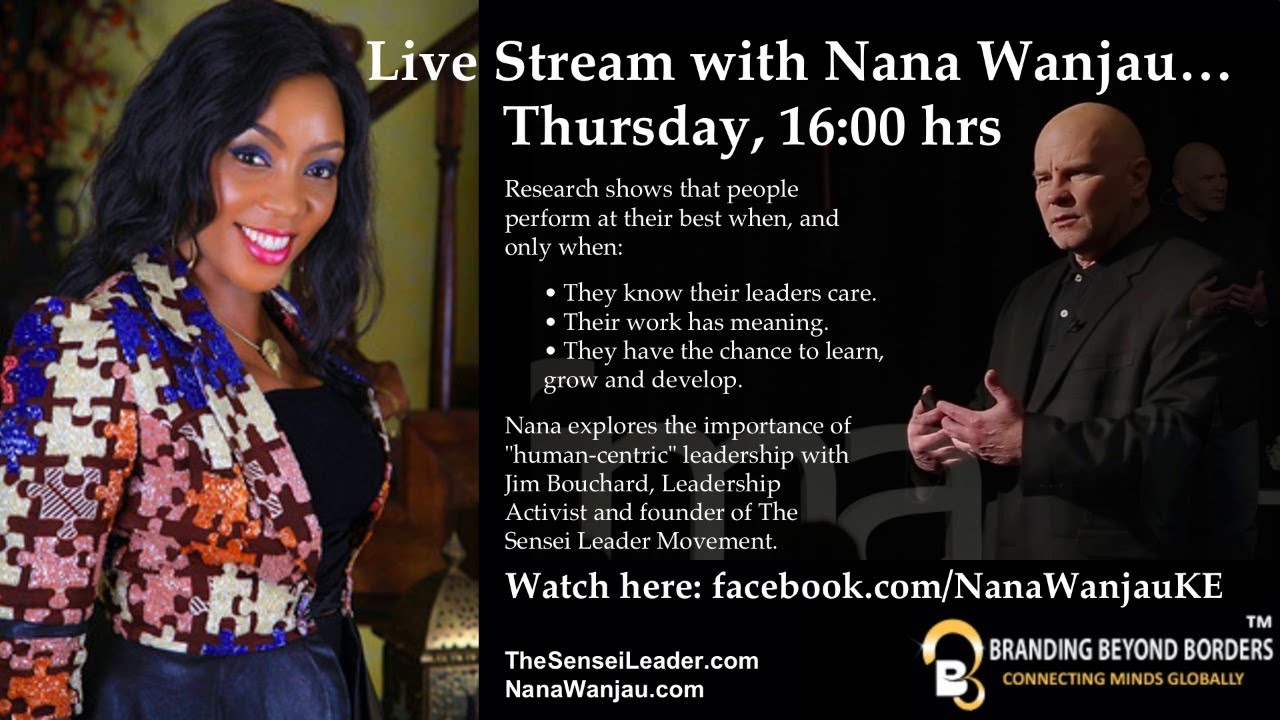
Leadership coach Jim Bouchard, a former karate sensei, argues that human-centric leadership delivers a 5-7x performance boost. He defines it as putting people first through genuine attention, front-line check-ins, and separating power from control, not traditional management.
Chapters
Hello, hello, hello everybody. This is Nana Wanjau from Nairobi, Kenya. Today we have a special guest, a great friend of mine He's written the book The Sensei Leader. The book is in Nairobi, published by Branding Beyond Borders, and it's The Sensei Leader: Effective Leadership Through Courage, Compassion, and Wisdom by Jim Bouchard. Jim, wonderful to have you here.
Nana, it's always a pleasure, always a pleasure to visit with Kenya.
You've done so many visits to Kenya without being there. I bet you know how the streets look like, you know how the sunshine feels against our skin. I mean, you've made so many visits.
I would like to feel that right now.
Let's start with our weather reports, Jim. Tell me.
We have sun today. Oh, really? We have sun today in northern New England. We have sun and we have, yeah, I think we're going to get up to about 50 degrees Fahrenheit. So a little cooler than Nairobi today.
Yes, we have our usual beautiful sunshine. It did rain quite a bit last night, but it's beautiful. It's green. It's bright. And our skies are blue, just like a blue ocean. Imagine that, Jim.
And thank you for promoting the book. You have copies in Nairobi, but here in the States, Amazon is not shipping books right now. So we're out. Well, we can still do Kindle.
Yeah, I know. We'll talk about that a little bit later. So now, Jim, in times like this, you know, COVID-19. These are unprecedented times. Government has shut down schools. We are working remote working. A lot has changed in the organization. The normal, the normal is no longer normal. And we as leaders, as business leaders, we have had to quickly, effectively find ways of managing staff of keeping them motivated, of getting still results with all the uncertainty that is happening both with the business owners and the employees. Now, you sent me an email that I decided I will have to read this because it's really, really inspired me, and we are going to start there before I give you a chance to tell us a little bit about yourself. All right. You say there is no new normal, or look at it in another way, normal is always new. I always quote Pliny the Elder on this one. You say, right, the only certainty is uncertainty. I like that. Life is change, period.
Yeah.
Leadership is responding to change. The best leaders even cause change to happen deliberately. Leadership is in many ways our willingness to embrace the continual process of transformation. The best leaders are those who master this process and inspire others to do the same.
That's it. See, I don't need to say anything. You said it all.
Because I'm really going to get into the meat of this email and You go on and say, at certain times in our lives or in our societies, we can find ourselves lured into a false sense of normalcy, usually when things are going relatively smoothly. But you never have to go far to find people and situations that don't fit the norm. Now, if you don't know, uh, Jim's background, Jim, um, first of all, Jim, as I was reading your book, I realized you are a drug addict, former drug addict, two-time college dropout, and then you spent 35 years of your life immersed in this discipline and art of karate. From drug addict college dropout, sensei, leader. It's a bit confusing. How did all this happen? Fill us— give us some, some, some perspective and insight into who you are.
That's a heck of a resume, huh? First of all, Angie Strader, thank you so much for tuning in. Alex, thanks for popping her up. Angie's a good friend of ours from the great state of Texas, where it's also much warmer than here in New England. But yes, Yeah, dropout and drug addict to, to Sensei, right? Yeah, that's how it— you know, you start where you start, right? And you can either get busy trying to make something of your life, or you can wallow in your, in your misery for as long as it, you know, you might feel like it. Well, at some point I was lucky enough, and I do have to say that there was a lot of luck involved. I had some good people around me, so when I was ready to quit drugs and get on with my life, uh, then people stepped in and were willing to help and willing to put me on the right path. So the short story is, somewhere along that, that, that, uh, period, which would probably lasted, I don't know, maybe 2 years after I quit drugs finally, uh, I found the martial arts. And the martial arts gave me a lot of gifts. One of them was that sense of discipline and the sense of focus, right? I believe I probably had discipline before. A lot of people do without realizing how much they have, but they don't know how to access it.. And certainly that, that was the, the case for me. It gave me structure, it gave me a purpose, it gave me recognition. All these things that I learned later on are very important for us to share as leaders because I found that the, you know, one of the, one of the greatest gifts as I look back on it was that the senseis that I met when I was studying were the greatest leaders in my life, you see. And so I was able to model my, myself after them and model myself after some of the ancient masters that I started to you know, study about. And I realized that that was the perfect imprint, you know. What is it? What's a sensei's job, really? A sensei's job is to inspire people, to empower them, to give them the tools they need to succeed, right? And to guide them along the process so that they'll be successful. It's not to push, it's not to shove, it's not to impose will. It's to inspire, to empower, and guide. And of course, over the last about 14 years that we've been involved with translating that for for business leadership primarily. That's what we've seen. It's the same qualities that, right, make a good leader in business, a good leader in the community. When you can inspire, you can empower, and you guide people, you're a leader. Because anyone can make you a manager, right? You can be, right, someone can make you a manager just by saying so. And sometimes for the wrong reasons. Sometimes it's because someone's politically adept, or there may be nepotism involved, right? Or they just might have enough time and grade, if that's the way people are promoting. But only the people you serve can make you a leader because they trust you, right? They give you their loyalty, they give you their respect, and these things have to be earned. And so that's at the, at the basis of all. But I'm glad you also brought up that idea that, yeah, I hate this idea of the new normal. I am disgusted with that idea. What new normal, for God's sake? I mean, as long as humans have been on the planet, right, And if I remember my history, some of which you probably shared with me earlier, you know, from the origins of the Rift Valley, when the first human beings started to populate the planet, okay, there's been nothing but change. That's what we do. That's what the universe does. So, the best leaders are those who are able to be flexible and adaptable. It's one of our strategies, right? Comfortable with uncertainty because that's what we're facing. But as you said, that I wrote in that blog, sometimes when things are going smoothly, We get lulled into that, you know, false sense of security that things aren't changing. But they are. Under the surface, they're always changing, aren't they? We might not notice it. A crisis like this focuses us on the change. And so, it's a great opportunity for people to express leadership. And I'm sure we'll be talking about this. I mean, at all levels. I don't care what your title is, right? I don't care what your rank is. It's, it's what can we each do to step up and behave as leaders, right?
And you actually say something in the same blog, it takes a good catastrophe once in a while to expose our vulnerability, to put things in perspective, to show us once again that we are a speck of dust in the greater cosmic scheme.
Isn't that a strange dichotomy?
Yeah.
You know what I mean? Because each of us is, and of course, when we're talking about leadership, we're talking about our importance in a lot of ways, right? Leadership is, is critically important. I think it's the most important human relationship. Again, that we all step up and find how we can act as leaders. All right, and we can talk about that in more detail. But at the same time, each of us is very small, right, in the scheme of things, even as, as human beings on this planet. I mean, our planet is a speck of dust in the universe. Right? I mean, the vastness of the universe is— we can't even wrap our heads around it. Poets try to wrap their heads around or try to give us some glimpse or feeling of it, but, you know, it's, it's, it's immense. So we are vulnerable. We are at the same time strong and vulnerable. And again, the best leaders are the ones who are able to express both of those, right, with, with humanity. And vulnerability leads to trust. When— not, not to come out, you know, like you said, we need good news too. We need people to be confident. We need people to be you know, enthusiastic about where we can go, what opportunities we have, even in the middle of a crisis like this. But at the same time, there's nothing wrong with a leader saying, "You know what? I'm worried too. I'm scared too. I don't know where this is going to go. But you know what? We're going to work together. We're going to get through it." That's the difference, right, compared to someone go, "Oh my God, the sky's falling!" Right? That's what we don't want from a leader.
Yeah. Now, Jim, let's talk about, you've just said there's a lot of You know, fear, anxiety at all levels. Um, at this point, you talk sensei leader, you say is to inspire in your book, empower and guide people to their very best. These, these to me seem like nice words, but how do leaders actually get to inspire, empower and guide people? It's not as easy as just reading the words. These are action-oriented. So how do we do that?
The words mean nothing unless you're willing to put them to work. Absolutely nothing. Yeah, I'm the first to say that. We have to develop disciplines in each of these areas. Now, take Inspire, for example, because a lot of people have been asking lately, you know, how do I inspire people? How do I keep them engaged? When we're doing the lockdown, working from home, we're not in the office all the time., and what, what I've seen is that too many people are looking for grand words to put together. They want the great speech, right? They want to be a Lumumba or a Martin Luther King, and that's not what we need right now, okay? There are people that are capable of that. That's fine. If, if you're a great orator, then go ahead and use that skill by all means, right? But you don't need to do that to be inspirational. One of the greatest ways you can be inspired. Two ways, really. First of all, your example. Nothing inspires people more than your example, especially when you're close to them, right? If they see you're strong, if they see you're moving forward, if they see you're taking care of business, then they'll be inspired to do the same. Now, the other thing about inspiration is— and I wish I could remember who said this, but it was a beautiful thing I heard about a year ago— the greatest gift you can give another human being is your attention. Now, we're hearing story after story now of leaders who are, all they're doing is reaching out, right, to people they might not have ever had contact with before in large organizations, right? Just reaching out, doing Skype calls and Zoom calls and just asking people, "How are you doing? How are you doing? How is your family? How can I help? How can I support you? How are you dealing with working remotely? How can I help you with that? What can we do?" See, that's the type, that's inspirational.. And we probably should take a step back and define it because the— and I chose these words carefully. Inspire means that you're touching somebody emotionally, you see. Okay, anybody can motivate. When we created that character, you know our character very well, the evil manager that we created, right? And the manager can motivate. Anybody can— you motivate, very simple. You bribe people or you scare them, right? You give them incentives or you threaten them with punishment. And they'll meet expectations a lot of the time, but that's all they'll do. See, inspiration is about destroying expectations. You see, because motivation, the root of that word itself, all right, means to give reason for action. But you know, human beings, we're not— we don't act reasonably first. We act emotionally first. Right? Emotion above rationality. So, if you really want to lead, inspire people, You've got to touch their emotions, which means you've got to reach out and connect. Now, that's the simple thing. Let's, let's reduce it. For instance, in workshops, this is one of the, one of the disciplines that people will, will come up with: simply making contact. Now, how many times do leaders lose sight of that, especially the higher up they go, right? And I understand if you have an organization with— well, once you get past 150 people, it starts to get a little tricky. You get 500, 1,000, 10,000, 50,000 people in organization, but One of the great retailers in history, Sam Walton, who founded Walmart, he did something brilliant which shows exactly how you take this philosophy and make it real. Every year, his top executives for 2 weeks had to go down to the front lines and work. They load trucks, they're working as clerks, they're stocking shelves, you see. And a lot of people criticized him about this. Oh my God, you know, what are you doing? You're taking people that are making 3/4 of a million dollars, a million dollars a year, US, right? And you're putting them on the front lines for 2 weeks. What a waste. No, not at all. First of all, right, they're connecting. They earned the respect of the people there because they were pitching in. They understood what people were dealing with at the front lines. They got close enough to them. So, you know, you've heard, you've heard this in my speeches, right? Don't be an undercover boss, right? You don't have to disguise yourself and sneak up on people. Just go down and, well, you know, we had one of our Walking the Walk episodes with your friend Darshan Chandria. He has 10,000 people in his organization. And you remember what did he say when he goes to the front? He doesn't know everyone personally. That's impossible. But when he's there, his first question is, how you doing? You have children? These things, not how's the work going? How many widgets did you make today? Right? That's very important. So that's a very simple thing. And in workshops, we come up with many of those things, right? The important thing is you embed that behavior in your leadership practice. You embed that behavior in your life. Contact X amount of people a month at the different levels. And you do that consistently. You see, that's the thing. You're right. You can't leave it in the world. Yeah, I love to talk philosophy all day long. But if you don't turn it into action, what good is it?
Call X amount of people at different levels. That's, that's powerful. And this is even simple, important, right?
Simple.
With all the anxiety and uncertainty going on, it's even more important that we connect with our staff as they are working from home, isn't it? And you— that's Inspire. Let's talk about Empower.
Empowering means getting people the tools they need, right? You can give orders all day long, but if people don't have the resources, they're not going to take those orders and turn them into anything productive, are they? In fact, they're going to find ways to work around it, you see. And a lot of times people— and I'm going to say manage— leaders don't leave that out. Sometimes managers do. We've got to get people the resources they need. Now, this just doesn't mean— well, it obviously, it does mean equipment, right? Tools, actual physical tools that they need if those jobs are, you know, it's appropriate to their job. But what it also means is the training, means the support, it means the encouragement, right? Means the criticism sometimes to do it fairly and to do it productively. But all of these things are part of empowerment. You know, what is, again, what does that word mean? It literally means to give people what they need to express power. And power is nothing but our ability or capacity to act or perform effectively. Too many people confuse power with control. And in human-centric leadership, we make that distinction very, very clear. Power and control are two different things. Power is your ability or capacity to act or perform effectively. That's what it is. So if we want people to be powerful, and if we want to be powerful as leaders in that positive sense of the word, not to control people, right, but to be able to perform effectively. Our power as leaders is only as good as the power of the people we serve. When we make people more powerful, when we empower them, then we become more powerful. We're able to do more, you see. It's that simple. But again, too many people— that the biggest mistake we see, and we see this over and over again, and hopefully by the end of a workshop, people have a different frame of mind Not everybody. We can't get 100%. But most people will, you know, once they accept those definitions, right, then they say, "Oh yeah, yeah, yeah, I understand that." By helping other people perform at a higher level. And let's face it, my success as a leader is only measured by that, isn't it?
My success.
That's it. I mean, but too many people want, still want to impose that command and control type of mentality. And you've heard me say that dozen times, command and control is dead. It's over. And in a situation like this, we're seeing that what's happening even— and this is all over the world— where, um, some, some political leaders are starting to impose more and more restrictions on people right now, even if the intentions are good. Let's, let's assume that, right? The intentions may be positive, but what's happening when the leader— the more, uh, control the leaders impose, the more the people push back. Right? And it's the same thing in your business. When you can empower people, when you can make them part of it, then everybody, everybody succeeds.
Now that brings me, as I was reading, um, The Sensei Leader, your book, brings me to the question that has been asked, um, following our interview last week. There was overwhelming question on What is a Sensei Leader? You speak about it extensively.
Yeah.
Sorry, you— what is a human-centric leadership? What is that human-centric leadership? And you speak about it extensively in the book, The Sensei Leader.
Fortunately, it's the same thing, right? Human-centric leadership really means that leaders are putting people first. Right. Admiral Grace Hopper, years ago, she said so beautifully. She said, you manage things, you lead people. And for too long, we went overboard on management. Now, don't get me wrong, management's important. Management is critical. But when we think about management, we're thinking about the systems. We can manage systems, we can manage processes, right? We can manage to some degree time. All right, that means the scheduling, how you run your meetings, all that stuff. Very important. But it's not leadership, okay? Leadership transcends that. Like I said, it's getting into people's hearts and in their minds and, and, uh, inspiring people to go above and beyond what's expected of them. And that's, that's much different. And you only do that when you focus on people. You have to understand their needs. You have to lead— like the book, uh, the subtitle, Compassion, Courage, and Wisdom. Those are the keys to that. And again, these are not just nice words. You know I'm not the lollipops and puppy dogs kind of guy, right? These are tangible assets, and they're the most important assets you have. Okay, compassion. We've just been talking about when you show— and the research is bombproof on this. I say this 100 times a week. People perform at their best when and only when they know their leaders care, when they know their work has meaning, and when they know they have a chance to learn, to grow, and develop, right? Now, in order to accomplish that, leaders need emotional intelligence, need strong interpersonal skills, need a strong, an accurate sense of self-awareness. And that's internal and external. All right. And so that's really the focus of human-centric leadership. We're developing those skills: emotional intelligence, interpersonal skills, and awareness. OK. And that's at the heart of the whole thing. And again, we're back to what we talked about a little earlier. What does a sensei do? It's just a blessing, a happy accident that I happen to have that life and was able to translate it to this one, because a sensei does just that. What's a sensei? It's a— he's a— he or she, a teacher, a guide, a mentor, someone who inspires, right? Someone who leads by example. That's what sensei does. So our, our mission really is just to turn you into a sensei, right? Turn you into the sensei too, because when you can adopt those things, um, And all the, all the most effective leaders that certainly that we work with and that I've studied have those qualities. I would be very comfortable— you're one of them— I'd be very comfortable, you know, using the term Sensei to apply to you. Absolutely.
Thank you, Jim. Now, a lot of people will ask, what is the return on investment? This is a lot of input. Yeah, from leader. And one might argue that I run a business. This is not a charity case.
Amen.
Where is the return on investment?
Absolutely. And there's interesting studies done on that now. And I'd point to two books. One is Return on Character, where they went into detail about how— they used a little different term— but how human-centric leaders will outperform the competition by as much as 500% to 700%. That's almost a 5x return, right? Now, of course, that's compared to organizations where they're not paying attention to human-centric leadership, where they are focused totally on bottom line, usually in the short term. You have to pay attention to the bottom line. But if you're constantly looking at just what's 5 feet in front of you instead of what's a mile in front of you, that's a problem. And there are organizations that do that. And some, and I'm not judging, there are some valid reasons— positioning for a sale, things like that. But still, You're going to increase the value if you take care of your people because the people are your most valuable asset. None of that stuff gets run without your people, right? Now, let's look at the flip side. The flip side is this: what does it cost you when you don't pay attention to this, right? Now, the— I think the world statistic right now is that to replace an average employee costs about $15,000 US, right? The average employee. Much, much higher for executives and managers. It's 2.5 times the annual salary, I believe. That's an expensive problem. What's one of the top reasons that people cite for leaving an organization? Bad leadership. You see, leaders who don't care, leaders who are not paying attention to the needs of the people, not giving them what they need to be productive, just issuing demands. Say, 'You got to meet this quota.' Well, that's great. I can't meet that quota if you don't give me the tools, right? You don't empower me to do that. So you're losing great people. All right. And there's a horrible— not a trickle-down effect, there's an explosive ripple effect from that. Because, you know, how many organizations have you been involved in? You lose one good person, one top person, and other people follow, don't they? Yeah, right. So you're never losing just one. Usually that one person kind of opens the door and the rest follow them out, right? One person finally has had enough. There's been waiting to see who goes first. So Those are expensive problems.
Yes, I know you touched a little bit on it earlier. But let's dive into it. Because this kind of ties to that leadership versus management.
Yeah.
Because we are used to being managed, we are used to managing people. Just dive into that a little bit more.
Yeah, well, again, it's just, and we do spend a lot of time on this in workshops, right? And hopefully, we'll be doing more online as well while we're stuck at home, right? But that's one of the things that we talk about a lot. You've got to define the terms. That's all. I understand that the word management and leadership have been kind of used inter— they're kind of intertwined traditionally, right? We've got to untangle them. Very important. Because if once we isolate that, right, you always produce more when you focus, right? Okay, so while I'm managing, I manage things. Admiral Grace Hopper said it beautifully, you manage things. So when I'm managing, I'm going to worry about things. When I'm leading, I'm going to focus on my people. Now, it'd be nice if all managers, because that's that word still used as the title, that's fine. It would be nice if all managers were also effective leaders. Not so much. We know this, right? So the more we can help managers develop in the leadership area, and that's, that's a tricky one because One study recently showed that only about 37% of business leaders worldwide are satisfied with their leadership development program. And we've understood why over the last few years. We've heard it directly from people in our workshops, leaders in our workshops. First thing is because while almost every LD program will talk about the nice things we're talking about, the human-centric parts, and they'll tell, they'll tell you how important they are, but they won't give you the disciplines like we talked about earlier. They won't give you the action steps in that area. It's weighed too heavily to the management side, even though they call it leadership development. Okay, the other major factor is focus. They try to accomplish too many things at once. And when I'm— especially when I'm working with someone one-on-one, but even in workshops, I'd rather spend a whole workshop session, you know, digging into one or two issues and coming out of there with disciplines that you can use that are going to work than to talk about 100 that you may or may not pay attention to later on, right? I mean, how many times have we come home from a conference with a bag full of stuff, right? We heard, you know, 20 great speeches, learned 200 things we could do.
We get lost.
Right? We discover 3 years later when we clean out our closet and we haven't done the first one. Right? It's to take that one and focus on it. So especially as individual leaders, that's part of our process. Our process in coaching first is discovery. What do you need to work on? What are you interested in working on? What are you willing to work on? And then let's work on that, right, for a dedicated period of time and get some, get some results from that. Then we can move on to the next one. And we found that that's much more powerful. So it's the focus. And again, it's the, it's thing. And that's cool because, you know, we, we fill kind of a niche. We don't displace any leadership programs. We work hand in glove with them.
All cultures?
All cultures. Absolutely, absolutely. And here's, here's why. And when I first got into this, that was something, frankly, that surprised me. I kept looking for the differences. Now, there are cultural differences that we need to respect. That largely has to do with communication, right? How do we communicate with people? Because different— for instance, on a simple level, different gestures mean different things in different cultures, right? Words mean different things even among English-speaking nations, right? Certain words mean certain things. There are some words that sound very, very nice in the UK that have, you know, filthy connotations other places. And like I said, gestures are important. How do we shake hands? How do we greet one another? One can be a welcoming gesture, and another culture can be an insult. But once we get past that, what do human beings need and what do human beings want? That varies slightly, if at all. And especially in leadership all over the world. And again, the research is very clear on this. What are people looking for in leaders? Number 1, compassion, trust, stability, and hope. Those are the 4 big ones. And no matter where those polls are done, everywhere in the world, that's what people are looking for. So that's who we have to be as a leader. We have to provide compassion, you know, trust, stability, hope.
Oh wow, I'm glad to— you know, all during all our interactions, we've realized that whether we are discussing, um, women issues, whether we are discussing leadership or business or just people, at the core of it all, we are more alike than different, right? Isn't it? And what's going organizations now, currently, Jim, what can they do to adopt the human-centric leadership in this space we are in right now?
A big one is, right?
Go ahead. We are running out of time. But let's just take on this and see what we can do.
A lot of it has to do with what you just said, recognizing our humanity in one another, devising disciplines, devising action steps, embedding processes in your— because you can do this with process. We don't leave a workshop without that, okay, to embed into your culture that helps people see the humanity in one another. And not just culturally. It's interesting because what you just said kind of triggered another thought amongst the different levels in an organization, right? Sometimes the people at the top forget that the people at the bottom are human beings. And I even hate to use the word bottom, but you understand, people on the front lines. And And vice versa. I can't tell you how many times in an executive session, because we do a lot of work we call Sensei in the C-Suite, our workshops for executives. And one of the things that comes up almost every time is, and I'll just, I'll say it kind of as a quote, you know, I'm working so hard for my people. I'm really doing my best, but they don't appreciate me. You see? Well, sometimes it's, most of the time there's a disconnection there. The people at the front lines, you have to, right, we have to remember the people at the top are human beings too and have the same, and especially now, like you said, politically, that's a big thing we have to think of. Our great political leaders, presidents, you know, prime ministers, whatever the case may be, some queen, right, Queen Elizabeth came out and made a speech the other day, a rare speech. They're people. They're human beings, right? They have the same flaws, the same strengths, the same weaknesses, the same fears, you see. So we have to do that. So in this situation, I want to make sure we don't lose that. We did a bumper sticker a few years ago and it said, celebrate adversity. It's your opportunity to discover the person you might not have ever imagined without it.
I love that, you see.
Now, other people have been asking, you know, uh, how do I, how do I train for something? They say, well, you're doing it, right? Those of us who have been around for a while, we've been through— not exactly like this, they're all a little bit different— but we've been through this kind of crisis before, this kind of contraction in the economy, worried about jobs, recessions, depressions, things like that, right? We've been there. And in those times we developed the skills, the tools to face the next one a little bit better. And that's what we're going through now. And if it's your first time, excuse me, for younger leaders, just appreciate where you are and celebrate every little victory. Every time you do something that moves you one step forward, you're preparing yourself for the next one. And that's the opportunity. Excuse me. This is allergies, by the way, not, not Corona, as far as I know. Tea would help. Some good Kenyan tea would help right here.
Yes, I'll send you some.
I think we— I think this is Kenyan tea, actually. We wouldn't drink any other kind, right? But anyway, like I said, it's, it's to focus on what you can do right now, uh, to work the problem, not to get overwhelmed by the massive amounts of news that we have. Very little of it, which is good. You, you talked about that before we went live. You know, we've got to be very careful of that. We need some good words. We need some encouragement. We need to help one another, support one another, and recognize. And leaders have to be very, very, how would you say it, attentive about this right now. Because it's easy for, especially business leaders, to get caught up in the very real financial concerns that are, right, that we're all facing right now. You still have to make sure you go to that person on the front line and say, "Hey, thanks a lot for coming in today. I know it was hard. I know you have people at home you're taking care of. Thank you for coming in." Thank you for putting in that little extra effort. Thanks for doing that extra hour the other day when someone else had to— you see what I'm saying? These are simple things, powerful, very simple. Nothing I talk about is really complicated. I don't know why we don't do it more.
We just sometimes, we just need to be reminded. And Jim, I'm just going to close. We're going to close now as I read from your book. The fact is that times like these are also opportunities to build resilience and confidence, discover new talent and skills, develop courage and fortitude, and grow as leaders and as a people, if we are willing. It's a choice. We either get busy accepting a new normal, whatever the hell that is, or we choose to be— and this is my favorite— flexible, adaptable, and comfortable with uncertainty. Now, Jim, there are programs that I want to make sure that we take advantage of. Tell us a little bit about the corporate, um, membership that are available to all of us who are willing to grow in this space, what do you have on offer for us?
Oh, absolutely. Come to SenseiLeader.com, TheSenseiLeader.com, SenseiLeader.com. And all the resources are there. Or just reach out. I'm easy to find on LinkedIn. You can reach out to Nana too. Nana has been just a great champion for us. And especially if you're in anywhere in Africa, India, those, those areas. Reach out to Nana. Alex just put your, your website up there too, right?
Yep.
nanawanjau.com. Yeah, and she can get you all the information. And thank you so much, Nana, for promoting us so heavily. Um, the organization memberships cost nothing. All we need is a representative to sign on, and then we provide resources and links to the organization, preferred rates for members. We have coaching available. Uh, obviously we're not doing too much for conferences and workshops. Usually it was about 90% of our schedule. But we're taking it online. So we have, we have some webinars that are available for free access, okay? We have some that are available that are customized. We have some that, uh, we do live webinars specifically for organizations, and I know we're going to be doing a couple with you, so that, that'll be really cool coming up. We're going to keep working. I mean, like you said, you get busy, right? You, you got to do— and we have the blessing of these tools. Not all, not all businesses have this opportunity, but we can. And I want everybody to think about that, and please reach out, because one of the concerns, of course, is people saying, well, I can't afford this, I can't afford that right now. Well, look, I have to work anyway. Nana has to work anyway. Reach out to us if you have, right, if you have some concerns financially. We'll make arrangements, uh, you know, if you're working still, because some people would come to me for coaching, right, and they say and I find out that they're making, still making very, very good money. No, you have to pay because you're helping us, right, subsidize the people who can't right now. That's a good way to work together. But if you have hardships, seriously, all joking aside, please reach out. Don't let that stop you. We've got to work together. We've got to put one foot in front of the other, and we've got to get through this, and we've got to bridge this, right? This is part of why, when you talked earlier, I'm so sad that we haven't physically made it to Kenya. I know we will. Because it feels such a connection to you and to so many people, you know, in Kenya and other parts of Africa. Um, our friend James, uh, uh, Mensah in Ghana, and, you know, several others, uh, Jared, uh, Andieke in Kenya, and people that have helped us for so long. Um, this— yeah, like you said just a little while ago, there— the important thing is how we're, we're together and how we're similar. How we're different, that makes us interesting, right? That gives us some flavor. But the, our ability to work together is really what matters. And we've got to keep doing that.
Yep. So Jim, thank you once again. The Sensei Leader is published by Branding Beyond Borders. It's available in Nairobi, Kenya. Reach out to The Sensei Leader online. I am so glad to hear that you have free membership and programs running right now. What we need to do as business people is learn, is grow, is develop ourselves during this lockdown so that we come back stronger and more equipped. This is the opportune time to actually do this, and it's great to partner with you, Jim, and we look forward to locking, locking horns with you again.
But you're too modest too. Branding Beyond Borders. Get in touch, nanawanjao.com, right? Nanawanjao.com has resources and Power Woman International to help.
Thank you, thank you, Jim. Bye.
More from Jim








Why AI-Only Customer Service Is Failing Customers | Danny Snow on Keep It Human


