Pivotn - How to change direction in your life and career… KEEP IT HUMAN Podcast 0002
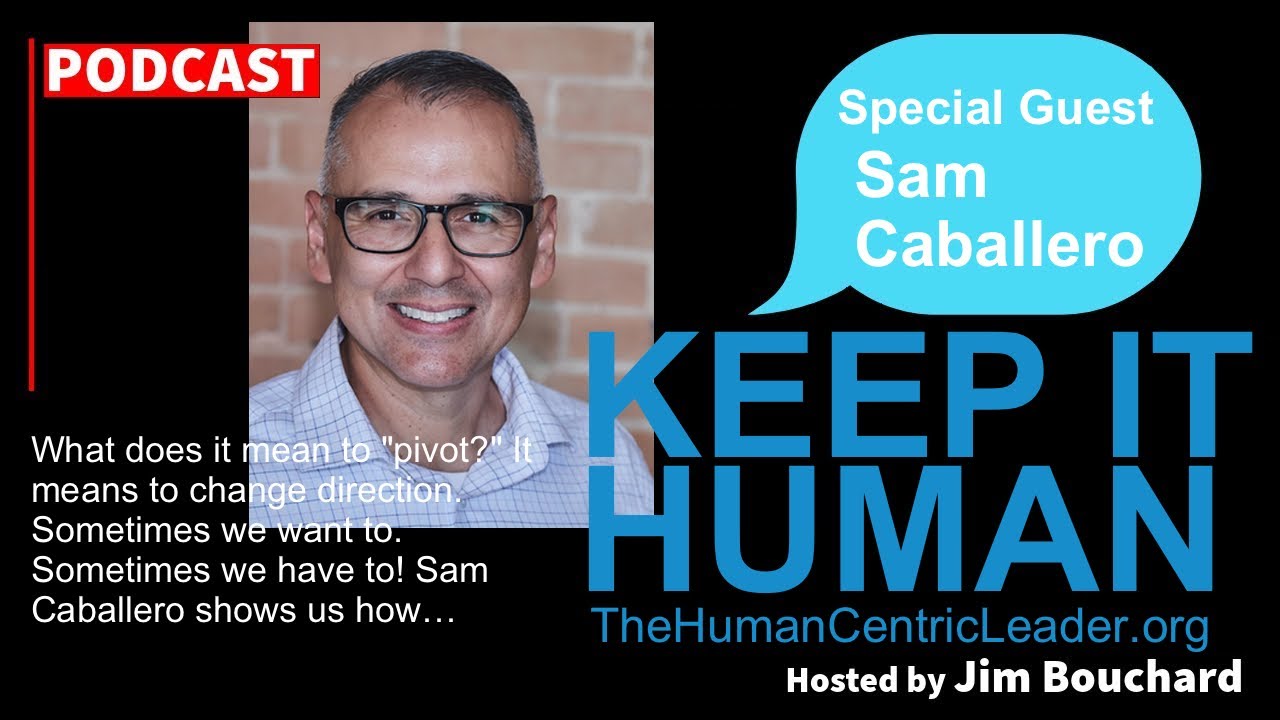
Sam Cavallaro, a former Air Force First Sergeant, left the military after realizing yelling doesn't sustain motivation. He got laid off in Lisbon during COVID, literally pivoted using a drill move, and founded Pivotin to help people find their next direction through frameworks like ikigai and reflective questioning.
Chapters
Well, this one's been a long time coming. A few years ago, I met this amazing leader down in San Antonio, Texas. His name's Sam Calviero, and we're finally going to share him with you today. You're going to be thoroughly impressed. We're going to talk about how to pivot in. I've been waiting for this one for years. My friend Sam Caballero and I, we met in San Antonio. Sam was with ATD down there. This was, geez, I don't even remember how long ago. I'm awful at this. Could have been 2 weeks, could have been 20 years. But anyway, we hit it off right away and I knew this was somebody you all would be interested in hearing from. And he's got a new adventure going and we're going to be talking about pivoting. We're going to pivot, finding new directions. This is something, in fact, just before the show, we were kind of touching on that, weren't we? We were talking about how my wife is a little bit risk-averse, and hey, I'm ready to pivot every chance I get, right? Straighten me out, Sam. Tell us a little bit more about yourself, what's going on, and let's see if— let's work through this. Let's see if you can get my life squared away, and maybe other people will benefit from it.
Well, Jim, thank you very much for having me here today. I have also been waiting for this. It's been a wonderful journey since, uh, first time I met you. It's now, I think it's been about 5 years. I know it was before the pandemic.
Yeah, it was. Yeah, before the crisis. Isn't that weird, right? Everything's either it's BC or right before COVID or after. Yeah, yeah.
No, you're, you're absolutely right about that. But, uh, it was actually a few weeks or maybe a few, like a month before COVID actually took its effect that I found my pivot, and it was during the pandemic where I was able to really solidify it. So my journey starts way back when I was a military training instructor at Lackland Air Force Base. And even though I had, I was in college at the time to get a bachelor's in urban planning, I always liked how cities kind of planned themselves out. I realized that screaming, yelling, kicking, threatening young people doesn't motivate them. It may work for maybe a day, less than that even, but they don't have it intrinsically in them to do it.
Doesn't work for old people either, right? Yeah, not for very long.
Yeah, I'm finding that out, as you know, as I get older myself.
Yeah, yeah.
So, so I realized that there was more to demanding, pushing, pulling when it came to young people. And so I just became very interested into what is intrinsic motivation, how do you connect with someone. And as I started to connect with my own mentors and they started giving me suggestions and letting me kind of learn on my own speed, I quickly realized what was necessary for you to be able to graduate great flights. We don't call them platoons in the Air Force, we call them flights. They're usually about 60 members, whether it's male or female. Or a combination of both. And in my 17 years as a reservist MTI, Military Training Instructor, I felt that I really was able to really understand what it meant to be that person, that leader, motivating and engaging young minds. And so I decided not to become an urban planner, but to do talent development. And I've had the pleasure of working for a variety of different companies, organizations in talent development.
Yeah, it's interesting, and I want to debate some semantics here for a second because I find that sometimes we get a much deeper understanding as we're trying to clarify terms. Because, you know, in the short time that I got to know you, and, you know, this is my old bodyguard instincts, I tend to trust my gut a lot with people, and most of the time it works out. You know, there's a lot of signals that I think we train ourselves to read that that are quick and not always apparent. But anyway, that's a long-winded way to say I always had a good feeling about you from the moment I met you. So I'm going to argue that you inspire more than you motivate. And the reason I'm saying that is, you know, we draw a hard line here about that. Motivation is simple. It's easy. You bribe people or you scare them. Because motivation at its root appeals to reason, right? The word means to provide a reason for action. And To me, you're always going deeper than that. You're going for the heart, which is really what we're talking about when we talk about inspiration, right? Touching people's hearts, not just their heads. And I don't know, you can, you know, feel free to debate that. But to me, that's what I feel. And I feel it's important to make that distinction that you are a very inspiring person. And it sounds like that's what you've really done your whole career. You've gone past the people's heads and you've really gotten to their hearts.
I appreciate that. You know, it's, it's interesting that when you walk into people's houses and you notice the living room and the family room and the dining room and how the, the person or people living there place pieces of furniture, you know, that's what you see. They decided to put that chair there. But then when you start to get in, into the root, to the deeper reason as to why that chair is there versus here. It could be, well, we had no other place to put it, or a family member used to sit there all the time and look out in the window, and I'm not moving it again. So what you just described is, is so important because at first when people walk in, they're like, how are you able to move these people? And they are intrinsically in it. They, they feel it. They want to do it. And it's because when you look at that word motivation, it goes back about movere, which is to move. In Spanish, we say mover. But when you move people, you want them to, for them to move themselves, but that they have that reason. And like you said, as a leader, how are you influencing and inspiring them to want to do whatever it's necessary? And so Very quickly, you have to learn who these 60 people are. What is it that really makes them who they are? And then you start to engage them with, what can I say or do, or put on the table where they can at least try, or hopefully they'll connect with whatever it is I'm putting on the table, so that I'm able to influence and inspire them. And then they in turn are doing it on themselves, so that they are able then to move. And I really love this word "inspiration" because it derives from the same word that we get "respiration," which is to breathe. And so if you're allowing and creating an environment where people feel like they can breathe, because you don't have leaders or managers just literally on them, then they will grow, so long that you're there also to help guide them.
I'm going to steal that. Well, that's terrific. And it really— and everything you're saying cuts to the heart of, I think, what you're doing now, because we're talking about pivoting. And let's spell that out. How did you just— but P-I— you've got it right there, right? P-I-V— no, do— yeah, there it is. P-I-V-O-T-N. And it's pivoting.com.
Correct, pivotin.com.
That's how we reach Sam. But it's hard to get people to embrace a new direction sometimes, especially if they see it as painful or risky or just different than what they're used to, right? I mean, that status quo is a big pull. So yeah, let's now talk about— you just talked about how important it is to reach into someone's heart and find that, you know, that emotional reason, because that's the thing too. I mean, it's funny that we've been through now, I think, two eras of study. The first was the Age of Reason, where people really ascribed more to the mind, and then there was the emotional era, I think, which we grew up in, where, you know, people's feelings were as important, if not more important. And now we're, you know, at least science is guiding us back somewhere to a balance, huh? Our emotions are critical, they're important, and they inform our decisions. We just can't let our emotions run away with us, right? We're back to from the tradition I studied, uh, Dr. Yongzheng Ming would be proud to hear this, you know, the horse mind and the monkey mind, and we're always trying to reconcile the two.
Absolutely, especially when you're faced with a challenge or tragedy. So a few years back, I was on vacation. I was in Lisbon, Portugal. I was on the final day of my vacation with my family.. And, uh, we were in a, in a shoe store, and I noticed my phone ringing when I saw it was my boss. And I quickly told my wife, hey, I got to take this call, it's my boss. I was, at first I thought, well, maybe he didn't get, or he didn't see that I'm still on vacation. I mean, he approved it, right? And then as I was coming out of the store It was across the street from this plaza called Rocio. And if you've ever been to Portugal or to Lisbon, this is— it's a beautiful plaza with a huge waterfall. Anyway, as I picked up the phone and I started talking to him, he's like, hey man, I don't know how else to tell you, but your department's been reworked out and we had to let your team go. And then, you know, we're gonna have to let you go. And I, and I knew the writing on the wall for at least a few weeks or months But, you know, you couldn't wait till I got home, right? Anyway, but when I got done with the phone call, you know, I just stood there. And if you'll notice it, in that plaza there's these cobblestones that are both grayish and white, and they make this beautiful pattern. To where, as I looked at the pattern, I looked up. It was a beautiful day. It was blue skies, not a cloud in the sky. And I thought to myself, you know, what are you going to do? For that split moment, you've been told that your livelihood doesn't exist anymore. What are you going to do? So I remember I just started to walk, and In basic training, we teach this class called left flank. So basically it's a drill movement where when you hear the command of left flank, when it's time for you to make your move, you're going to pivot 90 degrees to your left or right on the heel of the opposite foot, and that will then cause you to move 90 degrees to the left or right. Well, I started walking and I just gave myself left flank and I pivoted physically, which then helped me mentally with this feeling of I, I can do this, it can happen. And Jim, a couple of things about me too is that this was already my third time One of the biggest risks in learning and development is that the first thing that goes out the door when budgets are cut is you. And it's so unfortunate because your business is people and performance. It's like, why would you not want to save this department?
Right, right.
But that's the first thing that goes out the door. So we still had a 13-hour flight back to Dallas, then to San Antonio, And I just kept thinking to myself, what am I going to do? But I felt better at it because I felt like it's time to pivot. Even though I could feel COVID coming because I was already sick with something, when I got home, I was sick. But then laying up in bed, I kept thinking to myself, what am I going to do? And at that point, I knew what I needed to do. So I created this organization called Pivot In. Pivot to what— where do you want to go? In to what degree? Because ultimately is on you to determine where do you want to take yourself. But then how do you evaluate you and determine what your next steps are and how that relates to what you're passionate and what your likes are, but also what's your vocare, or what your vocation or calling is? Because then As I engage, yes, sir, it's going to be movement. But this, this is a process where you constantly and continuously identify what your next steps are. So I help people through coaching and workshops by helping them identify what their pivot is.
You know, that, that's so critical. And it's part of the reason I share my past adventures, if you will, as a drug addict and whatnot, because You talked about identifying next steps. And sometimes we're in situations where it doesn't feel like we have any, right? We really don't know what the next step's going to be. And a lot of people went through that when COVID hit. I mean, COVID literally eradicated some industry sectors, right? And to me, there's a process of— I've learned a process of substitution, right? I had to find something when I was When I made the decision to leave drugs, and we should touch on that too, you know, we have to be willing to make this pivot, right? If we're not willing for some reason or another, it's very difficult. It's very difficult to accept or even recognize any help from someone like you. So we have to do that first. And then we have to decide, we have to find some, we do have to find someplace that we want to go to, right? Someplace that's going to make us feel as good, if not better, than where we were before. So what is like a first step in general? I know we're not specific to an individual, but in in general, what's that process look like? How do I discover what my next step might be if I'm so lost that I just don't know what it is?
I love Maslow's Hierarchy of Needs. I, when I first learned it, even though some debate that it's not compelling enough or focused enough, to me—
It's a good place to start, isn't it?
It is a great place to start because I remember going to my wife's country where she was born and raised Bolivia. And, uh, we landed in La Paz, which is about 12,000 feet up in the air. And I really knew what it meant to have mountain sickness because I was like, oh my God, I can't breathe.
Yeah.
But, um, what's interesting is that that was my first introduction to Maslow's hierarchy of needs because it's that first line, which is the basics. When you're hit with tragedy, when you're hit with a change, you have those basics that are now gone or missing or they're lost, whatever it could be. And as human beings, we just, you know, we just want comfort. We want to be able to live. And so when something is taken away, we start to recognize that I want it back, or I want something that's going to be in its place. So the first thing to answer your question goes back to what do I need? What do I need to, to live, to, to feel some level of comfort? And, um, I, I appreciate it.
I'm a weirdo because that's the opposite of what I— I don't like comfort. I get very nervous around comfort. But go ahead, I get, I get what you're saying.
No, no, but you know what, everyone's got their own definition of comfort. Everyone. And there— and, and your definition, which now knowing you a few years, it is taking risk, it is living a, a life where it, it's a little bit more repetitive and the frequency is a little bit more harder compared to mine. But you know that, and I need that. Like, there are times where I needed to be hard-hitting, frequent, and repetitious, but not all the time. So whatever it is that is specific to you, that's the key. But people, a lot of times, they just go in their lives, living their lives, not recognizing that, not being aware of that, because they're just so caught up in the hamster wheel of life. But I know, I think that for you and me, we know what that looks like. We took the time to be mindful enough to recognize what's important for me and what's not.
That's critical too, isn't it? I mean, you just hit on something so important. We cover it an awful lot in workshops and retreats where, you know, I almost, as much as I'll insist on something, I almost demand from leaders that they take some time off that hamster wheel and give themselves a day of reflection, if not more, but at least a day of reflection each year. Get away from everything and take the time to address some of the fundamental questions. And I ask some pretty stupid ones. I mean, to me, the broader questions often will give us deeper insights because we're not— I would say we're not leading to an expected or a desired outcome. So the two big ones for me are, who am I? And what do I do? And I purposely leave that broad. And it surprised me a couple of times through the years. It's been pretty consistent, but And leaders report back to me that when they take the time to do that, they, they find some surprises too. But having said that, very difficult. And I get it. I understand the demands on our time and the demands of what we see as urgent priorities. But are we singing in harmony there? How essential is it? Is that something you coach for people to take a little bit of time for reflection and really sit down and consider some of the questions? I'm sure you have a some key questions. I'd love to hear the questions that you would ask somebody in the same situation.
Oh, it's so important. But one of the things that I also, uh, do is that I, I introduce something that the Japanese believe in, which is, uh, ikigai and the reason for being, and that their perspective of passion, mission, profession, and vocation. And When I coach, one of the things that I ask is, "What does it mean to be you? What's important for you? When, when days are tough, what is it that will pull you out of bed, maybe even push you out of bed?" And when you start to ask those open-ended questions, which include words like "what" and "who" and "when," "where" and "how," It is really to get them to think, because sometimes people are on that hamster wheel, running, running, running, and have no reason why they're running, but they're running. And to get them a moment to just reflect on that. But one of the things that I also am very mindful about is the why. Because sometimes when you ask why they're on this hamster wheel or why they're doing this, the last thing I want to do is put them on a defense mode. However, however, it doesn't mean it's off limits because once I build that relationship with them, I'll ask them a why question in a way that's constructive and positive in terms of really what is your why and how does it relate to your how and what.
Yeah, that's a total, that's totally a Sensei attitude, isn't it? If when you see somebody, right? No, when you see somebody that's too comfortable in whatever the exercise is, then you know you're not challenging that person, you know, and it's up to you to find find a way to challenge that. What's interesting too, you just got— you're stirring up so many thoughts. It seems that I've found this, the extreme of this hamster wheel behavior in the middle, and I mean the middle economically. A few years ago, I think it was either just before I met you or just afterwards, I think it was just afterwards, we got the chance to go to Cuba to work with Confederación de Créditos Caribeños, and got a chance to get out into Cuba. And I haven't, by my own admission, I haven't been out of the United States very much, so that was an eye-opener, and saw a whole new definition of abject poverty, to be quite blunt about it. And yet a lot of those people were very— I see the people I met were very comfortable in who they were and what got them out of bed in the morning, as you said, you know, and had a different pace of life. And then we see it On the other end, where people appreciate abundance, right, and are grateful for it and can take the time or will take the time consciously to reflect on these things we're talking about. Now, in the middle, and it may be emotionally more than anything else, but in the middle, there are all these people, and I've been there. I don't know if you have too, but I've certainly been guilty of it. Where again, I mean, I know it's a cliché, but there's no better way to say it. I love that description of the hamster wheel. We're just running and running and running, not really getting anywhere, afraid to get off the wheel. Don't know how to get off the wheel. It's, it's like an obsession. So I don't know, does that stir some thought? That's— I don't, I don't even know if I have a question there. It's just an observation based on what you were saying. I mean, yeah, it's just interesting.
It reminds me of the movie, uh, now it's been what, 25 years? Oh my goodness, uh, The Matrix, where, right, people are living their lives not knowing that they're actually batteries. But yeah, right, but they're living their supposed lives on this hamster wheel.
Just rock me to sleep tonight, Max.
But it takes those very profound events where you start, or maybe you have to think, what does it mean to be me? What's important in my life? What is it that is not important? And how am I going to continue? And can you imagine being on a plane in the back 13 hours and you, you're sick and you— it's just you and the seat. And that for me was very important because I I, I just had in my mind, what are you going to do? What are you going to do? What are you going to do? And, and this is where I started just to go on my own journey at that moment to recognize, okay, what are you good at? What is it that you're actually good at? What is it that the world needs and how can you fulfill that? And then of course, what are you going to do to to fulfill that need. So, so it's just this ongoing process. But then if you don't have— a friend of mine calls it a SEA, a significant emotional event— you may not necessarily have your time to where you could be able to reflect and get off the hamster wheel and to start to think in a, in a positive, productive way about what's important.
Oh, I'm glad you said that. And you know what's interesting, uh, And I've done it myself in my life. Sometimes those moments are there and we're so caught up in the whirlpool that we don't even notice them. But I agree with you 100%. I mean, the blessings of these moments that force us to take a pause. You know, when we met— yeah, I'm glad you mentioned that it was before COVID because, you know, we were hitting our stride. I was out there, I don't know, 3, 4, 5 times a month. Speaking and working with people. And what a joy that was, because to answer one of the questions that I still ask myself each year— just went through the exercise again— who am I, what do I do? I keep coming back to teacher, you know, in whatever way, shape, or form that, you know, that becomes a reality. But, um, when COVID hit and we saw our entire schedule evaporate to zero with no— right, we have no idea whether we were ever going to get back on the road speaking again. Things were changing by the minute, and, you know, certainly friends of mine that were in the speaking world, uh, took it much harder than I did, some of them. And then it was devastating. It really was devastating to people's lives. I remember looking at my bookshelf, the books that I had written, and said, oh my God, that's it, down the tubes. I wasted 12 years of my life.
It's gone.
And you're right, those are the moments where we have to take a breath and say, again, it forces us into that focus, right? Can we do it without— can we challenge people without exposing them to something that extreme? And I— but I'm with you 100%. Didn't feel it at the time, but in retrospect, that moment certainly was a blessing and reshaped the way I did things going forward.
I— one of the things that I think many of us take on as a mistake is that when the door shuts, we just shrug our shoulders and walk away. When there's change, we either decide or not to move forward with the change. But to me Every time a door shuts, a window closes, it's opportunity. The key is, are you open enough and curious enough to want to know what that is? And a lot of us, unfortunately, we feel that once a door shuts, okay, let's stop, turn around, go away, go back. And to me, I've learned that when doors shut, it's actually opportunity But you got to be flexible enough, and you definitely have to be curious enough to see what else is out there. And recently, I took on an opportunity where I retired from the Air Force Reserve after 34 years. Oh, wow!
Congratulations!
Thank you. And it was November 1st. And instead of having a ceremony, my— I decided with my wife that we would go to Universal Studios and go and celebrate the day, just me and her, uh, on this journey. And it has been a process because 34 years of weekends, um, you know, going on tour somewhere, um, having to answer military email and deal with military stuff, it's, it's no longer there, right? And it's a process of mourning. And, and there are times where I think to myself, oh, I got to get that fixed for my uniform or boots or whatever. I'm like, wait a minute, why am I going to get that fixed? I will never need to wear it again, right? But once again, it's a chapter in my life that's closed. But it's an opportunity. Are you curious enough to want to know what else is out there for you?
You know, that's so important, and I don't think there's— we have a strange mindset in our culture where we are so averse to pain and suffering, right? And yet, that's, to me, that's where all the best things happen. We, even a few years ago, even did a bumper sticker said, "Celebrate adversity. It's your opportunity to find the the person you might not have ever imagined without it, right? And it's interesting because I'm gonna share something very openly. I don't think I've shared this, at least not on this forum lately. When COVID hit and we went through that, I, for the first, well, for the first time in my life that I recognized, experienced a clinical depression, you know? And I felt guilty about it. First of all, I had always, even though I understand now that I'd probably been through that other times in my life, I was one of those people who said, ah, you know, now just, you know, pull up your bootstraps and get on with this. It's silly. For the first time, recognized the physicality of it, right? And the debilitating physicality that can happen with that. And I learned, this is the most difficult lesson. This is what I want to express that I hope people, you know, will find some solace in. It's okay to be that way. It's not healthy to let yourself stay in that trap, right? We need to reach out and get help, which was very hard for me because I don't like reaching out for help. But it's okay to go through those things. And like you just said, it can be one of the most revealing times of our lives. We ain't going to get there if we run from it, right?
No, absolutely. You know, I thank you very much for sharing that. I appreciate that. I have— I've had my own challenges, and I remember, I remember once where a friend of mine said, you know, Sam, if you were just simply to acknowledge that it exists, you'll find that just a little bit of whatever it is that's there will dissipate. Because when you acknowledge there's a powerful 4-letter word in the word acknowledgement, which is to know. When you start to really dive deep as to what's bringing this up, what's causing this, a lot of doors will start to unlock themselves. And, you know, with the guidance of a therapist or whoever is there that is educated around these topics can be there to help guide you through this, this process. I think that's so important. So in my military career, I was a First Sergeant. A First Sergeant is a person that dates back all the way to the Roman times, and this person basically is a liaison. And you'll notice that there's a set of chevrons on my board that's got a diamond on it. Well, that diamond is actually a lozenge, which represents the rank of a, or the position of a First Sergeant. So the belief was that this liaison is between the general and the people, the troops, and that the general wants to know about these people. And I'm going to go to you because I need you to stay abreast with who is—
or you're the representative of the—
you're the representative, absolutely. So as the representative of 125 and one unit 50 in another unit, 300 in another unit. I became very aware about what prevents people from showing up the way they want to show up. And there was all kinds of reasons as to what it was and how it impacted people. But what was key was that each and every one of us has something that prevents us from being at our best moments. What is it? And are we okay to, to just acknowledge it? Yeah. And little by little learn what could be causing this. That is so important. But unfortunately, some of us will go through life trying to pack it away and like, like a piece of luggage.
It's awesome, right? Because that makes the fear a lot— I mean, that monster is always bigger when it's locked in the closet, right?
Oh, absolutely.
It's, uh, yeah. And again, not preaching from the mountain, preaching from the gutter for sure. But, uh, we all go through these moments. But I think, no, I appreciate what you're saying. And, and like, the best way to express it now is I feel blessed to have survived and gone through some of those moments and truly survived. And, uh, you know, especially like I said, during the drug experience, I mean, I should— by rights I should be dead or in jail many times over. And, uh You know, it's— I'm going to say it this way. I hope people appreciate this. I do— I choose that word carefully, and it's not necessarily in a religious sense. I do feel blessed to have faced those challenges and to have had those experiences in my life. Again, not at the time. I'll tell you a quick story. When I was boxing, I had a trainer, Dave, who was like a— he was a guy from the street, and he was a little Yoda guy, and he would come up with the best things. This, this he usually said when our face was mashed up pretty good, and he'd say, 'Ah, Jim, don't, don't worry about it. You always learn more when you lose.' Then he'd take a deep breath, walk away, turn around and say, 'But some days you don't feel like learning anything, do you?' I think in a nutshell, he really captured our adventure, didn't he? I mean, we, we take a pounding sometimes, and, and we have to— you know, it's easy, it's trite for someone to say, well, there's There's always lessons in failures, always lessons in each. Well, there are, but we have to work at wringing them out, right? We have to, like you said, we have to be willing to face them and acknowledge them for one thing, and then to be willing to reach out and find— and, you know, maybe help isn't always the best word for it— guidance, right? Uh, to seek out guidance. What's interesting about your story about, you know, the first sergeant is not only were— and I'm using his words very clinically— the people on the front lines were obviously looking up to you, and the rank has something to do with that, although I'd argue that that rank needs to be earned if anybody's going to respect it at all. But also from the top, right, looking at you for guidance. So you were the— you actually were the pivot, right, between those two, two different cohorts.
Oh, absolutely. And you used the word top, and in the Army they reference the first sergeant as, hey, top, right? Yeah. And then the Air Force, uh, shirt, uh, hey, shirt. And, and it's because of the significance that, you know, who you are. And whether it's attempted suicide to a loss to, uh, someone overspending their money, where now you get a notification that you need to go speak to them about their financial management skills. I loved that job because it, it definitely aligned to my vocare, which is the calling of feeling that I need to be of service to people. I love to be of service to people, and so I loved it. It's one of those experiences that I will always remember as one of my most important.
We could talk forever now, and seriously, we're gonna— it's this has been a blessing that as we started, you know, we had the Walking the Walk podcast. For people who are wondering about that, we are still going to keep that going. It's going to be a little less frequent. Keep It Human podcast, we're going to do this, we're going to try to do it every week with somebody. Sam was supposed to be the first, and we had a technical glitch, so it's still a blessing to have him on the early episodes. And for members in the Keep It Human network, We're gonna invite you live as much as we can to these programs. So you'll be able to actually interact with our guests directly. That'll be a lot of fun. But we will have Sam back, absolutely. We've got so much more to talk about. But before we wrap up, we've gotta tell people directly, how do they get to you? How do they access? How do they fulfill your need to serve, Sam? You can help Sam right now by— Reaching out.
Yes, the biggest way to, to connect with me is to go to my website, pivotin.com. Uh, I'm relaunching a new website beginning of 2025 where I'll have a variety of different resources available about if you're interested in trying to find your own pivot. I find that pivoting is very personal because it starts with you. There will also be opportunities for workshops and most importantly, opportunities to connect. So you can definitely go to my website. You can send me an email to sam@pivotin.com, and you can find me on LinkedIn as simply Sam Cavallaro. But I'm here.
I'm gonna add just a couple things. First of all, Sam is somebody that I've come to trust, and we've only spent a little bit of actual time together, and it's kind of cool. I think we'll be spending some more time together. But the biggest thing is reach out. It's not, yeah, you can do it by yourself sometimes, but I'm gonna say this from experience. It's always better. You're always going to go further, sometimes faster in your journey if you reach out and get good people around you that can help you out and guide you. And, and Sam is definitely someone you should reach out to, and you're going to help him fulfill his purpose in life.
Jim, it's always a pleasure. And when I first met you, I, I continued to just leverage you as a benchmark as to what this looks like, you know, helping people help themselves. And after reading your book, The Sensei Leader, I definitely started to recognize and started, you know, connecting those dots about your own significant emotional event or events that led you to where you're at today. And so I salute you on all the things that you do to help people find their next step.
Well, I appreciate it, and I'm definitely looking forward to the next catastrophe. What surprises make it easier to manage as we get older.
I love that, I love that.
More from Jim








Why AI-Only Customer Service Is Failing Customers | Danny Snow on Keep It Human


