The 5 Things that will change your mind, your work, and your life. Today!
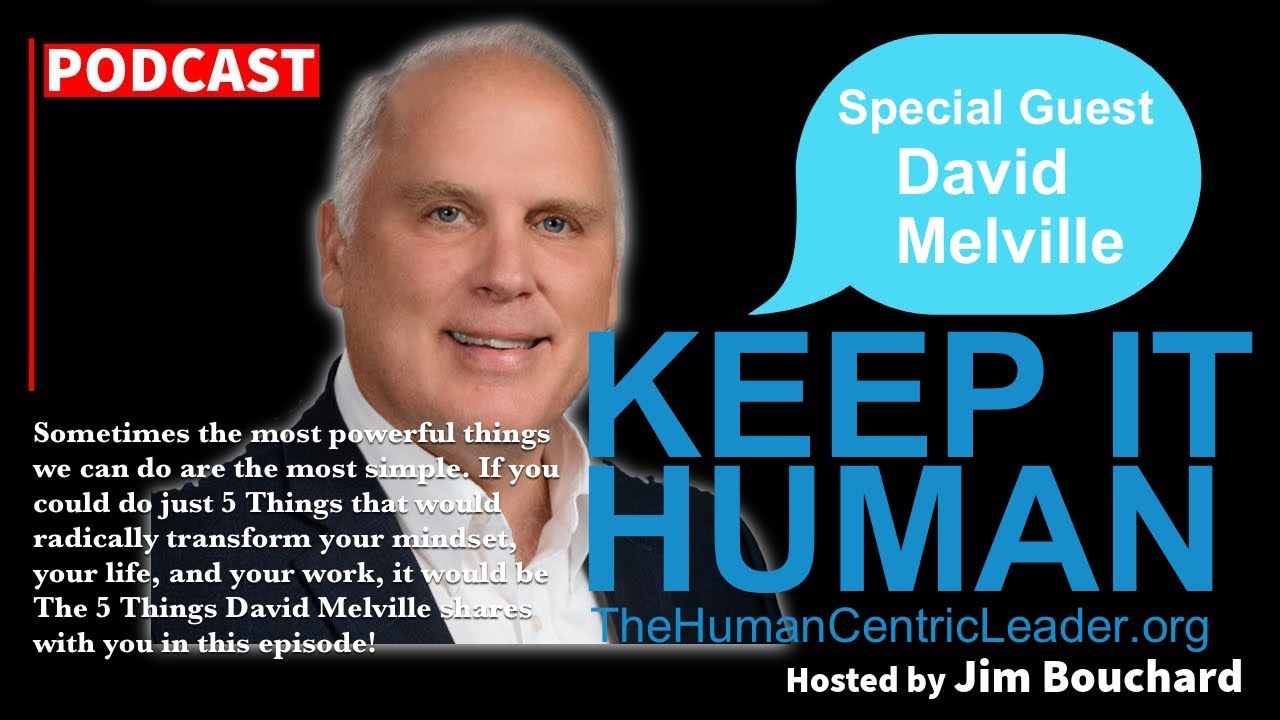
David Melville discusses five principles from his book, including paying attention to where you focus your mind, practicing radical acceptance without liking reality, and infusing days with genuine gratitude. An NSF study found people have roughly 80% negative thoughts, and Melville shares a water-drinking gratitude practice as a concrete way to shift that bias.
Chapters
I've been waiting to share this guy with you for a long time. Not only is he just a dear, dear friend and a mentor, and he's one of these guys that for years— you know, people always tell you you should write a book, right? People tell you that, but most people shouldn't really. But for years and years and years, all the friends of Dave Melville said he should write a book, and he finally did, and it's a fantastic book. So we're going to talk about that, a lot of other things. In just a minute when I introduce you to my friend, dear friend, David Melville. All right, the book is The Five Things, and we're going to talk about— well, I hope we get to all five things, but if we don't, I'm sure we're going to get deeply into one or two of them. And I want to introduce you, like I said, very dear friend of mine. We've known each other for years and years and years. He's, I think, one of the most brilliant thinkers you're ever going to run into. And I don't like reading self-help books or personal development books anymore. I really don't. I've read about all of them. So when Dave sent me this one, I have to admit, I kind of thumbed through it and I said, "Yeah, well, if it's halfway decent, he's my friend, I'll give him a good review." And I was just blown away. It truly, sincerely is one of the best that I've read, and it takes a lot to impress me. So here we go. Here's our friend, now your friend, David Melville. Dave, thanks for being with us.
Thank you, Jim. Thank you so much.
This is a fantastic book, man.
Yeah, you know, I'm thinking you and I about 1,000 years ago worked side by side.
Yeah.
And here we are like 1,000 years later working side by side again, kind of in the same space. It's so good to be back.
All right, you know what, I want to dive right into this. This is so cool. Pay attention to your attention. That's the one that really grabbed me because I'm going to tell you this quick story. When I was still running the martial arts centers, I used to have these little mat chats with my favorite class, the little dragons, 3 to 6 years old, right? And one of the questions I would ask them all the time is, what are the two most important words in the martial arts? And the response that I was always looking for was pay attention, which I think are the two most important words in life and leadership too. And then you nailed it with this whole chapter on pay attention to your attention.
Yeah, yeah, it's— let me just back up. I'll give you the format of my skinny little book. You know, I identify the 5 things, but I didn't want my book to be all dogma and blah, blah, blah. So at the end of each chapter, at the end of each thing, I added an actionable, something you can do, something you can try. So when you talk about each one of these, I'm going to give you an actionable because I want to be useful rather than just, you know, the guy that goes blah, blah, blah. But yeah, Pay attention to your attention. The takeaway for the second thing, which you landed on because of your little— your folks in the dojo. The takeaway is this: to that which you give your attention, you breathe life. So whatever it is, wherever your attention is going, you're making that bigger, whatever it is. So if you keep that in mind, all of a sudden you're like, oh, okay, so I'm going to spend a little less time focused in the problem and a little more time focused in the solution. Because whatever it is that you're paying attention to, that's where you're breathing life. I've got a great story. It's an extreme story, a story of a friend of mine, a good friend of mine now, Tom Pritz, who was diagnosed in December with stage 4 pancreatic cancer. And Tom had never heard that phrase before, but you and I, or for most of us who have heard that phrase, we recognize it as essentially a death sentence. So Tom said, "But Doc, wait, wait, wait, wait." And he decided he needed to make some big changes. So he decided to pay attention to his attention and that he would no longer allow any entry of a thought that wasn't affirming or healthy into his head. Now, you and I both know that's impossible. You're going to get some stray thoughts, you're going to get some dark thoughts, you're getting some bad thoughts. It happens to all of us. It happens— happened to him and is still happening to him. But he decided to take control of his thinking. And so he played militant gatekeeper if a bad thought came through. And he, in his own words, says he went over to the dark side many times, but he would let it pass and he would come back to something that was affirming. So the reason I tell you this story about Tom Pritzker, and you can YouTube him and hear it directly from him, was that, like I said, he was diagnosed in December, but it was December of 2004. So we're almost 20 years— we're at more than 20 years later, and Tom is cancer-free. To go more than 20 years after a stage 4 diagnosis is kind of a big deal. When you attribute it to where his attention and what he would pay attention to as a major factor— The question becomes, why wait for the diagnosis? If you can just pay attention to what we are making bigger in our lives. That's the story. I'll give you an actionable, but go ahead. It looks like you—
No, no, that's cool. But see, part of the reason that I was put off personal development books for a long time, and you know this about me. There are some powerful books out there, but I got so sick of the books that were just the power of positive thinking kind of thing. Not that that's a bad book, actually that's a very good book, but without the action— I'm glad you brought up The Actionable because without the action, I mean, you can think all you want. You can think you're a chocolate chip cookie all you want, it's not going to make you a chocolate chip cookie, right? And I think too many people bought into that New Age vibe where, you know, just manifest and things are going to come your way. But yeah, that's one of the impressive things about the book. But this has been your pattern in life anyway. You did it for me several times. First of all, you're always gifted about reflecting back, you know, whatever somebody's saying to you. And I thought that was really cool. It, you know, it goes back to Carl Rogers and actionable listening, right? Active listening. And that's kind of cool because as we talk, we start to solve our problems because we're starting to see, we're starting to focus our attention as we talk, I think, right? But it's helpful to have somebody like you reflect it back. And sometimes it's repeating it, but sometimes it's amplifying it. And then of course, the next step is action. Without the action, well, what's the point, right? If we're not going to actually do something to change, then what's the point? Yeah, so yeah, so what's the action step for—
well, you make a couple really good points there. The whole industry of manifestation has a tough reputation that it deserves because it's become an industry of, you know, people being fleeced for this idea that you can just think your way into a new situation. And the, you know, the power of positive thinking Gosh, the power of positive thinking is something that I pay attention to, but way more important than positive thinking is positive being. And that begins with you managing your thoughts because every thought you have, every, wherever you're giving your attention, you are penetrating your subconscious. Which is where everything starts. Here's one of my actionables. I've got a couple that I can share with you unless we want to move on to another one. But for example, one of my actionables for paying attention to your attention is let it go. Meaning, yeah, if something happens to you, you're in the checkout line and somebody's just out of it, just that was awful. That's just not the way you behave in public. That was That was ugly. If that happens to you, and it will, and it does, as soon as it's over, let it go. Completely let it go. Don't say, oh man, I can't wait to get back home and share what happened to me. I can't wait to tell somebody else about that bee, or I can't wait to relive it. I can't wait to relitigate it. I can't wait to— yeah, because every time you relive it, you're penetrating your subconscious with the same ugly experience, and your subconscious does not know the difference between the actual event and the reliving of the event. So if you want to pay attention to where your thoughts are going and where your attention is going, that's one way to kind of do the weeding out, is to let go of the, of the things that are annoying or even just disturbing, just completely let them go.
No, it's cool. It's cool that you brought that up. In fact, when you did, it reminded me of a— when I read that, it reminded me of a story, that old martial arts philosophy thing, where these two monks were on a muddy street and there was a woman trying to cross on the mud and the water and all this stuff. Now, this particular order of monks, they weren't supposed to even look at women, never mind touch them. But when one of the monks saw that she was trying to cross the street, he picked her up and carried her across the street, put her down. Now, the second monk, they walked on for miles that day and just wouldn't talk to the guy.
They usually walk in silence anyway.
Right, yeah. So finally, the monk who had carried the woman said, you know, you haven't talked to me all day. What's the problem? And he said, well, we're not even supposed to look at women. We're not supposed to touch them. He picked up this woman, carried across the street, and he says, "Yeah, and I put her down miles ago. You're still carrying her with you, right?" Right, right, right. There's a lot to be said for that. And I think especially when we're looking inward, and I know for myself, that's been always, it will continue to be a challenge. I don't think I'll live long enough to overcome it entirely, that we tend to look at ourselves, relive the things that we did, the worst things that we did, right? Yeah. And that distracts our focus from the positive things that we did. We need to do. We have to change our aim, right?
It's so easy to do, Jim. It's so easy to blame your parents, blame your neighbor, blame somebody close to you, blame somebody like your buddy the monk who touched a woman to help her up. It's so easy to blame yourself. Yeah, hang on. It's just so easy to hang on. But if you want to start paying attention and to your attention you want to let go.
Yeah, yeah. Nope, got to put the baggage down before you pick up the next one. So that's, that's good. Is there anything else you want to share about— I mean, we could go all day on, on just that chapter, Pay Attention.
I'm just on just that. I'll give you one.
There is one more I want to touch on here because this was another one of the action items that you talk about, and it, it touches right at the heart of the whole Keep It Human thing, is, is to seek inspiration. Because, you know, I believe that the key to a lot of— I don't think solutions. I'm a Thomas Sowell disciple. I don't think there are any solutions. There's trade-offs. But one of the trade-offs we got to continually make is, hey, let's get to people's hearts, not just their heads. Let's get to our own hearts, not just our heads, right? And to me, that's the whole key of the word inspiration. It's something that can touch us deeply. And you say we need to seek that out.
Absolutely. And it's like, you know, back to the Tom Fritz story is like, you know, he was who he was. And when he decided to change behaviors, he had to replace what was going on in his head with something that was uplifting. So I'm not going to sit here and tell you what's uplifting for you, but you know what it is. It could be music. It could be reading. It could be meditation.
It could be a few kind words from somebody.
Absolutely.
Yeah, yeah. No, I think too often people look— I don't like the idea that inspiration is something for only special people or the elite or the great orators or the great writers. I think inspiration should be terribly commonplace. We all do it all day long. We touch other people's hearts. We're not aware of it, so that's part of what we do around here is try to get people to recognize it and create disciplines that we can repeat, right? Just like your action steps.
You're kind of brilliant, as I knew, and that, you know—
You were one of the few.
Well, you're intuitive, let's put it that way. Because there's two parts to your attention. One is to weed, get rid of what doesn't serve you well, like the lady at the checkout or whatever. And the other is to feed, which is to seek information, seek inspiration. But when I talk about weeding, the kind of the low-hanging fruit, the easy one, is to take a media diet, take a political hiatus, you know, just kind of decompress from all the noise that's out there. Wherever you stand, whatever you think, wherever you are, doesn't matter. Let it go and replace it with something that makes you feel really good. Because the more you feel really good, and I keep going back to the subconscious because my whole arena is the science of mind, is to replace it with something that penetrates your subconscious, which then brings about situations on the outside that are consistent with what you keep feeding yourself with. So you're right, it's, it's a system of weeding out and feeding, and that is completely within your purview.
Yeah, I'm so glad you're kind of digging into that a little bit deeper too, because I hope people understand this. One of the reasons that I hold this book in such high esteem is because a lot of times this genre, people can get very flowery in their language, very esoteric, at the risk of offending someone, and I don't intend to, new agey, you know, and preachy sometimes. And this is— when I was reading this, it was as if you were in the room talking to me. Of course, I'm familiar with your voice, but this is so— I'm going to say down to earth, with that term being in the highest esteem, because it's completely human. It's just completely talking as a human being is talking to another one. And so as we're talking about all these conflicts, like you said, take a media diet. There's so much conflict that's affecting people's daily performance, especially in the workplace. And we're seeing that. It's one of the biggest challenges that leaders are facing today. Even in a small organization, in most places, you're dealing with a pretty diverse group of people. And they have different backgrounds, different experiences, different political beliefs, different religious beliefs, and so forth. And right now with the hatred at such a boiling level, it's difficult for people to to put that aside, right? But it's essential.
It is. And what I would say to anybody—
it'll still be there when you— right, it'll still be there when you want to come back to it.
But when you do come back to it, um, I, I would say you have a choice. If it's just, you know, who you are, what you did, it's what everybody has always done around you, and you need to feed on what's going on just that shift from paying attention to the problem and start paying attention to the solution and put your energy and your emotions and put, um, everything that you have into the solution rather than the problem. Because when you do look at what's going on, doesn't matter where your political stripes are, there's a whole lot of people that are just focused on the problem as opposed to the solution. So that's one way to weed and feed, is you just shift over to what's the solution rather than just being angry about the perceived problem.
Something, you know, one of the talents you've always had, and you are one of the best at this, and this is where I think any organization would do well to bring you in, whether it's for a conference or for a workshop or or anything else, because of how profoundly this mindset affects people, people's performance, if we want to reduce it to that. I think there's much more beyond that, right? There's the measurement of the baseline performance, but then there's also the, the, the unlocking of the potential that people might not even know is there, right? And when you're sharing these ideas, I think that's— it's at least equally important, if not more important. What you're teaching people will help them see possibilities they might not have imagined before. And so along those lines, I think you've always emphasized, and you were very good at, you were very good at it when you were a salesperson. It seemed to me like you were always more focused on the other person and their interests. And, and you're, you know, again, you're one of the, you're one of the best listeners I've ever met. How important is that? And how do you help people access that?
Oh my gosh. Uh, thank you for asking that. Um, One of the fastest, most surest ways to get what you want in life— and not that this is all manipulation— but if you really want to succeed, if you really want to get what you want, the fastest way to do that is to help everybody around you get what they want. And the only way you can do that is to know where they are, know where they stand, and feed where they are toward a better version of themselves in their definition of a better version of themselves. But yeah, and you know, someone might say, "Oh, that sounds good, but you know, who's got time to be helping everybody else? I gotta go get mine." But think about this now. If you're an organization of 10 people and you get to know the other 9, and you kind of know what they want and what they don't want, and you just feed them what they want, which is just— it's respect, is really all it is. And which leads me to another point. If there's somebody you just don't know what they want, first of all, you could ask them, but fundamentally, you already know what they want. And what they want is a chance with you. They want respect. They just want someone to look at them, understand them, and and, uh, respect them. So it's, it's as simple as respect, which I know sounds cliché, but back to the 9 people around you. If you're giving the 9 people around you what they want, the law of reciprocity says that those 9 people are going to seek ways to help you get what you want. So all of a sudden, while you're going to get yours, you've got 9 other allies who are helping you to move in the direction that suits you and the organization.
Not to reduce it all to commerce, but isn't that really what we're trading with one another all the time, right? Is that attention and that fulfillment of the other person's needs. I mean, really, that's what we're trading. I mean, none of us are, well, very few of us are living in a bubble, right? Some people try to.
Yeah, amen, brother. But it's not uncommon within an organization or a group to, you know, to assess the people around you and say, screw it, that guy can't help me, that guy will never be able to help me. Yeah. Wrong. Yeah.
Or to see them as a threat, right? See them as somebody who's trying to—
Or as a threat. Yeah, when you start to kind of know where you're going, know where the organization is going, you don't see anybody as a threat. But when you start to serve them, the people who you even see can never help you, you're going to be shocked, at least surprised, or at least amused, I don't know, when all of a sudden they're doing something that you never expected that helps you because, you know, the simple metaphor is if I open the door for you, you're going to open a door for me. So you do that for everybody around you and amazing things can happen. But here's the kind of the more important point that I would make is the people around you, the people in your space are not accidents. They're not there randomly. They are there at just the right time to help you and to help them evolve. So there are no accidents. And if you look at it from that perspective, that there are no random people in your life, and you start to treat them with the respect of people who showed up. I don't know how they showed up or where they came from, but here they are, and it's— they're not an accident, they're not random. And you start to treat them that way, all of a sudden, of course you're going to embrace them. This is your life, and this is— and, and conversely, you're no— they brought you into their life, and you brought them into your life, because now you're ready for this. And I'm talking about the person you're close to, and I'm talking about the person on the street that you're sitting on the park bench and they walk by, that person too. There are no random events.
I know you've been trying to convince me of that for years. Which is probably a pretty good segue, and I don't mean to go necessarily in order with these 5 things, and I know we skipped Number 1, which was change your mind. But you're running headlong into what you're— I know I'm not going to ask you the number. Everybody always asks me the numbers when I'm talking about my strategies. What's number 5? I don't know. Tell me the name, but the numbers were arbitrary. But the one that you list as number 3, which could easily be number 1, employ radical acceptance.
Yeah, it's number 3.
These aren't in order of importance, they're just—
Yeah, no, I think it's important that it's number 3. The reason is number 1 is like, oh, okay, all right, I get it, change your mind when it works for everybody. And number 2, pay attention to your attention, I get it. But number 3 is the most controversial, 'cause when you say employ radical acceptance, kind of a gut reaction is what?
That'll piss some people off these days. I said that'll piss some people off these days.
Yeah, people aren't ready to, I'm not gonna start the book with telling people employ radical acceptance, but I'll tell you, if there's something you don't like and there's something you want to change, the first and most effective step is to accept what is. That doesn't mean you have to like it. It means you have to understand it and respect it. The takeaway here is the most common mistake we make is thinking that things should be different. Than they are. They are the only way they could be. Everything is exactly the only way that it could be. And when you realize that, you stop, you stop getting wound up about what it is, and you stop— again, back to paying attention to your attention— you stop paying attention to the problems, because when you do, you're breathing life into the problem. So You accept what is in order to create change. I'll give you a great example of this. Martin Luther King Jr. found himself in a situation, and he wasn't okay with the situation, but he had great instincts, and he had a dream. Okay, so now he's paying attention to the solution, rather than the problem. What was the problem? The problem was generations of racism and oppression. Okay, that, that's a problem. But what Martin Luther King Jr. understood is these people— this is under the heading of radical acceptance— these people, my oppressors, they don't know any different. Maybe they do, but they, they, they're operating at their current awareness. They're doing what their dads did. They're doing what their mothers did, their grandfathers, both sides. They're just being who they are. So I can't use my energy, my emotions in trying to fix them. What I need to do is pay attention to the solution, pay attention to the dream, and understand that these guys are— they're operating at their current awareness. And he wrote about this in his letter from a Birmingham jail with a 4-step steps for effective civil disobedience. One of the steps was self-purification, which was his way of saying, man, I can't let my energy go to my oppressors and where they came from. What I need to do is put my energy on the solution. So that, I mean, that's extreme radical acceptance. But it was the beginning of an incredible movement in this country.
Well, and one of, I think this is critical. One of the actionables you have regarding this radical acceptance is modify your language, which today, one of the things I'm most concerned about today, and I've been kind of fixated on how do we sort of tamp down all the hate, all the passionate hate that's going on. And language is so critical. And right now it's so easy for people to express themselves and to amplify that, particularly with social media. And so this idea of modifying language is so important because, you know, I hate that people are— so many people are falling to Godwin's Law, right? And anything they don't like becomes Hitler or the Nazis. And I said, you know, be careful. Those are very specific words to use. You know, that's And the problem is, I don't care who any leader is at any particular moment. We can clinically analyze almost any of the leaders we have. We have the luxury of doing that. But I'm more concerned that the general population is falling so easily into this language model where we're dehumanizing each other. Through the language, we're dehumanizing. We're making that It's natural for us to see people as the other, but it's very dangerous when we start to see people as less, and we're doing that with language.
And after all, Jim, we need to keep it human.
Thanks for the plug. There you go. Yeah, absolutely right.
No, but absolutely. And the language that I just shared, uh, should help when you, when you see somebody who's like Oh my gosh, I don't know where they get their ideas. I can't believe they're saying that. When you just say, look, that person is operating at their current awareness. They— this is what they know. This is what— and sure, can I— can we have a conversation and kind of move each other's opinions of a shift here, a shift there? Well, probably not. I mean, you can have the conversation and you can present the best case that you can, but if you get so fixated on changing them, it's going to lead to a lot of frustration and no change, and in fact, more anger and probably feeding the problem. Because again, you're paying attention to the problem rather than the solutions. You know, should you spend the time? If there's anger involved, no. But if there's real— if there's an appetite for real discourse, sure, have the conversation. But if you're trying to fix people, Ain't gonna happen.
That's a pretty Taoist way to look at it, right? Lao Tzu a long time ago, right?
Really what I'm saying is they're okay. There's nothing wrong with them. You don't need to fix them, right?
Yeah, sorry. There's that beautiful story. I, I always forget this gentleman's name. He's a, he's a musician from the South. He's a Black man who approached— he wanted to understand why people in the last few years were so enamored still of the Ku Klux Klan and the neo-Nazis and whatnot. So he actually approached and he's deprogrammed a bunch of Klansmen. He's a fascinating guy. We're trying to get him on the program. And they actually give him the robes when they leave the Klan. And the thing he said exactly what you said. He said the first thing when people ask him, why do you approach these people? They're hateful people. He said, well, I needed to understand them for one thing. And what he started to understand, I guess he employed your radical acceptance because he didn't agree with what they were doing. He didn't condone it. He understood that that was the only worldview that most of these people had been exposed to, that they actually thought it was right. And until they saw something, until someone had the patience to show them something different with some love and some respect, they were just locked in combat. Against the different ideologies locked in combat. Scary world. Interesting world though, isn't it?
It is. It's fascinating. It's scary. It's lovely. It's all of those things.
Not a dull moment. What's your favorite one of the 5? And you know what? Quickly, I want to just read the 5 things just so we don't miss any in the conversation. 1, change your mind. 2, pay attention to your attention. 3, employ radical acceptance. 4, infuse the day with gratitude. That's something we should really talk about. And 5, be present. What, which, well, I'm not gonna put you on the spot and say which one's important, but do you have a favorite?
You know my answers. They're all my favorite. But if somebody said, yeah, okay, they're all your favorite, but cut to the chase, spit out something that's useful. Where are you gonna go? I am gonna go to, just as you suggested I do, I'm gonna go to number 4 first, which is to infuse the day with gratitude. And the reason is, it's the low-hanging fruit in terms of changing your experience, changing your world, is to infuse the day with gratitude. But I want to insert a very important word, genuine, authentic gratitude. You can't be like, oh yeah, yeah, okay, so I'll be on a higher frequency, I'll feel better if I, Count my blessings, sure. No, no, no, no, no. What you need to do is move into genuine gratitude and exercise that gratitude muscle as often as you can. One of the stories I like to tell, it's time for a commercial. Kirkland water. Whenever I have a chance, morning, noon, or night, I take a little Kirkland water. It's flavored with minerals, whatever that means. But anyway, no, this is, Flavored with minerals? Like what? Anyway, the point is, I, throughout the day, I either go to the tap or get my Kirkland water or my Poland Spring water, and I recognize it for what it is. This is the foundation of life. This is the essence of who we are. This is extremely important. And so I'll take a drink. Mm. And I'll say, this is what good health tastes like. So, you know, good, clean water. There are 2 billion people. I'm not trying to lay on a guilt trip. Maybe I am, but there are 2 billion people who can't get clean drinking water. But it's the low-hanging fruit for us. And some, some of your viewers or some people would say, Oh my gosh, I can't believe it. This guy's telling us to go crazy over a glass of water. So no, no, no, no, you don't have to, but you could. It's the low-hanging fruit that puts you on a frequency of gratitude. And if you do that and then move on to the next thing that you're grateful for and the next thing that you're grateful for, and this sounds kind of like soft, it's like, oh yeah, okay, gratitude. But I'm telling you, it is a game changer. It is a life changer. When you practice genuine gratitude. I don't, when I have a little glass of water, I am so genuine because I recognize how important it is. And, you know, I lived through, I moved down to North Carolina for a while and there was a drought and I'll tell you what, it got pretty ugly when it came to who's gonna get the fresh drinking water. It got very ugly. But it, so it really is the foundation of life. And if I could just, Back up to the very beginning of this is like I kind of set the stage for all 5 of the things with that study from the National Science Foundation that says that 80% of our thoughts are negative. Like, 80%? You're kidding me. 80%?
It's a survival mechanism, right? Yeah. Yeah.
Well, if it's true, and I still have trouble wrapping my head around that, but say it's not 80%, maybe it's 70%, but if they're even close, in this study of thoughts.
And it's not 80% all the time either, right?
Yeah. Well, it's 80% in this study. Well, generally, yeah. Over average, 80% of thoughts are negative, meaning fear-based, meaning scarcity, meaning comparison, maybe anger, guilt, worry. If they're even close, then our opportunity, our big opportunity is to flip that ratio. And the quickest and surest way to do that surest way to flip that ratio is to practice genuine gratitude. Because if you're— and my recommendation is 1,020 minutes a day. If you can be in a state of genuine gratitude 1,020 minutes a day, which is 17 hours, you'll sleep for 7 hours and you'll sleep like a baby and you'll wake up ready to go. And obviously that's just like ridiculous pie in the sky. Nobody's going to be grateful for 1,020 minutes a day, especially if it hasn't been your thing up till now. But if you're like, gratitude isn't your thing and you grab a kvitz about stuff, then just shift. In other words, how about 10 minutes a day? How about 5 minutes a day? As long as, again, it's not like, oh, that's right, I got to do my gratitude thing. No, no. If you can get into genuine gratitude and just shift that ratio, it is a game changer. And it really is. Quickest way to— of the 5 things. I mean, they are, they're all, they're all great, but that, that's a, that's a great one to start with.
No, I couldn't agree with you more. The power of it. And again, you know, I'm not the lollipops and puppy dogs guy for sure, you know. So when people, people, when I say I, I can't stand the, the tag that we get with some of the stuff, uh, soft skills, or, you know, That type of thing, because these are— it is tremendously powerful, you know, speaking from experience. That was— it was a recognition of gratitude that saved my life when I was a drug addict, you know. And I think at that time it probably came from my mom, thankfully. I mean, she grew up in poverty. She was immigrant family, so, you know, she knew authentic poverty. And no matter how little we have, when we focus on what we have rather than what we don't have That's what we have to work with at any given time, right? That's what starts expanding things. We start to see things more. I know we both admire Stephen Covey. We start to see things more from a perspective of abundance, however little that might be. And it becomes very powerful. Like you said, the small steps, the next step, the next step, and that's how it expands, no? And the other time, and I say this, I intentionally mean this as an endorsement for you, is I know you wrinkle your eyes when I say this sometimes, but you genuinely saved my life a couple of times. And it was because of that, is because at certain points in my life when we were working together at the hotel, that was television station for those who don't know the joke, but I allowed myself to slip away from that gratitude mentality. And I was much more focused on what I didn't have or what I thought I should have And you were one of the people that refocused that. I know I wasn't always receptive. We're not always openly receptive to it, but if we let that go in, and that's what changed things. And literally, I'm thinking right now of a very specific moment where it was on a Friday afternoon where I don't remember exactly what you said, but you shifted that focus and it helped me shift my mindset from going home on that Friday afternoon and probably either drinking myself into a coma or doing myself harm, or what ended up happening was, you know, I think Dave's right, and started to—
I think I remember what I said to you.
You do remember what you said to me?
I think I do.
This would be really cool. Pay attention, people. This is gonna— no, seriously.
This is the first time that this NBC affiliate had had pink slips ever, right?
You know what, keep going. This was a different story, but this is a good one too.
And this takes courage because you could have smacked me around at the time. I said, Jim, this is the best thing that's ever happened to you. Not knowing ever, but I said, this is a really good thing that's just happened.
Yep, yep, yep. I remember that. That was the second time though.
There was a— Oh, okay.
Oh wow.
All right.
I don't remember the first time, but I was, I was in a more desperate state the first time. At that time when I remember, yeah, when the layoffs came, um, oh, this was in South Portland. I think I was still, I think I was living in Portland at the time. I think I was living on State Street at the time. Oh, okay.
All right.
It was when I had a relationship that had broken up and, uh, two amazing things. Yeah, you, you, I, gosh, I wish I could remember what you said. And then our dear friend Nat walked in one day. I was in the middle of that. Yeah, I didn't know it at the time, but deeply depressed. And he threw a beat-up, tattered copy of Zorba the Greek on my desk, and he said, read this, it'll change your life. And I said, no, no way. And now I understand, because I went home and I, you know, I devour books. I went home and I read it, and it changed my life. And now when people say, hey, you know, we should have a manual for life, I said, there is one. It's Zorba the Greek, read that.
This is good. I was having trouble with the burden of saving your life. It sounds like Nat saved your life with Zorba the Greek. So good.
I've been blessed. I've had a few people do the job. It's a good thing because I wasn't doing a good job by myself. So yeah. But like you said, I mean, and I'm not— I think you embrace kind of the mystical quality of this more than I do. But you're right. If we're open to it, there are times— well, the argument I get into with some people when they ask me about drugs and how I survived all that and so the self-destruction, and I say luck. And people look at me funny that way, but I think we're kind of saying the same thing with different language. You know, there's this, all these things that are happening around us all the time. Which ones are we going to be open to? Which ones are we going to be focused on, right? And again, you're hitting that with the 5 things. Pay attention to your attention. If we tend to create what we aim at, right?
Always. And what we internalize. You know, it's one thing to have a picture of the BMW, vision board, picture of the BMW on the wall. The problem with the picture of the BMW on the wall is every time you look at the BMW on the wall, you say, I don't have a BMW. And what you're internalizing, lack, what you don't have. What you want to do is internalize what is the feeling that you will have, would have, if that BMW was yours, focus on that, internalize that. And for those who are saying, well, you know, to be grateful for a glass of water, really? Okay, if you say so. But if there is anybody who's struggling as to, well, what can I be grateful about? Well, yeah, I have four limbs that work and I have a roof over my head and blah, blah, blah. But here's a great take that I got from It was a Warren Buffett comment who said that the— he was talking about John D. Rockefeller, who in late 1800s, early 1900s was the wealthiest man in the world. And Warren Buffett said, where we are today, the bottom 5% of earners live better than John D. Rockefeller did. Like, wait, what, what, what? The bottom 5% of earners today live better than John D. Rockefeller did. And not to say the bottom 5% of earners are happier than Rockefeller was, but they have so much to focus on and be grateful for when you look at the advancements and, and scared, I guess, but education, transportation, entertainment, sanitation, medicine. Here's the example I like to use because it's very— it's not very, um, it's not very confrontational. Um, but so imagine John D. Rockefeller wants to watch a football game. First of all, he has to go to the game. There's no TV. So he's got— he goes to the game and he's watching the game with his buddy, and something happens on the field and the refs are getting together to talk about it. And he turns to his buddy and says, "What happened?" And the buddy says, "I don't know, I missed it." So what can they do about that? And the answer is nothing. I mean, they could turn and ask other people, I suppose, but there's really not much they can do. But today, the bottom 5% of earners, as well as you and me, we've got commentary, replay, we've got 8 different camera views, there's probably a whole podcast on that play, depending what the play was. But we have so much, you know, improvements in entertainment, et cetera. And if you take that kind of a picture, and you can translate it to every major category of evolution, we have so much. But, you know, I'm not sitting around saying, oh, man, I'm so grateful for replay. But I take it for granted. The fact that I can see, and I don't even have to listen to the guys yammering on the TV. I can see what happened. It's, it's, there's a lot to be grateful for if you just make up your mind to be genuinely grateful.
Oh, of course, we're cursed by abundance, right? You know, it's interesting. I love the fact that you've used water in your example because we actually experienced that when we went to Cuba. First of all, good water is pretty scarce there. We actually did run out of water our last night there. We ran out of bottled water. Oh, wow. And no access to— Now, we weren't going to die from it. I mean, we had had enough water through the day. But let me tell you something. It's the only time in my life I really understood what it was to be thirsty. When morning came and we were able to get another bottle of water, oh my God, it was like heaven, you know.
So you weren't going to go and turn on the tap. You weren't going to go and turn on the tap in Cuba, right?
Well, you know, we, we couldn't avoid being exposed to the tap water to some degree, so it took a couple days after we got home, and then we had the, uh, yeah, the Cuban revenge for a few days. So yeah, yeah, it's, it's almost unavoidable.
But, um, well, you think about water, you think they found ice crystals on Mars. I don't know when they did or who they are, but, you know, as the story goes, there's ice crystals on Mars. Oh my gosh, that means there's life on Mars!
It could be, right? Yeah, yeah.
I don't know what happened to that argument, but I don't know.
Listen, this is, this is going to be the first, not the last time you, you're on Keep It Human. And, uh, we've got a lot of things to talk about. And, and there's, like I said, there's some of the some of the areas we really didn't get into. I think we hit, you know, because honestly, the gratitude section, that's one of my favorites. And I think that's the most powerful one. And employ radical acceptance, I think, especially for leaders today. I don't care if you're the shift leader at a 7-Eleven or you're running a big corporation. I think that's one that if you can embed that in your leadership practice and your culture, By example, you could be doing a lot worse than that one. That is powerful right there. That's the one that's going to help us live and work together. So how do we find the book? It's everywhere. You Google The Five Things and I saw it comes up on Amazon and what's this other one?
Amazon, Barnes Noble, Ex Libris. So you can find it online. And I've got it for those who are local, meaning Maine, they're in Sherman's Bookstores or Cuppa Joe's in Yarmouth. So you can find it.
And you are ready to hit the platform and get out there, and you're speaking at a few conferences coming up now. You're doing some workshops. How do people get in touch with you if they'd like to bring you in?
Go to my website, which is sharing5things.com, sharing with a number 5, things, sharing 5 things. Number 5. And, um, and you can find a place to info at sharing5things.com.
David, we'll have you back very, very soon. Thank you so much, my friend.
Thank you, thank you, appreciate it.
More from Jim








Why AI-Only Customer Service Is Failing Customers | Danny Snow on Keep It Human


