There's NO "New Normal." Become comfortable with uncertainty!
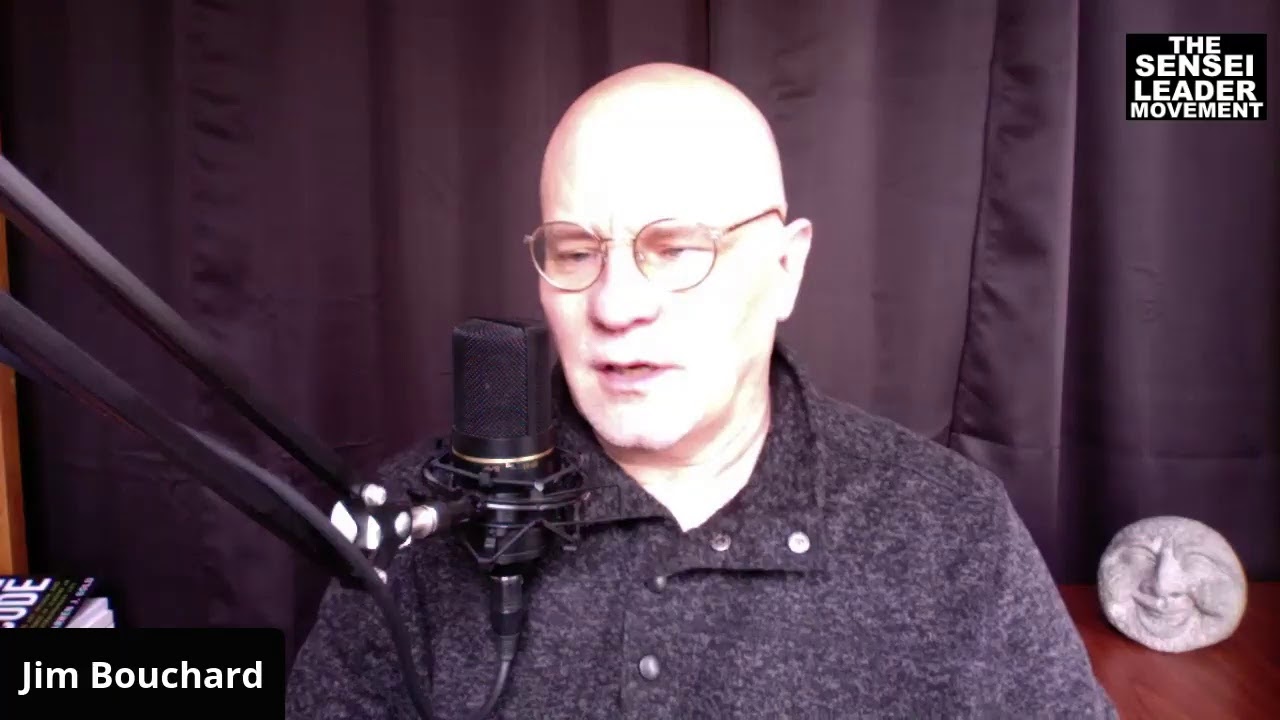
Jim Bouchard argues that "new normal" is a myth and uncertainty is the only constant. Leaders must build resilience through three pillars: training, preparation, and practice. He distinguishes leadership from management, emphasizing people and empowerment over tasks and delegation.
Chapters
All right, just in case you didn't get the message, this is Jim Bouchard from the Sensei Leader Movement, and we were supposed to have Grandmaster Mark Shui on today. He was going to talk to us about yoga and canes. This is one of the canes he made for me, actually. I don't know if you can see the inscription on here. Try to see. These Facebook, uh, FaceTime cameras aren't that good, but nice engraving and all kinds of carving. And there's a meaning to all these different pieces of carving. Pretty ominous looking weapon, isn't it? This is one of my favorite ones. This is one that, uh, was made for me when it was presented to me by the black belt community at Northern Chi when I think when I got my, uh, What was that? For Sensei James Bouchard, 5th dan. Oh, when I got my 5th degree black belt. Wow, in 2004. Oh my God, don't I feel old now? Anyway, I thought I'd pop on with you guys for a few minutes if you want to put some comments up in the, in the threads, uh, and I just wanted to share some thoughts on this idea of the new normal. This thing's driving me crazy. I hate this term, the new normal. You know, we talked about with Joe Callaway on the stream yesterday, uh, the only certainty is uncertainty. I think Pliny the Elder said that in Greece centuries ago. Lao Tzu said the only, the only real certainty in life is change. And yet we keep coming back to this meme of the new normal, the new normal, the new normal. What we need to do is become comfortable with uncertainty. And this is nothing new. This is something that we've been preaching for a long time here at the Sensei Leader Movement. In fact, it's one of the key strategies in, in the book, The Sensei Leader. And, uh, that's what we're going to talk about for just a couple minutes. But before I do, we did get something from Master Shuri. Here's a pass to his Cane Master's Virtual Dojo. It's a free pass. You can use that Bitly link there And, uh, I don't know any of the other details, but there it is. Okay, if you want to go ahead and try some of the Cane Master stuff, uh, for free, there's a free trial thing there in his virtual dojo. And, uh, I think he got mixed up between the East and West Coast time, so that's probably what the situation was. And, uh, he's— he is in fact doing the virtual dojo right now. So anyway, let's get back to what we were talking about. Um, This idea of uncertainty, like I said, the new normal is driving me crazy. It's, it's a crazy term. There's always uncertainty. There's always uncertainty. In fact, one of the greatest metrics in leadership, if you're trying to advance, if trying to move up the, up the ladder, so to speak, is your ability to deal with uncertainty. It's one of the things that especially larger organizations are looking for. Things are always changing, they're always evolving. There's always conditions and circumstances that we don't anticipate. And what's really interesting now is that at this time, it's really separating. Now, for those of you who have tuned in before or have read any of the materials or are Sensei Leader members, um, you know that we make a clear distinction between this character— we created this character of the evil manager to differentiate between a manager and a leader. Now, don't get me wrong, management's important, it's just not leadership. You know, Admiral Grace Hopper said it so beautifully. She said, Management is about things, leadership is about people. Or you lead— I think she said you lead— you manage things, you lead people. And for too long, we went overboard on management. Here we focus on completely on the human-centric side of leadership. So differences between a manager and a leader: a manager will try to motivate. Motivation is fairly simple— get you to an expected goal. You can bribe people, you can scare them, and they'll do more or less what you expect them to do. Inspiration means going beyond those expectations.. And that taps into the emotional side of things, a purpose, right? A manager will delegate, delegate, where a leader will empower, make sure people have the right tools, the right things they need, the training, the preparation that they need, and sometimes even permission or authority to go forward and, and act on their own. And then the manager will push or drive where the leader guides. And that really embodies this principle of the Sensei Leader that that we represent. You know, the leader as a guide, as a teacher, as a coach, as a mentor, as someone who's willing, willing to give the time necessary to cultivate that the next generation or help guide people to their best performance, right? So anyways, we're dealing with uncertainty. There's 3 major things you need to pay attention to: training, preparation, and practice. It's that simple. It's not easy, but it's that simple. All right, if we're going to become, become comfortable with uncertainty— and that's the strategy that we share, and I'll type it up for you too— is be flexible, adaptable, and comfortable with uncertainty. Pardon me while I'm typing here. With uncertainty. And that's what we're constantly thinking about. So again, how do you do it? Well, the best way to become comfortable with uncertainty is training and preparation. And the way, you know, that's why a leader has to empower people to be able to provide the resources for that training preparation. You train and you prepare for every single, uh, type of situations you can anticipate, and even some that are difficult to anticipate. But that's the best you can do. But the training, the preparation you do for, for, uh, predictable or, or conditions that you might anticipate will help you because that process of training is really the important part. You learn how to train, you learn how to train quickly, you learn how to muster resources in order to prepare for something that comes up that you didn't anticipate. So it's never wasted time, okay? So it's that training and preparation and then the practice. You have to embed this in your life, you have to embed this in your in your leadership practice. Okay, so training, preparation, practice. That's it. Now, the other side of the coin is this, especially if you're developing other leaders. If you want people to be comfortable with uncertainty, you've got to give them the opportunity to practice in conditions of uncertainty. Now, a lot of people are hesitant about that. Leaders are sometimes hesitant to do that because they're afraid that there's risk involved, and there is, and you want to manage the risk. First of all, you don't want to throw people into situations where they have absolutely no chance of success. That's, that's foolishness. And you want, you want them, uh, you want to manage the risk if it's their first opportunity to test themselves and make sure that if they fail, they're going to fail fairly safely. It's not going to cost you that much, not going to cost the organization that much. But there are plenty of opportunities for that. Sometimes you want to create them, sometimes they're a little outside the organization, sometimes it's by accepting leadership positions and volunteer organizations and things like that. But there are a lot of opportunities. But you will not become comfortable with uncertainty if you're not exposed to it. All right, now I just want to leave you with this thought, because one of the blessings of a situation like this, for, for a lot of us, those of us who are a little long in the tooth, like I said— what was that inscription on that cane? I earned my fifth dan in 2004. Holy cow, doesn't seem like that long ago. But anyway, those of us who have been around for a while, we've been through periods like this. Many of, many of us have lived through, uh, for instance, 9/11, okay? Or even in the case of this, the swine flu, which didn't seem to, to be as, as big an issue, but certainly was concerning to us at the time. And that's how you develop that. Then you start to get a— not thicker skin, but you get— you develop more awareness, you develop more ability to speed through the preparation that you need to, to do in a time of crisis like that. So if you're going through this for the first time, the silver lining in is that you will be better prepared for the next one. Now, caveat there, as long as you're willing to wring the lessons out of this. That's it. I hate those little poly— just like I hate the idea of the new normal, I hate these Pollyannish terms where the people say, oh, don't worry about failure, there's no such thing as failure, there's no such thing. It's, you always learn a lesson. Yes, you do, as long as you wring that lesson out of it, right? And you got to be willing to do that. That requires some introspection. Sometimes it's painful. But that's what, that's what's happening right now. So as you're going through this, if you're willing to really examine yourself, you're really willing to dig in, do the best you can, and then like I said, squeeze those lessons out of the situation, then you're going to find that you'll emerge as a better leader and a better person at the end of this. Okay, so once again, I don't want to spend too much of your time here. Very sorry Master Shui couldn't make it with us today. If you were tuning in for that, my apologies. Um, hope you got a little something out of this program. And we'll be back with you tomorrow. We're going to be right back with you tomorrow at, I'm going to say, 3 o'clock. It's 3 PM with David Lee. David Lee is one of the great, uh, speakers and experts in human, uh, human resources, and we're going to talk about courage and perseverance and how we can apply that in this, this situation. Okay, again, thanks so much for tuning in. Your support for these live streams has been incredible. I really appreciate it. Thank you.
More from Jim








Why AI-Only Customer Service Is Failing Customers | Danny Snow on Keep It Human


