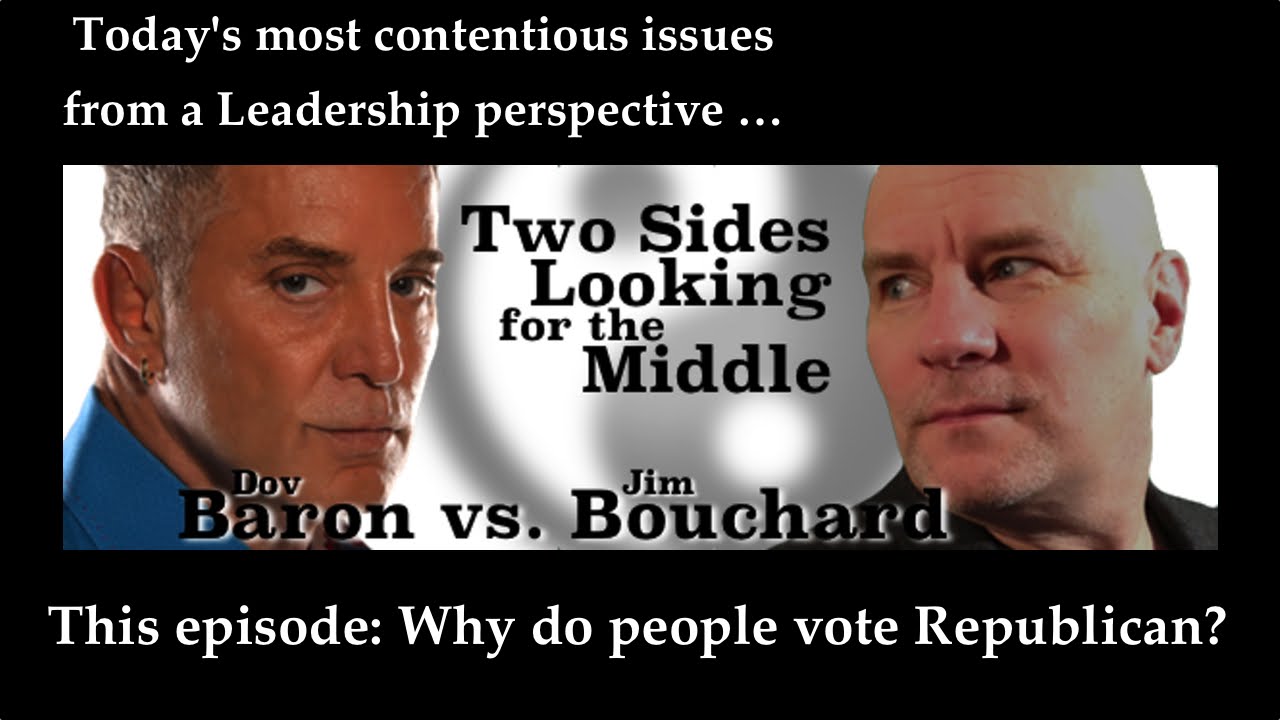
Dov Baron and Jim Bouchard explore why people vote Republican, examining polarization, party identity, money in politics, media influence, religion, and demographics. They critique willful ignorance and partisan behavior while searching for common ground across the political divide.
Chapters
Hello, everyone in the world. My name is Dov Baron, and I want to welcome you to our first inaugural episode of Two Sides Looking for the Middle, where we actually take on a subject and instead of doing the usual media thing of ripping each other's throats out, my co-host and I will actually be doing our best to find the middle ground between our two— the opposite sides of where it is we're looking at things. Our intent is not to sway you. But rather to catalyze you into a deeper level of thinking and get out of your own box. So let me introduce my esteemed co-host, co-presenter, Mr. Jim Bouchard. He is a former drug addict and not once but twice, two-time college dropout who has gone on to become a top-selling author whose latest two books, which are Think Like a Black Belt and the set, the the Sensei Leader, have received high praise from leadership and business around the world. Jim is an independent, in-demand leadership authority who helps people become better leaders and leaders become better people. He's an outstanding man and somebody I'm actually very honored to call my friend, even though he kind of leans on one side a bit too much. But nonetheless, Let's welcome Mr. Jim Bouchard. Round of applause, please.
There you go. Well, I'll try to lean on it a little harder, especially— I was worried about— you said we're not going for the throat, and then you immediately went to the resume piece. I sorted fast, but I appreciate it. And no, I appreciate what you're saying. We're trying to find maybe some middle ground. Maybe we're going to find places where we just don't agree at all. But what we hope to model is that while we're on different and opposite sides of issues many times, we find some respect and we find some areas where we can agree and some areas where we agree not to agree. So I want to introduce back to you my dear friend, Dov Baron, who was Inc. Magazine's, one of Inc. Magazine's top 100 leadership speakers last year. I think it was a great honor. And I want to tell you a little bit about his, well, he's been a bestselling author of several books, but his latest book, which I highly endorse, Fiercely Loyal, which is how high-performing companies Develop and Retain Top Talent, and that book needs to be on your bookshelf. So that's, I guess that's enough for praising and loving one another. Now let's get down to some battle, huh? We've got a contentious issue today, and it's one, I think it's very timely. Maybe it's nice that we're doing it today because later on this afternoon, this evening, the Republican candidates are going to be lining up for their first, well, alleged debate. We'll touch on that topic.
Well, for me, I mean, let's start there because for me it was fascinating because here's this debate We've got, is it 17 or 16, uh, candidates at last count? It's more like bingo than it is GOP candidates. Uh, but 16 of them, 6 of them didn't make it on. So they go earlier in the afternoon for a small audience. And then the big one, that is the big, where I think it's televised and everybody's involved, is the 10. That includes, of course, Jeb Bush and, uh, people like that, Cruz and some of the others. And of course, the Donald, the Donald, Captain Wiggy himself, uh, is gonna be on that. So right there, let's, let's just start there, because the question is, why would anyone vote Republican? And I'm just gonna give you my piece here, and then you jump in, please. So Here's the piece. Why would anybody vote Republican? Because even at this point, even at this point, when I look at the Democrats, and I'm not saying they're a lot better, but when I look at the Democrats, I'm not seeing Hillary Clinton trying to rip out Bernie Sanders' throat. And those are the two front runners. I'm not seeing Sanders trying to run out Hillary's throat.— but I'm already seeing people trashing Donald. Now, maybe with good reason, maybe not with good reason. I've seen them starting to already trash each other. If I'm a Republican voter, why would that instill confidence in me? Because at some point, somebody is going to be the lead and somebody is going to jump in behind them, who's probably somebody who tried to tear out their throat before. Why would I vote Republican if it's so adversarial? Inside, not just even outside.
You know, Democrat or Republican or any other party you want to throw in there, unfortunately— well, I don't know if it's unfortunate, but I'll say this, a statement of fact, that our political system is by nature adversarial. And you know what's difficult? There's two problems. First of all, I know you and I have talked about this— people who are willfully uninformed that don't like to dig into the issues like you and I do, uh, and so they're going to vote largely based on either personality, tradition, cultural perception, you know, these, these different things. I made a little list, not necessarily why people vote Republican, but why they vote for any party, why they have party loyalty, and those are the things that really crop up. The adversarial condition is because, and I'll tell you what, I worked in television broadcast in a past life too, and one of the stats that always came up around election time was that negativity sells. Unfortunately, negativity polls higher than any sort of positive message. I agree. Right, that the Democrats haven't got—
It leaves, it leads.
Right, exactly. That the Democrats haven't gotten around to it yet, I think, is just a matter of timing. Actually, Hillary's been very evasive of the media so far, and that's a well-publicized part of her strategy. I think they'll get their fangs out too. What's really interesting is how short our memories are as voters in America, and I think from friends, you know, like yourself in Canada, I think it's the same. Pretty much the same condition there.
I think that, I think, I think that people have political amnesia.
Yeah. Yeah.
Um, and they forget. And the advent— the, the advantage to that for politicians is people actually forget the hell they voted the person in on.
Yeah.
What's your policy? You know, I guess that didn't matter anymore, you know, because we all know the promises are empty. And part of the reason the promise is empty— I think there's a lot of reasons— that one of them, of course, is that some of these people we vote in are just damn unintegral. That's it. Boom. Then after that, if you get voted in and you actually do decide you want to do something, you've got to go through Congress, who can literally fold their arms, stomp their feet, and say, we're not doing anything, and get paid. And what other job in the world can you get paid a very nice salary for doing absolutely nothing? As you know, Congress, what was it, uh, 6% or 3% got the, uh, the vote of, um, people were satisfied, the American people.
Yeah, I actually, I actually wish they would do more of nothing though, because it seems that when, when they're, uh, less active— and it's interesting too, right, in business, uh, you know, both of us work in the arena of business leadership, and in business, how do we measure our successes? We measure it by results, right? We measure it by what happens, what the product is. And unfortunately, in politics, it isn't always measured that way. A lot of success in politics, and I've had some dear friends that have held office, and they've said this, you know, I said, why did you put forth this particular bill? And I remember one of them saying, well, we have to. She said, I have to put forth bills in order to show my constituency that I'm doing something. And I said, well, I'll tell you what, if I ever ran against you, my platform would be, I'll tell you what, I'll promise if you hire, you know, hire me, vote me into the legislature, which is the same as hiring, by the way. I'll promise this, I'll do absolutely nothing for 2 years, and I think your life will be a lot better off for it. Right. Yeah.
I mean, the whole, I mean, you know, we're actually discussing why would somebody vote Republican, but the truth is that we both agree from both sides that there's a lot of mess in the political system. Um, and, and, and let's bring that back to this question of why would we, why would somebody vote Republican? Because let's take, uh, the goodness, it's gone out of my head right now.
It just said Pew Report.
No, no, not the Pew Report. The, um, the people's, it was the, uh, the, the, the issue that was, God, I had it in my, on my notes 5 minutes ago. I was just looking at it.
It's a good thing you're not running because they nailed Rick Perry on this, right?
Exactly. It's called brain flatulism.
There you go.
So, um, you know, where money was allowed to flow into, into politics unlimited, uh, and I can't remember what it's called right now, it'll come to me in a minute. Anyway, that piece was put through as a Tea Party thing. Right. And so here's the thing for me when I look at it, because there are a lot of things I don't like about what goes on in the Republican Party, but there's a lot of things I don't like about what goes on in the Democratic Party. So let's be fair about that. But part of the issue is the misdirects that drive me crazy. And so here's the misdirect is the Tea Party, which seemed, seemed to be the purest version of the Republican Party because it wanted small government and wanted things returned to the people and good ideas. However, if we look at who finances it, who's behind it, who's, who's helping them tear down legislation, guess who it is? It's big money. And who's the big money? Well, it's the Koch brothers. So Now it's not really about the people at all. It's about using, manipulating people into thinking this is about you, the small person. So these people are voting, believing that this is about us and small government. But actually what it is about is removing legislation that gets in the way of big money. So part— you talked about willful ignorance. To me, what's so obvious is that People don't bother to look deeper.
Hmm, but you brought up two really interesting and really deep points, and the first one being that, uh, it does take big money to have a voice, not just in politics but in our culture in general these days.
Absolutely.
Um, although, you know what's really interesting, we're, we're the disruptors, right? By doing a program like this, anyone has access to a Google Hangout or to podcasting and webcasting, so your voice can be heard, but it's still not easy to get through the chatter and through all the, all all the other noise. Uh, you know, big money does tend to win out, and I don't have a problem with big money being involved if the individual, right, is allying themselves with that because the big money is supporting their cause, uh, which, which may be the case if someone's informed. If they're not, well, that's, that's a different issue.
That's a big presumption, Jim. That's a big presumption. So because you and I both know, um, if, if I decide— you decide to run We are going to go courting those big money people and they're going to say, you know, and, you know, 5 minutes ago before I went to court them, you know, I was, I was very much on a healthy diet and I was very much talking about a healthy diet, but now I'm talking to big sugar. I'm talking to high fructose corn syrup money. And I go, oh yeah. Oh yeah. I bake every day with it. Love this stuff. You know? So I think that that's part of the, you know, you saying you don't mind the being big money because you have to have a voice. I understand that. I get that it cost, um, Obama and Romney $1 billion each to run last time. That is disgusting because how can it possibly be neutral when that money is influence? Money is influencing in the political system, and that's what's wrong. Money is influence. So I, as the Republican voter, I, as the Democrat voter, I, as the whatever voter, I'm not hearing the true voice. I'm hearing the rhetoric. Because if, if I decide to run against you and you've got Coke money, you've got Big Sugar money, you got oil money, whatever it is behind you, and let's pretend that my— what it is that I'm standing for and fighting for is exactly what the voter wants. The voter doesn't get to even hear my voice because there's a billion dollars of Coke money and oil money and, and and all those monies behind you, so I'm drowned out. It's hard to get access, but it's not the same.
It's hard to get through it, it definitely is. My contention there, as always has happened in Western society, it's what's made Western society great, is we've gotta look at the disruptors, right? The people who are the voice in the wilderness, so to speak, and who are, through means like this, through platforms like this, are able to start a grassroots effort, which may not put them on the top, but it may, and it has influenced platforms before. And, you know, that's, that's very interesting. The problem is, and I blame ourselves as, as citizens, is that we allow, right, we allow ourselves to be influenced. Not again, not— I don't blame the big money so much, but when we're inundated with this message, and let's face it, we're all self-interested, and there's nothing particularly wrong with that, but the average citizen in America and Canada has a lot more to worry about other than who's running for a particular office. And here's a Another big contention that I have, and I wanna get, we gotta get back to the idea of the Republicans specifically, but what happens is we're talking about this now because it's a presidential election cycle. Well, the presidency is, first of all, despite what a lot of people in the States think about the presidency right now, the president is not a king or an emperor. And while they test the limits of power, there are checks and balances in place, and over time, that tends to sort itself out. Democracy is messy. It's not clean. Tyranny is very clean, right? If you're the despot, you can just issue an edict and things are done. So we gotta accept that factor. But the problem is that as citizens, because we don't put the most minimal effort into researching and understanding the issues, and I don't care what they are, what your opinions are on the issues, be passionate about it. One of the things I admire, I'm not a supporter of Bernie Sanders, but one of the things that I admire about him, he's not running from the label of socialist. He's embracing it. Now I'm not a socialist. I'm against almost all socialistic, traditionally socialistic policies, but I admire the fact that he's debating it in an honest fashion. And you know what? It's interesting that you're going to hit that integrity point one more time. I'm researching for my next project, my next book, which tentatively probably will be titled The Seven Deadly Sins of Leadership, and mendacity, right?
Oh, I'm writing that article right now.
Great.
I'm actually in the middle of that article.
We're gonna have to pool our resources because—
I think we'll have to co-write that one because I'm writing the same article. I did not know that. That's very cool.
Great minds, huh? Yeah, that idea of mendacity that, that, uh, and you know what's interesting, and I'll share this with you, I came across a bit of research and I can't remember the source right now, but a study that was done, it might have been Quinnipiac, that showed that, um, most leaders lie. And my contention is that we have such a childish dependency, especially like I said, on the office of the presidency You're much better off involving yourself and getting more passionate about your local, state, and regional elections because they have a greater impact. And in fact, those elections and that tone actually moves up more than it moves from the top down. That's another contentious role. I'm not sure it's quite the same in Canada. I know they've had the trials and tribulations with the Confederacy, but different Confederacy for those who— don't know the Canadian history than what we're talking about here, but that constant ebb and flow between the autonomy and the rights of the states and the right of the nation, right? And that's something I don't think we're gonna live to see that resolved, but that is one of the great issues, unspoken issues, we seem to never get around to talking about, and, you know, that's gonna define us going forward in the next few generations.
Let's go on to, you know, 'cause you and I talk, the subject is why do people vote Republican, you and I are both leadership guys. Part of being a leadership guy, you know, we work with companies, we work with leaders, we work with leadership teams, we work with family business, we work with all those kinds of people. So we're right in there at the leadership level. And for me, I think that the distinction is that in politics, officially, we vote to put somebody in. And in business, in business, we, we hire to put somebody in. So is that the same thing? I don't know if it's the same thing, but let's go to, let's go to the subject at hand, which is the Pew report, which came out in April of this year. And both of us have taken a look at that. And when we look at that, you know, we both know that there's a very sharp difference in who votes for who, particularly when it comes to demographics, gender, education, uh, people of color, Hispanics, Blacks, whatever it is, well-educated, less educated, uh, millennials, etc. Um, and of course white. What struck you out of that? What was it that really struck you when you saw that Pew report? Because, you know, there's certainly things that stood out to me.
I, I don't think there was anything in the report that really surprised me. No, other than, you know, that again, we talk about why— and you can ask me directly why I vote Republican, or tend to vote Republican, I should say. I don't always, uh, I don't define myself as a Republican. And I think that's part of the problem too, is that, uh, we've gotten so embroiled in this political identity, right, that it's hard for people to separate that personally. But here's the reasons. When you see the Pew report, you can, you know, you can extrapolate it very easily. Again, tradition. You look at the generations, right, that vote the same way, and I think you see, right, the same way demographically for Democrats and other parties that have come up from time to time. Again, cultural perception, and that one's extremely interesting because when you look at it historically, I think, you know, when we get down to the meat and potatoes of the topic, we're really not even talking about Republican versus Democrat. We're talking about, and I'm talking in the small case, a sense of this conservative versus liberal, and that the parties in the United States have flipped. The Republican Party was a radical and progressive party when it was formed. Of course. And right, and then it—
Lincoln, Lincoln was a Republican.
Exactly. And that's why, again, cultural perception— this is— I know we're talking about mostly Republicans, but same deal. We look at that Pew report and we see why are so many whites generally voting Republican, I would say most people don't even know. They're voting that way because they were raised to vote that way. They were voting that way because of tradition. And you see that in the same thing, why, the flip of the question is, why do fewer Blacks vote Republican? Why do they vote Democratic? And again, you look at tradition. One of my dearest friends, I challenged him on when he voted, he voted for President Obama. And my joke with him was always, I said, you wanted to make history. He's a Black man from the South Side of Chicago. He grew up with the civil rights movement was going. He even had a pub in his house called the Panther Den in honor of his uncle who was a Panther. And so I said, my argument was, you did it to make history. And he argued with me back and forth until he was a little bit discouraged that President Obama didn't fill what he thought was his promise. And so he started complaining. I said, well, you have nothing to complain about. You voted him in. And you voted him in because of history. You want to make history, and I got no problem with that. If that's what— just admit it. It took him 2 years and he finally admitted it. But the point being, he's not, he's not unusual, right? He voted that way because when we got talking about it, because his family always voted that way, right? Because that was the tradition. And when I challenged that and I asked him, I said, well, what does the Democratic Party stand for, uh, as far as their relationship with, uh, Black population. And he didn't know. I mean, he didn't know, and most people don't.
Uh, I think that's true on both sides, don't you? It is true.
Oh sure, yeah. Again, we're willfully misinformed, uninformed as a people.
Yeah. Uh, when we look at, when we look at these things, you know, I, I fully agree with you. I, I've said very often that I think that, um, just to use another subject as a metaphor, it's very easy for us to jump on and judge something as a cult because it's outside of the normal realm of what we call traditional religion. And we go, well, it's a cult. Well, let's remember, if you go back in time, that Christianity was a cult, right? When it was on the outer edge, it was a cult. And so what is a cult? A cult is very simply a bunch of people who come together with a single belief and will pretty much sort of diss you in every possible way if you're outside of their group. Well, I think that that's politically true too. I think that we are born into political cults and yes, very often the environment you grow up in, very often the family you grew up in. My dad was a Republican, so I'm a Republican. My, you know, we're 15 generations of Republicans. Well, if you're 15 generations, that's a very different Republican Party.
Democrat.
It's a very different party. So for God's sake, why wouldn't you stop for a minute and go, well, what do we stand for? I mean, let's go back a bit because we got to keep moving in time-wise, but who, who is voting for what? Because, you know, we've, we've just said, right, uh, the Republican Party definitely leans white. It definitely leans older white. There's no doubt about that. Who actually votes Republican? And for me, it's very interesting because I did bring up religion, and I brought it up on purpose, not only as a metaphor, but to say something that a lot of the people who vote Republican are the Christian right, and they are the people who believe in the death penalty. They believe in Israel. They believe in pro-choice, pro-choice, pro-life, not pro-choice, in pro-life, those kinds of things. And the problem with it is that a lot of the information, same thing, Jim, as we talked about before, this willfully ignorant. Nobody got bothered to go underneath the surface. You know what I find really interesting? Is that Republicans are very pro-Israel, therefore, and, and very pro the, you know, the Jewish state. Yet guess where Jews vote, right? Majority of Jews vote Democrat because many Jews are not Zionists. Now, if you look at the Democratic— if you look at the Republican Party and go, well, okay, well, these people are voting to secure Israel. And I'm not saying it's right or wrong. I'm saying look at it, what is underneath. And underneath it, when you discover that, you know, they're apocalyptic, they're waiting for the end of the world, and it can only take place if Israel is in the place of the Jews. And so now we got to keep everybody out of there. So now I understand there's military strategy, and I'm not denying any of that, but I don't think that's got anything to do with the Christian right vote. I think that that's a political, uh, military strategy. I understand that. That's a separate subject. I'm talking about the voter who doesn't bother to think, right? Because leadership— we are all— I think, as you work with leaders, I work with leaders, and one of the things that I'm constantly pushing on leaders is you must inform your people. Come out, be transparent, inform your people. Let them know what it is you stand for. Show them the vision. Let them see it. Even if they don't have to agree with you, but at least let them see it. Like, I think that a lot of what Donald Trump is saying is an absolute horse manure. It's, you know, you know, I'm going to be the greatest military guy ever. You don't know shit about military. You know, he's a blowhard. Okay. But you know what I do like about him is he's consistent. What I like about him is, yeah, He's integrally ignorant. What I like about him is he's integral in his arrogance.
Well, what, what you're talking about is not about good or bad.
Integrity is about integrity. And he's consistent with that. And he doesn't deny that he wants to build a wall. And that when the other side of the Republicans who are now trying to tear him down are coming at him and saying, you know, he's too radical. At least he's— if somebody votes for him, they'll know exactly what they're voting for. And I do believe, even though I would never vote for him in a million years, I do believe that whatever it is he says he's gonna do, he's gonna do his very best to actually make it happen.
You, you just didn't hit the nail on the head, you pounded it all the way into the board. That someone like him, it's a, it's a refreshing voice. We have somebody similar here. Our governor in Maine was criticized as being— well, he wasn't a politician, he was a business person, and a bull in a china shop, and he's become an ally and a friend of Donald Trump's, and Christie, and some other of these folks that, you know, tend to resonate with the popular voice. And it's exactly what you said, people have the sense that at least, whether you agree or don't agree, whether they piss you off, the guy's gonna do, at least try to do, what he says he's gonna do. Now, whether that happens or not, I don't know, but you hit on another subject, I don't know if you meant to, that idea, when you talked about religion,— and I thought about this a lot since we decided on this topic— I don't think it's a great leap of intellect to see that religion has largely been replaced in our culture, in Western culture, by politic, right? By government has become— and again, I'm going back to that idea that, you know, we act in a childish manner with our leadership, especially our political leadership. We have a childish dependency on them. We expect the the president to do everything for us, to make everything nice. We expect the government to provide for us and to make everything nice. And originally, that's not the role of government, certainly not in the United States. And what I understand— I think I understand a little bit more about Canadian history than most Americans— the same thing. These, these nations were founded largely on the principle, and largely by entrepreneurs who said, we want to be able to do for ourselves. Now, that doesn't mean we can't help other people through that device of government. That's not what it means at all, but we have to be very careful where those lines are, and we're so far past that that people have come to such a dependency that I won't even say it's a paternal dependency anymore. It's more like what you hit on. It's a, it's a religion, and the parties have become religions to people. And again, I'll go back and reinforce that point. When we ask an individual, why are you voting Republican? Why are you voting Democrat? Why are you voting Libertarian? By and large, I think, well, the Libertarians may be an exception from the people I've met, but they, by and large, just don't know, right? They really don't know. They voted for it because it's the thing to do, because their grandparents did it, all the reasons that you just cited, and that is an extremely dangerous situation for us to be in, because I'll tell you, and I've said this many times, when people start complaining about leadership, I said, hey, I know you use the analogy of hiring and voting, We hired them. I said, we voted those people in. We have nobody to blame but ourselves, and we lack the will to stand up and to get them out of there when they're misbehaving. We do that constantly. Why? Because it's easier. It's easier not to do that. It's easier not to rock the boat. You and I, I know, are both very cognizant of this, that sometimes people will take our passions, our political or our intellectual passions, and they'll hold it against us, right? They won't do business with us because of our opinions or our point of view. Which is completely freaking ridiculous. I mean, some of the best alliances and the best collaborations that I've ever had came with people who politically, ideologically, religiously were much different, were very different than I am. And, you know, that's okay, that's okay. And that's not a compromise position, it's that I respect the other person's point of view. There may be some, when it's reflected in core values, you know, when you and I sit down together our core values are very much in alignment.
And that's the thing that I think that most people miss, because again, it's back to that adversarial piece. You know, there's this, um, you know, it's been spoken about in business books, it's very big in New Age world, and that is surround yourself with like-minded people. I get that, I understand it, um, that you want to put yourself around people who support you moving forward. But I also think it's incredibly important if you actually want to grow to put yourself around people who are not like-minded, who will make you question. You know, one of the things that you and I do, as you know this as well as I do, one of the things that you and I do as consultants, as people who work with leaders, is we have what I call the— we're outside of the bias, right? So, you know, I'm working with a company right now, large organization, working with their entire leadership team. They're very— they're huge. The money they're handling, their financial— they're a financial company. They take care of money. And guess what I know about that? The hole in the donut. I know nothing about that. I don't know a damn thing about that. So I don't have that bias. That's my advantage, because like you, I'm looking at the humanity of it. So I don't have the bias. But the problem is when we surround ourselves with people So if they brought in a guy, a leadership guy who was from that background, that person is going to fall directly into the bias. They're going to buy into, oh, yeah, I understand it's difficult because of X, Y, and Z. Whereas you and I look at it and go, that's ridiculous. I don't care about X, Y, and Z. Here's the people. This is the people thing. This is— you got to deal with the people. The leadership is about people and how you communicate with them. And we can break through things because we're willing to go past the bias. And politically, people are not willing to go past the bias. They only surround themselves, they hang out in the pub or wherever it is with other Republicans or other Democrats, other libertarians, instead of having active, healthy communication with somebody who doesn't think like them. And I don't think it's about compromise at all, because I'm very anti-compromise. I think it's about cooperation. I think it's about broadening our thinking. I think it's about seeing things in a, in a bigger way that allows us to say, okay, let me actually take a look at what this person is about or what this party is about, what is driving this. And also, I think this is another piece in the question of, because I want to shift this and put this to you too. When we ask the question, who votes Republican and why would they? Then we have to ask the same question of who drinks Coca-Cola and why would they versus Pepsi? And the answer is what? Marketing. The answer is marketing, because we all saw— you and I are old enough to remember the Coke-Pepsi test.
Yeah.
And Pepsi won every time. It killed it every single time. But it didn't destroy Coke sales because the marketing machine behind Coke is fantastic. And I think it's the same with politics that people don't pay attention. So if you're looking at one particular channel, that channel is very pro-Democrat. If you're looking at another news channel, it's clearly very pro-right-wing Republican. Even if it says, what is it?
Fair and balanced. Yeah.
Fair and balanced.
You're hitting something very important there. And, uh, let's, let's not let go of that idea of the marketing for, for for a second, and you know, we both have that background in our lives too. Absolutely. That's very important. It's very important to have strong marketing to get the message across. And before I even go into this diatribe, I'll say this. If you're voting Republican because that's the party that reflects your values and supports your issues, then that's the right reason to do it. If you're doing it because you're too, I'll go ahead and just say it, if you're too stupid, you're too ignorant, Or again, that you just don't want to take the time to learn or understand the issues and values, then that's the wrong reason to vote for anybody or any, any, or to support any particular party.
But now, I want to jump in for a second. I want to jump in for a second because you just said something that I think is really important. You said if the party reflects your values, that's the party to vote for. I think we have a problem right away there because most people don't know what their values are. Most people haven't bothered. They're too damn lazy to actually say, what is it that really matters to me? They say, well, I'm very pro-life.
Why?
Oh, well, you know, your mother said it is, or your dad said it is, or your political party says it is, or your religion says it is. What about you? Have you thought about that? Because I'm very pro-gun. Why? Have you actually thought about it? Have you considered that? Don't tell me you're voting for your values when you don't know your values. No, the problem is not only not knowing the values of the party, the problem is not knowing your own damn values.
No, we're in agreement there that, you know, again, uh, most people don't take the time. Most people have other things to do. That's all fine. Now, if, if that's your position though, right, then first of all, don't complain when things don't go your way. That's, that's one part of the equation. And the other part of the equation is then stop being so damn, uh, effusively passionate about your alliances. If you really don't understand, then fine. If someone asks a question and you don't really know, "Why are you voting Republican?" Like my friend, "Why did you vote for President Obama?" "Well, because I wanted to be part of history. I wanted to see the first Black man elected president." Great! You know what? I'm not here to argue somebody's feelings. You're entitled to your feelings and opinions. I can't dispute those. I can't argue them. Those are yours. When we start to talk about issues, not only do we find the points of contention— and I want, before we leave that religion thing, there's a point I want to make on that— but there's, you know, there's that point where we also find the clarity. We find some things that we can work on, and in a democratic process, small d democratic process, that's the important thing. We can't solve all problems, right, in a free society. We have to decide which ones we're going to focus on. Now, The religion thing, and you mentioned the pro-life versus pro-choice debate. I can tell you, I mean, it's not the subject for today, but I can tell you why I'm very strongly pro-life, and it has to do with some personal experiences. And I would generally support the party or the candidate that lean that way, but having said that, it's not the key issue right now, you see. It's not the most important thing that we can work on together. Now, here's the problem with that. Demographically, I mean, this is no secret, you can look this up very easily, most people that are pro-life tend to be more religious. I don't have a God in the hunt, so I don't fall into that demographic. And so when we look at that issue, when you're combining a religious sensibility with the politic, which is gonna happen because we're people, you can't separate those different passions, As much as possible, if we're gonna be a democratic society, a free society, and we're reflective of the diversity in our societies, again, we've gotta be very careful. If we're gonna defend the individual right for someone to express their religious beliefs or any other belief, then we have to be very careful. And here's what I challenge my conservative friends on. I say, you know, I'm proud of the label conservative, if someone throws it at me, that's fine, but think about what you're conserving. Are you conserving some recently popular religious argument that somehow made its way into the politic because, you know, it buys votes, or, right, or are you really making a societal decision based on your values? And I agree with you, which most people haven't taken the time to say, and I'll challenge you to do that, right? Anybody that's listening, sit down.
Again, we're back to that same thing, which is is this an issue? Whatever this is, right? This in quotes. Is this an issue or is this what was brought to mind? Here's an example. Uh, you and I are on Facebook, you are on social media, it's part of what we do. And social media exploded because of Cecil the Lion. Oh yeah, people, you know, people were outraged at this dentist, um, who was a dick, who shot a lion and stood there like he was a big macho man because he shot a lion. Now, do I think that's good? No, I think it sucks. I think it's terrible. But hold on a second. Is that the first lion to be killed? Is that the first guy who went out and shot lions? Or the woman who shot a giraffe? You know, and completely like, you know, it's nothing vicious about a giraffe, and she's standing there open. Do I think she's a dick? I I do think she's a dick. I have no doubt about that, but you don't have the right to get outraged about something that's been going on and on and on. And you've been blatantly ignorant, but why are you not ignorant now? Why are you outraged now? I'll tell you why you're outraged.
Because it's easy.
The media told you to be outraged. And so you've got something to get passionate about. And this is the problem.
Oh yeah.
We've become passionate about what the media tells us to be passionate about because we haven't found out what we're passionate about ourselves. So we jump on the latest media bandwagon. And so we're pro-life. You never even thought about that before. We're pro-Cecil. You never thought about that before. It's not like it's new. I think this is, again, that's willful ignorance.
I see where you're going with that, but again, having worked in the— again, in the past life in broadcast media, uh, and some, you know, dealings with news departments, I can say this too. I think we give too much credit to the media sometimes. The media, the commercial media, is largely reflective of our interests and beliefs. And what's interesting with social media, which is, you know, let's face it, this is a very recent phenomenon. We still haven't figured out how to deal with this, and we can communicate instantly around the world with people, and, you know, people get passionate. You're right, they understand, and that's an interesting one because a lot of us have been, you know, wondering about the uproar over the lion, and the thing is, when you dig into the issue, it's much more complex even than the legality or of this type of hunt, or whether he followed all the rules, which arguably he probably didn't, or the people he paid didn't. But at any rate, you know, one of them, I'll give you just the quick baseline, because I don't want to get too off topic here, but for example, that type of business in Africa, one of the reports I read said that the taking of a lion like that, if it's done properly, if it's done with permits, that permit can feed a village for a month, right? So, you know, there's the outreach. They're exploiting their resources no different than we would exploit our resources, a field full of corn,, you know, oil under the ground, whatever the case may be. So at any rate, that you need to go into the complexity of the issue before you can make a, you know, a rational determination. But there's the problem, the social media particularly, then the traditional media reflects that, grabs onto these passions. And I said, because it's easy, right? Because it's easy, because we can get on Facebook and we can, you know, bullshit any way we want to, say anything we want to with no consequence, right? I could insult you horribly right now and you can't hurt me. You can't punch me through the screen.
Everybody hides behind social media.
Exactly, exactly. And that's, you know, that's a huge issue to me. And that's where, again, let's bring it back to that idea of whatever party affiliations you have, are you going to vote Republican, Democrat? One of the things I wanted to share with you on this program was it was an incident that I had, uh, with a very, very, very dear friend of mine who was a a martial arts student of mine, a doctor, very— I respected this guy, I still do, I respect him and admire him. But one day during the elections when George W. was running for president for the second time, and we're having lunch, and I don't know that we'd ever talked really politics before, we weren't really talking politics then other than a little bit about the election and how interesting it was and so on and so forth. And he came out and he said, what I can't understand is how anybody could be stupid enough to vote for George Bush. Well, I had done it and I was planning to do it again, right? That's the type of rhetoric and the type of disrespect and just a vitriol that goes back and forth, exacerbated by social media, right? That completely destroys a conversation. He and I should have had should have been able to have the conversation that you and I are having now. Why would you vote that way? And I would have said why I was voting that way— A, B, C, or D. Now, he can agree, he can disagree, that, that's true, that doesn't matter whatsoever. But the point was that I did have a rational reason for that. And what he did is he, he insulted my intelligence and my humanity by making that, that thoughtless statement, right? We've got to get back to the point where— and that's why I did that, that blurb about, you know, how to have respectful conversations and debates, right? If we can't get back to the, to the type of conversation you and I are having right now, our society is— that's probably the biggest problem we have. Nobody's going to look at it. Nobody's going to address that one, right? Why? Because it happens every day, and it's, it's death by a million cuts. It doesn't—
you know, the interesting thing about it is this, you know, because we're talking about social media I don't know if you— I don't know if you do this in your practice. But one of the things that we do is we train leaders in what we call courageous conversations.
Nice.
And what you and I are doing right now is a courageous conversation. We're talking about things we don't agree on in a way that's respectful. And I think that a lot of the time, what happens is The social media gives us this way to go at somebody or a belief system rather than inquire, rather than be curious. And I think that this is— and it's one of— it's one of the things I write about enormously, and I believe in deeply. It's my sign-off. And that is, I think we've desperately lost curiosity. It is one of the most—
amen.
I did a video on the secret to happiness, and one of the things I talked about, and it was curiosity. If you look at children who were joyous, you know, it's— they're so curious about everything. Their favorite question is why. And it's not why as in you're wrong, it's why as in I want to know. And that— that I think that in our hardened ideals, um, we lose that beautiful naivety to say, I, you know, I, I can— let me give you a quick quick, quick example. Years ago, um, I would have said I am absolutely anti-gun. Absolutely. So this is where people get confused with me because they think I'm a Democrat, but I'm actually not. And I'm certainly not a Republican, but I don't know, I fit into any of those boxes.
Well, you're a Canadian.
Yeah, but I've been following American politics.
There you go. That's a different show we'll get into, right?
Yeah. So, um, However, the, the piece around that for me is, is this: we don't, we don't stop, we don't pay attention, we don't take in what's— where somebody is coming from. We've lost that, that naivety, we've lost that curiosity, we've lost that ability to, to just say, I don't know yet, is there another piece, is there more I don't know. We get so hardened to our ideas that I think we've lost so very much. I think it's important to fight for what matters, but you've got to stop and be willing to say, maybe I don't know. What don't I know? One of the questions I give my leaders is to ask, what don't I know yet? I say to them, tell me something you're certain of in your position. They tell me. And I say, okay, now let me ask you this question. What don't you know yet? And it blows their mind because they've come to a conclusion. Well, your job for the next 7 days is to discover what you don't know. Not to discover the answer, but to actually discover what don't I know yet? Because that will create the curiosity that will allow you to open your mind and get outside of your own bias. It's the reason they bring you and me in is because we're outside of the bias. It's not because we understand the industry of X, Y, or Z. It's because we get what— how the brain works, how the mind works, and how to work with people. And part of that is getting outside of the bias because you can't connect if you're inside the bias.
Well, that's— there's why I think both of us place so much of an emphasis on, on the ideal of courage, right? What you're talking about there involves a tremendous amount of fear for most people. Right, right. We fear what we don't know. We fear what might challenge our core beliefs.
We fear what would make us uncomfortable.
No, exactly right, exactly.
Plain and simple. I might get uncomfortable with this.
No, exactly, exactly. And that's something that we have to overcome. We really do if we want to advance as individuals, we want to advance as a society or organizations, like you said, that you and I work with. I think that's one of the biggest— well, I don't think that, I know that's one of the biggest issues that we're always working with and always combating. Not to— I know we're singing in harmony on this. I can't teach you to be fearless. That's stupid, right? Even General Patton said he never met an intelligent person that wasn't fearful in battle. The intelligent person knows what he's getting into, right? And I say it this way a lot. I said, you know, courage is not the absence of fear. The absence of fear is stupidity.
Exactly.
But we learn how to manage it. We learn how to face it, even embrace it at times, right?— and in that political discussion, that's really critical, because what do we fear from the other person? You can't say anything— we could be diametrically opposed, but you can't say anything that would make me so fearful that I wouldn't want to listen to it. I'm going to learn from it. I may, in fact, be persuaded by it. I may not, but as you're saying, at least then I've got a more informed vision of what I'm thinking about, I'm able to either defend and adhere to my values or my beliefs at the time, or they're going to be challenged enough that I'm going to say, hey, you know what? And I'll tell you, I know, I appreciate what you're saying with the, with the gun issue. With me, it was the abortion issue. I was completely pro-choice for a long time. I don't mind sharing this. I had two personal experiences with it. One was my own responsibility and one wasn't. But I had two partners that went through that experience. And all I do when I challenge people on this, I say, look, I'm not telling you how to run your life, and the law is what it is right now. But here's how I challenge folks. I say, look, having been through the experience, I always ask them, have you? And usually they'll say no. And I'll say, do you understand the, the downside of it? To understand the pain and the anguish that goes along with it?? And usually people will say no. And then finally, I say, well, given what we know now, I said, all I'm ever saying is this: if we don't know exactly where the line is, why don't we err on the side of caution, right? Now, talked about social media that blew up with the Planned Parenthood, and this issue is only beginning now. This might be a great topic for another program. Again, that passionate outcry one way or the other, right? And here's, here's my argument there. And again, you know what, I should couch it this way. What you and I are talking about really, what's important to this whole conversation, is we're talking about leadership at all levels. We're not talking about just the people who have command and control. We're making decisions as voters. You have a decision to make, and it's a very powerful decision. You have a voice, however small that might be.
You're a leader. I mean, first of all, if we really grasp this. And I think, again, it's part of the challenge is that people don't embrace the mantle of leadership. Mark Zambon says it's a lie to say that everybody is a leader. And I agree with that in the sense that not everybody steps up to be one.
Exactly.
We're going to change the world for the better. Then we all have to embrace that we are the leader in our own life or we are a follower and we're a sheep. And if you want to be a sheep, that's okay. Just stop bullshitting that you actually give a crap and you're just going to go along with anything that anybody says. And that's because you don't want to offend anybody. Fine. Then just admit that. But if you're going to, if you're going to bitch, moan, and complain, then you have to be a leader in your own life first, to be a leader in your family, you have to be a leader in your business, you have to be a leader in your community and potentially even a leader politically. So it's all leadership at a level of personal responsibility.
Yes. No, we couldn't agree more. Again, back to this uproar over the Planned Parenthood thing, talk about challenging people's fears. Here's what I asked some of the folks that were in an uproar against the defunding and whatnot. I've never been a fan of Planned Parenthood, I'll state that pretty clearly, but at any rate, I challenged them this way. I said, "Look," I said, "When you were supporting the idea of pro-choice, you didn't talk about babies." right? Those were fetuses. They weren't human beings yet. Then why are you so pissed off that they're selling the parts of something that isn't even human? What difference does it make? Now, that's a pretty provocative statement to make. I mean, I surprised myself. I said I sounded like Peter Singer there for a little while, but, you know, it was, uh, it seemed to make sense to me. I said, now we can start from there. We can start talking about that value. But I said, your outrage to me is, is strange if you're a pro-choice supporter and you're outraged by the fact that Planned Parenthood traffics in, in human parts. Well, they weren't human parts to you, right? Then what difference does it make?
And for me, that's a fair argument because again, it goes underneath the issue. So, you know, I can, as I talked about, you know, I was very anti-gun. I'm still anti that any idiot can go and buy one because it really is ridiculous. Because this is why we're seeing the things that we're seeing. However, I had a conversation with a guy I was working down in Arizona who was ex-military, you know, who had a— he literally had a vehicle that he could attach to his own vehicle that was full of ammunition and guns. I'm like, you know, this is a bit much, don't you think? And he was like, nope.
I don't know, I might party with this guy.
And I said, why? And he said, First of all, I love shooting. So it's something he actually goes out and does and shoots targets and he really enjoys it. Okay, no problem. I get that. Do you really need this armory? And his belief was, you know, the conspiracy side of the government is going to throw us all into FEMA camps. Now, whether you believe that or not, When you look at history, and again, I am not pro everybody can have a gun, I'm sorry, I'm not. But when you look at history, sometimes those things have happened, that the, the, uh, dictator or the dictatorship or the oligarchy have taken away all of the, the citizens' weaponry and then done whatever the hell they want.
We, we did it. We did it to the German, uh, citizens. I'm not talking about, right, German nationals. We did it to Germans, uh, American citizens with German heritage, American citizens with Japanese heritage during World War II, right? We did it, right?
So, you know, those things have been done. But again, there's two— like you just said, there's two sides to that. But what it did was it shifted me to go, okay, there's a piece I never thought about, there's a part I never thought about. So I had to open up to, to some curiosity and go because my question to you, the viewer, the person watching, listening to us right now, is where is your hard line? Because wherever your hard line is, I'm going to challenge you to get curious and dig a bit deeper. Take a look underneath. I don't have a problem with your hard line if you've thought about it, because for me, and I know this for the work that I've done for the last 30 years, is somebody is fundamentalist in their thinking about anything— I'm not talking about religion, but about anything— they're like, this is the way. What that tells me psychologically, because that's my background, what tells me is you fear hearing the other side because you actually have doubts and you're too terrified to hear the other side. So you fight for this because it's where you're most comfortable and it's where your mental, emotional, and physical community is, instead of opening up and saying, hold on, if I'm going to believe in this, then let me look at the other side. Because if you form an opinion looking at two sides— and this is what this show is about, this is what Jim and I are about with you. We're not— I'm not trying to convince you to one side. Jim's not trying to convince you to the other side. We're having a debate about both sides so that you, the viewer, the listener, start thinking about things that you've not thought about before so that you— so you go, maybe I'm not a pure Republican, maybe I'm not a pure Democrat, maybe I'm not a pure Libertarian. There's this shit in the Libertarian Party I think is fabulous. There's things in the Republican Party I really like. I'm pro-business. There's things about the Democrats that I really like. I'm also about taking care of the poor. I would be torn to vote in the US because Nobody actually stands for Americans. That was— I wrote a whole many blogs on this whole piece. I wrote about Bushma, which was this blend of Obama and Bush. And it's like, same shit, different pile. You know, instead of saying, why aren't you pro-American? Congress is not pro-American. It's divided. Instead of saying, you know what, I have to— it's not about stopping the president because he's the wrong color or because he's the wrong party. And by the way, that wouldn't matter if he's a Republican or a Democrat. It's about what is the best for America. That should be the question. And so it's with that that I'm going to challenge you to think. It's that that Jim and I are pushing forward for you to think, because we're just coming out of time now. We're about at the hour, and I want to make sure that we don't keep you any longer. But our challenge to you— I want to give you a chance to, to, to say your last piece here. Jim Bouchard, before I sign off too, what's your, what's your final message to our viewers, to our listeners about today's show?
Well, you know, in the spirit of the show, that's where we found the middle ground in this topic. I don't care what your party affiliation is. I don't care if you're communist, I'll fight you because I don't believe in that system. Okay. But that's, that's your right. You're absolutely right. It's time for us and, you know, to, to think, uh, I, I like what you're saying about the national identity. That Americans should think American and Canadians should think American and the Canadian.
Nice step.
That was Freudian. John Hanson will enjoy that. Exactly. But the idea that we can take care of ourselves and we can take care of one another, but I'd like to expand that a little more. And part of the common ground I think we're finding is that symphony, that leadership exists at all levels. It's independent of your position of authority, of command and control. That doesn't matter. That's not what we're talking about. About. And I know, you know, Dov and I both, when we're talking to organizations, we talk about that in some form, that leadership at all levels. You don't have to be a manager to be a leader. You're a leader on the front lines. You're a leader amongst peers. And I'm going to, I'm going to echo your challenge, and I'm going to say, yes, think about it. Vote because of what you are thinking about, not just what you're feeling, right? And that's the key to it. Above and beyond all of that, be a leader on all levels. Be a leader with one another by example, not by being a pontificator, not by be— not by bloviating, but by sharing your thoughts in a respectful manner. Passionately, sure, but respectfully. You don't have to challenge the other person's integrity. You don't challenge the other person's intellect. You don't challenge their rationale. You present your case. You state your case passionately. You challenge where you see things that are rationally able to be challenged. And that's it. If we can do that and we can lead one another that way, right, we've got nothing to fear. We've got nothing to fear. You cannot— your ideals cannot be compromised by someone else's thoughts, opinions, feelings, right? You should allow your ideals to be compromised by facts and by someone's ability to persuade you to look at, look at it from another angle. So, Dov, I think we found some common ground. I think we found some middle here.
I think we did too. I think we did a pretty great job for our inaugural show, and I want to say thank you to you, Jim, for, for being part of this and for, for being the other side. And I think, uh, I really do believe we've added a lot of value.
Oh, I'm the other side. I get it. I'm the— I get it. All right.
Well, you are on the East Coast and I'm on the West Coast. All right. Uh, so, um, but I want to thank you, the viewer, the listener, for watching it, watching this. Uh, we want to hear from you. We want to hear what your feedback is. We want to hear what you got out of the show, what you thought of the show. Again, we are not about you agreeing or disagreeing with us. Whatever it is, whatever your feedback is, tell us, write to us. Um, you can post it right here. Underneath this broadcast, you can let us know, give us your feedback, tell us what you think, and also you can let us know subjects that you would like us to talk about. We're willing to do that too. We're open to your feedback. This is your show as much as it is ours, and we want to encourage you to be part of this. This is not a traditional media TV show where you have to sit there and, and just have stuff thrown at you. We want to involve you, we want to stimulate you, we want to bring you on board. So let us know, let us know what it is you think. Let us know what it, what it is you want to do. And we want to be one of you to be part of this. Again, I want to thank my co-host, Mr. Jim Bouchard, the Sensei Leader. And if you haven't got his latest book, The Sensei Leader, make sure you go grab a copy of that. It really is fabulous. I highly recommend that you read it. As I said, Jim and I have so many things in common about the way that we approach leadership and that we are always going to be pushing you to get outside of the box as a leader in your own life and as a leader of others. He did a great job with that book. But actually, both of his books are fabulous. Grab a copy. Make sure you grab a copy. I want to thank you, Jim, for being here with me. I want to thank the listener for joining in. And I want to say, as I sign off, thanks for joining us. Stay curious, my friends. Stay curious.
More from Jim








Why AI-Only Customer Service Is Failing Customers | Danny Snow on Keep It Human


