2017 Outstanding Leader Award - James E. Lukaszewski
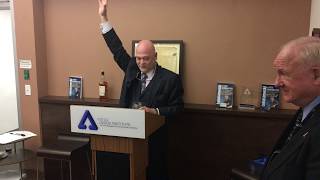
James E. Lukaszewski receives the 2017 Outstanding Leader Award from NYU's Logos Institute for Crisis Management. Colleagues share stories of his mentorship and crisis interventions that saved companies from disaster. Lukaszewski traces his influence back through Edward Bernays and calls for recognizing the next generation of leaders.
Chapters
Good evening, everybody, and welcome to the Logos Institute for Crisis Management and Executive Leadership. I'm Fred Garcia, and I'm delighted to welcome you. Today we are here to honor America's crisis guru, Jim Lukaszewski. I will. I will formally introduce Jim in a few moments. I'd also like to welcome and acknowledge Barbara Lukaszewski. Before we move forward, I'd like to ask those who are members of the Logos Institute to please raise your hands and wave your hands and allow us to acknowledge you and thank you for all the work that you do. So now, let me. Let me ask everyone else in the room. Who here is currently an NYU student? Please wave, applaud, or what have you. Who here is currently an NYU alumnus?
Yay.
Who here is currently an NYU professor?
Yay.
Yes. Who here, either directly or indirectly, has been a student of Jim Lukaszewski?
Wow.
Who here has been a client of Jim Lukaszewski? Wow. Best kind. Who here has read Jim's books? All right. Who here has attended Jim's workshops? All right. Who here has been influenced directly or indirectly by Jim? That was a trick question. So for the NYU students, current and former, 95 years ago, the first course in public relations in a university was established, and it was here at nyu. The professor was Edward L. Bernays, who said, wow. Edward Elberd Ayes was a mentor to Chet Berger. Chet Berger was a mentor to Jim Lukashevsky. Jim Lukashevsky has been a mentor to me and to many of you. And I have been your teacher for many of you. So we have an unbroken line from Bernays through Berger, through Lukaszewski, through Garcia, to each of you. And now the heavy burden falls on you to pass it forward to the next generations. The mission of the Logos Institute for Crisis Management and Executive Leadership is to help leaders become better leaders and to help leaders in crisis make smart choices because they think about the outcomes. This year, we decided to pay tribute to leaders either who have influenced us and the world around us, or those whom we believe have the potential to influence others in the world around us. So the Logos Institute developed two different leadership awards. The first, the Rising Leader Award, honors new professionals, recent graduates and students for their extraordinary leadership potential and demonstration of excellence in their work that offers meaningful contributions in the strategic communication profession. In May, we presented that award to Dr. Carolina Perez Sanz, who's right here. The Outstanding Leader Award honors established industry professionals for their consequential professional achievements that set the aspirational standards for all of the rest of us. The award also recognizes the recipient's excellence in the use of strategic communication to achieve professional and business objectives, with substantial and positive results. This year, as we sat around to determine whom we ought to award that to, the unanimous conclusion was Jim Lukaszewski. However effective I and Logos might otherwise be at crisis management and executive leadership, we are far more effective because of Jim, who has made us better leaders. Thirty years ago, when I had hair, I attended a Public Relations Society of America workshop by a young man named Jim Lukashevsky. And I was blown away by what I heard. And I went up to Mr. Lukaszewski afterwards, and I asked if I could.
Have a cup of coffee with him.
And over the cup of coffee, I made a bold request.
I said, what you do is really.
Cool, and I want to do what.
You do, and can you help me do what you do? And as any good mentor, he said, I'll keep an eye on you.
I'll occasionally test you.
If I see there's promise, I might invite you to help me with something along the way. And about two months later, I get a phone call from Jim Lukaszewski, and he says, hey, I'm writing a piece for this magazine. I need a sidebar on this. Could you do 800 words by next week? Students?
There's only one answer to that question. A few weeks later, I got another.
Call from Jim and, hey, I'm speaking at a Public Relations Society of America thing. I need a panelist. Could you help? Next thing you know, we're sitting together in front of microphones and doing webinars, and we're speaking in front of students at nyu. And at that point, I was the faculty recruiter for the public relations program, and I managed to persuade Jim to join our faculty. Lucky us. And as Jim and I got to know each other better, and he became a deeper and deeper mentor in my life, I read everything he had ever written.
He.
He eventually invited me to blurb new stuff he was writing. I invited him to blurb new stuff I was writing. We ended up quoting each other and blurbing each other and sending clients to each other. And I have a meaningful book of business that came because Jim invited someone to call me. And I'm forever grateful. I'm delighted that we have an opportunity for Jim's friends and colleagues from his life before he went back to Minnesota to meet here in New York. I hope it's the first of many. I am particularly delighted that our students who have learned from Mr. Lukaszewski have an opportunity to meet him and shake his hand and get to know him And, Barbara, allow me to invite anyone who might have a glass of anything spirited or who may need something spirited.
To be put into your glass to please raise a glass, physical or metaphorical, in honor of our mentor, Jim Lukaszewski.
You're here. Bar.
Still.
They say that a teacher lives for eternity. You never know just quite how far his influence will go.
That's certainly the case with our friend Jim.
Jim, cheers. Cheers. And with that, I am delighted to present to Jim the Logos Institute Great.
Leader Award in recognition of his creation of other leaders.
And, Jim, I've been asked to ask.
You to put this on your lapel.
Thank you. Thank you so very much. I have to start with a quick story. I don't do a lot of work in politics, but I actually told this story to Fred a little while earlier this evening. But a friend of mine, we lived out here, was running for, I think, the state treasurer in Connecticut, and he had. He's a new political type guy, and somewhere they heard I worked on this, and whenever we lived in Minnesota. And so, anyway, so I met him, talked to him, and decided that I liked him and that sort of thing. Met his wife, and so we decided to put on, I guess what you might call an old fascist Midwestern political campaign, would basically run from people's homes. And the first home was the home of the candidate, and his wife agreed to be the greeter and to introduce him. And so we talked about what she might say, and we thought about different things and said, think of a story that you might find interesting about him and a little bit about you, but mostly about him. And she said, I know just the story to tell. So I wasn't there, but he told me the story. Afterwards, she got up and she welcomed everybody, and it was a very pleasant evening, very convivial. They all knew each other, neighbors. And she told this story about him providing really significant help to a returning service person whose life was really messed up. And her husband was really instrumental in his life. Well, the problem was that as she told the story, he was reliving his experience. And by the time she introduced him, he was too choked up to talk, so he had to be there. Hi. I'm kind of in the same boat, but I'm not really too choked up to talk. I really debated what I would talk about this evening, what I'd say. I don't really want to take too much of your time, so I thought maybe I'd ask you questions that you might find helpful, because this is something I would like to know all These wonderful things being said about me. We've been great friends for so many years. Let me just turn the tables on the audience and ask you, what are you doing here? What is it about me or what we did together or what you learned that makes you show up at rush hour in Manhattan, for heaven's sake? This is extraordinary. We lived here 30 years. We love this place. We're glad to be back. So someone, Anyone? Yes.
Adoration and admiration of you, Jim.
Loyalty to Fred and Logos throws a great party.
How about. There you go. All right. Yes.
To see you. Say again to see you, Professor. Because we didn't directly learn from you. Professor Garcia told a lot about you in the class and half of the content is actually from your book. And read your book. Actually inspired, I guess, going part of my whole career. So I have to meet you here.
Thank you. Thank you. Thank you. Anybody else, please. Don.
Very important thing, Jim. You always answered the phone when I called or called me back. And I can't say that about many top people in the field.
Interesting. Maybe I'm lonely in Minnesota.
Jim, a couple of times took me to task in his very direct way, but very influential in my life. So I'm here because.
Thank you.
You gave me so much. And I'm sure it's the same for half the people in here who won't mention it.
Can I build on that giving side of it? Jim, you are one of these generous people. You've got a. Well, that just doesn't. You don't get to the bottom of it. You give and give and give. And you've been a mentor to me in many ways in terms of you gotta give and eventually you'll get too. But you've got so much. You can afford to give enormous amounts to us. And it's greatly appreciated.
Thank you. Yes, please.
I'm here because I had the same lunch.
Well, he had a coffee.
Mine was a lunch with Fred Garcia that Fred Garcia had with you to.
Ask if he could do what you did.
I could not have had that lunch with Fred Garcia if he hadn't had.
His coffee with you.
So thanks a lot.
Yes, please.
You don't remember.
It was 1986. The carbide was digging its way out of a couple of holes in the chain of sauce. We saw Ed Van Denemel, who was working for me, media relations.
He wanted to hire you.
We didn't hire him.
We're not sorry.
We didn't hire you.
Made out okay. But I came here because ever since then, and we've Been good friends. And you came and taught my class one day, spoke at my class. And we said before about your generosity of spirit is wonderful. That's what we need in this profession. And I hope all the young people.
Remember that this is a giving profession.
It's a wonderful profession.
Thank you, Steve.
I'm here because 22 years ago, I thought I was riding high. Not this kind of high. Business was good. As president of a company, we could do no wrong. Didn't get any better. One employee in our Midwest crossed the.
Line.
And it ended up in the Wall Street Journal, front page two times within one month. I was networked to Jim, and he said, what's the issue? I said, well, somebody crossed the line. He said, no, you did. I said, excuse me. He said, you did. I said, but that's not us. He said, yeah, it is. Even though it was one person, it ended up to be us. The end of the story is that Jim, in many important ways, saved our lives. I thought I was going to die with all the publicity. So I'm still connected to Jim because I don't want to die.
Thank you.
I gotta say one more, please.
All right.
I realize the other reason I'm here is because I think I'm right. That I'm old enough to remember communications emergencies and all this stuff was kind of a by, you know, side business. We all did media relations business back in the day. We didn't talk crisis communications. We didn't talk a lot about strategy. And I think of you as one of the people who put, you know, it on the map. And you backed it up by writing about it and supporting it and educating everybody just implicitly by what you wrote. Never mind your personal context. So I think of that. I don't think of Chet Berger as much as I love Chet as being. I think of you as the person. Person who set it in concrete for us.
Thank you. I should talk about Chet for a minute, because when I started. When I started writing, which is back in the early 70s, there's another great story. Some. Some other time, but. But I had a couple things published in a public relations PRC publication. And I got this. This. This green light, green paper note, handwritten. And it said, dear Jim, I love the piece about such and such and such. Could you please talk about this more? We need to learn more something. Okay. Sign Chet. Well, I got, like, three of these in 90 days. And I'm walking around Minneapolis saying, who is Chet? Who is Chet? And somebody said, you know. You know Chet. Well, not really, but seemed to know me. But then I got a letter from another person, a guy named Bob Dylan Schneider. And then I got another letter from. I don't know, it just sort of started. And it was never a lot. It was just something really, really short, sharp. And I mean, really. That's the reason I'm here. I mean, someone just recognizing what I'm doing and when they hear what you're doing. If there's one thing we have to do in this business, it is to find the people who are going to make the business great and their own lives great going forward. We do a lot of stuff in this business, writing about this and that and being pontificators. But I'd like to see a lot more people recognized for what they're contributing and what they're doing in this business. Because a lot of it goes on, but it goes unrecognized or, you know, we don't recognize it. It's something we ought to think about. I think it's a personal responsibility of each of us who most of us, I think, are planning to be leaders in the business. And one of the ways. One of the things. One of the most important contributions that leaders make, I think, is that they identify those to follow. And we need to do this in our profession and for lots of reasons, but mostly because there are just a lot of us making really interesting contributions. And those should be recognized somehow in some useful way by someone. So, I don't know. I'm not empowered to charge anybody with anything. But if you think about this particular night and this particular reward, which I'm incredibly flattered to get, maybe that's sort of the departing message. Look for others, others who stand out for whatever reason, and send them a note. Even if they say, who's Curly? Still know soon enough. Right. I'll never forget that. Who's Chet? You know, Chet. Actually, the prophecy was that I never knew this at the time, but basically we had went through some business issues and things. And I hired Chet because he was an expert in business management. He was the first. He was usually the first business PR business manager in the business. And so I hired him. He came to Minneapolis, and we were going through a particularly difficult change in my relationship with the parent organization. And we knew it was going to work at the start, was not going to work at the start. So anyway, Chet was advising us. And so he calls me on a Thursday, a Thursday afternoon, and he said, how's it going? I said, well, it's going well. He said. And so he didn't Ask me why he wasn't at work, because he knew why I was at home. There was a meeting going on that I was not invited to. And he said, so, what are you doing tomorrow? And I said, well, I won't have a job in about 45 minutes. I don't really know. He said, well, why don't you come to work with me, like in New York? Barbara's on the extension phone. I looked down the hall and say, you want to go to New York? She says, literally, let's go. 16 days. 16 days later, this kid from Robbendale, Minnesota, is walking down Madison avenue looking for 371 Madison, which was Chet's office, to be interviewed by his partners because he was retiring at the time. But that, in a way, that was just an extraordinary set of circumstances by somebody who made a business in his life of finding people. And, you know, when he walked into Rome, if you've been in any meetings he was in, people got on their feet when he walked in the room, because I don't care. There's a thousand people in that room. He had to touch the life of every one of those thousand people. It was amazing. It was amazing. Go forth and touch a thousand people. Okay, thank you so very much for coming.
We invite all of you, including those who've just arrived, to please get to know each other. Come get to know Jim and Barbara, and please help yourself. We have plenty of food and drink, and if you want some harder stuff, we got it up here.
Alan, thank you so much. Barbara. Hey, how are you?
More from Jim
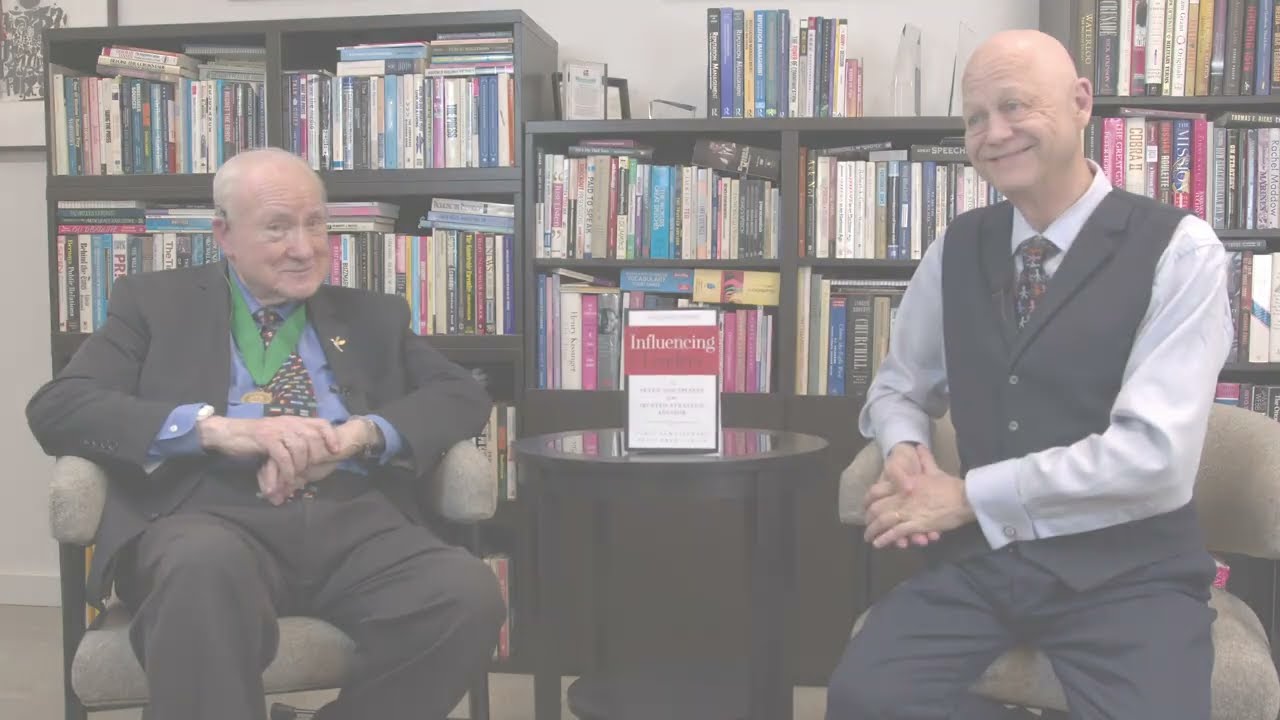
James E. Lukaszewski and Helio Fred Garcia discuss writing Influencing Leaders together