12 Ways to Build Resilience (Don’t Get Triggered)
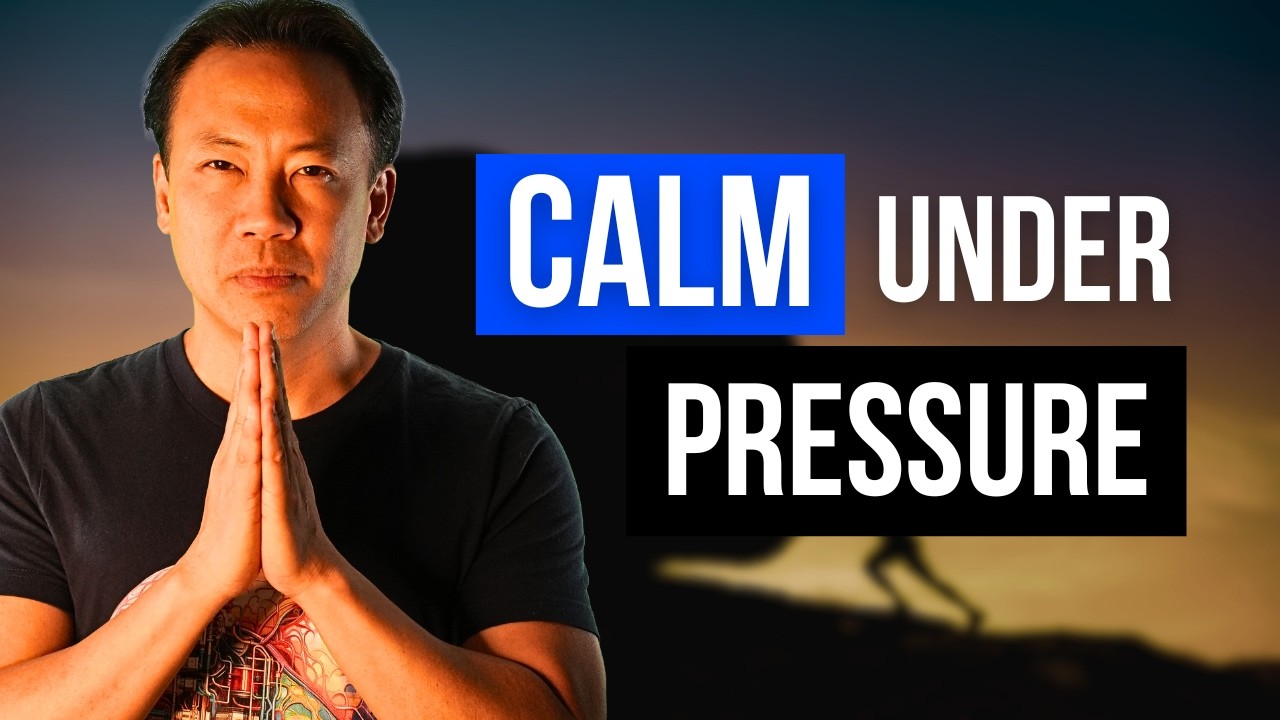
Jim Kwik shares twelve ways to stay calm under pressure, from reframing stress as opportunity to breathing techniques like 4-7-8 breathing and grounding exercises. He covers sleep, boundaries, letting go of outcomes, and building a daily routine with morning meditation and evening reflection to build resilience in high-stakes environments.
Chapters
We got a recent question from our community that I wanted to answer, 'cause I think it'd help a lot of people. They're in a high-stake, fast-paced environment, and they're asking, how do you build resilience to stay calm under pressure? So if you're facing a difficulty in demand, I wanna give you a few quick tips on how to navigate this difficult situation. You know, building resilience to stay calm under pressure, it's really essential for whatever your age or stage in life, whatever your career path happens to be. Especially for people who operate in, in a high-stakes, fast-paced environment. So here's how to develop a mindset and a set of strategies to thrive in these conditions. Number one idea, first quick tip is to reframe pressure as opportunity. And I know it's easier said than done, but it requires you shift your mindset. Where you could view challenges as opportunities to showcase your expertise, to be able to solve problems and build your problem-solving skills. As an example, if you happen to be in finance, instead of thinking this market downturn could lead to client dissatisfaction, you could think this is my chance to guide clients with clarity and confidence. How do you do that? You, you focus on the controllables. You control what you can control, right? You control the controllables. You concentrate on what you can control. It could be your communication, it could be your, your state, it could be the strategies rather than external uncertainties. Number 2, it requires you practice emotional regulation. And there are a number of ways of doing this. Something simple like deep breathing. You could use the 4-7-8 8 technique where you inhale for 4 seconds, you hold for 7 seconds, and then you exhale for 8 seconds to help calm your nervous system. Maybe you have a mindfulness practice where you spend 5 to 10 minutes daily practicing a meditation to improve your focus and emotional regulation, your emotional control during stressful moments. You might discover your own grounding techniques. In tense situations, use grounding exercises like naming 5 things you could see, 4 things that you could touch, 3 things that you could hear, 2 things that you could smell, and 1 that you could taste. And it helps you to stay present, right? Very, very simple. We're engaging all your senses and it brings you in the now. Number 3, 3rd quick tip. You could strengthen your resilience by embracing discomfort. So let's say if you regularly expose yourself to controlled stressors, like taking on challenging projects or learning new skills to build mental toughness, you could reflect on past wins, remind yourself of previous high-pressure scenarios you navigated successfully. This reinforces your ability to handle tough situations. You could take a cold shower. You could exercise. The challenging thing is this, right? It's this paradox. If you, if you have an easy life, like just do the easy things, life gets more difficult. But if you do the more difficult things, life gets easier because you're stronger, you're smarter, you're better. Number 4, the importance of building a resilient mindset. We talk a lot in our podcast about adopting a growth mindset where you see mistakes or setbacks as learning opportunities. You could ask yourself a question I ask all the time: What can I learn from this? What can I learn from this experience? You could also use the power of your imagination to visualize the success. Before high-pressure talks, for me, you know, I imagine myself performing, you know, with grace and with ease and effectiveness. Maybe you have a meeting, you have to make a good decision. You could visualize yourself confidently handling the situation with that grace, with that poise, with that effectiveness. Some people, maybe it's not visualizations, but it's more verbal. So you could use affirmations. You could reaffirm your abilities with phrases like, I'm prepared and capable of handling any challenge that comes my way. Remember, your brain is like a supercomputer. Your self-talk is the program it will run. Number 5, develop some mental clarity. Simplify your decision-making. Often we make things too complex. So you could break complex issues into smaller bite-sized manageable steps. And what will this do? It'll help you to reduce overwhelm. And remember, stay proactive. You can anticipate potential challenges and you could prepare solutions ahead of time. You could also focus on facts, not on fear. You could rely on data analysis to make informed decisions, minimizing emotional reactions. Number 6 is to really train your communication under pressure. Train yourself to pause before responding. You're in a heated debate. Maybe you want to take a moment to process before speaking, especially during tense conversations. That you're having with family or maybe with clients and practice the art of empathetic listening. Acknowledge that person's emotions to build trust and understanding. You're demonstrating understanding and frame solutions more positively. Instead of focusing on problems, you could emphasize action steps, you know, and a path forward. Give people hope and give them the help. Number 7 quick tip is probably the most important thing, and it's common sense, but it's not common practice. Prioritize self-care. You might want to look at your physical health, whether it's regular exercise, a balanced diet. Are you getting adequate sleep? I mean, these are the basic essentials for mental resilience. Are you taking mental breaks? Are you incorporating brain breaks, short breaks into your day to reset? your brain, to reset your focus. Even for me, a 5-minute walk just feels like I could just release a lot of stress, like maybe between meetings or between writings. And are you setting boundaries? When you're saying yes to somebody, are you saying no to yourself? You need to protect your personal time, your focus, your energy, your heart to recharge. And so you're avoiding burnout.
Are you tired of constantly feeling overwhelmed by your never-ending to-do list? Do you struggle to find enough hours in the day to accomplish everything you need? But what if I told you there's a solution that can help you take back control of your time, your focus, your productivity? I'd like to introduce you to Kwik Productivity. This 10-day course is designed to provide you with the proven strategies you need to get more done in less time without Burning out. So if you're ready to learn to get the most out of your time, your tasks, and your life, then don't wait any longer. Click the link below to learn more and secure your spot and your access right now.
8th quick tip, I would say build a support system. It's not always easy, but remember, it's not just your neurological networks, it's your social networks. Do you have mentors? Do you have colleagues that you can lean on? Peers who understand the pressures of your profession? Or maybe you're seeking a life coach for additional support or therapy. Working with a therapist or a coach can provide tools for managing stress and building resilience. Have you created accountability partners? Somebody that's a little bit like-minded and you support each other. Partners with someone Share your goals, share your progress, share your, your big challenges, and it helps you to stay grounded and connected. 9th quick tip for resilience is put together a toolkit. Imagine developing a resilience toolkit, whether it's anchoring statements, like you could have these calming phrases ready, like I prepared for this, or one step at a time. Maybe you incorporate some form of gratitude practice where every day you're writing down and feeling 3 things that you're grateful for each day. And what does it do? It shifts your focus from stress to positivity, right? And be also thankful for all the things that you're not dealing with also as well. Remember, chronic stress will shrink your brain and stress, not so great for your learning experience. We probably don't react really well when we're stressed. So what stress management techniques do you have in your toolbox? On the podcast, we've talked about journaling. We've talked about visualization. We've talked about yoga and meditation to be able to process and release this tension, physical, mental, emotional tension. Number 10 quick tip is to learn to let go. And again, another thing that's easier for me to say than it is to do, but learn to let go, detach from those outcomes. Focus right now on doing your best rather than fixating on the result, which is often out of our control. And then the acceptance part. Recognize that uncertainty, the unknown, is part of our world. Embracing it reduces resistance and anxiety. Number 11, and I kind of mentioned this going back to mindset, is you need to really Check in and maintain your perspective. What helps me a lot is when I zoom out of a situation. Let's say you're in a high-stake moment. Remind yourself of the bigger picture. Will this issue matter in a month? Will this issue even matter a year from now? And then a very important one, which I often neglect myself, is celebrating progress. So important to acknowledge your small wins. And milestones. It helps you to stay motivated during challenging times. You can always come back to purpose, right? You come back, we talk about it in Limitless. There's a whole chapter on purpose. Focus on your why. Keep your purpose in mind. Write it down. Have pictures that embody it. Whether it's helping clients achieve a certain level of health or financial security or creating a more meaningful impact, just allow yourself to be able to feel it. Let it go from your head to your heart, then it'll go to your hands. Number 12, train for crisis. You could train for crisis scenarios. They do this in multiple industries where you simulate high-pressure situations and you practice acting, responding to challenging scenarios in a safe environment with colleagues or mentors. To be able to build your confidence and your competence. And so you could create a plan B, you could create a contingency plan, and allows you to have less fear because you know you have a backup if something goes wrong, because you are prepared for the worst-case scenarios so you can act quickly and decisively if they arise, which they probably won't. An example of a resilience routine, uh, it could be something like Starting in the morning, 5 minutes of mindful meditation. Maybe you're reviewing your goals and affirming your ability to handle obstacles or challenges. Maybe during the day, part of your routine, using deep breathing before high-stake meetings, right? If the stakes are high, you want to be able to self-regulate. You have some kind of closed-eyed process or breathing process, or maybe you integrate it. Maybe you have a routine of taking a short walk. Or doing some stretching after intense work periods. And then finally, in the evening, have some kind of routine where you could, for example, reflect on the day's wins and ask yourself, what did I learn today? So you get the lessons also as well. You could write down 3 things you're grateful for that day and 3 things that you learned that day. It'll help you maintain momentum. It'll help you maintain a, certainly a more positive mindset. And by applying these quick tips, you'll cultivate a calm, a more focused, and a more resilient mindset. And you'll be empowered to thrive under pressure while other people are struggling. And you guide other people using what you learn with confidence and clarity. Remember, the life you live are the lessons that you teach. And you can inspire the people around you. And this is also just a reminder also that we never know the battles people are facing. It always looks great on social media because you see the highlight trailer and all the wins. That's why kindness, I feel, is so very important, that a kind word or a gesture has this ripple effect. And that's why I feel like we're here, right? We talk about changing your brain to change your life. You can also change your brain. We could change the entire world. With love and kindness. So I want to thank you for joining me today. I look forward to seeing you very shortly and very soon. This is your brain coach, Jim Kwik. Until our next meeting, be limitless.
More from Jim





The Library of Minds: Brain Coach: How to Stay Sharp When AI Does the Thinking | Jim Kwik





