5 Science-Based Strategies for Stress Management | Dr. Aditi Nerurkar
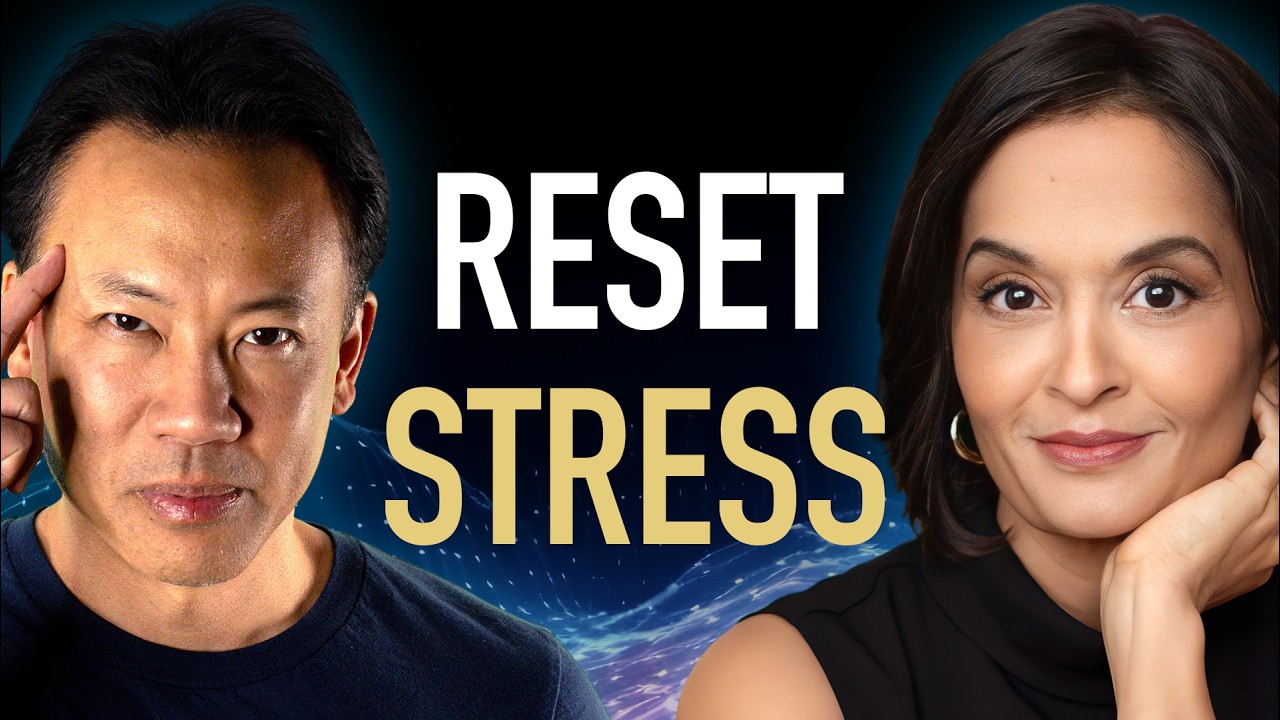
Harvard physician Dr. Aditi Nerurkar explains why 60-80% of doctor visits involve stress, yet only 3% of physicians address it. She outlines five science-backed resets: clarify what matters, find quiet, sync breath to body, take movement breaks, and show up as your best self.
Chapters
Even though 60 to 80% of visits to a doctor have a stress-related component, only 3%, approximately, of doctors counsel their patients on stress management.
And then your doctor says, oh, you're fine, everything's great. It's just stress. Go try to relax. And so you're kind of left to your own devices.
Stress is a natural part of your life, and in fact, it's an important default pathway in your brain. It's deeply tied to your lived experience and so essential to being human It's the very foundation on which your brain and biology are built.
There are actually 2 kinds of stress. There's healthy, productive stress and unhealthy stress, scientifically known as maladaptive stress.
Is stress really the enemy? And what can we do about it?
What the 5 Resets does is really a tool to help you move away from that maladaptive, unhealthy stress and back to healthy levels.
Welcome back, Kwik Brains. I am your host and your brain coach, Jim Kwik. Today, we'll discover how to reset your stress. Chances are everything good in life was created because of a little stress. A healthy amount of stress is important because it's an adaptive response to life's demands. It serves a very functional purpose to move your life forward. The key is to figure out how much stress is too much stress for you, and when it becomes out of tune with the frequency of your life. Our guest today is Dr. Aditi Nairakar, a Harvard physician, speaker, and television correspondent. She was recently named 100 Women to Know in America for her work in redefining stress, burnout, and mental health in the new normal. Before becoming a physician specializing in stress, Dr. Aditi was a stressed patient looking for answers. She is the bestselling author of this book, which I'm, if you're watching this It's on YouTube. I'm showing you a copy of it. The 5 Resets: Rewire Your Brain and Body for Less Stress and More Resilience. Welcome to the show, Dr. Aditi.
Jim, I'm such a fan of yours for years and years. Thank you so much for having me.
I wanted to start by asking you a question I'm just curious about. Having been trained in the conventional Western medical system, what's your pers— how do you see stress differently now? As a part of an overall, uh, diagnosis than you did while training to become a doctor?
Ooh, I love this question. What a juicy question to start. You know, stress is really the elephant in the exam room, so to speak. You shared that statistic. I loved your intro. 60 to 80% of people who go to a doctor, so patient visits, 60 to 80% of those have a stress-related component. That means that you might have headaches or abdominal pain, In my case, when I was a stressed patient, I had a stampede of wild horses across my chest. And you go to see your doctor, your doctor does the full workup, checks your lab work, and maybe does some heart tests or imaging and x-rays and whatnot, depending on the condition.
Mm-hmm.
And everything checks out normal. And then your doctor says, oh, you're fine, everything's great. It's just stress. Many of us have heard that. I certainly did when I was a stressed patient. And then there's not really much else, you know, go try to relax. And so, you're kind of left to your own devices. So, the good news, you feel a sense of reassuring, you know, you're reassured like, okay, my symptom is not due to stress, or rather my symptom is not due to something actually happening in my body, but it is very real.
Mm-hmm.
And it's almost like this mind over matter mindset, like, just get over it, it's just stress. And so, in many ways, stress is truly that elephant in the exam room. It is not addressed. It feels like doctors don't really talk about stress, not because it is an individual failing. It is not something wrong with doctors. Doctors simply have too much work to do. You know, there's another statistic that for a doctor to really do their job well, they would have to work 27 hours a day. Now, these are impossible standards. Doctors are held to impossible standards. And so, we know that the healthcare system is very broken and they're just really doing the best they can. And so stress, when you're trying to focus on your patient's cholesterol and diabetes and heart disease, stress is often left to the wayside. And yet it is involved in every single, nearly every single visit. Now, I just wanna say, Jim, that it's not that stress causes these symptoms, right? You, if you have a particular symptom, it's really important as a doctor, I have to always say, it's really important to see your doctor.
Mm-hmm.
To get checked out, cuz sometimes these symptoms are very real in that they are due to a particular organ system. It's a sign of something, but your symptoms can also feel very real when it's stress-related. And so a lot of my work focuses on closing that gap between those 60 to 80% of doctors' visits with a stress-related component and only 3% of doctors saying that they actually counsel for stress. And my work really focuses on tangible, cost-free, 'cause that's really important. As a doctor, I've seen patients with varying resources, so everything I always suggest Just as cost-free, time-efficient. We don't have a ton of time to do all of this work. We have busy lives that we're living. Stress shouldn't cause you more stress, and really practical. And so, a lot of the work that I do is to help close that gap. So, people, patients, just like me, when I was a stressed patient, I used all of these strategies myself, and then I became the doctor I needed during that difficult time.
I love that, and I appreciate you taking your struggles, which can become strengths, and helping other people, you know, in this area. Our show, especially as a doctor, right? You hear the, we, all of us, we've heard these phrases that, you know, stress is, it's the pressure that creates the diamond and all of this. And there's these kind of like beliefs that we hold that we have to maybe unravel a little bit. Our show is all about the brain. I'm curious, how does our brain respond to stress? Because I want to go into the strategies, but I want people to understand the consequence. So how does our brain respond to stress, and what happens to the brain when we are— when we undergo long periods of chronic stress without a reset?
You know, Jim, so much of your work and my work, there's such an overlay, like a really beautiful connection there. So when you are feeling a sense of acute stress, so short-term stress, your brain and your body are actually expertly designed to handle these short bursts of stress. And your stress center, something that you talk about a lot in your work, is your amygdala. It's that small almond-shaped structure deep in your brain, what we call in medicine reptilian brain, meaning it's the part of your brain that hasn't fully developed. And then there's another part of your brain, if you put your hand on your forehead, again, this is something you talk about a lot, your prefrontal cortex. And that prefrontal cortex governs things like memory, planning, organization.
Hmm.
And that's what you're— that's very much online when you're feeling a sense of resilience or under quote unquote normal circumstances. So very much we are living in the new normal and most of us aren't really being led by the prefrontal cortex. For most of us now, it is not really acute short-term stress, but really long-term chronic stressors. And so therefore that amygdala has really taken over. That amygdala where your stress response lives, the fight or flight response is cave person mode. It's focused on survival and self-preservation. So when you think back to evolutionarily with our human brains, that fight or flight response has a really important role.
Yeah.
You would be, you know, we were all tribespeople, cave people living in the forest. You would see a tiger, you would either fight the tiger or you would run away from the tiger. That's where fight or flight comes from. And now we have lots of metaphorical tigers, relationship constraints, bills that we are really struggling with, financial constraints, climate disasters, humanitarian crises, everything in the palm of our hands, right? Like every headline, it's just a flurry and it's this cascade and Onslaught of constant stressors that never really seem to go away. And so those tigers are everywhere all around us. And so therefore your amygdala, that stress response kind of always stays on in the background. Now, like I said at the start, your brain and your body can handle short bursts of stress. We are actually built for that, but they're not as good at handling these long-term stressors that just go on and on. Your brain has to come back to equilibrium and your amygdala, if it's staying on for long periods of time, it leads to chronic stress, which causes all sorts of problems and in turn can lead to burnout.
And many of our listeners that they're listening and they, they wanna know more about The 5 Resets, and I highly recommend everybody get their copy of the book. What are your go-to simple daily practices that you recommend that could significantly improve mental clarity, emotional resilience? What are some of your favorites to recommend?
You know, so the premise of The 5 Resets, like you talked about in the, in the introduction, Is that not all stress is bad.
Hmm.
There are actually 2 kinds of stress. There's healthy, productive stress, like getting a new job, getting promoted, falling in love, having a baby, buying a new home, rooting for your favorite sports team. These are positive stressors. They're actually considered healthy stress for your brain and body. In science, we call this adaptive stress. Now, there's another kind of stress, unhealthy stress, scientifically known as Maladaptive stress. That maladaptive stress is what you and I have been talking about, what goes, what gets you into the doctor's office with various symptoms. You know, there's so many brain and body manifestations, so many physical and mental health manifestations of that unhealthy maladaptive stress. And so what the 5 Resets does is really a tool to help you move away from that maladaptive, unhealthy stress and Back to healthy levels. 'Cause the goal of life is not to live a life with zero stress. It's actually biologically impossible. And we can get into like mechanistically, how is it biologically impossible with the cortisol, that stress hormone, et cetera. But really the 5 resets will help you transform your relationship to stress because it will bring that stress, that runaway, unbridled, unhealthy stress that is unchecked back to healthy levels so that you can finally get out of that survival mode and back to thriving. And so there are several, you know, the, the way I, Wrote The 5 Resets, it's very much the way I practice clinical medicine. When I would see my patients in a clinical setting and the kind of advice and prescriptions I would give, what I have done at this particular book, it's, there's 5 key mindset shifts, and then in each is like anywhere from 2 to 3 prescriptions for managing stress. Everything is science-backed, of course. It's all cost-free and time-efficient. Those were really important to me, those kind of pillars.
I love how you address mindset and while you're giving the methods, a lot of people, you know, want the instructions, but they don't— they're not making the shift in terms of their beliefs, the things that are holding them maybe even stuck in a certain way. Yeah, let's go into a couple of them.
Yeah. And I feel like your work just focuses so beautifully on mindset and the limiting beliefs, you know, limitless, of course. Right. Is that what we're all trying to achieve? All of the book is meant to get you out of amygdala mode and back to the prefrontal cortex so that you can actually, you know, finally kind of live up to your highest, best self.
Yeah, 'cause sometimes when you're stressed or you're in fight or flight, you're in survival mode, and maybe holds you hostage away from that executive functioning, to your creativity, to your ability to remain focused and solve problems.
And it's actually by design, Jim, because Your amygdala by design is focused on your immediate needs, survival, self-preservation, what's happening in the immediate terms. Whereas your prefrontal cortex is focused on strategic thinking, forward planning, complex problem solving. So, it's so easy when you're feeling a sense of stress to get in your own way because that's quite literally how your brain is designed. It's, there's nothing wrong with it. If you're feeling a sense of stress, you're not alone. It's not your fault. Over 70% of people have at least one feature of stress or burnout. burnout right now, and some studies show up to 90%. And so the first kind of reset is get clear on what matters most. And this is kind of a foundational element to a lot of the work that I do, which is mind-body connection and how to connect your brain to your body. And so get what, what this means is get clear on what matters most. When you are feeling a deep sense of stress, your inner critic, right, has a megaphone because that's also powered by your amygdala. It's a voice inside your head that's berating you, telling you all of the ways that you're Wrong or weak or less than or undeserving and unworthy. I mean, we all have that voice and it just gets louder when you're feeling a sense of stress because it, your brain is trying to keep you safe. It's trying to keep you protected. Again, that amygdala self-preservation. And so the first reset really tries to get into that megaphone and takes that megaphone out of the hand of the inner critic. And when you are feeling a sense of stress, you are likely saying to yourself, What is the matter with me? Why do I feel like this? What's the matter with me?
Hmm.
And instead, the first reset asks you to reframe that inner dialogue. It's less about what's the matter with me and rather what matters most to me. And now most is not this existential big ask. It is a very concrete thing, but using the brain and the biology of neuroplasticity and brain and changing your brain. And so, M-O-S-T. M-O-S-T is an acronym. M stands for motivating, O objective, S small enough to guarantee success, and T timely. You pick a goal that's within 2 to 3 months, you know, uh, of a timeframe that you can achieve something very doable, something that you've wanted to do for your mental health or physical health for ultimately less stress. Like you wanna get to bed earlier, you wanna have more energy so you can look for a new job. Maybe you have a toxic boss. You know, there's so many, Examples that I can give you of most goals. And so the first reset is about how do you craft that most goal? Because that most goal, it takes about 2 to 3 months to achieve simply because it takes 8 weeks to build a habit, right?
Yeah.
It's like that's the neural wiring in the brain, brain circuits. It takes 8 weeks. Understand that falling off and getting back on is part of habit formation. And so when you create your most goal, that is the first step to getting out of amygdala mode. And back to the prefrontal cortex. And then there's several strategies in that first reset to help you actually operationalize that most goal. Like, how do you live it into your life? How do you bring it into your life? And so I talk about the backwards plan, and there's several other strategies that are all science-backed that can help you get out of that immediate need of survival and danger. Again, it's not you, it's your biology of stress. You know, it's doing exactly what it should. And so that's sort of the first reset. Getting clear at what matters most by creating your most goal. And then the rest is various other strategies. So the second reset is find your quiet in a noisy world. Reset number 3, sync your brain to your body. Reset number 4, come up for air.
Hmm.
And reset number 5 is bring your best self forward.
You know what I, what I love is that you, You live what you teach. You know, you practice what you post. I'm curious your relationship with technology. A lot of people view technology, obviously it makes our lives convenient in a way, but also in some ways it makes us more— it amplifies potentially the amount of stress. How do you integrate technology in managing health and wellness without letting it detract from your mental peace or focus?
That's a beautiful question. It is top of mind right now with everything happening in the world. You know, I talk in great detail about digital boundaries. And so we all need digital boundaries in our life. We have boundaries in every relationship in our life, Jim. You have boundaries with your partner, your colleagues, your children, everyone. And yet you have zero boundaries and likely porous boundaries when it comes to the relationship you have with this little thing, your digital devices. There's no boundary.
Hmm.
And the science shows that in fact, abstinence from your devices and technology, you know, if you're like, oh, I don't wanna engage at all, abstaining from your digital devices Does not much for your health and wellbeing and actually can worsen it because technology is very important. It keeps us productive. I know a lot of your work focuses on productivity and maximizing productivity. Technology in this era, of course, very important for keeping us productive, keeping us connected, educated, and informed about what's happening in the world. So this is not about becoming a digital monk. You want to be engaged in what's happening in the world, and technology is an incredibly powerful tool. Science shows that it's not about abstinence from devices, but rather decreasing your reliance on your devices. It's about recalibrating and reconsidering that relationship you have with your digital devices. So it's about creating healthy boundaries, the same as you would with every other healthy relationship in your life. And so there's several strategies that you can use to create these healthy boundaries.
Yeah. What would be an example of a of, of a boundary, you know, around technology.
As you know, when you are engaging with technology, especially when you are consuming social media or the news feeds, RSS feeds, et cetera, this is not passive scrolling, right? Like we all think, ah, just scrolling, just gonna hang out. It has a very direct and active effect on your brain. It stimulates the reward pathway and it, you know, secretes cortisol and adrenaline and all of these things. And so, there's no such thing as mindless scrolling. There's no such thing as passive scrolling. It is an active response. It actually stimulates your stress response, your fight or flight mechanism. And so, how do you create a boundary? One easy way is to create a geographical boundary. What does that mean? Keep your phone off your nightstand. Invest in a low-cost alarm clock instead. So, first thing in the morning when you're waking up, over 90% of people are scrolling on their devices often before their second eye is even open, right? And so instead, when you invest in a low-cost alarm clock, again, not about becoming a digital monk. Keep your phone in your bedroom. You can keep it, you know, a little bit far away, out of arm's reach. And then you wake up and you might say good morning to your bed partner, use the bathroom, say good morning to your kids, and then engage. Because what you're doing is if you start scrolling first thing in the morning, you're priming your brain for more stress throughout the day. And instead, a little bit of a buffer can go a long way. A boundary. Again, at night, if it's not on your nightstand, you're not scrolling until late into the night. Maybe you're gonna do something else. Nature doesn't like a vacuum.
Maybe.
You would read something. Maybe you can listen to a podcast, do some gentle stretching, or, you know, just engage in conversation. So these are really important tools there. That is a geographical boundary. The other really powerful thing you can do, and again, you know, during the day you can keep it off your— you can put, if you work in a cubicle or if you work on a desk from home, keep it out of arm's reach. Ideally, keep it out of sight. Next, a visual boundary. One of my favorite kind of hacks for the brain, which you talk a lot about brain hacks, is grayscale. You can grayscale your phone. And what that simply means is switching your phone off of color mode to black and white mode. And I'm gonna show you here, Jim. I have been able to, if you can see here, Mm-hmm. went right to black and white. And I have my action button in my latest phone. I have a shortcut there. To do that. What does grayscale-ing your phone do? It's been demonstrated through the science to decrease screen time. Why? Because it makes scrolling less enticing and less quote unquote addictive for your brain. One marketing executive said, it's like if you were walking through the grocery store and you saw black and white cereal boxes like lining the aisles.
Yeah.
It'll be less exciting, right? You wouldn't be like, ooh, I want this and this. You'd just kind of be like, eh, And that's what kind of happens to your brain when you switch your phone to grayscale. So when is grayscale important? When people first learn grayscale, I too, when I first learned grayscale, I said, you know, I'm going to switch my phone to grayscale all the time. In fact, it doesn't really work because you need certain colors and certain apps. Like if you're ordering from online shopping, you can't actually see and engage in the same way when there's no color. So when do I use grayscale or when do I suggest to use grayscale to others? Typically, if you're focusing during the day and you really need to get your work done and you want a period of deep, intense focus, deep work, switch your phone to grayscale. You'll be less, it'll be less enticing to scroll. Also at night, so many of us engage in something called revenge bedtime procrastination. We all do it. You do it, I do it. Those of us who are parents, it, there's a greater predilection for women to do it than men based on the data. Science. But what is revenge bedtime procrastination? It simply means that, you know, at the end of the day, it's like 8 or 9 PM, kids are in bed, kitchen is clean, dinner, homework, everything is done, and you sit on that couch with a big sigh. It's like, ah, you're finally just— you get a little me time. And then you start scrolling and you tell yourself, I'm gonna go to bed early, and, you know, I'm gonna go to bed at 10 o'clock tonight. Start scrolling, and before you know it, it's 1 AM or 2 AM. You know cognitively that going to bed early will be helpful for your all sorts of stuff, right? Your health, your mental health, your physical health, energy. And yet it is so difficult to do that. And that grayscale can help short circuit that revenge bedtime procrastination. Again, not your fault. It is just the biology of stress. And essentially revenge bedtime procrastination is a toxic manifestation of hustle culture.
Yeah.
If you're always on the go all day, every day without really taking any Time for yourself, we know that what that does to the brain, there's been lots of science to show the reason that breaks are important, but it then will prevent, you know, if you take a few breaks, again, there was a beautiful study through Microsoft which showed taking frequent brain breaks throughout the day decreases your stress, cumulative stress at the end of the day. And so then you won't engage in that revenge bedtime procrastination. But at the start, when you're first learning about all these things and digital boundaries and how do you do it, just switch your phone to grayscale. It's super easy. I can walk you through it. You go to your settings, accessibility, display, and I think it's like display and screen or display and color, display and colors. And then you go to color filters and then you switch on grayscale. And like I just showed you with my phone, I have figured out how to do a shortcut to get to grayscale, but it can be a real game changer.
It just feels different when you look at the screen. It's less enticing for sure. Anecdotally, but it's great that you did the research on that. The subtitle of your book is Rewiring Your Brain and Body for Less Stress and More Resilience. I'm curious, I feel like a lot of us have been programmed from a young age that tolerating a high level of discomfort and holding it together equals resilience. What do you— how do you define resilience and what's the key there? None of the ingredients contained in the Kwik Mind product are claimed to treat any disease or health condition. Consult your own physician before commencing a nootropic regimen to ensure that this product is appropriate for you. Do you struggle to stay focused or find that your mind wanders when you need to be sharp? Are you looking for an advantage or an edge that can eliminate sluggishness and elevate your cognitive performance? That's why after Decades of research and development, I'm thrilled to bring you Quick Mind. It's more than just a supplement; it's a key to unlocking your cognitive freedom on a day-to-day basis. Just imagine having the clarity of thought, sharp focus, better memory, and being calm under pressure. Every capsule of Quick Mind is a blend of five pristine ingredients. Each batch By research and chosen for its ability to support specific cognitive functions. So are you ready to meet the sharpest version of yourself? It's just a click away. We have it all at kwikmind.com, K-W-I-K mind.com. Place your order for Kwik Mind today and join a community that's redefining what it means to live a life of mental abundance.
The true scientific definition of resilience Resilience is your innate biological ability to adapt, recover, and grow in the face of life's challenges. So innately, we are all resilient.
Adapt, recover, and grow. I like that.
In the face of life's challenges. But what has happened over the years, particularly over the last, I would say, 4 to 5 years, is that there is a new definition of resilience that's like sinister, and that is Toxic resilience. And what is toxic resilience? If you compared the two, toxic resilience is a mind over matter mindset. It's productivity at all costs. It's all systems go all the time. Whereas true resilience, it's innate within all of us. True resilience honors your human limitations, understands your brain and body's ability for rest and recovery. We talked about that, right? Like it's a biological need. Not a nice-to-have luxury for rest and recovery. And so toxic resilience, when you hear the word resilience now, I really grappled, Jim, when I was writing the book and trying to think of what would be a good subtitle that would really encompass a lot of this work. I struggled. I thought, no, I can't use the word resilience on the COVID because that word is so cringey. I hear the word and I have a visceral response. It is truly cringeworthy because you have heard it over and over, particularly the last few years when people have said to Maybe it's a demanding boss, maybe it's someone in your family. Oh, you can handle that, you're resilient. Oh, you can take on another deadline, you're resilient. Oh, you, you know, you should be able to care for your kids and work because you're resilient, right? Like, you hear this messaging over and over. Every culture has its embodiment of toxic resilience. Here in the US, we have the Energizer Bunny, like, just keep going.
Hmm.
No matter what, just keep going. Keep calm and carry on every culture. And so really a lot of my work is aimed to dismantle this idea of toxic resilience so we can get back to true resilience because the science shows, you know, when I went through my stress struggle, Jim, I was a medical resident and working 80 hours a week and I was taught, you know, pressure makes diamonds. So when the going got tough in my medical training, I was like, hey, diamond in the making. And then my diamond cracked. And when I went to go see my doctor and she said, oh, everything's great. You know, you're, it's just stress. You're resilient. In fact, my first response wasn't, oh no, what should I do? I have a lot of stress. It was stress. Stress doesn't happen to people like me. I'm resilient because I was living the resilience myth, which now I know 25 years later, what is the resilience myth? It's essentially this idea that resilient people don't get stressed. and resilient people don't get burned out. But I just shared the scientific definition of resilience, which is that it is our innate biological ability. And the science shows that in fact, that is a myth, that resilient people of course feel stressed and burned out, especially now. We know that resilience is protective, but it is not enough to prevent burnout.
Hmm.
And so, a lot of my work really focuses on moving our societal norms and expectations away from this idea of toxic resilience, And back to true resilience where we can really flourish.
You mentioned mind-body connection, and I'm curious, do you have a mindfulness or a meditation practice? And then second part of the question is, how do these practices wire our brain, and what changes might someone expect to see in maybe their cognitive performance or levels of stress with regular practice?
That's a great question. And a lot of my work focuses on the mind-body connection, and the mind-body connection in very simple terms is that your brain and your body are inextricably linked and in constant communication. What's good for your body is good for your brain and vice versa. And if you are hearing about the mind-body connection for the first time, you might be hearing the term, but you've been feeling it since, you know, essentially since birth. So sweaty palms when you're giving a talk or a big moment when you were going to senior prom or something and you felt those sweaty palms and you were nervous.
Right.
Or your heart beating in your chest before you're about to do something really important, or butterflies at falling in love.
Mm-hmm.
All throughout our life, we felt the mind-body connection at work. It's like gravity, it's all around us. The beauty of the mind-body connection is not only the first step is you become aware of it, so once you see it, you can't unsee it, but not only do we, can we just see it and know that it exists, but we can actually do things To influence it so it can serve you for, you know, a better, more, for better health and greater wellbeing. And so that's kind of like why a lot of my work focuses on the mind-body connection. And also because your brain is like your biceps, your brain, because through the process of neuroplasticity, which is a long fancy word, simply means that your brain is a muscle just like your biceps and you can train your brain, which is a lot of the work that you do. And so yes, I have had a mindfulness practice. I've been a longtime meditator. I started, it was probably one of the first things that I learned to do when I was in my stress struggle, meditation, mindfulness meditation. And then I advanced over the years, over the decades to be able to teach a particular kind of mindfulness meditation. And mindfulness is a wonderful tool. I still practice this nearly daily. It is a real buoy for me during difficult times. In fact, have 2 programs on the Calm app, which is my tool that I use when I'm feeling stressed. But you know, when you are feeling a sense of stress, yes, meditation has been incredibly helpful to me, but there have been patients of mine who have said, I can't sit still, I can't meditate. So, you know, trying to decrease your stress shouldn't cause you more stress. And so instead, if you aren't someone who is into meditation or sitting still, or if you've tried it and it's not for you, try movement meditation. You can tap into your mind-body connection that way as well. Walk, spend 5 to 10 minutes every day walking. Articulate your feet on the floor as you walk. Understand that your feet have 30 bones and 100 muscles. There's a lot of grounding power in your feet and try to keep your mind where your feet are. In the 5 Resets, I offer a couple of different strategies for movement meditation. One is this idea of sticky feet. So you can You know, focus on your feet on the floor, think of them as sticky webs, and it helps kind of ground you. Another way to tap into your mind-body connection is simply, if you're not into meditating, is simply focusing on a 3-second brain reset that I talk about a lot called Stop, Breathe, Be. And what you're gonna do, the name is in the instructions, you stop, you breathe, and you just be. You ground yourself in this present moment. I practiced Stop, Breathe, Be right before I clicked join Jim for the interview today. I practice it all day, every day. I started it in my medical training when I was going through my own stress struggle. I would see 30 to 40 patients a day and I would knock on the door and as I would turn the doorknob, I would say to myself, stop, breathe, be. And so what does Stop, Breathe, Be do? It gets you out of that what-if thinking, which is like that amygdala and anxiety. And, you know, fight or flight, doom and gloom. Mm-hmm. Because anxiety is a future-focused emotion, right? It's not about the moment. It's about like, what if, what if? And Stop, Breathe, Be gets you out of that what-if thinking and back to what is in the here and the now. And when you practice it over and over and over again, it helps to rewire your brain, tap into the mind-body connection, and can help reset your stress. And I think, you know, Now, the reason that it all works the way it does, why Stop, Breathe, Be works, why movement meditation works, why medit— why mindfulness meditation, sitting meditation, how does it tap into your mind-body connection? The common denominator here is your breath. Your breath is the only physiological mechanism that is under voluntary control and involuntary control. Your heartbeat can't do that. Your brainwaves can't do that. Your digestion can't do that. Only your breath. So you, you and I can sit here and we can practice stop, breathe, be, and then when we're just hanging out and talking, your breath is going on in the background. And so that is why the breath is such a wonderful and powerful gateway to tap into your mind-body connection. And so I use lots of those strategies for myself. I've taught patients that, and it's something that I really believe can make a world of difference if you practice it. Again, no magic bullets here, but it's something that if you practice incrementally every day, you will change your brain for less stress simply from neuroplasticity.
There's so many nuggets here, you know, in terms of your promise of mentioning things that are low cost of money and time. So we take away those excuses for individuals. You mentioned sitting, you know, and there's this phrase that sitting is the new smoking. And it's on one side, movement, you know, so very important for, for your brain, but also just sitting is probably not that good just alone, right?
Yeah. So there's a popular expression, sitting is the new smoking. And so what the science shows that it's not that sitting is, oh yeah, you know, exercise is really good for you. We should all try to exercise. We know that, right? We know exercise is good for you, but increasingly the science is showing us That sitting for prolonged periods of time is actually bad for you. It can increase your risk of anxiety, and it has lots of ramifications beyond mental health. Can also impact your physical health. Again, you and I are sitting here talking, sitting here talking.
Mm-hmm.
And having a conversation. This is not to say that you should be standing all day, every day. Of course not. You want to be sitting, but you know, you also wanna make sure that your body is in motion. Most of us, particularly in the Western world and particularly now more than ever, we sit for copious amounts during the day. We have, many of us have desk jobs. We aren't really active. And so, we sit during the day and do our work, and then we sit in the evening and maybe watch, you know, something on TV. And so, your body is really just sitting for long periods of time. And there are a host of mental and physical health manifestations that occur with too much sitting.
Good to know. I mean, and then some of the, when someone's listening to this right now, it's just also a good reminder. You know, I find that even when we talk about how to remember names and I give strategies, even if people don't use a strategy, they're just more, they're more aware and they're paying attention to it. So they're more likely to remember names. And in this case, we're giving people really good reminders. I'm curious, Looking forward, what are some, maybe an emerging trend in mind-body wellness that you find exciting and maybe think that our listeners should maybe pay attention to? Like looking forward, what does the future look like for this area of stress management or mind-body wellness? Is there an area that you're excited about? Yeah, I think that's a great question. particularly excited and optimistic about?
That's a really interesting question. You know, one thing that I've been thinking about increasingly is these— this juxtaposition between high-tech and high-touch. A lot of the work I focus on is high-touch, right? Like, our entire conversation has been about high-touch. Now, we know increasingly AI is making its way into many spheres of life, and so there is a high-tech element that is going to be coming in. And how do you reconcile that? How can those 2 elements work together? And so, a simple example that I could give you is, so I'm wearing a watch, a smartwatch, and it tells me every hour on the hour to stand up.
Hmm.
And so, to me, that is a really nice, quick and easy way to engage the science. So, it's high-tech and high-touch because what we were talking about, right? Like sitting is a new smoking. Oh, I see that. And I could ignore it, or I could say, okay, let me just stand up for a second and go walk around the office and come back and stretch my legs. And we know that that is a really nice way to bring in the high-touch and high-tech element together. But much more broadly, I am very curious to know how this new world of AI is going to influence what I love. One of my most favorite topics is the therapeutic encounter.
Hmm.
And so, the therapeutic encounter is fascinating. There is a lot of emerging science, and the data shows that, you know, when you have a doctor or a practitioner where you feel a sense of connection, rapport, empathy, compassion, these are not soft metrics. They actually influence the bottom line. You have better health outcomes, better and tighter glucose control. You are more likely to take your medications and follow through with the advice. When you feel that sense of connection, it's called a therapeutic encounter. It's like when you're meeting with someone and somehow something about how they're speaking or their energy, you feel a sense of healing. Now, you know, we don't have to get too woo-woo. It's not like if you have a diagnosis of cancer, you talk to someone and suddenly you're healed. That's not what I'm talking about here. What I mean is like that therapeutic sense, the felt sense of like, wow, this felt like a really therapeutic conversation or a meeting. And so I'm curious to know. How technology, AI, and other, you know, smart forms of intelligence will replicate the therapeutic encounter. My felt sense, I am an eternal optimist, and so my felt sense is that we as humans are needed more than ever for that humanness, that sense of empathy, compassion, and connection. We know that this actually changes our brain. In fact, when you have a sense of compassion for others, but also for yourself, Jim, as you're going through this and you're trying to bring in some of these elements that we talked about, these strategies into your life, having a sense of self-compassion has a direct influence on your amygdala. It decreases the volume of your amygdala. And so, I just am so curious. And of course, yes, cautiously optimistic, apprehensive. I wouldn't go so far as to say excited or energized. I don't feel that when I read the various headlines about AI and how it's encroaching on all aspects of life. But I'm certainly curious as to where this this wave and this trend is headed for the future.
Amazing. You know, at its essence, the nature of our work and certainly the podcast is about, about learning and the love of learning. And to end this episode, I'd love to ask you, is there one thing that you are currently learning or studying that is exciting for you?
There is. You know, I have been an expert in this field Of mental health, stress, burnout, resilience for quite a while. And since writing this book, I've been out there and speaking and engaging with audiences. And so one thing that was really important to me, particularly this year when my work has really ramped up as a quote unquote expert, is to become a student again, because we know that that has huge brain benefits. And so I have been doing lots of things Learning French, for example, getting, you know, getting really fit with weights and lifting heavy weights and really focusing on being a beginner and having that beginner's mind because it is so refreshing to do things that you really are a novice at and learning and failing and laughing at yourself and getting back up and trying again just for the love of learning something new. And so, to those listening, I would encourage you, If, you know, stress or burnout or all of these things sound very like, ugh, I'll never get there, it's too far away, try it. Have that sense of a beginner's mind and try it, 'cause you might surprise yourself the same way I have surprised myself this year with the various things that I've been learning.
Dr. Aditi, I wanna thank you so much for being on our show. Uh, it's such a pleasure. Um, everyone should go get their copy of The 5 Resets: Rewire Your Brain and Body for Less Stress and More Resilience. Where can people stay in touch with you? Go deeper with your work besides the book, obviously.
You can follow me on all social platforms at Dr. Aditi Nerukar. That's at D R A D I T I N E R U R K A R, and you can also check out my website five resets dot com number five resets dot com and also Dr. Aditi D R A D I T I dot com.
Awesome. Well, as always, we'll put this all that in the show notes. Very popular page. Go to jimkwik.com/notes. We'll put, in addition to the summary, all the links to your social media, to your website, to your book. And I just want to remind everyone, as always, you can find out more ways to fuel your brain's potential on our YouTube channel. That's where we put the extended version of this conversation. So we put 20 minutes. We keep it quick on all the audio channels, but on YouTube, you can join 1.8 million subscribers there and watch the entire episode, the extended version, if you will. Make sure you hit the subscribe button and leave a comment under this episode. I speed read every single one of them. And so we'd love to know your thoughts. And until next time, this is your brain coach, Jim Kwik. Be limitless.
More from Jim





The Library of Minds: Brain Coach: How to Stay Sharp When AI Does the Thinking | Jim Kwik





