5 Types of Wealth: Are You Playing the Wrong Status Games?
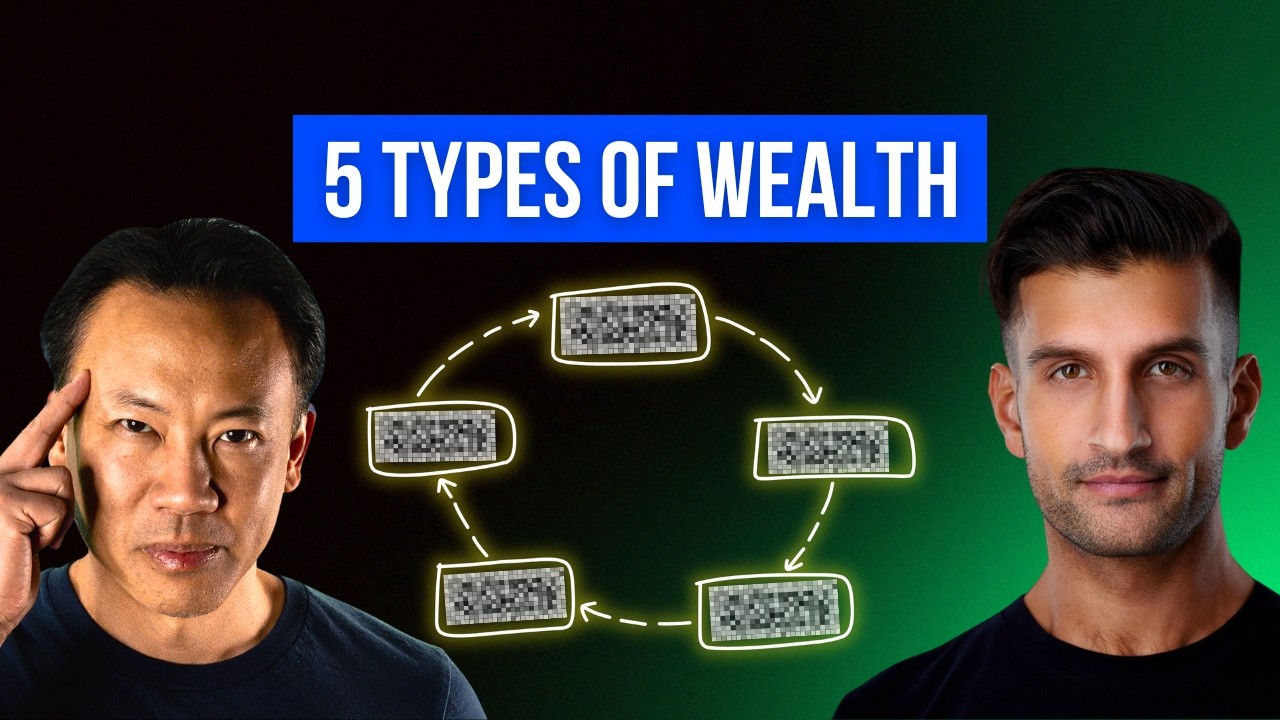
In this Kwik Brain Podcast episode, host Jim Kwik interviews investor‑entrepreneur Sahil Bloom about his book The 5 Types of Wealth. Bloom recounts a personal turning point – a conversation about his aging parents that made him realize his traditional focus on financial success was missing the larger picture. He introduces a framework that expands wealth into five inter‑related domains: time wealth (control over how you spend your hours), social wealth (quality of relationships), mental wealth (purpose, growth, and reflective thinking), physical wealth (health, movement, nutrition, recovery), and financial wealth (money, with an emphasis on defining an "enough" point). He argues that each type compounds like financial capital, so tiny daily deposits in any area accumulate over time. The conversation provides concrete, low‑barrier practices for each domain – an energy‑calendar exercise to map energy‑creating versus draining activities, a simple daily appreciation habit for social wealth, a monthly "think day" for mental wealth, a Level‑1 health routine (30 min movement, mostly whole foods, 7 h sleep), and a clear visualization of one’s "enough" financial life. Bloom also discusses the danger of treating life areas as on/off switches, proposing a dimmer‑switch mindset and seasonal focus, and introduces anti‑goals as guardrails to avoid Pyrrhic victories. He shares a Japanese misogi challenge (voluntary extreme hardship once a year) as a way to build resilience, and highlights guiding questions he uses to align daily actions with deeper priorities. Throughout, he stresses that true wealth is a holistic portfolio, and that investing in oneself is the single most powerful investment.
Chapters
What if everything you were taught, something that you knew about wealth, was completely wrong?
And I just remember feeling like I had been punched in the gut. I was focusing on this one thing at the expense of everything else.
The wealthiest people you know might actually be, in a way, broke.
It's the person who made hundreds of millions, maybe a billion dollars, that we pat on the back, celebrate, and admire, and we ignore the fact that they have 3 ex-wives and 4 kids that don't talk to them.
Today, we're not just talking about money. We're uncovering the 5 real types of wealth that actually makes life rich.
That is the single most important mindset shift for all of these types of wealth, is to recognize that all of them compound in the same way that financial wealth does.
So whether you're a student, you're a CEO, you're a parent, you're a creator, if you've ever chased money, status, or even time only to feel like something's still missing, this episode will change your Welcome to the Kwik Brain Podcast, where we help you to learn faster, achieve more, unlock your limitless potential. I'm your host and your brain coach. My guest is Sahil Bloom. He's an investor, an entrepreneur, a storyteller. He's the author. And if you're watching this, the extended version on YouTube of this breakthrough book, which you see everywhere, and I hope many of you have it already. If not, Highly recommended, The 5 Types of Wealth. So in a world that's obsessed with chasing dollars, Sahil, he invites us to explore something much deeper. He's taken powerful insights from Wall Street, philosophy, science, even ancient Japanese rituals, and turned them into very practical, pragmatic tools that anybody can use. So let's presence this. Whether you're walking, you're driving, you're journaling right now, I'm going to ask you to take a pause and slow down because this conversation could be the mental reset that your future self will thank you for. So welcome to the show, Sahil.
Thank you so much for having me.
So good to have you. Most people, they chase financial wealth, but your book, which I really enjoyed reading, half our team read it also as well. It invites us to redefine what being truly wealthy means. If I was to open your brain up like a book, what was the— was there a moment that shifted your definition of wealth?
A single moment, really. A single conversation. I was in May of 2021. I had spent at that point 7 years of my life marching down The very traditional path towards a quote unquote successful life, the path you're supposed to follow. I had taken the high status, prestigious sounding job. I'd marched down the path with my head down thinking that all of my contentment, my success, my fulfillment, my happiness in life was on the other side of some achievement, some milestone, some amount of money, some bonus, some promotion, some fancy thing. And all along that path for those 7 years, every single time I would get that thing that I thought was going to mark my arrival, I would feel this familiar dread of never having done enough, of just the resetting of those expectations to whatever the next horizon was. And I had started to have this sensation at the end of 2020, early 2021, that from the outside looking in, it really appeared like I was winning the game. But if that was what winning felt like, I had to be playing the wrong game. I had started to see my relationships really suffering and showing cracks with my parents. I was living 3,000 miles away. My sister and my relationship had ground to a halt. My wife and I unfortunately were struggling to conceive at the time, which was creating strain. I was drinking 6, 7 nights a week. My mental and physical health were in disarray. All of these other areas of my life were suffering. While on the surface, it seemed like everything was going great, like I was doing the things you're supposed to want to do. And it all came to a head for me with this one conversation with an old friend. We went out, he asked how I was doing, and I told him that it had started to get difficult living so far away from my parents, who were 3,000 miles away on the East Coast. And he asked how old they were, and I said mid-60s. And he asked how often I saw them, and I admitted that it was down to about once a year.
Hmm.
And he just looked at me and said, okay, so you're going to see your parents 15 more times before they die. And I just remember feeling like I had been punched in the gut because in that moment I realized that my entire definition of success, of what it meant to build a wealthy life, had been incomplete, that I was focusing on this one thing at the expense of everything else. And coming out of that, my wife and I took a pretty dramatic action. I went home the next day, we made a decision, and I left my job. And within 45 days, we had picked up, sold our house in California, and moved 3,000 miles across the country to live closer to both of our sets of parents. And that one decision was the spark that changed everything, because in that one decision was a recognition that you are actually in much more control of your time than you think. You know, that number 15, it's now in the hundreds. I see my parents multiple times a month. They're a huge part of my son, their grandson's life. We had taken an action and actually created time for the things that we care about. And that was what sparked my thinking and understanding that you actually get to create your own definition of what it means to live a wealthy life, what you measure. And then you can go take actions to build your life around those things.
That's powerful. You mentioned the word enough. I'm curious, in your current state, like, what does it mean to have enough? Or what's your relationship with this word enough?
You know, personally, my definition of enough is pretty simple. I want to be able to take my son in the pool at 1:00 PM on a Tuesday.
Hmm.
Think about that for a second, right? I, whenever I say that to people, a lot of people will get a puzzled look on their face. But if you deconstruct what that really means, that captures my wealthy life in a nutshell. That means I have the time freedom, I have the control over my time in order to, at 1:00 PM on a Tuesday, be able to go in the pool. It means I have enough money that I have a pool. It means that I'm healthy enough to be able to do that. Means that I have the relationship with my wife and with my son, that they want me to be there with them going and doing those things. I can't imagine anything better than being able to do that. And so to me, that clear definition and that ability to articulate what that enough life looks like to you is so important because then what it means is I don't need to chase more money. If I wanna chase something, it's gonna be grounded in something more meaningful than money. It's going to be about purpose. It's going to be about my health. It's going to be about these other areas of life, but it's not going to be about money because more money is not going to bring me any closer to that reality that I already have.
For our listeners, do you have a suggested scoreboard for how we should be keeping these different types of wealth in our life? Or maybe we could maybe go through the 5 types, you know, rather quickly. And just wondering how, You'd be able to measure, you know, our growth or success in those areas.
So the 5 types of wealth that I can just walk you through in a quick format are time wealth, which is about your freedom to choose how you spend your time, who you spend it with, where you spend it, when you trade it for other things. It is about an awareness of time as your most precious asset, the one thing that you can't get back. Second type is social wealth. It's about your relationships, the people The third type is mental wealth. That's about purpose, it's about growth, and importantly, it's about creating the space necessary to actually wrestle with some of these bigger picture, more unanswerable, uncomfortable questions about your life, whether through spirituality, religion, solitude, mindfulness, meditation, what have you. The fourth type is physical wealth. It's about your health and vitality. And then the fifth type is financial wealth. But with the specific nuance of really understanding that definition of enough, with the recognition being that your expectations are your single greatest financial liability. So if you have expectations that are rising faster than your assets can grow, you will never feel rich. You will never feel wealthy. What I really want people to do here with this framework in mind is to take a step back in, in the week ahead. You listen to this, Pause. Give yourself 10 minutes to ask yourself what your enough life really looks like. It is not about a number. Normally, if I go ask someone, hey, what does enough mean to you? They're gonna make up some number off the top of their head. And what I have found, having done this thousands of times, is that very few people know what the number means. Very few people know what the money is actually for. What is the life you are trying to build towards? What is the vision of the life you want? Where are you? What are you doing? Who are you with? What are you thinking about on a daily basis? Those are the things that define your enough life, and it is not about it being Spartan or bare or impressive or simple to anyone else. All that matters is that it's yours. It is your enough life. It's not governed by these default assumptions that you've been handed by the world, by culture, by your friends, by social media, any of those things. You get to choose what races you want to run in life. And it is perfectly reasonable and okay to live a life that looks confusing to other people. You get to define what your wealthy life looks like, what success looks like to you. And in fact, unless you create your own definition of success and wealth, You will never feel successful or wealthy.
Well, let's break this down. Let's go shine a spotlight on some of these forms of wealth. Let's maybe start with physical wealth. So if your body is a bank, you know, what daily compounded interest habits do you do to protect? Do you have any sacred kind of rituals? And I say this in that I follow you on social media, so I have an idea, kind of a little bit glimpse into you know, what you do physically, but what daily compound interest habits do you have in the area of physical wealth?
I love that you're asking the question in the context of compound interest habits because I think that is the single most important mindset shift for all of these types of wealth, is to recognize that all of them compound in the same way that financial wealth does. So putting away tiny daily deposits, tiny investments towards these things, whether it's your health, Whether it's your relationships, your mental health, all of these things compound and stack on top of each other over periods of time, meaning that the tiny daily action done today is infinitely better than doing nothing. Anything above zero compounds. So when it comes to health, your physical wealth, I really think about this along 3 pillars: movement, nutrition, and recovery. To me, this is like a video game. You know, if what you see on social media from the health gurus is like level 100 of some video game. You know, Bryan Johnson, Andrew Huberman, Peter Attia, all these people sharing all this information. It can be intimidating to someone just starting out. What I encourage people to think about is just to say that you are at level 1 as a starting point. And level 1 is very simple. Move your body for 30 minutes a day. It doesn't matter what type of movement it is. Could be walking, hiking, biking, jogging, lifting, dancing, whatever you like doing. Move for 30 minutes a day. Eat whole unprocessed foods at about 80% of your meals. That's 17 out of 21 meals during the week. And then try to sleep for 7 hours a night. If you can do those 3 things, level 1 of the video game, you are ahead of 90% of people. And it is cost-effective and freely available to basically anyone to go and do those things. So if you start there, you'll be in a great spot to start compounding in the right direction.
I notice with clients or some people in our community, they will often trade away one of their wealths for another, like their relationship wealth for financial wealth, you know, especially in high-performance careers. You know, has there been a surprising trade-off that you made and how would you do it differently today? Yeah.
You know, the way that I think about this is I'll give you kind of 2 frames of reference. Number one is that Your life has seasons. What you choose to focus on or prioritize during any one season can and will change. The second overlay to that though is the traditional wisdom around these different areas of your life has been that they exist on these on-off switches. So when you talk about trade-offs, the way people typically do that is they say, okay, I'm gonna really focus on financial wealth, on my career during this season of my life. They flip that switch on, and the trade-off they make is implicitly flipping off social relationships. They flip off physical health. They flip off mental health. They turn off these other areas of life. This is like that 4 burners theory on the areas of your life. And unfortunately, the reason that's such a dangerous mentality and mindset for living is because for some of these areas of life, if you leave them switched off for too long, You cannot turn them back on or they become very difficult to. I mean, ask anyone who didn't prioritize relationships and health during your 20s, 30s, and 40s how difficult it is to re-find those things in your 50s and 60s. And so the antidote to that, the kind of more nuanced mindset that I try to give people is that these areas of life exist on dimmer switches. And just because you have one turned way up during a season of life, doesn't mean the other areas are turned off. They can just be turned down low. The recognition being what I said before, which is that anything above zero compounds. Turned down low is infinitely better than off in terms of how that compounds and stacks into your future. So even if you are in a season where you are prioritizing your financial wealth and your career, you still need to design some tiny daily action for these other areas of life. It could be as simple as making sure that you take a 15-minute walk every single day. For your relationships, make sure you send the text to the person when you're thinking about them. Call your mom for the 2 minutes that you have in the car ride on the way to work. Those tiny daily actions stack and compound into your future, and they prevent the atrophy that implicitly occurs when you turn these things off.
If our listeners had like a wealth portfolio and they had 100 points to allocate across these 5 types, they could fluctuate over time. I guess, you know, where would people be investing today and how would that compare to maybe where you were allocating those 100 points of time, energy, you know, emotion, focus even 5 years ago? Has that changed over time?
For me, it certainly has changed. I would say that the most common arc is probably the one that I find myself on, which is You know, your 20s and early 30s are spent very focused on financial wealth and on building this foundation. I actually think that that's very smart, right? Because of the way compounding works, because of the fact that you are coming up Maslow's hierarchy of needs in those early years of your career, you're taking care of those basic foundational security needs, basic comforts, reducing fundamental stresses, et cetera. After that, I would say that most people start to think about family. You kind of come into the like family building years of your life. So maybe you turn down the dimmer a little bit, on financial wealth, turn it up on social a bit. And then you're kind of starting to see those changes as your kids get older, kids leave the house. Then people are trying to refind purpose in a new phase of life after their kids have left. You know, maybe you're retiring and you're trying to find purpose in the later years, trying to refine some of your physical wealth in the later years. So those general adjustments that you're making are part of these like natural waves and natural seasons. I write in the book about this idea of the surfer mentality, that a surfer gets up on a wave and they don't worry about the fact that the wave is eventually going to end and maybe even crash down on them. They just enjoy the wave that they're on with the recognition and awareness that there are always more waves coming. Your life is very similar. You are that surfer on this wave, and the appreciation and awareness of the current wave that you're on You can just embrace it and enjoy it. You don't need to be attached to and stressed about the prior wave and how you handled it, or concerning yourself overly with any future waves that may come. You can just appreciate and feel gratitude for the present.
And what would you say to someone listening who maybe has a level of, let's say the word guilt for slowing down and putting energy and deposits in those other areas? How can, how would you recommend they learn to earn the moment without losing what they perceive as some kind of momentum in their career or somewhere else?
You know, this tension that we all balance and navigate between what I would say is presence on one side and ambition on the other is really one of the most fundamental tensions of life as a parent, especially because The period of time when your kids are young, you and I are both in this right now, is the most beautiful period of time of your life. It also happens to coincide for most people with the period of time when you are just starting to experience the real compounding in your career. You have just started to feel how everything is accelerating. And so feeling like you're stepping off the gas right then feels wrong, both in terms of the security that you can provide your family financially, But to continue pushing in the way that you were, maybe feels wrong towards the presence and the desire to be around. What I would say in the way that I have navigated this is to recognize that work and life do not need to be in tension. You really should include your entire family in the why of why you are working hard on the things you're working hard on. I would argue that one of the most important lessons your kids can learn Is that working hard on things you care about is the way that you achieve anything in life. And so bringing your family along for that journey, having them a part of the mission of what you are trying to build, the life you are trying to build towards altogether, all of a sudden these two things don't feel in tension anymore. Your, your wife, your partner, your kids, they are a part of that journey and that mission with you rather than being an afterthought of the things that you were trying to go create.
So if questions direct our focus, which determine how we feel and what we do, are there maybe 2 or 3 dominant questions that you find yourself asking on the daily, maybe even unconscious at this point, to realign with what truly matters? I mean, you must have opportunity stress, right? You know, opportunities come up, you know, where you put your Your time, energy, your focus? Are there certain questions that you're asking that our audience could adapt or adopt to help refine and give them clarity? In a world where everyone has access to the same information, the same tools, your mind is your only true competitive advantage. But here's the reality. Most of us, we learn what to think in school. We learn a lot of facts and formulas and procedures, but nobody taught us how to think. That's exactly what Kwik Thinking does. In our flagship program, in just 21 days, 3 weeks inside, you'll discover how to think clearly under pressure instead of freezing up, how to accelerate your learning speed so it becomes your real superpower so you can adapt faster than ever before, how to absorb and retain more information with less mental energy and effort. If you're ready, To unlock your limitless mind, click the link on the screen. Stop letting unclear thinking hold you back from the life that you're truly capable of creating.
Yeah, maybe not daily, but certainly monthly. I mean, what I, what I try to do on a monthly basis is I take what I call a think day, which is really just an hour or so. Go to a kind of different space, you know, go to a coffee shop, go outside, go somewhere that's not familiar environment for you and ask a few bigger picture questions that force you to kind of zoom out and create perspective. So one of my favorites is, if a third party were to come and observe me for a week, what would they say my priorities are? Because there are 2 types of priorities in life. There are the priorities we say we have, and there are the priorities our actions show we have. And oftentimes there's a big gap between the two. Creating an awareness of that gap and then taking action to close it is how we improve our lives fundamentally. But you have to create that awareness as a starting point. You have to be able to see from an outsider's perspective, what are you doing on a daily or weekly basis? Is it aligned with the things that you say you care about? And if not, what are the corrections or the adjustments that I maybe need to make In order to improve my life.
And to get those outcomes, I'm curious, what's your approach or relationship with goals and goal setting? You know, I know reading, you know, going through your work, you have goals, you have anti-goals. What's your relationship? How do you look at goal setting or goal getting, if you will?
Yeah, I love having one sort of big ambitious goal for an arena at any point in time. I find it, clarifying in an abstract big picture sense. But what I will say is that I also find it completely unmotivating on a daily perspective because it's so big picture and so grand that, you know, you can see the summit way off in the distance, but you don't feel any progress towards it. So it's almost like anti-motivating at times. So what I always do is for every big picture ambitious goal that's sitting off on the horizon, I work backwards from it. to what I call like my sort of checkpoint goals that are going to be the things that I have to get through along the way to get to it. And those are actually the things that I focus on more. So, you know, if I want to build a newsletter to a million subscribers, that's like this huge, big, ambitious goal. Well, to get to a million, I got to get through 100,000 for sure, right? So that might be my first checkpoint goal. And the checkpoint goal is what I can kind of work towards and start adjusting course if I'm falling off. Anti-goals, which you pointed out, are the other big piece of this for me. Anti-goals are the things that you don't want to happen in your pursuit of achieving your big goals. So they are the kind of boundaries, if you will, the guardrails as you continue to march towards the future. So my goal might be to, uh, you know, become the CEO of my company. Well, my anti-goal for that might be spending 300 nights out of the year away from my family. I want to become CEO. I want to achieve that goal, but not if it means this anti-goal becoming real. It is what I'm not willing to sacrifice as I climb towards that goal. The reason that's so important is because what happens to a lot of people is that they set out for this goal. They get this narrow, myopic, focused mindset, which is great. But what happens is that they win that battle. They go and achieve that goal, but they lose the much bigger picture war. It's called the Pyrrhic victory. It's the battle won, but the war lost. And we don't have to look far to find examples of people like this around us. You know, it's the person who made hundreds of millions, maybe a billion dollars that we pat on the back, celebrate, and admire. And we ignore the fact that they have 3 ex-wives and 4 kids that don't talk to them. And the truth is that for all of us in our own lives, we need to ask ourselves, If that's actually a game that we care to win, because it's avoidable. You can actually take actions and plot your life in a way where you can avoid losing the bigger picture war as you pursue these goals. You can win the battle and the war, but it requires you being very deliberate about the way that you pursue your life on a daily basis.
And I love it because it's, you know, the presupposition is that we have agency over all this. And you've spent Birthdays, interviewing older, in some areas wiser people to get their perspectives on life knowledge, right? And you've also done your own version of a Japanese ritual that involves doing something that is so challenging that, you know, there's lasting benefits for the rest of the future. I'm curious where there's some key nuggets, some really brain bites. Maybe 1, 2, or 3 impactful answers that you've heard during these conversations? You know, what realizations did these spark about, about maybe your own life?
The most impactful piece of advice I got was from my late grandmother before she passed. And she said, never fear sadness as it tends to sit right next to love. That idea unpacked as a mental model or a framework for thinking about life is very powerful. Because what it implies is that the most beautiful things in life dance on this razor's edge, the good with the bad. And you can't hope to experience the fullness of the good without exposing yourself to the struggle of the bad. The two come hand in hand. They come in the same kit. And I think that applies to so many things in life. There's so many things where people are trying to avoid the struggle but still get the benefit. And that is just not the way that life works. If you are going to try to build and experience these beauties, incredible things in all areas of life, you have to be willing to expose yourself to the struggle along that journey.
And that leads into this Japanese ritual. Maybe you could talk a little bit about that practice, what it's led to.
Yeah. So this is the concept of a misogi challenge, it's called. The idea is doing something so hard one day out of the year that it sort of has lasting benefits for the rest of the year. The most traditional version of this is that you climb to the top of this mountain and bathe in this freezing waterfall on this frozen mountain. I have tried basically once a year to do some version of this. I've done a 12-hour walk, which was surprisingly, shockingly challenging. Some Really hard physical challenges. And I have found immense benefit in the value of voluntary struggle, doing hard things. We talk a lot about the value of doing hard things, but very few people ever tell you why it's so important. I really believe that when you take on voluntary struggle, you are better prepared for the involuntary struggle that inevitably comes into your life. So you are training yourself, you're building this muscle to then endure whatever stresses or struggles do come. And when we do that on a more regular basis, when we embrace the fact that every single thing you want in life is on the other side of something that you don't want to do, you know, like the relationship you want is on the other side of 100 hard conversations.
Hmm.
The body you want is on the other side of 100 hard workouts or bland meals. The business you want is on the other side of 100 hours of focused work. All of these good things in life are on the other side of something that kind of sucks. So learning and training yourself to embrace that suck and finding along that journey the suck that you can actually enjoy, that meaningful one to you, the meaningful struggle, the hard-earned win is the best thing in the world.
I love it. Your book is full of very practical ways, very pragmatic ways that people can enhance their wealth in each of these categories. Maybe we could do just a minute or so, just one thing per each wealth category that you would tell that— you mentioned your, the version, the 20, in your 20s, you know, what would you tell him? Maybe one thing per wealth category.
Sure. And we'll do rapid fire. So time wealth, I would say to go through what I call an energy calendar exercise. Your outcomes in life follow your energy, meaning the things that you feel naturally pulled towards, a natural energy for, are going to be the things where you generate the best outcomes. The first step is figuring out what you actually have energy for. The way to do this is my energy calendar exercise. At the end of a given day, Color code your calendar according to whether an activity was energy creating, meaning you felt a pull towards it. Mark it green if it was neutral. Mark it yellow, and if it drained your energy, mark it red. If you do that for five days, do it for a week, you will have a very clear visual perspective on the types of activities that are creating energy versus draining your energy in life. That will arm you with the information to slowly and steadily start positioning your life. Towards the energy creators, which is where the outcomes will start to flow. Social wealth is the second one. I would say that the most important is very simple, which is when you think something nice about someone, let them know right then. This seems so obvious and so simple, but so few people do this. When we get busy, the first thing in life that falls by the wayside is our relationships. When scientifically, our relationships are the single most important predictor of a happy, healthy life. You can do the one tiny action every day to stack and compound social wealth in your life. All it takes is letting people know when you think something nice about them. Send the text, make the phone call, tell the person to their face, whatever that tiny act of appreciation is. That's where your relationships will grow and thrive. Mental wealth. This is the third area of wealth. I would say the think day. So I talked about this earlier, taking an hour once a month, getting out of your normal headspace, zoom out, see the bigger picture in your life. Ask yourself some of these questions. I've talked about a couple during this conversation, but one that I would encourage everyone to ask at their first think day: if you were the main character in a movie of your life, what would the audience be screaming at you to do right now?
Great question.
Really think about that. What would the audience be screaming at you to do right now? Then go take some tiny action against your answer to it. That one tiny action could be the thing that dramatically changes your life.
Love it.
Fourth type, physical wealth. We talked about this a little bit. Movement, nutrition, and recovery. Pick one thing in each of those categories. And for the next 30 days, Just do that very simple level 1 level. So if it's moving for 15 or 20 minutes is your goal within movement, do that. If the food one is like, I'm going to focus on eating, you know, a protein source at every meal, pick a rule within each of those categories and check the box on it every day for the next 30 days. You will feel completely different. I guarantee it. And then the final type is financial wealth. And the exercise that I would want everyone to do here, which I think is a prerequisite to building the life you want, is to really clearly visualize and define what your enough life looks like. The exercises in the book, the questions to ask, sit down and journal on this. Really create a clear picture in your mind of what the money is for, what the life is that you are really trying to build, and then you can go and make that a reality.
Powerful. So simple, but so doable also as well. If you got the question, like, what is the single greatest investment in the world? What do you think your answer would be?
Any investment in yourself. My dad, before I started my first job, just gave me the advice, never think twice about investments in yourself. That was the piece of advice he gave, which is, you know, books, personal development, food, Fitness, health, all of those things are investments in yourself. They might look like expenses on the surface, but really you're investing in you and investing in your own growth. And those are investments that pay dividends for a long, long time. So anytime you find yourself stuck or feeling like you can't see the path through, just default to investing in yourself in some simple way. Because the truth is that everyone wants to know how to change their life, And the reality is that you won't change your life in a day, but if you start to change your days, you will eventually change your life.
That's powerful wisdom. People just break things down. They have an outcome in mind. You know, a lot of people have challenges maybe adopting new behaviors or new habits. I'm curious, this show is primarily about Learning, right? And the love of learning. Is there, is there one thing you're currently learning that's lighting you up outside of maybe some of the things we talked about, you know, in this conversation, something that you're studying that has you particularly excited?
I don't know if excited is the right word, but I am spending a lot of time reading and studying history right now. In particular, trying to focus on these time periods where the future felt very uncertain. I am feeling this brewing uncertainty about the future, given all of the changes that are happening so rapidly in the world of technology and AI in particular. And so what I try to do whenever I start having this sensation of, oh my God, the future's so uncertain, it's never been like this before, what I try to do is then go study the past and recognize that for the most part, there are analogs for everything that we can find in human history. And so I'm trying to study right now a lot of these periods in human history when the future felt very uncertain and try to get inside the minds of some of these people and understand what allowed us to continue to endure. What were the things that stayed the same despite all of the changes that were happening? And sort of use that to create my own roadmap for what the future might look like.
I love it. Where can people go deeper in your work? Obviously, I recommend The 5 Types of Wealth where they could get anywhere. Where else can they go deeper in your work or stay connected with you?
You can find me on any major platform. The benefit of having a weird name is that it's just my name on all of the platforms. And then my website is just sahilbloom.com. You can find my newsletter there, which I send out 4 times a week, completely free, and would love to hear from you. So send me a message, send me an email. That's me responding to everything. I don't have a team managing that and would love to hear from you.
I love it. Thank you so much for, for being on the show. Love to have you back for future projects and passions.
Thank you.
I just want to just— this conversation, everyone, this could serve as a powerful reminder that wealth isn't just a number, you know, in your bank account, right? It's, it's also the energy you bring to your days, the love that you give to the people around you, the health that you're, you Enhancing and protecting the memories that you're creating. And just, just remember that knowledge alone is in power. Certainly it could help you create profit, not just financial, but all the treasures of your life. And a reminder that the real power comes from applying what you've learned. And this session is no different. So here's the quick brain challenge for everybody. Reflect on your personal wealth, right? Into your personal wealth, your personal portfolio in these 5 categories. And where are you the richest? And where, where do you want to grow? If you found this valuable episode, take a screenshot wherever you're consuming this, tag us both wherever you post this. We get to see it. I was mentioning before we started recording that I've given out 20 copies of this book. I have a few extra and I'm happy to gift that out randomly. Make sure you tag us and just share one Insight that maybe shifted a little bit of your thinking so we can inspire others to redefine wealth together. So until next time, be limitless.
Limitless.
More from Jim





The Library of Minds: Brain Coach: How to Stay Sharp When AI Does the Thinking | Jim Kwik





