Captivating People in Every Conversation! | Bill McGowan
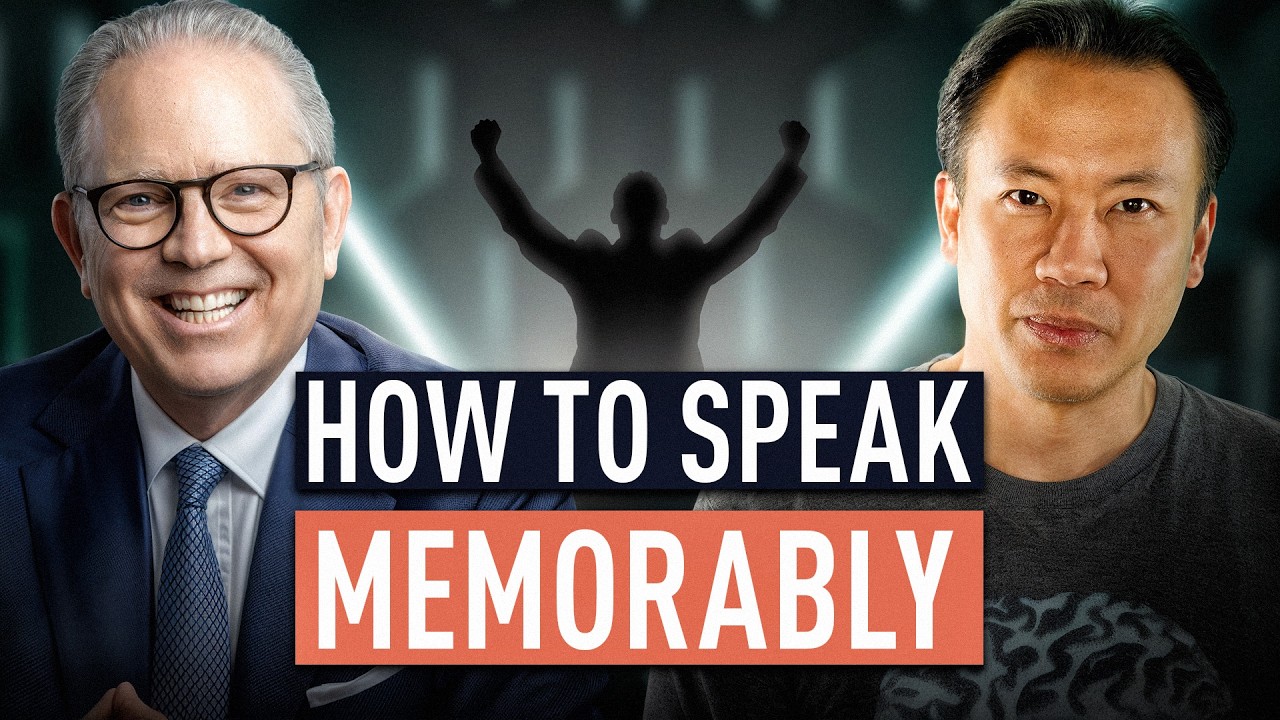
Communication coach Bill McGowan breaks down how to make yourself memorable in conversation. Poor communication costs trillions, and LinkedIn ranks it as the top skill employers want. He teaches the hook (first 15 seconds), the Coppola Storytelling Formula, and techniques like strategic pauses and vivid vocabulary to cut through jargon and stick with people.
Chapters
What if improving the way you speak could make you 25% more productive without adding a single new task to your list?
If what you say sticks with people, you have this golden opportunity to motivate them, persuade them, influence them, inform them, move them emotionally.
Communication is one of the most powerful mental skills that we have, but most people, including myself, never learned how to use it effectively. And today we're gonna be talking about how How to speak memorably.
If you take factual information and you embed them within stories, the information becomes 22 times more memorable.
You're used to us teaching you how to remember things, but how do you become more memorable so that you can lead better, you can connect deeper, and you can unlock more of your potential?
You have to do something in the first couple of lines that intrigues people to want to hear more.
Welcome back, Kwik Brains. I am your host and your brain coach, Jim Kwik. Today, we're gonna be learning how to speak memorably so that your message really sticks and why mastering this can make you a more influential thinker, leader, parent, uh, learner. Because if you can't communicate your ideas effectively, they never get a chance to do what they're supposed to do. You know, whether it's changing a life or changing the world. There, as research prep for this, I was looking and reading this book that I highly recommend. Studies show that poor communication can cost companies over $1.2 trillion. That's with a T each year. Even more, LinkedIn recently named communication as the number one in-demand skill 2 years in a row. That means learning how to speak clearly, compellingly, confidently, and memorably is not just helpful. It's absolutely vital and essential. And to help us become better messengers, I'm excited to welcome Bill McGowan to the show. Bill is the founder and CEO of Clarity Media Group and a 2-time Emmy Award-winning correspondent and communication coach behind some of the biggest names in business, sports, entertainment, media. So whether it's coaching the founders of LinkedIn, Instagram, Spotify, to Oscar, Grammy winners, to Olympic champions, Bill has helped thousands find their voice. and become unforgettable communicators. He is the author of Speak Memorably: The Art of Captivating an Audience. If you're watching this on YouTube where we have the extended version, you can see this copy that I'm holding right now. And today we're very fortunate enough to learn directly from him. So welcome to the show, Bill.
Thanks, Jim. Thanks for having me on.
I feel a little bit of pressure to be able to perform. You probably get this, you know, as I do. I do.
I hear that sometimes, but I say totally unfounded.
Okay. Well, I appreciate it. Thank you for putting me at ease. As a memory coach, I always, I get that people feel pressure sometimes when I'm working with them that their memory has to be, you know, at its best. I just want to start out, you know, as an Emmy Award-winning journalist, were you always a strong communicator or did you have to train yourself, train your brain to get better at being at it?
I definitely was, I would call a news junkie growing up. I watched a tremendous amount of news on television. I'd listen to it on the radio. You know, when I was a kid, Jim, I did something probably considered pretty nerdy. When I was 13, I, instead of going out and playing in the summer, I actually stayed in and watched the Senate Watergate hearings. Which was not something a 13-year-old was probably supposed to be doing. But I was always fascinated and intrigued with the idea that communicating could help bring about the outcome, a desired outcome. And so I went into that line of work, which really gave me an ability to tell a compelling story in 90 seconds because that's pretty much all you had in television storytelling. So it really helped me streamline the thinking about what goes into telling a good story and what they call in TV a hook. You have to do something in the first couple of lines in the first 15 seconds of a story that intrigues people to want to hear more. And so that was a really good training ground for the work I do now, which is really helping people give an audience a compelling reason to want to pay attention and then deliver something that rattles around in their brain for a few hours, a few days, or longer if you're really good at it.
So I have to go deeper with this because I'm the memory guy and I love geeking out of how to make things more memorable, more unforgettable. In your book, it suggests that there's a very strong link between effective communication and memory. Maybe you could talk a little bit about how mastering one can enhance the other, particularly in the people you work with in high-stake environments.
You know, there's probably no greater gift in life than having your words be remembered. And as you were mentioning in your intro, if what you say sticks with people, you have this golden opportunity to motivate them, persuade them, influence them, inform them, move them emotionally. And this is a golden opportunity that is being squandered every single day in offices, not only all over the US, but all over the world, because people speak in a very bland, predictable, jargony way. And it's what I call in the book this conformity zone. We tend to adapt and adopt this speaking style in the work environment that is based on what we've learned through osmosis by watching how other people present. And the people that we're learning from don't necessarily have the kind of skills and tools to be memorable. So what happens is that this strategy and this style of communicating that tends to be pretty forgettable and empty gets spread almost virally through the work environment. And it's incredible. You were citing some stats early on, and one that really jumped out at me was this Harris poll that said that the effectiveness of communication among leaders had dropped about 12%. And you can't have diminishing communication skills at the same time you have increased performance and success of a company. It just can't happen like that. And there's probably no better compliment that anybody can get than somebody coming up to you and saying, you know, I'll never forget that thing you said last year in the meeting. That is the treasure chest of communication. That's when you realize I'm on the right track here.
This is interesting to me because, you know, our audience is used to me training them on how to optimize their neurological networks. This feels like to me we're optimizing really our social networks through, through those communication channels. We had the opportunity to interview the late Larry King, and we're talking about the power of questions. And I want to go into the tools also of storytelling and why stories are so memorable and such a powerful tool to have in your communication toolbox. As a journalist, you've really mastered the art and science of asking questions that really open people up. Is there a formula that helps our listeners craft a powerful question? And just as important, how do you— how would you also deliver a powerful answer also as well?
It's interesting you bring that up, Jim, because I do a lot of coaching of executives who now have to be in the position of moderating a panel or being the interviewer in a fireside chat at an industry conference. And there are a couple of questions I always tell them to try to avoid. And they're a little bit of the open-ended or what I call lazy questions, which are, so talk a little bit about this, or give me your thoughts on that. I find that those questions don't steer the guest in the direction that you're hoping they go in. And in fact, when you ask a question, it should be with the intent of learning something. But perhaps you are aware of a story they've told in the past because you've researched the person. Sometimes that question should be— the intent of it should be to tee that person up to tell that story. And one of the things that can help an interviewer get the guest to be more anecdotal and be a better storyteller is to ask what I would call a point in time question, which could be, you know, you made this transition, Jim, from here to there. Was there— Was there a particular moment or revelation or epiphany you had that really sealed the deal to motivate you to have that transition? Try to drive people to an aha moment or something that can be identified as happening at a point in time. That's what I would like people to do more in terms of questions. And when I coach people on asking questions, sometimes it can be difficult to get them to be concise. What you're really looking to do is have your guest react instead of plan. And what I mean by that is today most people go into an interview with a game plan and they have their key messages of what they want to say. And when you ask a very long-winded question with a big contextual setup that precedes the actual asking of the question, what you're really giving the guest the opportunity to do is just lapse into, oh, okay, that's the innovation question. Oh, okay, that's the leadership quality question. And it allows them to retreat back into just pre-rehearsed canned talking points. Whereas what you want to do is mix up the length of questions and sometimes have something very quick-hitting come at them so they don't have the time to make that association of, oh, here's that topic I prepared for. They just have to react. And when you get guests to react more than plan, what you get, in my opinion, are more revealing answers that are just a lot more transparent. And telling about the guest.
Yeah, I can appreciate that. And in a way, questions direct the person you're communicating to, their focus, and an audience focus also as well, where our brain, it's been my experience, is primarily a deletion device. We're trying to keep information out because we can't process all of it, all the stimuli, a billion different things. But a question really hones that in. their focus. In a way, conversations would be these powerful questions. A great conversation would be powerful questions and stories, right? Making a tapestry of that connection. In their toolbox, storytelling. So throughout time, individuals have used stories or parables that are extremely memorable, that like a splinter in someone's mind. Do you have a similar process as we talked about for questions to creating stories in response, whether it's on stage or on television or even stories to your children in our everyday communication? What does that look like? How do you view, if you're going to deconstruct a good story?
Well, I think the reason why storytelling is such a powerful tool is that Some of the research we did for the book established that if you take factual information and you embed them within stories, the information becomes 22 times more memorable to your audience than just hitting them with a lot of facts and information and data. So you get much better recall on that. In fact, what I'm often telling people to do when they have to present especially in front of a large group of people, maybe at a conference or an event, is don't start with the agenda slide. That's just not a compelling hook to get people to pay attention to you. That's, you know, in the entire history of book reading, nobody has ever bought a book in a bookstore and said, boy, I can't wait to get home and rip open that table of contents. You know, nobody has ever said that in the history of reading. And that's what an agenda slide is. That is your table of contents. That sends a signal to the audience, I don't really need to pay attention for, for another 30, 40 seconds here until this person gets into the meat of the presentation. So what I recommend to clients all the time is let's figure out a story that is metaphorically connected to the message you're trying to deliver in this talk. And if it can be completely outside the realm of your industry, That's even better. And don't belabor the story too much. You don't want to be the person telling the joke where the setup before the punchline just drones on and on and on.
Right.
Because people start to get fidgety. But figure out how you tell that story. And to specifically answer your question, Jim, a good story sets the scene. Typically, it establishes some kind of challenge or tension in the story, something that has to be resolved. And then the payoff usually is the resolution to that problem or the outcome. So if you think about most stories fit those 3 buckets. If you tell that story in the beginning of a presentation, then perhaps the most crucial element is what I would call the through line. This is the line that connects what to the audience might seem like some random disconnected anecdote to the topic you're there to talk about. That through line connects that opening story with what may be slide 1 of your presentation or the meat of what you're up there to talk about in your keynote. So those are really the components that can get you off to the races. in a way that the audience is compelled. I've had people skeptically say to me, yeah, but if I start this story, I'm here to talk about, you know, cloud software, and you're asking me to start with a story about cars.
Right.
I mean, isn't everybody in the audience gonna think that I just lost my way, and what the heck is this guy doing? How's he gonna get from A to F? My response to that is, yeah, that's great. I mean, if they're sitting in the audience, that bewilderment of where is this going is a form of engagement. That's not a bad thing. It's the predictable, this is in the conformity zone type of content and structure that I find doesn't get retained. And probably It doesn't get retained, probably because it wasn't engaging in the first place.
In memory science, there's something called the Baker-Baker paradox, where they'll take a room full of subjects and they'll have somebody walk in and say, hi, I am Mr. Baker. They will leave. Somebody else will come in and say, hi, I am a baker. And then they'll do that for Taylor, Miss Taylor, who's, you know, who's also a tailor, another person who's a tailor, and so on. They'll bring the individuals back in and do it test to see which one they remembered, whether it's the name or the profession. And as you can imagine, a huge skew for those who remember the profession. And maybe one of the reasons is because there's a story. If someone's a baker, you have a story about that person's life in terms of how early they wake up and you have, you know, the smells and, you know, you could picture it, you visualize it, and you could also feel it. You know, what about emotions? We do a lot with emotions in terms of information by itself is very forgettable, but information when it's tied with an emotion, in your middle brain, you have this, you have your hippocampus, which is memory. It's connected to your amygdala, which is processing a lot of emotions. In the system that you have when you're coaching a client, what role does emotions play? And then also, How can we learn to navigate these, our own emotions with patience, with calm? You know, I imagine with all the interviews you've done, you've had situations where people weren't able to self-regulate, right? And control their emotions.
I'm laughing at Jim only because I had a guy one time so unable to self-regulate in the middle of an interview. He hauled off and belted me in the jaw in the middle.
Oh, my goodness.
In the middle of an interview because he didn't like where the questions were going. So, yeah, I mean, as you know better than anybody, emotion and rationality constantly in balance. And the more emotional you are, the less rational you are. The less rational you are, the poorer your decision-making. And certainly when you get on stage and you've got a ton of anxiety and nerves that can affect your decision-making process. I know I'm telling you something you know really well, but to me, emotion is so crucial in communicating your message to your audience. And for me, as a coach, it has a lot to do with intonation of voice and how people are manipulating and varying the pitch of their voice. And so I'll give you an example. A lot of times people have to get up and deliver good news, encouraging news about results or growth or future initiatives, and they don't let the sound of their voice reflect that optimism. They keep their voice in a very narrow pitch range so that in terms of tone, it sounds exactly the same as information they would deliver that isn't good news. And they need to let their voice rise, talk about these are the types of things that are going to drive us in the future, letting the optimism reflect in the pitch of your voice, to me, makes that message land so much deeper. I often tell the people I'm working with that if you were speaking a totally different language that I did not understand and you were on stage doing your presentation, I would want to understand just from the pitch of your voice if you're telling me something encouraging, something Discouraging just from your demeanor, from your voice, from your facial expression. Most people deliver great news without any warmth in their voice or on their face at all. How many times have you seen somebody get up on stage and talk about how excited they are to be there and they don't look the least bit excited? That happens all the time. So Oftentimes what I'll do when I'm working with somebody on a speech is we will use sometimes emojis as an emotional stage direction that you would put perhaps at the top of a paragraph that you're about to read. And that emoji is meant to inform you, I need you to sound a little incredulous here. I need you to sound hopeful here. Yes, this is where the performance aspect comes in, but it's enormously important.
I remember reading decades ago that when it comes to communication and influence, it was 7% words, 38% voice tone, and then 55% your physical body. Does that ring true to you? I don't even know where that was referenced from.
Is that That's an Albert Mehrabian study from UCLA back in the late '60s. And it's interesting you bring that up because over the years that's been cited a lot, but it's been a little misunderstood all these years as something that directly pertains to what it is we remember from people. And so if you can imagine how discouraging it is if you're a writer or you're a wordsmith, And you hear that only 7% of what people remember are your words. That's— and I always thought, wow, that's so discouraging. Could that possibly be true? Because the difference between a good speech, a speech written well, and a speech written poorly, to me, makes a huge difference. What Mehrabian really meant was that what we're able to read emotionally off of somebody is based on that. And now that makes total sense. 38% of how we say it means I can tell from the tone of this person's voice how they're feeling about it. And I can tell from their hand gestures and their facial expressions an awful lot. The words, not so much in terms of a window into the emotional frame of mind of the communicator.
It's interesting. I'm sure we share some of the same clients. When I'm training TED speakers to remember more, not present, but remember what they need to, because often it is word for word, but it has to sound natural and organic. That time constraint is challenging because you say in the book that more is not necessarily more, right? When it comes to making impact.
Mm-hmm.
How do people overspeak and how can they avoid this verbal clutter, if you will, these traps that people fall into? Are there words or phrases or habits that could actually dilute or weaken the impact of the message? And then how can we avoid that and strengthen the opposite?
There's no greater tool to self-analyzing than just rolling a record, either audio or video, on your own presentation. And when you listen back to it, I think what jumps out at people the most is, well, I could have said that in 20 seconds instead of 2 minutes. That immediately jumps out at people. You know, there's an old expression, Nobody ever makes a mistake inside their own head, which is a really good argument for why people always need to practice out loud and rehearse out loud. That's a very different experience than just silently playing in your head what you plan to say when you get up on that stage in front of people. And when you hear yourself either live or on a recording, you can really start to make some adjustments and figure out how to be punchier, And more concise. The 2 words I hear all the time, Jim, are standpoint and perspective, that there's a scourge running wild. You know, from an etymological perspective, I think we could be doing a better job here. But from a vocabulary standpoint, those 2 words in corporate America have completely taken over people's delivery. And when you hear those 2 words come out frequently from somebody, that is a clear sign that they are over-talking, that they are taking way more time to communicate their thought than they absolutely need to. But there should be— let's say you're doing a presentation and you have a PowerPoint deck or a Keynote deck or whatever. audiovisual tool you use. I think what gets in people's way is not being aware of what the starting line is and what the finish line is of each individual slide. And when you're not really sure how you're going to end this thing, there is a tendency to drone on. And what I'd like people to do is be Very, very clear of what that opening punchy declarative line that gets you into each slide is and understanding what's the crisp finish sound like, or what is the line that helps me segue from, say, slide 2 to slide 3 and, and sort of foreshadow and signpost what's coming up. And when you know that top and bottom structure, It tends to keep you a bit more crisp and concise.
Did you find with working with clients that taking a pause is difficult? Like when people have the spotlight or they're nervous or they just want to say everything they need to say and maybe stop, or they'll fill in that awkward silence with words. And I'm guilty of this also as well. Like, They'll say like, or they'll say, um, or they'll do these things. Is that something that you support your coaching clients with? And how would people have a tendency to do that, not take a pause or use those kind of filler words? What should they do?
Well, I'm preaching to the choir here, Jim, in terms of talking about how the brain works. And a lot of studies seem to indicate that our brains are about 600 milliseconds ahead of our mouths. And what your brain is doing all the time is it's navigating out ahead and it's deciding, what thought do I want to communicate here and what words do I want to use to communicate that thought? And your mouth follows along on whatever instructions it gets from the brain. And when you are speaking very quickly, you're really not giving your brain time to vet those thoughts in just fractions of seconds. It's like driving down a road and there's a huge pothole in the road. And if you're driving really fast, the chances are you're not going to have the time to swerve and avoid that pothole, and you're going to end up in it. If you're driving more deliberately, You'd probably be able to spot it, steer around it, and avoid it. And think of that pothole as filler language. You know, like, um. And I recommend people, as you just said, take a beat before you answer, before you deliver that first line. So, um, should never be the first 2 words of any sentence. And I'm guilty of it too. I am constantly working to eradicate that from my vocabulary. But most people will utter, so, um, and while they're doing that, their brain is formulating where they want to start the thought afterwards. And imagine how much better it would be if you just had a beat, a beat and a half, 2 beats of silence And during that silence, you are making those decisions about what thought do I want to communicate and what are the first 5 words out of my mouth? And when you very intentionally select what those first 5 words are, so, um, will not be 2 of them.
For sure. It's interesting. Not only does it give you time to process, but it also gives the person that you're with time to process. Sometimes when you use silence, it could really underscore an important point. But even myself, sometimes I feel a rush, especially with television interviews or something, where that pause could feel a little bit awkward. And to stop the awkwardness or mitigate it, you add those other words.
I think it's also a sign of respect to the person you're in conversation with or the people that you're presenting to. in Q&A at the end of a presentation and somebody's asked you a question and you take a thoughtful beat or 2 before you begin speaking, to me, that seems as though the message you're sending to the audience is, I care enough about helping you understand something deeper that I'm being very selective here and I'm being very intentional about what I say. When I hear people just talking a mile a minute with no separation between the question and the answer, I immediately feel like there's less value to that. I feel as though that's just something they're programmed to say. It's the pull it out of the drawer response. It's not in direct response to something that I specifically just asked this person.
That makes a lot of sense. You mentioned vocabulary a little while ago. What are your thoughts when you're working with a client? Do you encourage people to expand their vocabulary or at the same time clean it up to keep, or, you know, keep things more simple? Are you tired of constantly feeling overwhelmed by your never-ending to-do list? Do you struggle to find enough hours in the day to accomplish everything you need? But what if I told you there's a solution that can help you take back control of your time, your focus, your productivity. I'd like to introduce you to Kwik Productivity. This 10-day course is designed to provide you with the proven strategies you need to get more done in less time without burning out. So if you're ready to learn to get the most out of your time, your tasks, and your life, then don't wait any longer. Click the link below to learn more and secure your spot and your access right now.
I love the Mark Twain quote that I never want to use a 25-cent word when a 5-cent word suffices. And there is a lot of truth to that. I don't mind using a word that expands the understanding of the vocabulary of the audience. I'm not averse to that, even though I like for people to keep it simple. What I am averse to are these manufactured words that have crept into the business lexicon over the past couple of decades. It's as if we add 3 more syllables to something, We're making it sound more educated for, for instance, intentionality instead of intention. What's wrong with intention? That's been a perfectly good word for a really long time. I don't know if we, you know, I had a client the other day use the word modernity, and I'm thinking, I don't think that's a word. I think if you wrote that on your computer, I think there'd be a red line underneath that word. And so my rule of thumb is, If there's a red line underneath that word on your computer, that should not be coming out of your mouth. Decomplexify. There are a lot of— no, I'm serious. And I actually had somebody in a session use that word. And I said to him, you mean simplify, right? And he said, well, yeah. I said, well, why don't you just say that? Like, why do you have to make up a new word that's not in the dictionary? It's not with clients. Dictionary is full of great words and we should use them, not just create new ones. And so that's what I'm vehemently opposed to. And I really try to break people of that jargony rut that I feel a lot of people have just gotten mired in.
We get simplified to amplify that message a lot. We had a lot of people come to us Because they, when it comes to communication, the fear of public speaking. And so to mitigate that, we help people to remember the facts or the figure or the client information, the scripts or whatever. And there's this confidence competence loop when they become more confident, you know, that they're gonna remember. So they show up a little bit differently. But it is, I don't know, when you're working with individuals and they have, they, there are high stakes. A lot, there could be a huge audience. It could be on national television.
Mm-hmm.
They get this adrenaline rush and cortisol, and that spike could force people to feel a little bit more stressed and talk more rapidly. How do you approach a client that's struggling with public speaking? Like maybe someone listening, they have a book report or they have to give a toast at a wedding or something at work. I mean, is it voice? Is it body language? Is there breathing patterns? All of this could affect things. This could be a whole conversation on its own, but maybe a couple of quick tips to help somebody who has a fear of public speaking.
3 quick ones, Jim. One is most people, because their adrenaline is going and the cortisol is getting released, they stop breathing efficiently right before they have to go on. You know that they almost mini hyperventilate, take really short, shallow breaths, and What that typically does is it depletes your lungs of the air you need to project. And so when you hear somebody on stage with that shake or that tremble in their voice, typically that's a lack of wind. And I will recommend that clients take 3 good, deep yoga-style breaths before they go out. Long intake through their nose. Hold it. Long, slow, steady exhale through their mouth. That's going to slow your pulse a little bit. In fact, I even tried this out on the treadmill not too long ago. And you know how you put your hands on the handlebars of the treadmill and it measures your beats per minute? I found that after 3 breaths, it did drop about 3 beats. I scientifically Proved it to myself the other day. But it's not only going to slow your pulse, but it's going to replenish your lungs with the air you need to give that steady stability to your voice. Another thing is body language. When we are standing in front of a room, our body likes to expel all that excess physical energy we have, and typically our feet wind up being the portal through which we like to get rid of it. And so that creates what I call the stationary march, which is you're not really moving from one side of the room to the other, but your feet are not standing still at all. You're just moving around in place, shifting, swaying, rocking. And it can look very fidgety in front of an audience. And a good way to minimize that or eradicate it is to stand with your weight forward on the balls of your feet so you feel a little pressure in your toes. And it's not that your heels are off the ground, but your weight shift is forward. And typically what that does is it keeps you from moving around and shifting and swaying, and it gives you a much more stable, rock-steady presence in front of the room. One other thing that can be important is just your eye movement. The more nervous you are, the more your eyes typically will dart around the room and can also emphasize nerves and anxiety. Try to pick 4 people around a conference table or 4 people in an audience and select the people who are what I call good, encouraging listeners. The people who are smiling and nodding and giving you that affirmation that what you're saying is interesting. And if you're standing in front of an audience, maybe pick someone in each quadrant of the room, near left, far left, far right, near right, and just speak to those 4 people and land on person 1, communicate the majority of a thought, but maybe move off to somebody on the other side of the room to finish that thought. Just try not to have your eye contact pinball and ping pong all around the room in a very rapid way, or just abstractly look over the tops of people's heads. Really connect with people in the audience.
Because it can be distracting not only for the messenger if they're looking around, but also receiving that as well. Your visual focus is going to largely determine your mental focus. And if your eyes are darting everywhere, people do that also sometimes when they read. When you're crafting messages for a messenger to give, present to an audience, what role does the position of the important information lie? I don't know if that's kind of a clear question, but is there a process where you could build a memorable presentation and the syntax matters in terms of where you're placing the important information you want to— You want to share to make it more memorable?
There's a chapter in the book that I call the Coppola Storytelling Formula. And it's based— the chapter title is based on an interview I saw Freddie Zakaria did with Francis Ford Coppola a couple of years ago. And he asked Coppola if there was a formula that he followed in making movies. And he said, well, I learned from the masters in Hollywood years ago that you should identify what your 3 best things are and take the best thing and finish the movie with it. Find your second best thing and lead the movie with it. And then find some logical thematic place in the middle for your third best thing. He's talking about moviemaking, but he could just as easily be talking about giving a keynote. Because they're both forms of storytelling. And this completely aligns with something I have in the book called the primacy recency effect, where people's recall of what you tell them is maximized in the first 5 minutes and the last 5 minutes. What you say in the middle has a much greater likelihood of being forgotten. So when you're putting together a presentation, the overall storytelling arc should take that into account. You should lead with something punchy and memorable, close with something that sticks in people's minds. That might be a call to action, or it could be something else. And it's not only something that applies to the overall storytelling arc of the entire talk or presentation, But as I mentioned earlier, it applies to each and every individual slide. Think, I wanna start strong, I wanna end crisp, and what I say in and around those things can have a certain amount of conversational wiggle room. I'm not gonna get crazy about making sure it comes out of my mouth exactly the same way every single time. I'd rather follow more GPS directions on how to navigate through the slide, whether that's my bullet points or whatever it may be. But I just find it interesting also that the famous chef Thomas Keller, who has the French Laundry in Napa and per se in New York, he's often been quoted as saying that the most important moments of the meal are the first 5 minutes and the last 5 minutes. And his meals go on for like 4 hours. There's a lot of time in between, but this theory seems to be pretty well adopted by, by people.
We talk about in our training primacy and recency, where if you go into a room and meet 20 strangers, you probably remember the first, you know, handful of ones that you met and then the last few. Or if I gave you a list of 20 random words, you probably remember the first and most recent, most recent, right? The last ones. Even when people study and they cram for 6 hours, you know, either you remember things in the beginning, things at the end, and there's this big dip unless you add emotion and stories. And then there are these, these spikes. I'm curious, when you're working with a client and you're crafting their content and the way they're presenting it, how much of what role does knowing the audience, understanding them, their lens play in the presentation communication process?
It's everything. I know we've all heard that edict about know your audience. It's been around a really long time, but that has to transcend just reading some kind of prep document that people hand you about, here's who's gonna be in the audience, and this is what the organization they're from. And I think you have to conduct your own intel if you have the opportunity and the time. Years ago, excuse me, I was doing a presentation for the folks out at Netflix, and I was leaving my hotel to head over there. And there was another person waiting for a rideshare. And it turns out, I guess, we were going to be in the same car. And I found out she was going to be in the audience that morning. And so you best believe I took that opportunity to say, great, you know, I'm going to be the speaker this morning. What would be a big win for you? What would you love to walk out of there in terms of knowledge or insight or awareness? What would you most like to hear? And that gave me the opportunity during the talk to storytell around, you know, drove over here this morning and Elizabeth, and I pointed her out in the audience, and I were in the same car. And I was really intrigued to hear that one of the most important things For all of you is X, Y, and Z. And just that moment really connects you to the audience, and it makes it feel like this is not just a template presentation you're giving that you gave to some automobile company last week, or that it is tailored to their specific interests and needs. And if I don't have the opportunity, to go over in a Lyft or an Uber with somebody who's going to be in the audience. I try to show up in advance. Maybe it's a morning talk, so I'll get there early enough for breakfast, and I'll try to work the room and have as many 90-second conversations as I can, just taking the pulse of everybody there with very much the same inquiry. What's important to you today to hear or to come away with? And not that you're gonna overhaul your presentation completely and start from scratch, but I do think that it gives you the opportunity to fine-tune it, to allude back to the specific interests of your audience throughout the whole presentation, verbalizing and anticipating what they— their feelings, their emotions, their challenges of what they're trying to overcome.
It's powerful. It lands when people feel seen, they feel heard, they feel more understood, and they're much more receptive towards the solution you're providing, whether it's a product or service, an idea. I'd love to do some troubleshooting here. This happened to me recently where I made a mistake in a live environment. Have you ever said something or had a client say something they wish they could take back, or it was a mistake, right?
What advice?
Do you have any advice on how to recover gracefully after having said maybe the wrong thing, or maybe you There's a tactic when you're doing a media interview that you can get what I would call an invisible do-over.
And the invisible do-over occurs at the very end of the interview when the journalist or whoever it is says, great, Jim, anything you feel like we haven't touched on or anything you feel like is important for me to know, or you want to add. And what I advise clients to do is be very casual and say, yeah, no, I think we pretty much covered all the bases. I know earlier we were talking about the role emotion plays in recall and just an additional thought. I don't know whether it's helpful to you or whether you can use it or not. And then you go for your take 2. You say it as you wished you had said it the first time. And people do tend to take the last thing you said as opposed to the earlier thing you said. So while you're making it sound like an addendum, what the goal is, is to get a swap out and to have them take the latter thing. Now, that obviously is not available when you're doing a presentation. But sometimes we find ourselves on stage and we feel as though our mouth is a runaway train and we are just droning on and on and on about a particular point, and you need to apply the brakes. Sometimes I suggest that people try to come up with a way to button that thought that crystallizes what you just said. In one simple declarative sentence. And that could be an effective device and strategy for how to undo a mistake that maybe you said 20 seconds earlier. Maybe you almost stop yourself amidst this long, winding, meandering explanation and say, listen, better said. The more engaging you are, the better retention you're going to get. Like something very concise and punchy that restates what you earlier said. Obviously, each mistake carries with it a different—
Sure.
Level of problem. But I find that 95% of the mistakes people think they've made up in front of an audience, the audience is completely unaware that it was not how you originally intended to say it. So people are often over-apologizing for things that unless you hadn't brought the audience's attention to it, they would've been completely oblivious. So I do think that we have an oversensitivity to Correcting and apologizing. If something's offensive, obviously you have to address it. But hopefully you've done the kind of preparation ahead of time in rehearsal that something wildly ad-libbed and risky like that would not come out of your mouth.
I'm curious, you having done this for as long as you have, if you've seen things change with digital media at all. Maybe you haven't. With the rise of digital media, social media, Have you seen any changes? And I know certain principles are timeless, right, when it comes to communication and influence. You know, some people listening, they might be wanting to grow their influence on social media. And if there are any of these principles that would apply or apply more in this kind of short form, depending on the platform, you know, with technology and AI and everything changing rapidly, have you seen— any changes in the way people can or should communicate?
Digital definitely inspires greater brevity, whether you're posting on X or any other social media platform. We all know that people tend to engage with and remember ideas that are communicated with the greatest economy of words.
Sure.
And There are, there's a chapter I have in Speak Memorably that I call the Magnificent 7. And that doesn't refer to the tech companies. It does refer to 7 devices that anyone can employ in their communication that creates something memorable in the minds of your audience. And they're just interesting, different ways of framing your thoughts. One of them is an analogy or a metaphor. People tend to remember those really well. There's something that I call a creative label, which is an expression that you coin. So for instance, the Great Resignation is a creative label. Quiet quitting is a creative label. These, you can see from the ones that I've just I use as examples the viral pickup they tend to have. Years ago, the founders of Twitter were asked, you know, what's the criteria you have for decisions behind acquiring or investing in another company? And they could have gone on this really long, wonky answer. And they said, well, it's going to be a product or service used twice a day, every day. It's got to pass the toothbrush test.
Hmm.
You know, and that toothbrush test became this creative label that people seemed to remember, and they knew exactly what it meant. So those are just 2 of the 7 that I find people talk about all the time. I was coaching a bunch of people in the hedge fund industry a few years ago, And they were about to do a panel on Brexit, which is a topic that can be really hard to be memorable about. And this one guy said, well, you know, listen, let's face it, before the last prime minister left office, she was the chess player. Only the king left, and she was just moving it around one space at a time till she got checkmated. I do not remember anybody else who was on that panel that day. I don't remember what anybody else on that panel said that day. But I still remember that guy. And you could probably explain this to me, Jim, better than I can explain it. But what he gave me was a little 10-second mental vacation from this onerous topic of Brexit, where he allowed me to visualize a chessboard and take my mind outside the realm of the topic at hand. And it almost gave me this little mental refresh. Where after visualizing that, I was able to come back and reengage with the topic with a little bit more fresh focus.
And you still remember it all these years later, which is astonishing. And when you understand how your memory works, you could work your memory. And I really feel like everything you talked about in this episode should have been taught back in school.
I think schools are starting to pick up on the fact that Storytelling is important for students.
Yeah.
You know, I think it is catching on.
Before we wrap, I always love to ask our guests, since this show really is about learning and our love for learning, is there anything outside of this topic that you're currently learning or you're studying, something that you're particularly excited about or curious about?
Yeah, I do. I love the idea of lifelong learning. I'm an avid cook.
Hmm.
So I'm constantly trying to experiment with different ethnic cuisines and, you know, really focusing right now on Indian food and food from Asia. And I'm trying to get back into that and just expand my horizons in terms of making my own curry. And so I'm enjoying that exploration a lot because it has great fringe benefits, right? You get to sit down, have a meal, and sample just how well it went.
I love it. Turmeric is a strong brain food. The active ingredient—
Oh, really? Oh, that's good to know.
Curcumin, very anti-inflammatory. Where can— I highly recommend everybody get their copy of Speak Memorably. Where can people go deeper with your work or get your book? Website, social media?
Yeah. At claritymediagroup.com/speakmemorably, you'll have an opportunity to preorder the book and just also learn about Clarity Media Group as an organization that helps people be not just messaged, but more memorable in what they say. Because today, I think everybody is messaged. Being on message is table stakes.
Mm-hmm.
And the definition of success really is on the rise because there's so much noise out there that to stand out and be noticed really takes saying something that sticks with people.
Thank you. We'll put all that in the show notes. Always jimkwik.com/notes. We'll put a link to the book, to Bill's website. Highly recommend you get Speak Memorably if you want to be more unforgettable. And who doesn't want that? It's not just what you know, you know, it's also who you know and who knows you. Where did you stand out in their minds? And so I want to thank you, Bill, so much for being, being on this episode.
I really enjoyed it, Jim. Thank you very much for the invite.
Thank you. Kwik Brains, how powerful was that? If you're ready to become a more confident communicator, remember, it's not just what you say, it's all these other things, including how you're saying it, that really creates— and when you're saying it and where you're saying it. And who you're saying it to. So I love this conversation. I think it's one of the most important skills for us to master today is our ability to communicate well. And so check out the book. And as always, you can find more insights like this on our YouTube. This was actually probably the longest conversation I've had of any episode. We'll put the extended version on, which is probably almost 3 times longer than And our 20 minutes on YouTube. So join 1.8 million subscribers there. And if you love this episode, make sure you hit subscribe, leave a comment. I read, avid reader, read every single one of them. Until next time, this is your brain coach, Jim Kwik, reminding you what you say matters, but how you say it also matters. And so I'll see you next episode. Until then, be limitless.
Thank you.
More from Jim





The Library of Minds: Brain Coach: How to Stay Sharp When AI Does the Thinking | Jim Kwik





