How can Travel Make You Smarter? (With @aggie) | Jim Kwik
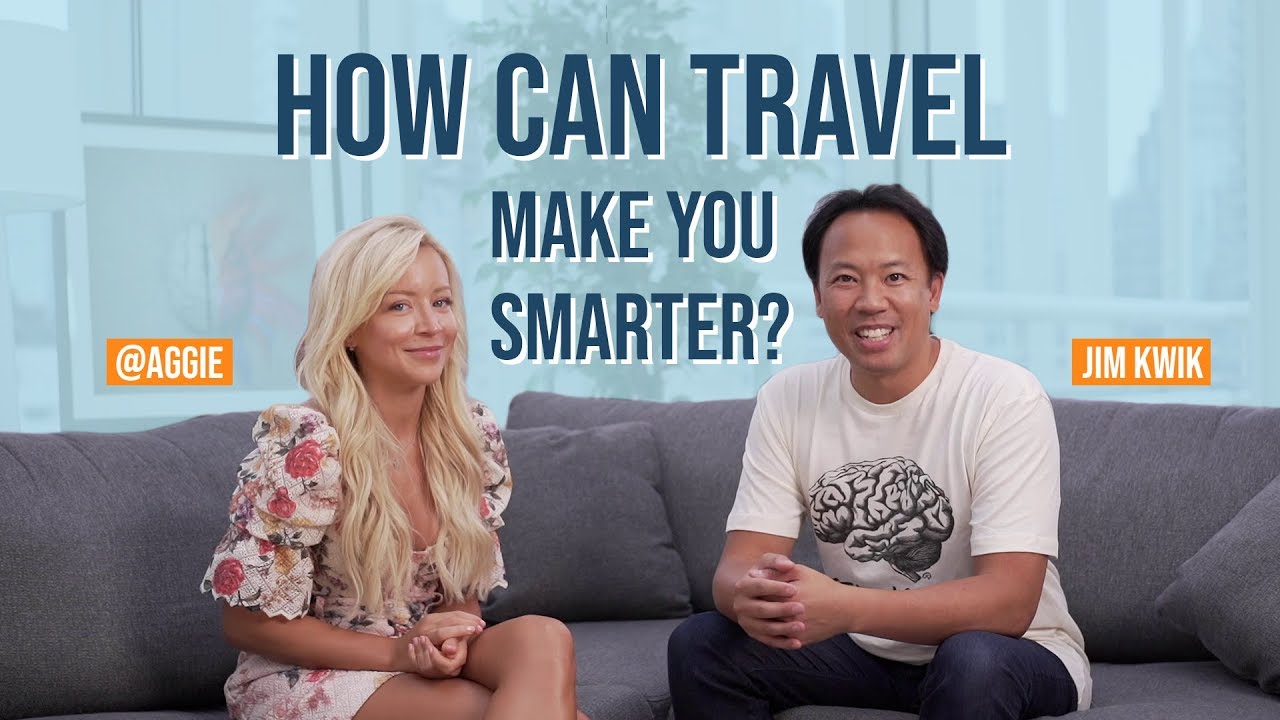
Travel forces your brain to build new neural pathways through novelty and language immersion. Aggie, a travel author, learned thought-management and resilience through solo sailing, and describes her "100-word challenge" per country. Even micro-trips and cheaper tickets can break routines and expand perspective.
Chapters
Welcome back, Kwik Brain. Here's your question of the day. How can travel make you smarter? How can it help you to build more brain power? And I'm excited about this conversation, especially because I love to travel. I didn't start traveling till I was later in life, but I have like the person who travels more than anyone I know, Aggie. And some of you follow her on social media already. And, you know, she's a travel influencer and she's an upcoming author. I can't wait for your book to come out with Random House.
Thank you so much.
So exciting. Thanks for being on the show.
Thank you for having me. I'm super, super honored. I'm a big fan, Jim. So, oh, this is amazing.
I know we did some things on social media together about learning languages, like learning more words every day when you're in different countries.
The 100-word challenge.
The 100-word challenge.
Yeah, per country. And it was really, really Successful among my community. And then when I stopped it this year, they're like, hey, Aggie, you're not doing the 100-word challenge anymore. I'm like, oh, I'm trying. It's been hard, and you have to really put a lot of effort, but you did give me some tips, so it was a little easier.
Amazing, amazing.
Musical, uh, classical music, right?
We talked about all the— well, maybe, uh, maybe we could do something together.
Yeah, that would be really, really helpful.
Link to this episode, um, learning languages as so, so powerful in terms of travel. So that, that's kind of an obvious one. But, you know, when you go to a country and you're deeply immersed, and you have to learn the language, I have— we have a friend, Quincy Jones, who speaks, who's spoken at our events, the famous music producer, and he says, you have to go to know, you have to go to know. I want to give some brain hacks around, around travel, like how travel could build your ability to learn. So I really think people should learn to travel and then travel to learn because today classrooms, they don't have 4 walls anymore. And so you were telling me when we met a while back, you were telling me about this incredible story. And I don't want to like, I want to start with this just to give people some context. This specific adventure, you were sailing.
Yes. Yes. So I was 25 years old. I lived in Sydney. And I hit a quarter-life crisis. I was like, surely there's more to life than just working a corporate job, which I had at that time. And I bought a boat on eBay, a sailboat on eBay.
On eBay?
From Mexico, 'cause that was like, sounds very, it sounded very legitimate. And we basically, my then partner and I flew from Australia to Mexico. We showed up, the boat needed a lot of work. I've never built, I've never been on a sailboat before ever in my life. Neither of us have ever sailed, but I was like, surely it can't be that hard. Yeah, the spoiler alert is it was super hard. And obviously, I underestimated how hard it is to sail. And it's dangerous. But that basically, that whole experience defined me. It was a year of being out in the ocean. The longest time I didn't see a single human or land was 54 days.
Wow.
And you're just totally by yourself with your thoughts. Which is— it teaches you—
So you had never sailed before?
Never.
And you're going from Mexico to Australia?
Yeah.
Okay.
Not a good idea. I do not— I don't recommend it to other people. But it was life-changing for me because, like, first of all, thought management. You have a lot of thoughts, you're stuck with them for the longest time, and you really have to be able to manage your brain because brain is your biggest enemy because it's the mental game, right? Like, you're in a storm and you have to believe you can do it. So From that perspective, I feel like it's trained me to see how powerful my brain is. And it really is up to me whether I can survive or not, just based on the fact how I feel about the experience, which is very different to how people— what usually people think that will make you smarter, of course. But I think there is this psychological part of brain that I owe to traveling, which is being resilient, being, yeah, being in control of my own thoughts. And my brain.
The brain is incredibly resilient, but it requires that challenge because with challenge comes change. And so I can't even imagine managing your mind for all those, all those weeks solo alone. You've never sailed before. And then so how did you control that? Did you have any doubt in your mind? Did you have negative thoughts?
Oh my God, constantly. I was like, okay, this is it. I'm gonna die. I've been in storms that, you know, some of the waves had like 25 Uh, they were 25 feet tall. And I was like, oh my God, that's it. Like, I've seen those waves in movies. Like, people don't get out of it alive. But I was just like, no, I can do it. I can do it. And then basically, I think the only way— every time I tell people what I did, the kind of storms I faced and survived with my lack of experience, with not having autopilot, satellite phone, nothing. And they said, it's a freaking miracle. And I'm like, yes, but it also The power of brain in telling myself every day, "I can't die here." Like this, like my brain can do this. I can. I think like genuinely the power of my subconscious mind has helped me make it through because I just believe that there is no other way. It's like I'm not dying here. Like no, I have to make it happen.
So and you had that certainty and that belief, and it came from within even when the environment didn't support you.
Yeah, and just. Weeding out the negative thoughts. They're obviously coming every day and there are no distractions. Like, turns out I have emotion sickness, seasickness, so I couldn't even read. I was puking up for like 3 weeks straight. I couldn't even read. There was no electronics, nothing. So it was just like, it's you and your brain. So I was meditating. I had out-of-the-body experiences meditating for an hour or 2. So that was really— I feel like this is the time of my life where I realized how powerful my brain is.
Right.
Because my idea of brain being powerful was like, remember 500 numbers, or like, you know, I studied business management at University of Sydney, and the smart kids were the ones who could remember the most, like memory-wise. So I wasn't familiar with this idea of the power of the brain being something I can use to survive or like to make my— give me hope. And that's just like, I love that part of the brain. That's just—
Now you're not recommending people sail across an ocean for months at a time. And if they've never done that and they're—
Definitely not. But definitely challenging yourself. 'Cause I feel like I've grown so much as a person and I've become so much smarter and more like more open-minded. And I think this is what travel, travel, traveling makes you question things. And I think I'm not a brain expert, but I feel like once you question, you become more intelligent because you don't assume and you don't think take things for granted. You don't— you start analyzing patterns and looking for your own way.
Right.
Yeah. And that kind of like perhaps creates connections.
You do create new pathways, 100%. You know, one of the ways of doing it actually is just through novelty. Novelty and nutrition.
Oh, that's me. I remember. Yeah.
So imagine your people are immersing themselves in new environments. And that's— people don't realize, um, when I mentioned Quincy Jones, he speaks about 23 languages. Now music has a different— it has an effect and enables part of that because music and musical centers and language centers. But also he says he travels so much because, again, that phrase, you have to go to know, because he has a deep appreciation for people and the individual cultures, language, art, The literature, the foods. I mean, it's full sensory experience.
Absolutely. And I find that it's just seeing how other people live or like trying to make sense of a situation where you don't understand the language. All of these things trigger your brain to, yeah, to like, to grow.
So it forces you to have that wonder and fascination because when there's something you don't understand, your brain needs that And tries to figure it out.
I personally, like, love traveling, and I always, like, I— if I'm any, any way remotely a cool person, I owe it to traveling because it has made me kind of more understanding because I just see that there is no right or wrong way to do things. I see everyone does things differently, and then I can just— I was able to form my own way of living and Live by design, not default. Because when I lived in Poland up until 19 years old, this is how you do things and this is normal. And then you go to another country, it's like, oh, this is— people do it completely differently. And then in the US, so I'm like, oh, actually, how do I want to live my life? And how do— what's the norm for me? And, you know, we live in a society where we think that speaking 2 languages is crazy. challenging, right? And most people in the US only speak one language, right? And then you hear Quincy Jones, 23 languages, and it's like, oh, that's abnormal, right? I'm like, you make the norm, right? So traveling opens you up to these— what is normal?
And you know that joke that, um, you know, what do you call somebody who speaks 2 languages? It's bilingual, right?
Oh yeah, yeah.
And you speak 3 languages is trilingual. What about one language? American. And it's— but it's a statement also. I could appreciate when you're saying when you go there, it gives you an appreciation because it's hard to judge somebody else when you're there with them. And you're on— because it's not just about, you know, when you talk about classrooms, it's not just walls, it's when you cross borders.
I cannot agree more. And I always have a little challenge that whenever I hear something really negative about a country, I'm like, okay, I want to go and experience it myself. Because most likely there's a lot of media, there's a lot of misunderstanding. So whenever I like, oh, when I went to Saudi Arabia or Jordan, countries like, you know, being right next to Syrian border, I'm like, I wanna understand how people, how is it really dangerous? Like, how do people live? What do they think about Americans? What is their perspective of what's going on? And every time I can't believe how different a perspective is to what we think is right. So again, it's just like, it still gets me that there's something that I didn't think about. Like, it's yet another angle to look at things. And that's exciting. I mean, I, like I said, I owe everything to traveling because I find that you just meet people, languages, different flavors. I mean, like even different smells that like, like, oh, I've never smelled this smell before. I've never eaten this salad. Like, there's always new recipe. There's always...
Right.
So, so much novelty in traveling that it just keeps me on my toes and keeps me wanting to grow and learn.
So what would your advice be to somebody who's listening or watching this right now? I know you talked about some of this in your TEDx talk, and we'll make sure we put a link in our, in our show notes for that because that's incredible. What advice would you give to somebody who, who hasn't traveled much because either they don't feel comfortable about it Or some people think that it's gonna cost a lot of money. And now you've, you didn't always start going to the most amazing resorts and—
No, I mean, just being super honest and direct, like I was super poor. I grew up in Poland, I made $1 an hour. I was like, surely I can figure this out. Surely I can find a way to travel. And I did, you know, so there, there are ways to find a cheaper ticket. You just have to be resourceful. And I think being resourceful, it's another thing that traveling teaches you. So my advice would be, A, be patient with yourself. I know you hear, uh, my story and you're like, well, I could never do that. I'm not a traveler. I'm a, I'm a tourist. I'm like, it doesn't matter. Whatever your comfort zone is, step out of that, you know, and go slowly but surely outside of it. Because to me, going to a 5-star resort, all-inclusive, not even learning a single word, not even connecting with locals— even if you do go to a 5-star resort and that's your wish and you like, I just wanna chill, talk to a local server or someone who works at the front desk and ask them 5 questions about their culture. Ask them to teach you a word, like try to order from the menu. I love actually traveling and seeing the menu 'cause I always compare 'cause they put it, the most resorts in both languages.
Mm-hmm.
So you can try to make out what means what. And yeah, even if you come back with a couple of recipes, like from Greece, I got back from Greece same as you and I was like, I was eating Greek salad in LA for breakfast, lunch, and dinner after I came back 'cause it's like, oh, it's so good.
So yeah.
I think just be open, right? And just embrace and take advantage of the value that travel can make you a smarter person.
And getting out of our own routine is useful in itself. They don't have to travel across the world. Some people haven't been— yeah, just across their community or their state, or even parts of their own city they haven't even explored.
Yeah. And I just realized, so now I travel a lot, so I kind of have forgot what it used to be like. But back in the day, I would— I had this grand idea of what I want to do in the morning. I'll wake up, you know, brush my teeth with my left hand, write down my dreams. You know, I was always a fan of Jim Kwik. So I was like, you know, journal, meditate, go to the gym. And then you start slacking off. And then I would go on a trip, and that was like a brand new start because I came back from a trip.
Mm-hmm.
And that was my excuse to break my bad routines, my bad patterns, because it's so much harder when you actually in the same routine to all of a sudden go to the gym. But when you're on a trip, make it, make it, make it a resolution. I want to change one thing about my morning when I come back. And it's so much easier when you're inspired from a new trip and a new place to add the one thing you always wanted to add to your morning, because you just come back so refreshed and your routine is gone. So you can create yourself from scratch. I love to do it all the time.
I love that, that you mentioned that, because sometimes our environment keeps us a certain way. It creates triggers for you. So when you do it, you go into this unconscious pattern. But when you go into a new environment, you could be conscious again and self-aware.
You are, and you definitely are. You start to pay attention to the things that you stopped paying attention to because that was your routine. So even though you can— I like, I always wanted to be, you know, the female Jim Kwik and do all these things. It's like life happens and you slack, right? But then when I traveled, I was like, oh cool, now I'm back to 5:30 wake-up call and I can I can do all these things because there is no routine anymore because I was gone for 2 weeks. I can just create myself all from scratch and it's amazing.
And people could do this again anytime at a meta level. People listening to this, they could take these little micro trips or micro travels, even if it's just a day or a couple days a day or even a weekend, to be able to do that and do it in a way that's affordable. But the benefit is huge.
I think so.
Yeah. I— here's the challenge for everybody, is to take a screenshot of this episode and tag Aggie. Where would they find you on Instagram?
@aggy. That's it.
That's perfect. And @jimkwik. And what I want you to do is to share your favorite place that you've ever been. And I would love for you to also share the place that you most want to go? What's on your personal emotional bucket list? So again, you're taking a screenshot of this, or you're taking a picture of yourself, or you're making a video. Tag Aggie, tag myself, and share with us the place— your favorite place that you've ever been and the place that you most want to go.
I'm very excited about this challenge because, yeah, I'm happy you learn so much about, uh, from other people about places. So Yes. Can't wait.
Places is so important also to human memory. We remember things, places we go. So I'm looking forward to seeing your, your very favorite places. And as always, I'll repost some of my, some of my most inspiring favorites that I see there. And then we have a very special gift that we'll send out to a handful of you also this week. Thanks for being on the show, Aggie.
Thank you for having me. My pleasure. See you somewhere around the world, Jim.
More from Jim





The Library of Minds: Brain Coach: How to Stay Sharp When AI Does the Thinking | Jim Kwik





