How to Be More Creative | Jim Kwik
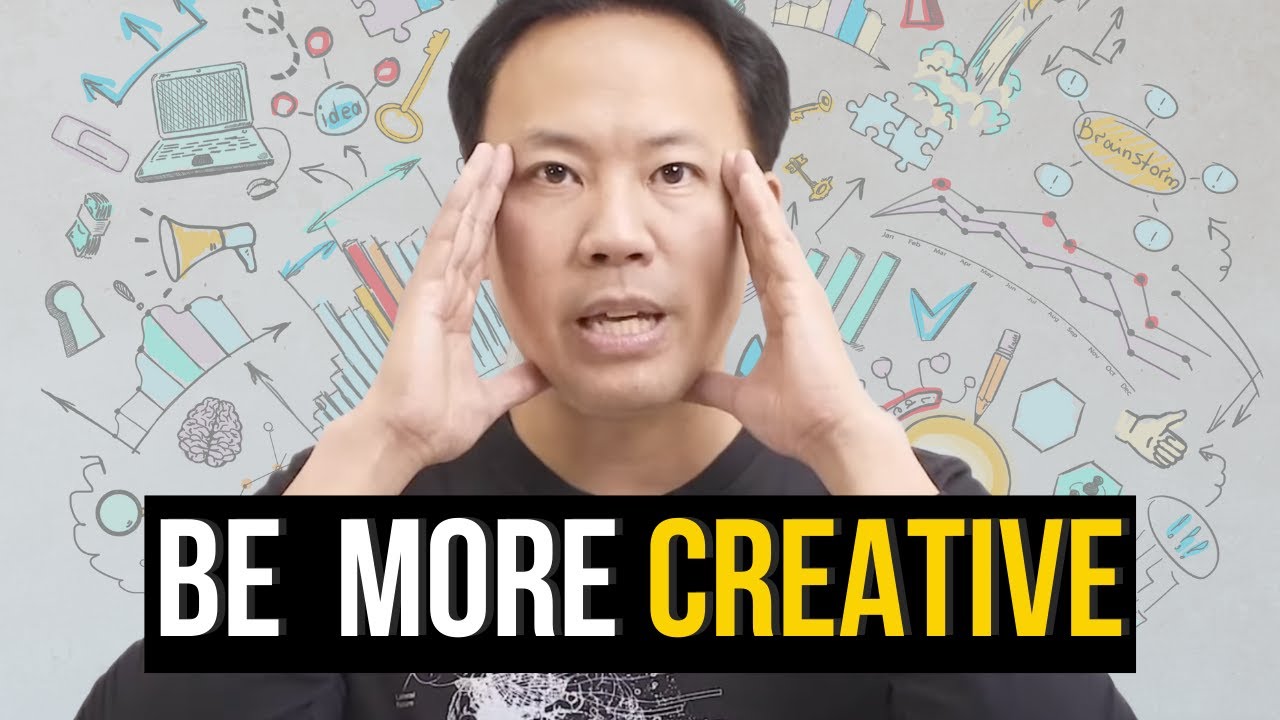
Jim Kwik argues creativity is a learnable skill, not a fixed trait. He maps brainwave states to creative practices: alpha for passive learning, theta during showers for breakthrough ideas, and delta dreams for problem-solving. Start with one habit: journal first thing, avoid your phone's first hour, or schedule dedicated creative time.
Chapters
I'm your brain coach, Jim Kwik, and in this session, we are going to unlock your creativity. How can you be more creative? And now when I say this word, some people think like, oh, I'm not creative, I'm very logical, I don't have creativity. You do not have creativity, it's something that you do. Just like you do not have motivation, you do not have energy, you do not have focus, you wake up and hope that you have these things, it's actually something you do. So it's about taking a noun and turning it into a verb, that you don't have to wake up and hope you're creative. There are specific things you could do to become more creative, and I'm gonna talk about some of those in this lesson. Now, the first place I wanna start is the power of questions, that questions are the answer. I find being around a lot of creatives that creatives ask different questions, and because they ask different questions, they get different answers. The whole point of creativity is to create something new, and so if you ask a question nobody's ever asked before, you're gonna get an answer no one's ever gotten before. So I want to start with the power of questions. What are the questions you're asking yourself to be more creative? Now, what are the benefits, first of all, of being more creative? Maybe you're a blogger. Maybe you need to make videos. Maybe you want to be able to write music. Maybe you want to express yourself in new ways. I believe the future belongs to the creatives. In a world where everything's being outsourced to machines, to automation, to artificial intelligence, what's not going to be outsourced is our creativity, our imagination. Yet it's not taught in school. It's kind of interesting. You can't go to somebody and say, be more creative. It's like going to someone again saying, Play the violin to somebody who's never taken a lesson on how to play the violin. Same thing with creativity. Now it's interesting because we've already discussed that children naturally are creative. All the children raise their hands when you say, who's an artist here? A whole room full of kids will raise their hand because they feel creative because they're not limited by the expectations and the opinions of other people. They're not scared of making mistakes. When we're talking about being creative, remember, creativity is a state of mind. It's actually a state. We talked about all learning is state-dependent, all thinking is state-dependent, well, creativity is state-dependent. When you cultivate play, we talked about the power of play and how children learn musical instruments and languages. They make fun of people's names, that's how they learn names. I don't know if your name was made fun of. My last name is Kwik, I got a lot of slack for having that name all the time growing up because that's how kids remember things. They are very playful. And again, Learning is a state of mind, and so is creativity. State— all learning is state-dependent. The power of questions. In fact, another great book, and I recommend a lot of books, The Structure of Scientific Revolution. The Structure of Scientific Revolution, wonderful book. It's pretty dense, but the big idea is this: that most creativity and innovation in industries usually come from somebody outside the industry. Let me say that again. Most innovation, creative ideas in an industry comes from people outside the industry because you have to have different points of view, a different perspective. Being outside of an industry, let's say you're an Elon Musk looking at the automotive industry, you're saying, wow, you're asking a different question. If I was to create a car today with today's existing technology, how would I do it now? Right? You're asking a different question, you're getting a different answer. Now, the reason why so much innovation comes from outside the industry, whether it's fashion, automotive, any kind of technology, is because if you grow up in an industry, you're also learning the same limitations in that industry. So it takes somebody from the outside to look inside with a fresh perspective. So let's talk about your brainwave states. You start at beta. Right now you're in beta state. It's the fastest moving state, right? You're most If you were being measured on an EEG, this is the beta state, that's the awake state. Now, the slowest one is the delta state. The delta state is where you're asleep, you're fast asleep, so it slows down. In between those states, you have 2 states that I wanna talk about. One is the alpha state. The alpha state is right below the beta state. The alpha state, I would describe as the relaxed state of awareness. relaxed state of awareness. When you're in this state, your critical mind is set aside and you're just absorbing information. The alpha state is a wonderful state to accelerate your learning. If you want to learn facts, figures, foreign languages faster, in our programs when we teach memory training and speed reading, we train you to get into that alpha state of awareness. It's where your critical mind is set aside and you're just absorbing information. You know what puts you in alpha state? Television. Television programming puts you into an alpha state, and it's really hypnotic. It's interesting because it's called television programming because your critical mind is set aside and you're just absorbing whatever's going on. And you might know this if you've talked to somebody, you're trying to have a conversation with somebody who's watching television, they're watching sports or they're really into their show, and they don't hear you. And they're trying to talk to you, but they don't hear you because they're so entranced with the television. That's an alpha state. It's a wonderful state to learn facts and figures and foreign languages again, because your critical mind, which can't handle a lot consciously, is set aside and you're unconsciously absorbing it, right? In fact, most of your learning was done in an alpha state where you didn't try to learn these things. Like, think about how many songs you know. How many lyrics to songs do you know? Hundreds, right? How many did you sit down and actually study with flashcards and outlines? None of them, right? You learned unconsciously. So unconsciously, you're a genius. But it's about getting into that alpha state. Now, below the alpha state is the state of theta. Theta. It's right below the alpha and right above delta. The theta state is that state you're in and out of sleep. You know that state when you first wake up and you're very creative? When you first wake up, you have all of these ideas. In fact, when I was talking about Albert Einstein doing this visualization, he would do these thought experiments and he would imagine himself doing these thought experiments, you know, sitting on a beam of light going towards the clock. But while he was doing that, he would hold a rock in his hand. He'd be on his rocking chair holding a rock. Now, why would he hold a rock? Because he didn't want to fall asleep. He wanted to be right on that brink to help him be really, really creative, because if he fell asleep, he would stop, like, being creative, right? And so he would drop the rock and it would wake him up, and that's why he held that rock. Now, that theta state is a great state to promote creativity. You know what puts you into a theta state? Taking showers. Have you ever noticed that when you're taking a shower, you just have all of your ideas? It's always when you can't write something down. That's why we train you to improve your memory, right? So in the shower, that water puts you in a state of creativity. It puts you in such a relaxed state, you have all these ideas bubble up. I took 6 showers this morning before I got on camera to make this video for you so I could be most creative and serve you in the biggest way. possible. All right, so you could engineer that theta state, and one of the ways of doing it is when you first wake up in the morning, have a journal by your bed to write things down, because another way to tap your creativity is in this delta space, and when you're fast asleep. Now, how specifically? It's when you're dreaming. When you're dreaming, you are extremely creative. Now, this is what I mean. When you're working all day or you're studying all day at school, Your brain doesn't shut off at night. A lot of people think it does, but if anything, it's more active at night. And what is it doing? It's consolidating short to long-term memory. It's trying to solve the problems of the day, come up with new solutions. But the challenge is you don't remember those things first thing in the morning. So you want to train yourself to be sensitized to your dreams. Let me give you an idea right now. Have you ever had to wake up the next morning, specifically very early, uniquely, like you had to catch a plane or you had an early meeting that you had to get to and you You set the alarm and you're like, oh, 4:30, 5 o'clock, and you kind of thought about it a bunch, and then you woke up 2 minutes before your alarm went off? Have you ever had that experience? Now, that's the power of your mind. You just programmed your mind to wake up within seconds or minutes of when you had the intention. What if you use that incredible power to set an intention to solve some big problems in your life? Before you go to bed, what if instead of obsessing, just as you obsessed about a specific time to wake up, What if you thought, wow, how can I solve this specific problem? Or how can I be more creative in this way? And have your dreams come up with the solutions. You know, while you're sleeping, we probably spend about 20 years of our lifetime sleeping, 3 to 5 years dreaming. 3 to 5 years dreaming. Do you realize some of the most creative inventions, works of art, literature, music came from dream states? Do you know Mary Shelley came up with Frankenstein in her dream? Do you know Paul McCartney came up with the song Yesterday in his dream? Elias Howe, who was an inventor, came up with the sewing machine in his dream. A chemist dreamed of the framework of the periodic table. It came from a dream. So what can you program your mind before you go to bed to be more creative? And again, creativity could come out in any kind of expression. It could be writing, it could be videos, it could be music, or it could be just solving a problem, having a creativity mindset to come about a new problem, to be able to approach a new problem in a new way, come up with a 3rd or 4th kind of solution. So another thing you could do is set an intention before you go to bed, dream about it, and then write it down, especially first thing in the morning. When you wake up in the morning, you're in that theta state, you're most creative. Set your intention for What do I want to achieve for today? What do I want to create today? That first hour of the day. What you don't want to do is pick up your phone, because what that does is it forces you to be distracted. It forces you to be reactive. It puts you on the defense. You want to do this pre-input. You don't want to input information for that first hour of the day by watching social media and cat videos and everything. You're in your most creative space. You want to come up with the information, the creative parts in your mind, and express it. And express it in the power of journaling. So these are just some of the ideas to help you become creative. My point in saying these things is there's no one way, and it's not somebody's creative and somebody's not creative. Yet another way of being creative is taking walks. A lot of the most creative individuals, whether Steve Jobs or Bill Gates, they no longer do these sit-down meetings. They didn't talk about doing these sit-down meetings. They would walk around with They are a team. They would walk out in nature, 'cause nature is a great way to promote creativity, getting fresh air and new perspectives, 'cause as your body moves, your brain grooves. And so to be more creative, take a walk and come up with some wonderful ideas. Set up some white space. Schedule your creative time. My main message for you is this: there's no such thing as a creative person and an uncreative person. In this session, we listed probably a dozen different ways you could tap into more of your creative potential. What I want you to do now is be creative. I want you in the comments list one thing you could do to cultivate more creativity in your life. What's one thing you could do, one idea, either in a routine or something you could do like we talked about, taking a walk, exploring float tank meditation, something that will get you into your mind and tap the incredible potential of your creativity. It is literally the only infinite resource we have on planet Earth. The only infinite resource we have is our creative potential, our imagination. There are no limits to the creative mind, and the future belongs to the creatives. I hope you enjoyed this lesson. I'm your brain coach, Jim Kwik, and I'll see you in our next session.
More from Jim





The Library of Minds: Brain Coach: How to Stay Sharp When AI Does the Thinking | Jim Kwik





