How to Control Your Emotions (& Benefit from Negative Ones) | Ethan Kross
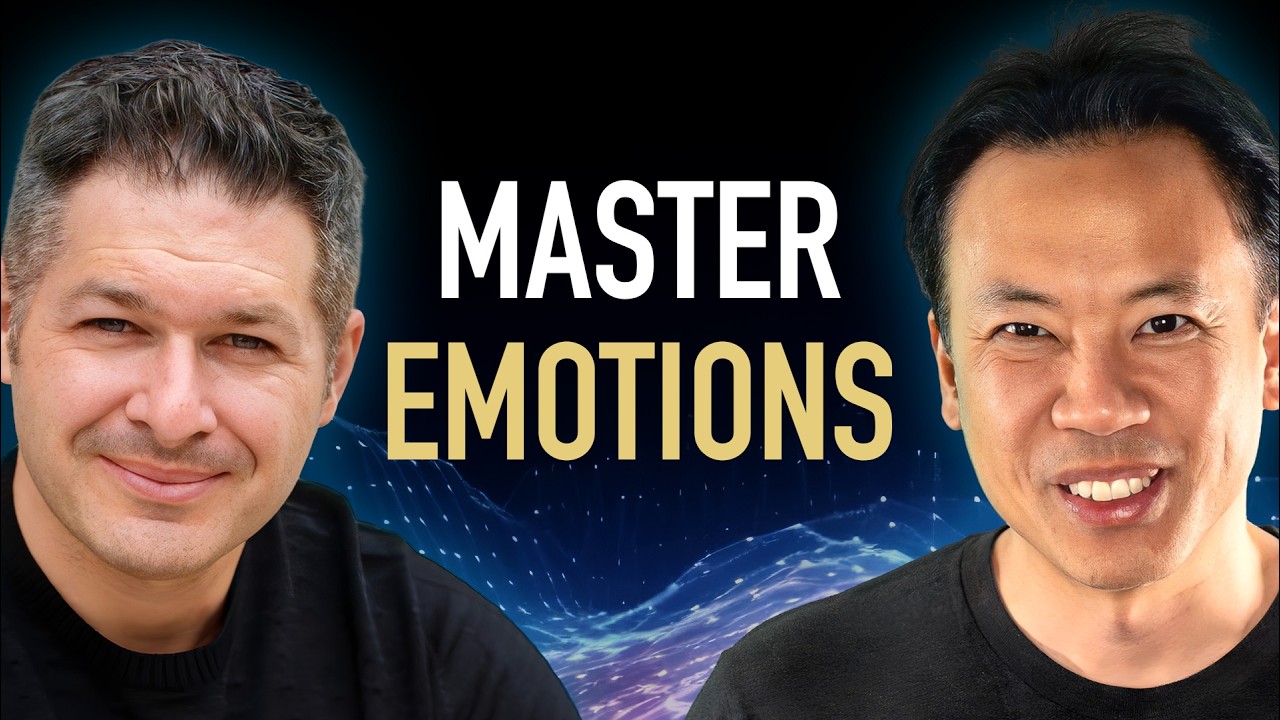
In this interview, Jim Kwik hosts psychologist Ethan Kross, author of Shift, to discuss the science of emotion regulation. Kross explains that emotions are functional tools that, when experienced in the right proportion, guide behavior and decision‑making. He outlines why managing emotions matters for performance, relationships, health, and overall wellbeing. The conversation introduces a practical toolbox: (1) perspective‑broadening shifters such as distanced self‑talk, (2) mental time travel (future‑oriented and past‑oriented reflections), and (3) sensory cues like music, touch, and smell. Kross emphasizes strategic flexibility—moving between approach and avoidance rather than adhering to a single rule—and debunks common myths (e.g., “no bad emotions,” “always stay in the moment,” “one‑size‑fits‑all solutions”). He shares findings from a large COVID‑era study of 18 emotion‑regulation tools, highlighting individual differences and the need for self‑experimentation. The interview closes with resources (the book Shift, Kross’s website, and social media) and a call for listeners to try these low‑effort, evidence‑based techniques.
Chapters
A 2020 report found that approximately 1 in 8 adults in America took an antidepressant every day to manage their emotions.
You don't have to choose between only approaching or only avoiding. You can move back and forth.
Meanwhile, people who are, are good at managing their emotions are less lonely. They maintain more fulfilling social relationships and are more satisfied with their lives. They experience fewer financial hardships, commit less crimes and perform better at school and at work.
Your emotions get triggered, they elevate, and then as time goes on, they eventually fade.
How do you manage your emotions so that they don't manage you?
There are no one-size-fits-all solutions when it comes to managing our emotions. Different tools work for different people.
Is there a quick, practical tool that you recommend for managing such moments in a very high-stress Situation or environment.
All of our emotions, even the ones we call bad emotions, are functional. They are useful when they are activated in the right proportions.
Welcome back, Kwik Brains. I am your host and your brain coach, Jim Kwik. Today, we'll be learning how to understand your emotions, what they are, why they matter, And most importantly, how to harness them. Our emotions, both the positive and the negative ones, they are tools that we use to navigate the world. They influence who we fall in love with and who we dislike. They motivate us to stay longer hours at work to realize our dreams, and they are often the difference maker when it comes to sustaining close bonds with others or becoming Mired in relationships fraught with conflict, and yet for all their profound impact on our lives, few of us receive a science-based guide for how to turn the volume on our emotions either up or down, or how to transition gracefully from one emotional state to another. Our guest Ethan Cross is one of the leading experts on emotional regulation. He is an award-winning professor at the University of Michigan. Michigan's top-ranked psychology department and its Ross School of Business. He is also the director of the Emotion and Self-Control Laboratory and has participated in policy discussions at the White House. He is the author of Shift, which if you're watching this on YouTube, where you could watch the extended version of this interview, Managing Your Emotions So They Don't Manage You. Welcome to the show, Ethan.
Thanks for having me, Jim. Ben, thanks for that lovely, lovely introduction.
Why don't we start here? Why don't we define what are emotions and why, from your perspective, are they often difficult to manage?
So emotions, you could think of them as these responses that are triggered when we encounter events in the world or we imagine events in our minds that are meaningful to us. And it's almost like when we encounter such events, it's like a software program gets loaded up in our brains to help us ideally manage that circumstance. And so when we use the term emotion, we're actually talking about a coordinated set of responses, a loosely coordinated set of responses. Things are happening in your body. Your thoughts may be tuned to certain kinds of information and And you actually feel a particular way and maybe have an expression on your face. All of those different parts of this emotional response are designed to help us navigate the situations we find ourselves in optimally. And so let me make that super concrete because that's a little abstract. Let's say, let's say I'm experiencing an emotion of anger. We experience anger when our view of the world Is is transgressed, right? This isn't the way things are supposed to be, and there's an opportunity that you can do something to fix the situation. When we register that circumstance, we have this anger response, right? We we get energized. Our attention zooms in on the problem at hand. We can often see the anger in someone else's faces, which is providing other people information. And that can sometimes be very helpful when it's activated in the right proportions. Not too intense, not too long. What might be a situation which is as useful? I'm a parent. I want my kids to be safe. If I see my kids do something that is dangerous, I'm going to feel this emotion, right? If I see my young daughter ride her bike without a helmet, that's a no-no in our house. I'm going to experience this emotion of anger. It's going to motivate me to approach the situation. confront my daughter, deal with it. She's going to see on my face that I am experiencing this state, and that's going to provide info to her to change the way that she's behaving. Now, whether or not that happens, that's another story. But that's just one example of how what we typically call a negative emotion can actually be functional. And I am of the belief that all of our emotions, Even the ones we call bad emotions are functional. They are useful when they are activated in the right proportions. That's hopefully a message that listeners find liberating, right? Because we often hear you should strive to live a life free of all negative emotions. Like, number one, good luck. It's not the way that we are built. We are built to experience those emotions for a reason. And it's often helping you out, Jim. If I think about the times in my career, I do a lot of public speaking like you do. And if I think back to the times when a presentation didn't land as well as the other ones, when wasn't it an A+ magical experience? It tended to be the times when I didn't feel any anxiety beforehand. As a result, there was no— there were no cues inside me to Essentially say, hey, dopey, focus on this so you can prepare, practice, right? So a little bit of that anxiety, really useful. Now, too much of it, that's the topic of my book Shift, because oftentimes these very helpful responses, they become unhelpful because emotions are unwieldy tools. We often experience them out of proportions and with the situation we're in. And when that happens, Then the question is, what do you do about it? And the good news is there are lots and lots of things you can do. Um, and scientists like myself have spent our career trying to identify what those things are.
And we'll definitely unpack a few of those here. And I highly recommend people get their copy of Shift. Um, maybe we could start by, could you share the, so what would you distill as the core idea behind Shift? And why, for our listeners, is it crucial for them to learn how to manage their emotions more effectively?
Well, the crucial idea behind Shift is that, number one, all of our emotions are useful. They're tools when they're activated in the right proportions. But as we all know from being human beings on this planet, oftentimes our emotions get the best of us. And we evolved a remarkable set of tools to help us in those situations, but we don't get a user's guide for how to implement those tools in our life. And so what Shift intends to do is provide readers with that science-based accessible user's guide. So you don't have to wait to stumble on a solution when you find yourself spinning, so to speak.
Hmm.
You can be super strategic and deliberate about what tools to bring in To the fold when you're struggling. People often ask me, as an expert on emotion regulation, do I ever, do I ever become emotional or get triggered in some way? And my response is typically to pause. And I say, yeah, of course, I'm a human being. We all do at times. What I'm really good at though, is the, I can, the moment I find myself spinning in a direction I don't want to be spinning. Towards, I know exactly what to do. I've got, I've got different plans, different little mini interventions. There are 2 or 3 tools I'll use for 3 quarters of the situations I find myself in, which quickly bring the temperature down on my emotions. For the other ones, I may go deeper into my toolbox. And then a few, and then the really unique moments in life may, may take a little bit more extra hard work, but I'm never. Stumbling, right? I'm always highly strategic. And that is the— my hope with this book is that we can give people those tools while also shattering some myths about emotion regulation that are pervasive and potentially damaging. Um, so that's the goal. Why is this important? Because number one, we are an emotional species. There's this wonderful research I talk about in my book that that tried to index how much time during the day when you're awake are you experiencing an emotion. And the researchers found about 90% of the time that people are awake, they are feeling something.
Wow.
This is, this is part of who we are as a species. We are constantly feeling different kinds of emotional responses. And the research compellingly shows that your ability to manage those emotions, to increase or decrease their intensity, to lengthen or shorten their duration, or even to shift from one emotion to another, that capacity predicts outcomes in life that all of us care a great deal about. It is directly relevant to your ability to think and perform. It predicts the quality of your interpersonal relationships, and it has direct implications for not just your Subjective wellbeing, which is critically important, but also your physical health. So if we just stop right there, we're talking about thinking and performance, relationships, health and wellbeing. These are the areas of life that I think I can uncontroversially state make life worth living, that all of us are striving to excel at. And your ability to manage your emotions Has implications, really important ones, for all of them. So if you care about those life domains, you have to care about managing your emotions. You have to care about managing your emotions.
And speaking to our students, who many, many of our listeners have gone through our courses and read Limitless, it's, uh, for, for learning, one of the keys to learning is, is all learning is state dependent. And you'll notice Dr. Kross mentioned frequency, duration, intensity, you know, as we do in memory training. Um, you introduce a number of science-based strategies, uh, for managing emotions in, in your book. When someone's spinning, or which, which, which technique or tool do you find most people are surprised by in terms of effectiveness? Or do you have a default in terms of where you, your go-to?
Well, I have a default, and let me tell you about my default, and then I'll tell you about some, some findings that people may find, um, surprising. And then if we have time, Jim, I'd love to circle back to some research we just finished performing where we actually taught thousands of students about these emotion management tools and looked at the implications that that had causally in the context of a randomized trial on achievement. And the results are really interesting. So I have a default set of Responses when I find myself needing to manage my emotions. The first thing I do is I use a set of what I call perspective broadening shifters. When we get stuck in an emotional state, we often zoom in really narrowly and we focus on the features of the situation that are driving that emotional response. Oh my God, what happened? Or what if this happens? And when we focus in on those provocative features of the situation, It perpetuates our emotional response. And as a result, it can sometimes be really hard for us to just change the way we think about our circumstances. People often say, why don't you just look on the bright side? Change the way you think. Like, yeah, that sounds really great, but easier said than done. Sometimes it's not so easy to reframe how we're thinking. One of the hacks, if you will, for helping people reframe what they're going through is to change their perspective. And there are lots of different ways you could do this, and some of them are really simple. So the first thing I'll do is I'll use a tool called distanced self-talk. Jim, I'm going to guess— I don't know you very well. I hope to get to know you more in the future, but I'm going to guess you've probably had this following experience where you have found it at times in your life easier to give advice to other people than to follow that advice to yourself. Is that a fair assumption to make?
Sure. Yeah, I would imagine a lot of people could relate to that.
This is close to a universal experience we have, right? We can often dole it out, give really great advice to other people who are struggling with big problems, but when we are mired in the problem, much, much more challenging to wade through it. Well, you can harness that feature of how people work to your benefit. Distance self-talk is a way to do it. I will silently try to coach myself through a problem and give myself advice. Using my name and you. So I might think to myself, Ethan, how are you going to manage this situation? What using those parts of speech does is it shifts your perspective. Most of the time that we use the word you, it's when we're thinking about or referring to someone else. That word is the verbal equivalent of pointing a finger. So when you use that word or your name to refer to yourself, It's putting you in this mode of thinking about another person altogether. And that makes it much easier for us to wisely and objectively work through our problems. Also happens to be one of the most effortless tools that we possess. Not very hard for people to do that. So that's the first tool I'll kick into high gear.
And you feel like you're more at a distance, like you're less associated. With it, and it's not as— you're not seeing it from your own point of view or perspective.
That's exactly right. And often what we need to do, what we find is really useful, is just this ability to just take a little bit of a step back, puts things in a new light, makes it easier to handle the circumstance. That's what distant self-talk helps you do. I'll then layer on another set of tools that I call mental time travel. First thing I'll typically do is travel into the future, and I'll, and I'll still talk to myself using my name and you to do this. All right, Ethan, how are you going to feel about this next week, next month, next year? I, just like you, Jim, have lived through millions of emotional episodes over the course of my existence on this planet. And what's interesting about those episodes, almost all of them, follow a specific time course. Your emotions get triggered, they elevate, and then as time goes on, they eventually fade. Even lots of the big things in life, right? As time goes on, they gradually fade in their intensity. There are always exceptions to this rule, chronic conditions that we may be dealing with, but most of the emotional experiences we have follow that logic. We lose sight of that. In the heat of the moment when we're struggling with our anxiety and our sadness and our anger, jumping into the mental time travel machine and asking ourselves, how are you going to feel about this next week, next month, next year, automatically makes accessible the idea that as bad as what you're going through is, it will eventually get better. That further helps turn the volume on our, on our emotions down, making them more manageable. Sometimes, Jim, I will, I will wake up. I don't know if this ever happens to you. I suspect it may not happen to you. As much as it happens to me. I'll wake up on a Monday morning, I'll look at my calendar, and I'll instantly be overwhelmed. I just see meetings from the morning till the evening. And sometimes these are big things that I have to do, different kinds of preparation for each one. And if I were to hyperfocus on a day or two, it could very easily overwhelm me. But instead, I jump into this mental time travel machine and I ask myself, How am I going to feel Friday at 5? I know with 100% certainty, 100%, and that is not me being hyperbolic, that no matter what happens during this week, Friday at 5:00 PM will come.
Right.
I'm convinced the world will not implode before then, I suppose. But I have pretty good reason to not believe— pretty good reason to believe that that's not likely to happen. And that just turns the volume down. That's mental time travel. So the last thing I'll mention is I can also jump into this mental time travel machine and go into the past. And that's also really useful for me for shifting my perspective, but it works a little different. If I'm struggling with a problem, I'll go back in time and I might think, how have I dealt with other kinds of circumstances like this in the past? Or sometimes I'll, I'll go further back in time and I'll go hang out with my grandparents. During World War II. So I tell a story about this in my book. My grandparents, their, their family was slaughtered during the Holocaust, and they spent some time just, you know, fleeing from the Nazis in the woods. Sometimes I'll go back and hang out with them in my head. And what that does is it really puts my experience in perspective because I may be worrying or sad about something really legitimate, but it almost always pales in comparison to what my grandparents dealt with. And so that kind of perspective broadening also can be helpful. And I think we all have those experiences in our lives that we can anchor on, or experiences in society that we can anchor on to help us. So that's my initial kind of default response to dealing with provocations that trigger me emotionally. Usually that's all I need to do to get back on track. Sometimes I'll go a little bit deeper in the toolbox, but, but that's the go-to.
And how remarkable it is for, I mean, we hear a lot about time management, not as much about state management or, or mind management. How remarkable is it that we could represent time and space different and it affects how we, how, how we feel? We hear a lot about Integrating emotions, processing emotions, or being present, you know, being in the moment. Is there ever a time where avoiding our emotions and not being in the moment ever works out well in our favor? And if so, like, how do we know when to express and when to suppress?
Yes. One thing that I would love for readers to come out of this experience with the book being aware of is there are several— there are seldom simple one-size-fits-all solutions for managing emotions. And the idea that you should always be in the moment or never avoid your emotions, this is just not what the data support, and it's not how we are wired. We evolved to not be in the moment for a reason that often serves us really, really well. Like, one way we learn from the past so we don't repeat errors in the future. Oftentimes, wonderful things can come from savoring past experiences or anticipating, fantasizing about the positive future. That gives me my life great meaning and helps me achieve my emotion management goals to be happier. It's true. Sometimes we go into the past or the future and we, our mental time travel machine breaks down. We ruminate and worry. When that happens, you can refocus on the present and that is useful for some people some of the time. But there are also lots of other things you could do. And I just showed you, we just talked about 2 other ways that you can mental time travel to help you, right? I'm talking about going into the future, not being in the present. See, How am I going to feel about this next year? Or going back in time to think about how, you know, how does what I'm dealing with compare to what my grandparents dealt with? So mental time travel is a flexible tool. And I think becoming proficient in how we utilize that tool across the board goes far beyond simply learning how to be in the moment. That's one way to use it. Lots of other things you can do. Avoidance is a great question that you're asking about because One of the most common messages I hear is that you should never avoid things that are bugging you. And indeed, that was a message that I was exposed to growing up. I was raised to always deal with the problem as soon as it happens, confront it, work through it, move on. Uh, I got to graduate school, heard the same thing, right? Avoidance is bad. Turns out it's not that simple. So there's been research on this, and yes, it is true that chronically avoiding problems is linked with negative outcomes consistently, and there's a large literature on that. What I'm saying with chronic avoidance is you've got a rule. Every time you are provoked or triggered in some way, you're just going to not think about it, and you're going to maintain that avoidant response across the board. This is not good. It is also not good to try to distract yourself by Engaging in risky behaviors or taking illicit substances tends not to work out well for people when they do that. But being strategic in how you approach and avoid can be really useful, right? So you don't have to choose between only approaching or only avoiding. You can move back and forth. And I, and I must confess, Jim, uh, I was late in the game to embrace this in my own life. And has really made a difference. So because of the way I was raised, when I get confronted with information directly or in an email, I'll typically want to approach the situation and deal with it. What I've learned is sometimes taking some time away, distracting myself, avoiding that issue for a few hours or even a few days, and then coming back to it can be remarkably useful. Sometimes I take the time away. When I come back to the problem, I realize there is no problem, right? It just— this was insignificant in the grand scheme of things, and the passage of time helped me realize that. In other situations, I'll take some time away, I'll avoid, and then when I come back to the problem, I'll find that it's still there, but it's not quite as intense, and I have a different perspective when I approach it, and I can engage more productively with this problem. That is being strategic in how I approach and avoid. Now, there's an art to figuring out when you should approach and when you should avoid. If you find, for example, that, um, your attempts to avoid, you keep on getting these recurring thoughts compelling you to want to approach a situation, that means either you're not engaging in an immersive distractor, but you might need to actually deal with the situation at hand if you can't actually get away with it for a specific period of time. The flip side, though, is also true. If you find that trying to work through the problem, you're not making any progress, you just continue to turn it over and over in your minds in ways that make the problem grow and feel even worse, that might be a cue to avoid for a little while or engage in another kind of strategy. And I break down a few others. There's a kind of like a decision tree that follows when to approach, when to avoid, when to go back and forth in the book.
Yeah, this is really underscoring the importance of cognitive and emotional flexibility. Absolutely. For those that are listening that are in high-performance roles, emotional spikes are often part of their job. Maybe it's one that you've already mentioned, but is there a quick practical tool that you recommend for managing such moments in a very high-stress situation or environment? Do you want to be able to remember confidently the information that you hear on this podcast? Do you want to improve your memory to easily and confidently be able to remember names and faces, client information, give a speech without notes, learn another language, remember what you read, and so much more. There's a solution, and I call it your quick recall. In just 15 minutes a day for 30 days, I've designed the ultimate course, How to Unlock Your Quick Recall. Just go to kwikbrain.com/quickrecall. Enter podcast15 for your immediate discount as a thank you for listening to our show.
Yes and no. And so I'll offer you the yes from my own life, but I'll preface it by saying, Jim, we just finished this massive study that we did on how people manage their emotions during COVID We just published this. And what was so interesting about the study is we track people's emotional reactions each day. And we tried to see which of the 18 different tools— they could use up to 18 different tools each day— which ones predicted the best outcomes. What we found was there was this beautiful complexity to people's emotion regulatory lives. Different combinations of tools worked for different people each day. And so the no one-size-fits-all solutions applies here. The things that work for me They're different from the things that work for my wife, and I'd bet they're different from the ones that work for you, which is why the real challenge I think we face is, A, identify the tools that are out there. They're not hard to use. You just need to know what they are. And then B, start self-experimenting to find the optimal solutions that work best for you given your unique emotional life. But for me, in a high-performance context, and I sometimes operate in those, My senses are super powerful shifters of emotion. I think we often underestimate the senses. So sight, sound, touch, smell, hearing are the major ones. You could think about your sensory system akin to having these satellite dishes mounted all over your body. And the, the, the function of those satellite dishes is to, is to take in information about the world around you so that you know how to navigate that world well. And a one big part of understanding how to navigate the world is to find things that you can approach and stay away from things that you can avoid. So part of how sensation works is through emotion. Sensation is tightly linked to emotion, which will come as no surprise to anyone who's listening when they think about how sometimes you bite into something and the taste immediately elicits A positive reaction. Sometimes it elicits a really negative one. You can harness your senses to help you manage your emotions. And in my review of the literature and in my experience talking to people, this is a tremendously underutilized set of tools. Take music as an example. If you ask people, hey, why do you listen to music? Close to 100% of people that are asked that question will say, I like the way it makes me feel. I like the impact, in other words, it is having on me emotionally. But then if you look at what tools do people use when they're struggling with their emotions, when they're angry, when they're anxious, when they're sad, we've done studies on this. We ask people, hey, the last time you were angry or anxious or sad, what did you do? Only between 10 and 30% of participants avail themselves of this tool that very quickly pushes our emotions in a direction we want. And so I, I, once again, I was guilty of not availing myself of this tool until I knew about this research, right? I would just happen to be the case that sometimes my playlist would put on a song that made me feel good, but I was never really strategic about it. Now that I know how this works, I don't look at my iPhone the same way. I now think about this as like an emotion regulation device because when I need to get lifted up, I know exactly what 3 or 4 songs to put to play. When I need to calm down, I know exactly what 5 or 6 songs to put on there. And, and it, it can, it just works. It's a quick shift. And sometimes That is what we need, right? It's not going to be super long-lasting, but sometimes it's that quick, quick shift in a different direction. That's what we need to perform the task or use another set of tools. So think about your senses as tools you can use to manage yourself. And, you know, all the senses function in this way. Touch is a powerful tool with the right people. Obviously, you don't want to go haphazardly touching strangers, but Amongst loved ones and people you care about, and affection and embrace can be a powerful regulator of our emotions. Smell. I mean, why do people wear perfume and cologne? Their impact, they're using those substances to manage the way other people feel about them and even how they feel about themselves. And so, so that's one, one kind of hidden in plain sight tool that folks in high-performance contexts can utilize.
Is there a common misconception about emotional control or emotional regulation that you would like our listeners— that you would like to debunk for our audience? And what should our listeners remember about the true nature of mastering or at least managing their emotions?
I'm going to rattle off for you a few misconceptions, and I'm going to warn you, Jim, I get excited, I get worked up when I'm talking about these. So, so Just prepare. Um, you know, um, it's just such a, there's such an opportunity in sharing these misconceptions with folks to improve our collective emotional literacy, which I think has the potential to just be so useful and enriching for everyone's lives. So number one, we talked about one, there are no one-size-fits-all solutions when it comes to managing our emotions. Different tools work for different people. It's a lot like working out in the gym. If you were to sample 5 of my closest friends and look at their physical fitness regimen, they'd all be different from each other and from myself. They've gone to the gym, they've familiarized themselves with the different tools that are out there, and then they found the unique combinations that work for them. That's what we all need to do. Number 2, there's really no such thing as a bad emotion. All emotions are useful when they're experienced in the right proportions. Hopefully listeners find that liberating, right? Because it means if you experience anxiety or sadness or anger at times, there's nothing wrong with you. In fact, there's everything right with you. The challenge is not to let those emotional responses metastasize and cloud our lives to the point that they become dysfunctional. Another misconception, it's not possible to manage your emotions. There was one study that asked people, can you actually Control your emotions? 40% of participants said no. How is that possible? Well, I like to point out to folks that there are parts of your emotional experiences that you cannot control. This is true. I cannot control when I'm going to brush up against someone on the street and their scent is going to make me feel really good or really bad.
Right?
I don't have control over that automatic emotional response. I likewise don't have Control over the negative thought that might pop into my head for a reason I still don't understand that might lead me to feel a particular way. I can't always control the trigger of my emotional responses and no one can, but what I can control is how I manage that state once it is triggered. That's our playground and that's where all these tools come into play. Other very quick misconceptions. We touched on a bunch of them. Um, being in the moment can be great at times, but you don't always be on the— you don't always need to be in the moment. Much emotional richness can come from traveling in time in your mind. Avoidance isn't always bad. Sometimes it can be helpful. And the last thing I'll mention is that the idea that emotion regulation is always hard. Sometimes managing our emotions can be really hard. And some of the tools that I talk about in my book, are effortful. Nothing wrong with that. They can be really effective tools, those effortful tools. But there are also easy-to-use tools. Harnessing our senses is one example of that. Listening to music is pretty easy, right? You just preemptively, you identify the songs that push you in the direction you want. You just play the song when you want to achieve that state. Distant self-talk. Ethan, how are you going to manage this situation? easy tool to use. So the tools vary in their intensity, and you want to be thoughtful about cobbling together combinations of tools that maybe some are easy and some are a little bit more challenging to use.
The nature of our work is around learning, the science and art of learning. And I'm curious to finish this conversation, this episode. Is there one thing right now that you are currently learning about or studying that has you Excited?
Oh, yeah.
Yes.
I mean, I'm first and foremost, you know, a scientist, and I still have a kid in the candy store response when I think about improving our understanding of our emotion regulatory lives. And let me present to you and everyone who's listening what I think is the big question we now face in the field. I think if you look back at the past few decades of research, scientists have done a pretty good job at identifying individual tools of the sort that we've talked about today and carefully, carefully studying those tools, profiling how they work, when do they work, and so forth. What we have not yet done is studied how these tools work together optimally. How do they combine? And how do different combinations of tools Work for different people in different situations. I wish you could come to me and present me with a specific different set of circumstances that you're struggling with, and I could prescribe to you different combinations of tools to perfectly help you deal with each of those different situations. I cannot make that prescription, nor can any scientist that I know of, because we don't have that knowledge base yet. But that is precisely what we are trying to do. Develop that very nuanced, fine-grained understanding about how tools combine. So that to me is a very exciting, um, uh, opportunity that awaits the field. What I'd like to remind people who are listening— what I'd like to remind people who are listening to this though is, in the meantime, you don't have to wait for us to come up with those principles. You could start self-experimenting yourself with these tools. These are, these are simple tools. The, you know, they're, they're, they're side, more or less side effect free. These aren't substances you're consuming. Try a tool out. If it works, keep using it. Layer on another tool. See how that affects your circumstances. If you find a tool is not serving you well, move on to another one. That's the challenge I think that presents itself to everyone right now. And it's one that is, uh, An easy challenge to avail yourself of.
Amazing. We could talk to you for hours. Ethan Kross, where can our listeners get more of you, go deeper in your work? Where do they get the book? How do they connect with you? Maybe some social media or your website?
Yeah, my website's great. It has links to the book, information about the book, my lab, my social media accounts, www.ethankross.com. K-R-O-S-S dot com. And I'm also on Instagram and LinkedIn.
Perfect. And your book Shift is available where, where books are sold.
Wherever books are sold, grab a copy and I hope you find it enriching.
Amazing. Highly recommend it. Ethan, thank you so much for taking time. Everyone listening, as always, we put links to everything mentioned that Dr. Cross mentioned, his social media, his website, the book. At our show notes at jimkwik.com/notes. And as always, you can find out more ways to fuel your, your potential, your mental potential on our YouTube channel where we post the extended version of this episode. This episode went a lot longer than 20 minutes. So I hope you listen to it and watch it on YouTube. You could certainly hit subscribe as a way of supporting us. Leave a comment. I read every single one and let Let us know what you think. This is your brain coach, Jim Kwik. Until next time, be limitless.
More from Jim





The Library of Minds: Brain Coach: How to Stay Sharp When AI Does the Thinking | Jim Kwik





